Ghetto Heroes' Square and the Eagle Pharmacy: visitor's guide
Krakow: former Jewish Ghetto guided walking tour
What is Ghetto Heroes' Square and why is it significant?
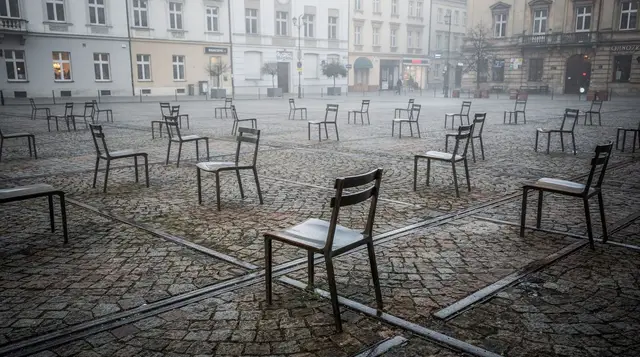
Plac Bohaterów Getta (Ghetto Heroes' Square) was the main assembly square of the Kraków Ghetto, used as the deportation staging point during the 1942–1943 liquidation actions. It is now marked by 70 empty metal chairs — a memorial to the deported residents. The Eagle Pharmacy on the square, run by Tadeusz Pankiewicz throughout the Ghetto's existence, is now a moving museum of Ghetto life.
| Where | Plac Bohaterów Getta 18, Podgórze |
| Cost | 22 PLN adults, free entry Wednesdays |
| Time needed | 45–60 minutes for the pharmacy; 20–30 for the square |
| Getting there | Trams 3, 9, 11, 13, 24 to “Plac Bohaterów Getta” |
| Best time | Weekday mornings, before 10:00 |
The square and what happened here
Plac Bohaterów Getta — Ghetto Heroes’ Square — is a modest open space in the Podgórze district of Kraków, flanked by ordinary apartment buildings and a tram stop. It looks like a hundred other urban squares in Central European cities. That ordinariness is part of what makes it affecting: this unremarkable public space was, for two years, the epicentre of a catastrophe.
When the Nazis established the Kraków Ghetto in March 1941, this square — then called Plac Zgody (Harmony Square) — became the administrative and social centre of the enclosed area. The nearby ul. Józefińska 14 housed the Jewish Council (Judenrat), which was forced to administer the Ghetto under German orders. The square served as a marketplace, a gathering point, and — most grimly — the assembly location for deportation actions.
Between 1942 and 1943, thousands of Ghetto residents were assembled on this square and at adjacent streets before being transported to the Bełżec and Auschwitz-Birkenau extermination camps. The final “liquidation action” of March 13–14, 1943 effectively ended the Ghetto: the 2,000 residents deemed useful for labour were marched to the KL Płaszów camp; those deemed unfit were killed in the Ghetto streets or deported immediately.
After the war the square was renamed in honour of those who resisted — hence “Bohaterów Getta” (Ghetto Heroes) — and for decades remained an ordinary municipal square without strong memorial character. The current memorial installation was created in 2005.
The memorial chairs
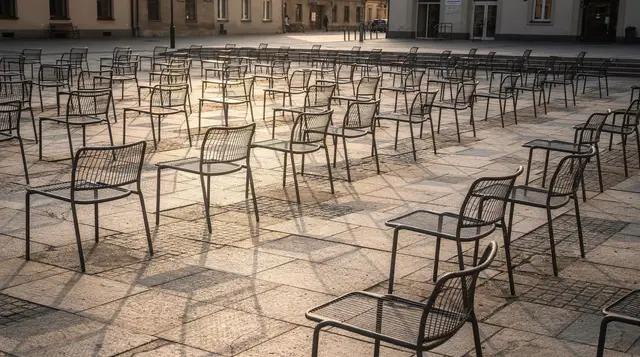
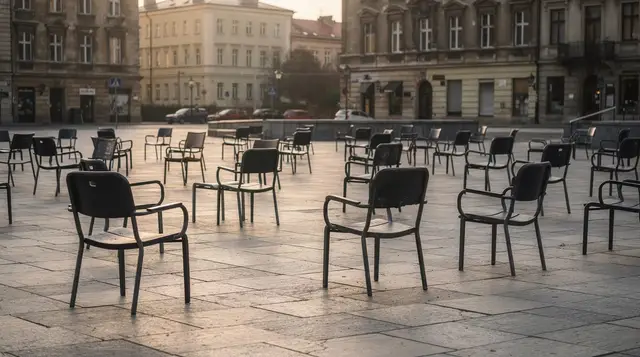
The dominant feature of today’s square is 70 oversized metal chairs, spread across the paving in irregular lines. They were designed by sculptors Piotr Lewicki and Kazimierz Łatak and installed in 2005. The chairs reference the furniture and belongings that Ghetto residents were forced to abandon when they were deported — the mundane domestic objects that became markers of a life interrupted.
The chairs are intentionally abstract: they are not figurative, not sentimental, not explicitly religious. They ask visitors to fill in the absence with their own understanding. Sixty-eight of the chairs are made of weathering steel (Corten); two smaller bronze chairs represent children. The installation occupies the entire square and is accessible at all times, free of charge.
At night, the chairs are dimly lit and the square is quiet — a different quality of experience than the busier daytime hours. Early morning visits, before tour groups arrive, allow for extended reflection.
How to spend time on the square
There is no prescribed route among the chairs, and that is deliberate. Walk slowly, let the spacing between them register, and notice how the tram stop and the apartment windows sit right beside the installation. Everyday life carries on around the memorial, which is exactly the point: the events of 1942–1943 happened in a place where people still live and commute. If you want the wider story of how the occupation reshaped the city, the guide to Kraków under Nazi occupation gives the background that the square itself only hints at.
The Eagle Pharmacy (Apteka Pod Orłem)
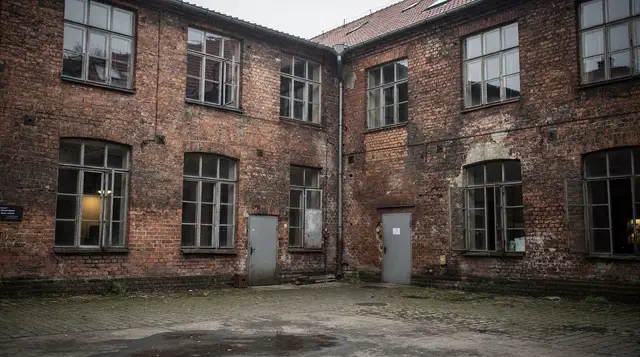
At the corner of Plac Bohaterów Getta 18, on the ground floor of an apartment building that faces the square, is the Eagle Pharmacy — the only pharmacy permitted to operate inside the Kraków Ghetto throughout its existence.
Tadeusz Pankiewicz was the pharmacy’s owner, a Polish Catholic pharmacist who had operated the business on what was then Plac Zgody since before the war. When the Ghetto was established around his building, the Germans allowed him to continue operating — as a commercial concession and because they needed the pharmaceutical services. Pankiewicz could have moved; he chose to stay.
Over the following two years, Pankiewicz and his assistants (Helena Krywaniuk, Aurelia Danek-Czortowa, and Irena Drobnik) provided not only medicines but a crucial civilian sanctuary. Jewish residents gathered at the pharmacy for information, for temporary shelter, for help obtaining documents. Pankiewicz sourced hair dye to help Jews pass as non-Jews, provided sedatives to parents trying to keep their children from crying during searches, and documented what he witnessed in meticulous notes that later became his memoir “The Kraków Ghetto Pharmacy” (published in Polish in 1947 and now available in English translation).
In 1983, Yad Vashem recognised Pankiewicz as Righteous Among the Nations — the Israeli designation for non-Jews who risked their lives to save Jews during the Holocaust.
The pharmacy is now a museum operated by the Museum of Kraków (Muzeum Krakowa). The interior preserves the pharmacy’s original layout, equipment, and some original furnishings. The exhibition presents:
- The history of the Ghetto from establishment to liquidation
- Pankiewicz’s testimony and archive
- Photographs taken inside and around the Ghetto (some by Raimund Titsch, the factory manager who secretly documented the community)
- Personal accounts of Ghetto residents collected from survivors and their families
- The specific stories of the pharmacy’s staff and their wartime activities
Allow 45–60 minutes for the full exhibition. The experience is intimate and deeply personal — this is not a large-scale museum but a carefully preserved site of individual human action within historical catastrophe.
Visiting information:
- Address: Plac Bohaterów Getta 18 (Podgórze)
- Opening hours: Wednesday–Sunday 9:00–17:00; closed Monday and Tuesday
- Entry: 22 PLN / ≈€5.25 adults; 16 PLN / ≈€3.80 reduced; family ticket 44 PLN; free on Wednesdays (limited capacity — arrive early)
- Language: Panels in Polish and English; check audio guide availability at the desk
The neighbourhood context
The immediate area around Plac Bohaterów Getta preserves several other Ghetto-era details visible without entering any museum:
The Judenrat building at ul. Józefińska 14 (2 minutes walk from the square) still stands — an ordinary apartment building with a commemorative plaque. During the Ghetto years it housed the forced Jewish self-administration apparatus.
The Ghetto walls: Two surviving fragments are a 10-minute walk from the square (details in the Kraków Ghetto guide). The fragment on ul. Lwowska 29 is the largest and most accessible.
The Optima building (ul. Lwowska 25), now converted to apartments, was used during the Ghetto period as an assembly point and processing centre for deportees.
Reading the exhibition with care
The pharmacy rewards a slow pace. Rather than moving quickly from panel to panel, pause at the personal testimonies and the photographs: they carry the human scale that statistics cannot. Pankiewicz’s own writing is the thread running through the rooms, and it is worth reading his account of what he saw from behind the counter. If you have visited or plan to visit the memorial at Auschwitz, the history of Auschwitz-Birkenau explains where many of the people assembled on this square were sent, and the guide to visiting Auschwitz with respect offers a useful frame for how to behave at sites of this kind.
The pharmacy also shows that resistance took many forms. Pankiewicz’s quiet acts of help sit alongside the armed and organised efforts described in the guide to the Home Army and resistance in Kraków, and reading the two together gives a fuller picture of how people responded under occupation.
Placing the visit in the wider Podgórze district
Podgórze is more than its Ghetto history, and a few extra minutes of wandering make the visit feel less isolated. The district sits across the river from Kazimierz, and the contrast between the two is instructive: Kazimierz was the historic Jewish quarter, while Podgórze is where the Ghetto was imposed. Our Kazimierz Jewish Quarter guide covers the older community that was forced across the river, and the Podgórze destination page lists the other sights nearby. For readers who prefer to see the full arc of Jewish life in the city before and after the war, the Jewish heritage trail itinerary strings these districts together in a sensible order.
Guided tours covering Ghetto Heroes’ Square
The memorial chairs and the pharmacy are most powerfully experienced with historical context. A guided tour of the Ghetto area, which places these sites within the full narrative of the occupation, makes the visit significantly more meaningful.
Former Jewish Ghetto guided walking tour — covers the square, pharmacy, and Ghetto walls 2-hour World War II Ghetto walking tour — focused on Podgórze and the occupation periodFor a tour that connects Kazimierz and the Ghetto in Podgórze in a single experience:
Jewish Quarter and Ghetto combined tour (3 hours, crosses both districts)Combining with Schindler’s Factory
The natural pairing for a visit to Ghetto Heroes’ Square is Schindler’s Factory Museum — a 10-minute walk south along ul. Lipowa. The two sites together tell complementary stories: the square and pharmacy show the Ghetto from the inside (daily life, deportation, individual resistance); the factory museum shows the occupation from a broader urban perspective with particular focus on the factory and its Jewish workers.
Allow a full half-day for both: 45 minutes at the square, 45 minutes at the pharmacy, 2.5–3 hours at Schindler’s Factory.
Schindler’s Factory with skip-the-line entryPlanning a wartime-history day
Many visitors fold this stop into a longer day devoted to the occupation years. A sensible shape is to begin at the square and pharmacy while the area is quiet, continue to the factory museum, and leave the afternoon free for rest, since this material is heavy. The World War II history itinerary and the broader WWII in Kraków guide show how to chain these sites without rushing. If you intend to enter the factory museum, the guide to Oskar Schindler museum tickets explains the booking side, and for readers who want deeper national context, Polish history for visitors is a helpful primer.
Respectful behaviour at the memorial
The square is both a public space and a place of mourning. Keep voices low, avoid climbing or sitting on the chairs for photographs, and be mindful of other visitors who may be reflecting or praying. Photography of the installation is normal, but staged or playful poses are out of place here. Inside the pharmacy, follow the staff’s guidance on photographs and keep the pace unhurried so that everyone can read and listen without pressure.
Practical notes
Getting there: Trams 3, 9, 11, 13, 24 to “Plac Bohaterów Getta” from the Old Town or Kazimierz (10–15 minutes, 4 PLN / ≈€0.95). From Kazimierz it is also a 15-minute walk across the Józef Piłsudski Bridge.
When to visit: Weekday mornings are quieter. The square can fill with tour groups between 10:00 and 13:00 in summer. Late afternoons are peaceful.
Nearby food: There are no significant restaurants immediately on the square. The nearest good options are back in Kazimierz (15-minute walk or 2 tram stops). A small café at the Schindler’s Factory MOCAK cultural complex provides coffee and light snacks.
Frequently asked questions about Ghetto Heroes’ Square
What do the 70 chairs represent?
The chairs were designed to evoke the furniture and everyday objects abandoned by Ghetto residents during deportation. There is no specific numerical symbolism to 70 — it was chosen as a number that fills the square effectively as a visual installation. The two smaller chairs represent children. The chairs are intentionally non-literal: they invite interpretation rather than prescribing a singular meaning.
Is the memorial square open at night?
Yes — the square is a public open space accessible at all hours. The chairs are illuminated with low lighting at night, creating a different and quieter atmosphere than during daytime touring hours. Night visits are particularly moving during the Jewish Culture Festival week in June/July.
How does this site relate to Schindler’s List?
The square appears in Spielberg’s film as the site of deportation scenes (though some of those sequences were filmed in Kazimierz rather than Podgórze for logistical reasons). The actual historical events that inspired those film sequences took place on and around this square. See the Schindler’s List filming locations guide for the relationship between film geography and historical geography.
Can children visit the Eagle Pharmacy?
Yes, though parental guidance is appropriate. The exhibition deals with deportation and persecution honestly but without graphic imagery. Children aged 10 and above can generally engage meaningfully; younger children may need age-appropriate explanations. The pharmacy is more intimate and less overwhelming than larger Holocaust institutions, which some families find makes it a more manageable first introduction to this history.
How much time should I set aside for the square and pharmacy together?
Budget 75–90 minutes total: 20–30 minutes at the memorial square itself, and 45–60 minutes inside the pharmacy exhibition. Add another 10–15 minutes to walk to the nearby Ghetto wall fragment on ul. Lwowska if you want the fuller Podgórze picture — see the Kraków Ghetto guide for the complete walking route.
Top experiences
Bookable activities with verified prices and instant confirmation on GetYourGuide.