Kraków Ghetto and Podgórze: a guide to the historic district
Krakow: former Jewish Ghetto guided walking tour
What remains of the Kraków Ghetto in Podgórze today?
The Kraków Ghetto (1941–1943) in Podgórze has left several significant sites: Ghetto Heroes' Square with the memorial chairs, two fragments of the original Ghetto wall, the Eagle Pharmacy museum, and Schindler's Factory Museum. The former KL Płaszów camp site is nearby. A half-day is enough to cover the core; a full day if including Schindler's Factory.
| Where | Podgórze, across the Vistula, 15 min walk from Kazimierz |
| Cost | Free (Ghetto Heroes’ Square, wall fragments, Płaszów); 22–60 PLN for museums |
| Time needed | 2 hours for the core sites; a full day with Schindler’s Factory and Płaszów |
| Getting there | Trams 3, 9, 11, 13, 24 to Plac Bohaterów Getta, or 15 min walk from Kazimierz |
| Best time | Weekday mornings, before tour groups arrive at Ghetto Heroes’ Square |
Understanding Podgórze
Podgórze is the district directly across the Vistula from Kazimierz, a 15-minute walk south of the Old Town. It was once a separate municipality — a rival town to Kraków with its own mayor and market square (Plac Wolnica, now incorporated into Kazimierz) — until incorporation into Kraków in 1915. In the 20th century it became largely a working-class residential and light industrial district, known more for its tram depot than its cultural life.
The Nazis changed that history irrevocably. In March 1941, they established the Kraków Ghetto in a 15-block area of Podgórze, expelling the non-Jewish residents and forcing 17,000–18,000 Jews from Kraków and the surrounding region into accommodation intended for 3,000. The Ghetto was enclosed by a wall with deliberately designed Jewish-gravestone-shaped tops — an act of symbolic humiliation by its architects. Over the following two years, mass deportations to the Bełżec and Auschwitz-Birkenau extermination camps reduced the Ghetto’s population. The final “liquidation action” of March 13–14, 1943 effectively ended the Ghetto: those who survived deportation that day were transferred to the KL Płaszów labour camp. Approximately 2,000 Jewish residents of Kraków survived the war.
Today Podgórze is experiencing a gentle renaissance: MOCAK (the Museum of Contemporary Art) opened in 2011 adjacent to Schindler’s Factory, Zabłocie is now a design and tech district, and young Krakovians are moving in for lower rents and more space. The historical sites are woven into this everyday neighbourhood life in ways that make the visit distinct from a conventional museum experience.
Ghetto Heroes’ Square
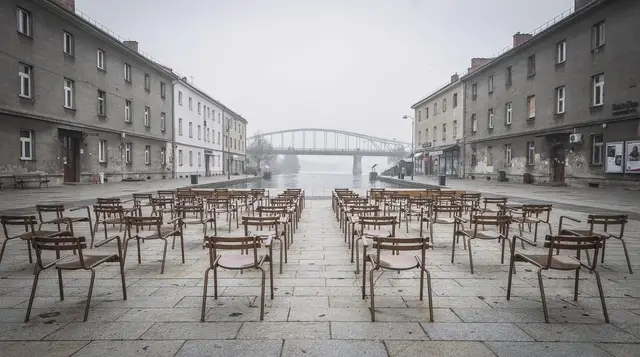
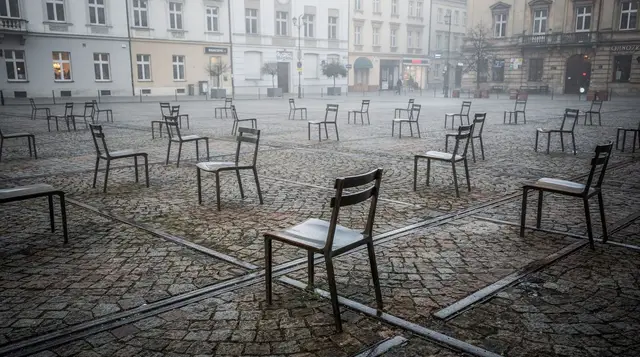
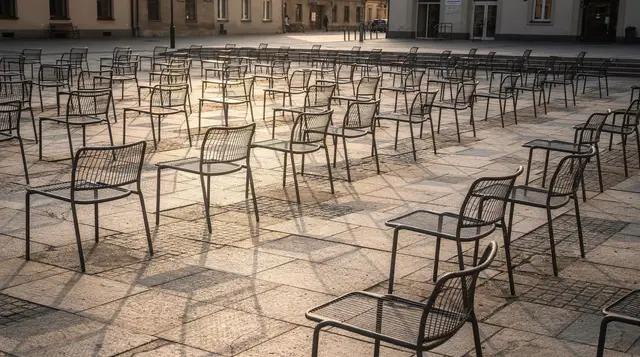
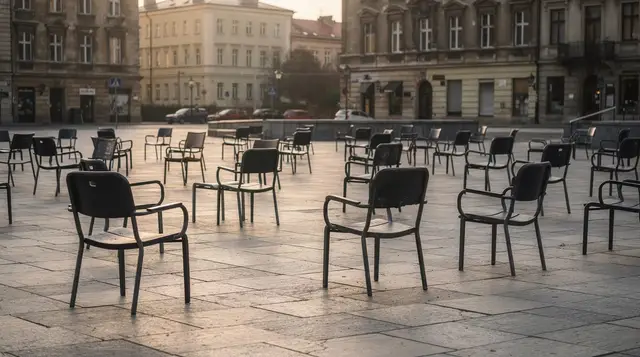
Plac Bohaterów Getta (Ghetto Heroes’ Square) was the Ghetto’s main square and the site of assembly for deportation. It is now a memorial space dominated by 70 oversized empty metal chairs — each one representing the belongings Jews were forced to leave behind when they were deported. The chairs were installed in 2005 and designed by Piotr Lewicki and Kazimierz Łatak. They are deliberately not figurative or sentimental; their emptiness is the point.
The square is open at all times and free to visit. It is a quiet and contemplative space on weekday mornings; on summer afternoons it can be crowded with tour groups. Come early or late for a more reflective experience. See the full Ghetto Heroes’ Square and Eagle Pharmacy guide for detailed information on both sites.
The Eagle Pharmacy
Apteka Pod Orłem (the Eagle Pharmacy) at ul. Bohaterów Getta 18 was the only pharmacy permitted to operate inside the Kraków Ghetto. Its Polish owner, Tadeusz Pankiewicz, was allowed to remain in the Ghetto and used his pharmacy as a refuge, information point, and supply station for the Jewish community throughout the occupation — an act of solidarity at enormous personal risk. He was later recognised as Righteous Among the Nations by Yad Vashem.
The pharmacy is now a branch of the Museum of Kraków with a permanent exhibition on Ghetto life. Entry 22 PLN / ≈€5.25 (free on Wednesdays). Opening hours: Wednesday–Sunday 09:00–17:00; closed Monday and Tuesday. The exhibition is intimate and carefully curated — personal testimony, pharmacy equipment, photographs from inside the Ghetto, and Pankiewicz’s own account of those years. Allow 45–60 minutes.
The Ghetto wall fragments
Only two sections of the original Ghetto wall survive; both are in Podgórze.
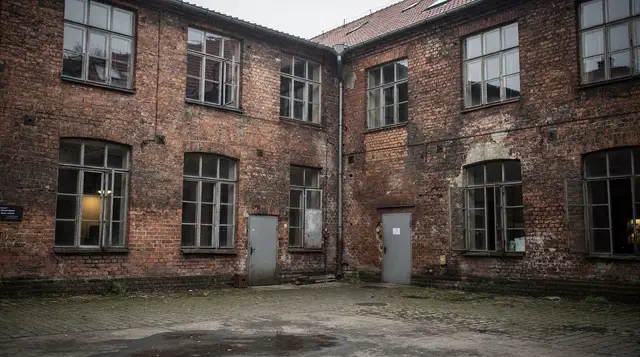
ul. Lwowska 29 (the larger fragment, approximately 30 metres): Set into the rear wall of a school building, with a commemorative plaque explaining its history. The characteristic rounded tops — designed to resemble Jewish gravestones — are clearly visible. Access is through the school courtyard; ring the intercom during school hours (Monday–Friday 07:30–16:00) or pass through the gate on weekends when it is usually open. Free.
ul. Limanowskiego (shorter fragment, near the corner with ul. Rękawka): Less visited, more weathered, in a quieter residential street. No entry restrictions. The interpretive panel is smaller than at ul. Lwowska.
Both fragments deserve a respectful 15 minutes each. The contrast between the surviving masonry — ordinary brick, ordinary construction — and its intended purpose remains one of the most unsettling aspects of this site.
Schindler’s Factory Museum
The Oskar Schindler’s Enamel Factory Museum at ul. Lipowa 4 is the largest and most comprehensive memorial site in Podgórze — a full museum covering the Nazi occupation of Kraków from 1939 to 1945 across 4,000 square metres. This is not simply a museum about Schindler but about the entire occupation period and how an urban community experienced and survived it. Allow 2.5 to 3 hours.
Schindler’s Factory with entrance ticket — skip the queuePodgórze is separated from Kazimierz by the river, and that separation was the point: a short river walk and guided tour of the former ghetto crosses it on foot, which is how the geography starts to make sense.
The KL Płaszów memorial site
About 2 km southeast of Ghetto Heroes’ Square, the site of the former KL Płaszów concentration camp is a largely open memorial park. The camp operated between 1942 and 1945 under commandant Amon Göth, holding 25,000–30,000 prisoners at its height. It was used primarily as a forced labour camp; mass shootings took place at the Hujowa Górka (now “Peace Hill”) site within the camp perimeter.
The Nazis demolished most camp structures before retreating in January 1945. The site today is unmanicured parkland with walking paths, a large 1960s socialist-realist monument, and several smaller markers identifying former prisoner barracks locations, the Grey House (the camp administration building, partially surviving), and mass grave sites. A new comprehensive memorial is in planning as of 2026.
The site is free to visit at all times. It rewards a map and some preparation — the remains are scattered and easy to miss without knowing what you’re looking for. A 45-minute guided or self-guided walk covers the main points. Tram 3 or 13 from Podgórze direction, or a 35-minute walk from Schindler’s Factory.
Amon Göth’s villa (ul. Heltmana 22) is a private residence visible from the street but not open to the public. The building appears in Schindler’s List. No memorial signage; be respectful of the private occupants.
Guided tours of the Ghetto area
A guided tour of Podgórze adds historical depth that self-guided visits can struggle to match — the sites are spread across a wide area with limited on-site interpretation at some locations (particularly the Ghetto wall fragments and Płaszów).
Former Jewish Ghetto guided walking tour (2 hours) Jewish Ghetto walking tour — covers main sites with commentaryFor a combined tour covering both Kazimierz and the Ghetto:
Jewish Quarter and Ghetto combined tour — 3 hoursPractical logistics
Getting to Podgórze: Trams 3, 9, 11, 13, 24 cross the Vistula and serve Plac Bohaterów Getta. A 90-minute ticket costs 9 PLN / ≈€2.15. Bolt/Uber from the Rynek is 12–16 PLN / ≈€3–€4.
Walking from Kazimierz: 15 minutes across the Józef Piłsudski Bridge (ul. Starowiślna) and south to Plac Bohaterów Getta. A natural pairing — Kazimierz and Podgórze together form the most complete picture of Kraków’s Jewish heritage.
Eating near Podgórze: The immediate area around Plac Bohaterów Getta is not a restaurant hub. For lunch, cross back to Kazimierz (10 minutes on foot) for the best food options. The MOCAK café (adjacent to Schindler’s Factory) is a reasonable option for coffee and light meals.
Where Podgórze fits in a wider Kraków stay
Podgórze sits comfortably beside the rest of the city’s history. For the broader story of the occupation years, the Kraków under Nazi occupation guide and the WWII Kraków guide give the context that these sites assume. If you are choosing where to base yourself, the neighbourhood comparison for where to stay explains how Podgórze and Kazimierz differ in feel. Visitors who want a lighter counterpoint after a heavy morning can head to MOCAK, right beside Schindler’s Factory, or step back into the Old Town for a quiet evening. Those with only a short stay can slot Podgórze into the one-day Kraków itinerary or follow the dedicated Jewish heritage trail.
Respectful conduct notes
The Ghetto and its memorial sites are places of historical mass suffering. Behaviour appropriate for a cemetery is appropriate here: quiet voices, no picnicking at the memorial chairs, thoughtful photography (document, don’t selfie). The same applies at the Płaszów site, which contains mass graves. Children respond well to gentle pre-visit explanations of what these places represent.
Suggested visiting order
A logical route minimises backtracking: start at Ghetto Heroes’ Square and the Eagle Pharmacy (both on the same square), then walk 10 minutes to the nearer Ghetto wall fragment on ul. Lwowska, continue on to Schindler’s Factory (about 15 minutes further), and finish at Płaszów if time and daylight allow — it is the most spread-out site and benefits from being seen last, when the light is lower and the park is quieter. If you are combining Podgórze with Kazimierz on the same day, do Kazimierz’s Jewish heritage sites in the morning and cross the river to Podgórze in the afternoon, since the two together form a chronological narrative — pre-war Jewish life, then the Ghetto and occupation.
Comparing the Podgórze memorial sites
| Site | Cost | Time | Best for |
|---|---|---|---|
| Ghetto Heroes’ Square | Free | 20–30 min | Everyone; the anchor point |
| Eagle Pharmacy | 22 PLN | 45–60 min | Personal testimony, intimate scale |
| Ghetto wall fragments | Free | 15 min each | Those wanting the physical, unmediated site |
| Schindler’s Factory | 60 PLN | 2.5–3h | The fullest historical context |
| Płaszów memorial park | Free | 45 min–1.5h | Visitors with more time, comfortable with an unmanicured site |
Combining Podgórze with a wider Jewish heritage day
For visitors who want to understand Kraków’s Jewish history as a continuous story rather than isolated stops, pairing Podgórze with Kazimierz’s Jewish quarter and the broader Jewish Kraków history overview gives the fullest picture: pre-war community life in Kazimierz, forced relocation to the Ghetto in Podgórze, and the eventual near-total destruction of that community. Several operators run this as a single guided day; if going independently, budget a full day and expect it to be emotionally demanding — pace yourself and take breaks. The Kraków WWII history itinerary offers a structured multi-day version that also includes Auschwitz.
Frequently asked questions about the Kraków Ghetto and Podgórze
Was the Ghetto in Kazimierz or Podgórze?
The Kraków Ghetto was established in Podgórze, not Kazimierz. This is a common point of confusion, partly because Schindler’s List filmed some Ghetto scenes in Kazimierz. The historical Jewish community lived in Kazimierz before the war; the Nazis deliberately moved them across the Vistula into the separate Podgórze district in 1941. See the Schindler’s List filming locations guide for the film geography.
How long does it take to see all the Podgórze Ghetto sites?
The core sites — Ghetto Heroes’ Square, Eagle Pharmacy, and the two Ghetto wall fragments — take about 2 hours including travel between them. Adding Schindler’s Factory (2.5–3 hours) makes it a half to full day. Adding Płaszów extends this by 1.5–2 hours. A full Podgórze memorial day is 7–8 hours, usually combined with Kazimierz.
Is there an entrance fee for Ghetto Heroes’ Square?
No — the square and its memorial chairs are permanently accessible and free to enter at all times of day. The Eagle Pharmacy museum on the square charges 22 PLN / ≈€5.25; the Schindler’s Factory Museum charges 60 PLN / ≈€14.30. The Ghetto wall fragments and Płaszów site are also free.
How is visiting Podgórze different from visiting Auschwitz?
Auschwitz-Birkenau is the largest extermination and concentration camp complex, designed and operated to kill on an industrial scale. Podgórze shows what preceded Auschwitz: the ghetto system, forced labour, deportations, and the urban environment in which families lived under extreme persecution before being transported. Both are important; Podgórze provides urban human context that the camp sites cannot.
Can children visit the Ghetto and Podgórze sites?
Yes, with preparation. Ghetto Heroes’ Square and the Eagle Pharmacy are manageable for older children with a brief explanation beforehand of what the memorial represents. Płaszów, with its mass graves and unmanicured setting, is better suited to teenagers and adults. Schindler’s Factory Museum is dense and text-heavy, working best for ages 12 and up.
Is a guided tour necessary or can I visit Podgórze independently?
Independent visits work well for Ghetto Heroes’ Square, the Eagle Pharmacy and Schindler’s Factory, all of which have strong on-site interpretation. A guided tour adds most value at the Ghetto wall fragments and Płaszów, where signage is minimal and the historical context is easy to miss without a guide — see the guided walking tour options above.
Top experiences
Bookable activities with verified prices and instant confirmation on GetYourGuide.