Kraków under Nazi occupation: daily life, terror, and survival 1939–1945
Krakow: Schindler Factory Museum guided tour
Duration: 2h
What happened to Kraków during the Nazi occupation?
Kraków was designated the capital of Nazi-occupied Poland's General Government from 1939 to 1945. German authorities expelled Jews to a ghetto in Podgórze, persecuted Polish intellectuals and clergy, requisitioned the university and churches, and ran a sophisticated surveillance and terror apparatus from Wawel Castle. The city itself was largely spared physical destruction, which is why so much of the occupation's landscape is still physically present today.
| Period | September 1939 – January 1945 |
| Key sites today | Schindler Factory Museum, Podgórze ghetto remnants, Wawel Castle, Płaszów |
| Time needed | Half a day for Schindler Factory + Podgórze walk; add a day for Auschwitz |
| Best starting point | Schindler Factory Museum, then walk to Ghetto Heroes Square |
| Booking | Book Schindler Factory tickets ahead — it sells out most summer days |
The General Government capital
When German forces entered Kraków on 6 September 1939, the city’s fate diverged sharply from Warsaw’s. Warsaw would be subjected to deliberate destruction: first the bombardment of September 1939, then the massacre following the Uprising of 1944, then systematic building-by-building demolition ordered by Hitler in punishment. Kraków was to be preserved and used.
Hans Frank, appointed Governor-General of occupied Poland on 26 October 1939, chose Kraków as his capital. The choice reflected both practical and psychological considerations: Kraków was the historic capital of Poland, accessible by good rail connections, and far enough from the front to be secure. Making it the seat of German colonial administration was a statement about who now owned Polish history.
The machinery of occupation that Frank established in Kraków was elaborate and efficient. The SS (Schutzstaffel), the Gestapo (secret police), the German civilian administration, and the Wehrmacht all had headquarters in the city. The Gestapo established its regional headquarters at Pomocy 2 and later at Pomorska 2 — the latter building is now the Eagle Pharmacy Museum, though it is sometimes confused with the pharmacy of the same name that actually operated in the ghetto.
The November 1939 arrests at the Jagiellonian University
One of the first major acts of the occupation was targeted at Kraków’s intellectual core. On 6 November 1939, SS officers and Gestapo agents attended what was announced as a meeting at the Jagiellonian University, ostensibly to hear a lecture about German educational policy. When 184 professors and academics assembled, they were arrested and transported to concentration camps — primarily Sachsenhausen and Dachau.
The operation, known as Sonderaktion Krakau (Special Action Kraków), was designed to decapitate the Polish intellectual class in the city. Of the 184 arrested, 21 died in the camps; the majority survived and were released following international protest (primarily from the Vatican and Italian academic institutions) over the following months.
The action set the template for occupation policy toward the Polish intelligentsia: universities were closed, Polish cultural institutions banned, and publishing in Polish restricted. The Jagiellonian University continued in illegal underground classes throughout the occupation — a direct predecessor to the broader underground education network that operated across Poland.
Daily life under occupation: restrictions and fear
For the Polish Catholic population of Kraków, occupation meant systematic degradation rather than immediate murder. Jews faced a categorically different and worse reality (covered below), but the experience of all Kraków residents was shaped by violence and fear.
Practical restrictions included: curfews (initially 9 pm, later 8 pm); requirements for identity papers to be carried at all times; prohibitions on Jewish businesses and gradually on Polish-owned businesses; rationing of food, fuel, and clothing; forced labour requirements; and the constant presence of uniformed German forces.
The psychological experience was one of surveillance and arbitrary violence. The Gestapo maintained a network of informers; denunciations for real or imagined offences led to arrests, beatings, deportation to labour camps, and execution. Public executions — carried out in the streets as deterrence — were a regular feature of life in occupied Kraków.
Food was scarce. The German administration set ration levels that provided Polish residents with approximately 2,600 calories per day (the minimum to sustain moderate activity) and Jewish residents with approximately 680 calories per day (deliberate starvation-level). The black market operated everywhere; bartering replaced cash transactions for many necessities. The milk bar tradition — cheap communal eating — dates partly to this period and the need to pool food resources.
The Jewish community under occupation
For Kraków’s Jewish population — approximately 68,000 people before the war — the occupation was a death sentence. The process moved through recognisable stages.
Identification and dispossession (1939–1941): Jews were required to wear armbands with the Star of David (then later the yellow star badge). Jewish businesses were “Aryanised” — seized and transferred to German or collaborating non-Jewish owners. Jewish professionals were barred from their professions.
Expulsion (1940–1941): In May 1940, the German authorities ordered the expulsion of all Jews except those with work permits. Approximately 53,000 Jews were forced to leave the city. Those who remained — around 15,000 — were concentrated in the area around Kazimierz but not yet formally confined.
The Ghetto (1941–1943): In March 1941, the remaining Jews were ordered into a purpose-built ghetto in Podgórze, south of the Vistula. The ghetto is covered in detail in the WWII Kraków guide. Population within the ghetto eventually reached 20,000 as Jews from surrounding areas were forced in.
Liquidation (1942–1943): Mass deportations to Auschwitz-Birkenau and the Belzec extermination camp began in 1942. The ghetto was finally liquidated in March 1943; survivors were sent to the Płaszów forced labour camp.
Of Kraków’s 68,000 pre-war Jewish residents, approximately 6,000 survived the war — roughly 9%.
Wawel Castle as occupied power
Hans Frank’s residence at Wawel Castle is historically and symbolically significant beyond the castle’s own importance. Frank was one of the most prominent Nazi administrators: a lawyer by training, one of the original members of the Nazi Party, personally close to Hitler. His rule of the General Government was characterised by extreme brutality; he is widely regarded as one of the main architects of the Holocaust in Poland.
Frank lived in the castle’s royal chambers and entertained senior Nazi officials there. He used the castle’s legitimacy — its association with Polish kings — as the stage for German colonial administration. When he addressed the Polish population, he did so from the site most associated with Polish sovereignty. This was deliberate.
After the war, Frank was tried at Nuremberg, convicted on charges of war crimes and crimes against humanity, and hanged on 16 October 1946. His diary, kept throughout the occupation, provided some of the most detailed evidence at the Nuremberg Trials.
A visit to Wawel Castle now involves inhabiting the same rooms that Frank occupied. This is not advertised prominently in the castle’s own interpretation — understandably, given the desire to foreground the positive Polish history — but it is historically present for those who know it.
Resistance and underground life
Polish resistance in Kraków was substantial and took several forms, covered in the Home Army resistance guide. The most immediate forms included: underground education (the clandestine continuation of university courses), underground publishing (the daily newspapers and literary journals produced in secret), intelligence networks, and armed sabotage.
The city’s geography made it a significant centre of underground activity: the university provided organisational infrastructure, the Church provided protective cover for some activities, and the network of pre-war civil society organisations provided personnel. The underground government — the Polish Government in Exile’s representatives in occupied Poland — had significant presence in Kraków throughout the occupation.
The end of occupation: January 1945
Soviet forces of the 1st Ukrainian Front entered Kraków on 18 January 1945. The German garrison, facing encirclement, evacuated relatively quickly — unlike in Warsaw, where they had been ordered to defend to the last building. The result was that Kraków was liberated largely intact, while Warsaw lay in ruins.
The speed of liberation was partly due to a successful Soviet operational plan and partly due to the actions of the Polish resistance, which disabled some of the explosive devices the Germans had placed in the city’s bridges and infrastructure. The myth of a deliberate German decision to spare Kraków has been largely debunked by historians; the city survived because of the military situation, not German sentimentality.
Hans Frank was captured by American forces in Bavaria in May 1945. Wawel Castle was handed back to Polish authority almost immediately; the restoration of the castle’s Polish character — the return of looted art, the removal of German modifications — became one of the first symbolic acts of post-liberation Kraków.
The Płaszów forced labour camp
After the Ghetto’s liquidation in March 1943, the survivors — approximately 8,000 people — were marched to the Płaszów forced labour camp, built on the site of two Jewish cemeteries in the Płaszów district of southern Kraków. The camp operated from 1942 to January 1945, when it was liquidated as Soviet forces approached.
Płaszów was commanded by SS-Hauptsturmführer Amon Göth, who was characterised even by his SS superiors as unusually brutal. His practice of shooting prisoners personally from the balcony of his villa overlooking the camp is documented by multiple eyewitness accounts and confirmed by post-war testimony. Göth was tried by a Polish court after the war, convicted, and hanged at the site of the former camp in September 1946.
Oskar Schindler’s specific historical significance lies in part in his relationship with Göth: Schindler bribed Göth and other SS officials to allow him to move his Jewish workers to Brünnlitz in the Sudetenland in late 1944, removing them from the deadly final phase of Płaszów’s operation.
The camp site is now a memorial park in the Płaszów district of Kraków, accessible on foot from Podgórze. The barracks and most structures were removed after the war; the terrain itself survives, as do several former administrative buildings and the Jewish cemetery fragments that the camp was built on. A large granite monument was erected in 1964. The site is unmarked and requires some effort to find; guided tours that include Płaszów are the most efficient option.
The street experience of occupation
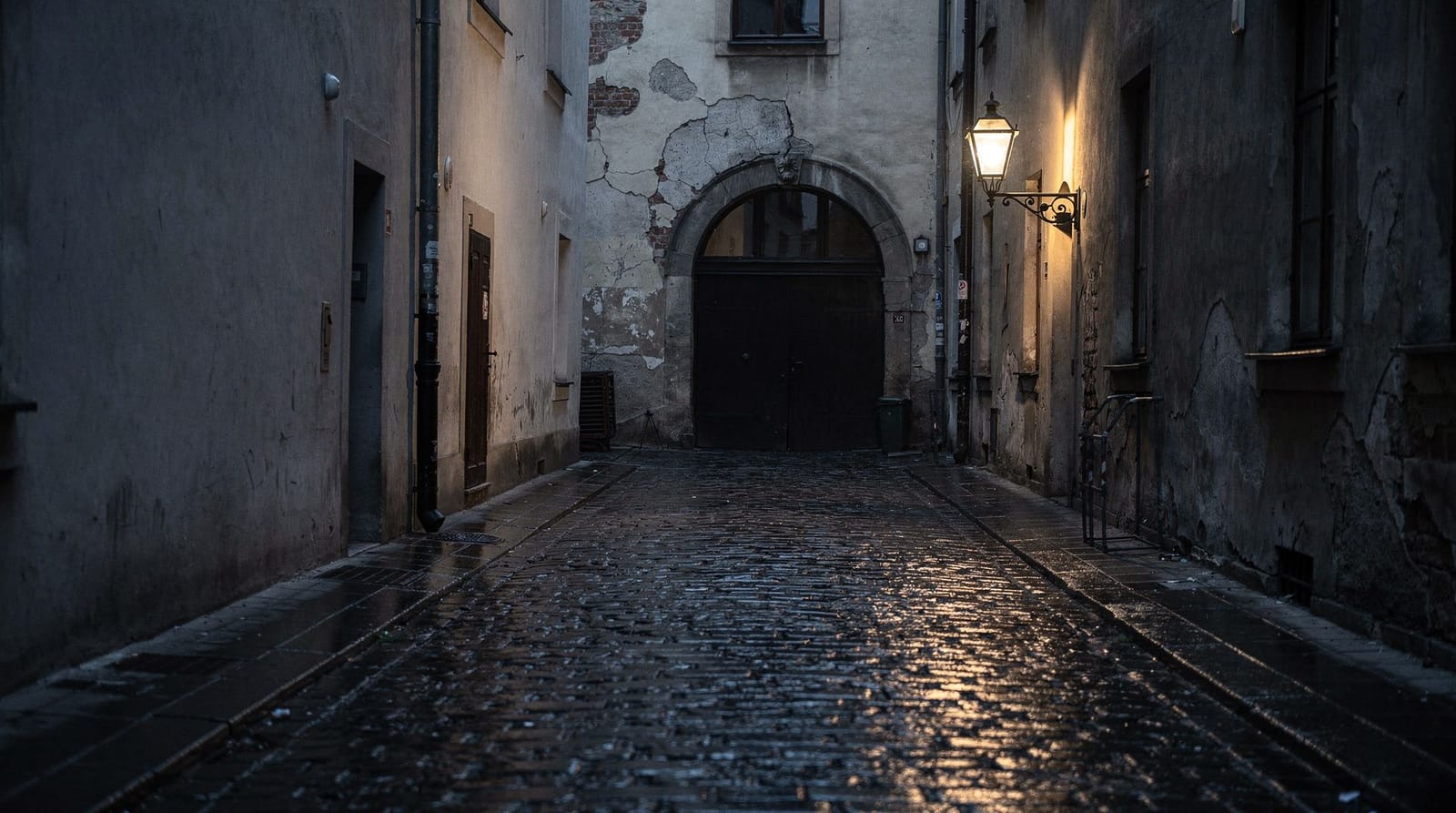
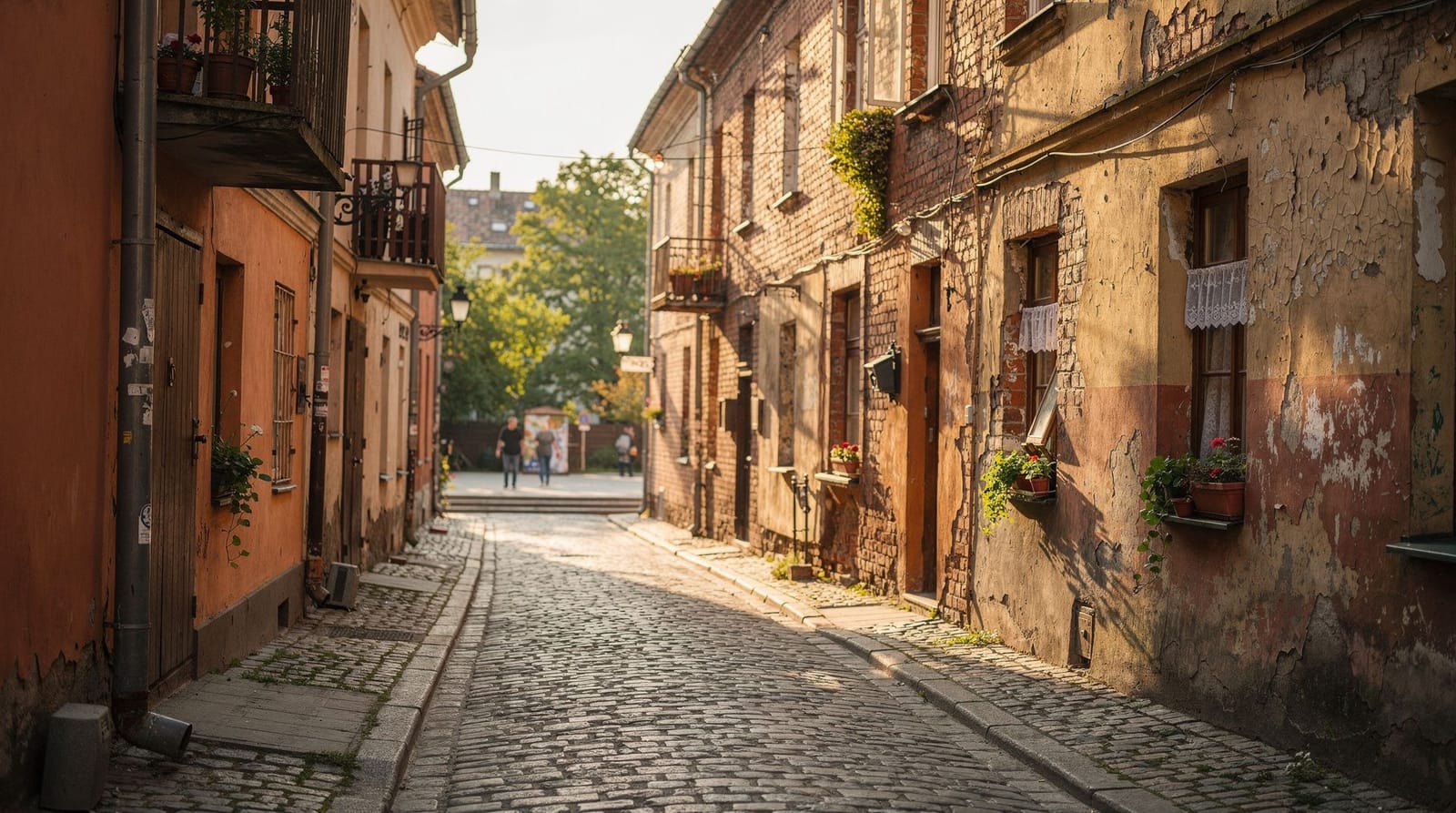
Walking through the Kraków Old Town today, it is easy to forget that under occupation the same streets operated according to a different set of rules. Several practical elements of occupation daily life shaped the city’s physical experience:
Identity checks: German patrols conducted random document checks (łapanki) in which entire groups of pedestrians or tramway passengers would be stopped and detained. Those without correct papers — or those randomly selected regardless of papers — were deported to forced labour in Germany or to concentration camps. The łapanka was a terror tactic as much as a security measure.
Segregated public spaces: Jews and Poles occupied different legal categories; Jews were prohibited from most public establishments, required to walk in the road rather than on pavements in some areas, and excluded from parks and green spaces. Polish residents lived with slightly more latitude but were also subject to sudden arbitrary violence.
Economic extraction: The German administration requisitioned food, fuel, vehicles, and materials. Polish residents received ration cards providing minimal caloric allocation. The black market was pervasive; survival required bending official rules constantly. Anyone caught in significant black market activity faced severe punishment.
Curfew and movement restrictions: Movement after the curfew hour was prohibited; violations were dealt with harshly. The geography of the city contracted for residents who had to be home by dark. Much of the social and intellectual life that continued underground operated in the pre-curfew hours.
The post-occupation city
Kraków was liberated in January 1945, but the liberation by Soviet forces inaugurated a new set of constraints rather than freedom. The communist government installed in Warsaw required rapid political conformity from Kraków’s intellectual and Catholic establishment. The Jagiellonian University reopened but under new political supervision. Former AK (Home Army) members were systematically arrested by the communist security services; some were executed, more were imprisoned.
The physical rebuilding of Kraków — unlike Warsaw, which required massive reconstruction — was primarily a question of repairs and maintenance rather than reconstruction from rubble. The medieval city survived; its institutions and its pre-war community did not. The rebuilding of social life in post-occupation, post-communist Kraków is a long process that is still, in some respects, incomplete.
Visiting the occupation today: practical guide
The most comprehensive single institution for experiencing Kraków’s occupation is Schindler’s Factory Museum in Podgórze. The permanent exhibition “Kraków Under Nazi Occupation 1939–1945” covers the experience of all groups — Polish Catholics, Jews, and the German occupiers — with exceptional archival depth and immersive design. A guided Schindler Factory Museum tour is strongly recommended; book in advance.
For the physical landscape of the ghetto, visit Podgórze: Ghetto Heroes Square, the surviving wall fragments on Lwowska Street, and the Pharmacy Under the Eagle museum. All are within walking distance of Schindler’s Factory.
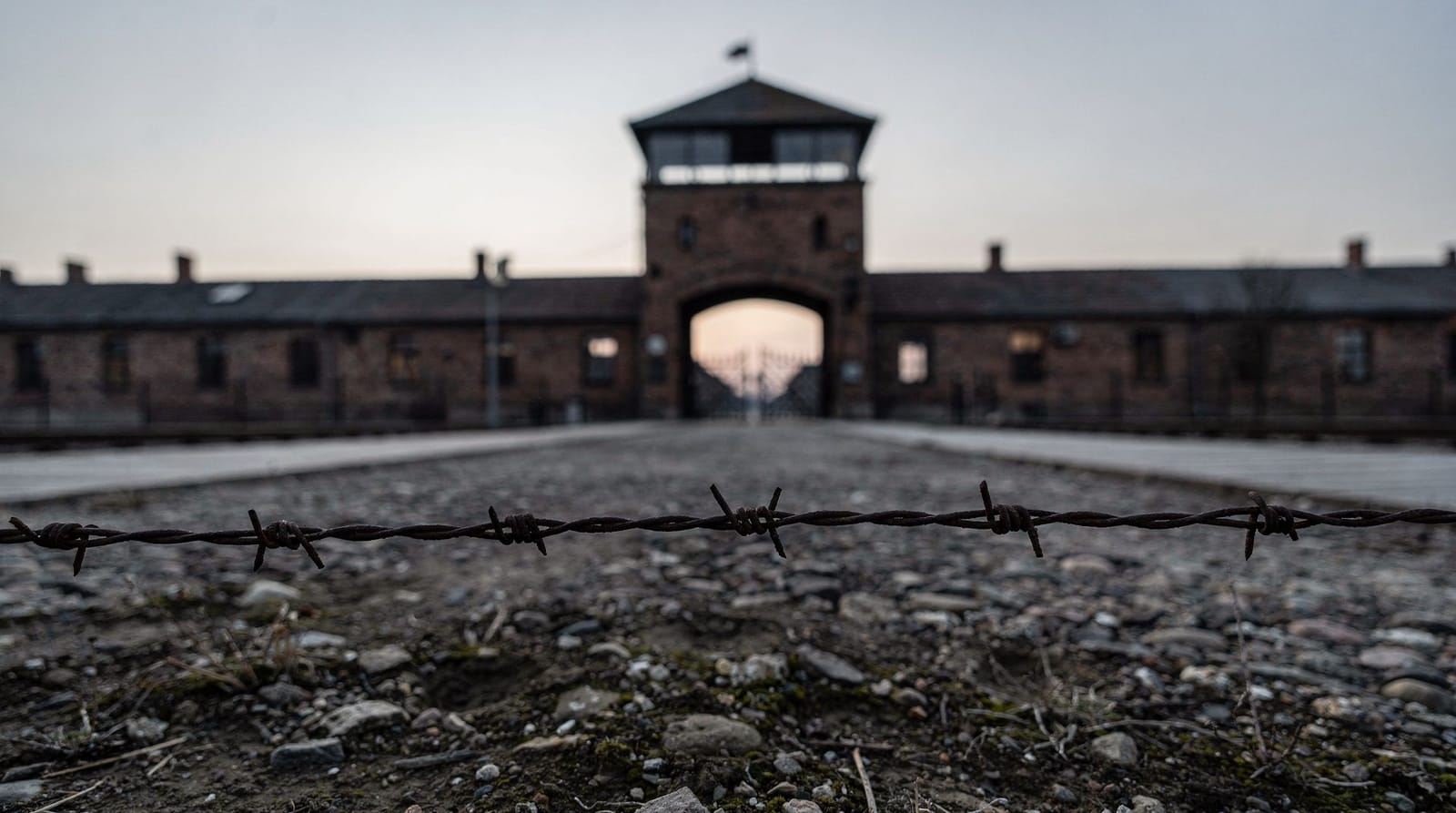
For the broader connection to Auschwitz, a guided Auschwitz-Birkenau tour from Kraków provides the direct historical link between the occupation in the city and the extermination camps that were its endpoint.
The medieval history walking tour — while not focused on WWII — provides the contrast of Kraków’s pre-war history that makes the occupation’s destruction of community more comprehensible.
The Jagiellonian University under occupation and after
The university’s experience under occupation and in the immediate post-war period illustrates the continuity of institutional resistance that characterised Kraków’s intellectual life. After the November 1939 arrests, the underground university — operating in private apartments across the city — continued to award degrees that were recognised by the Polish Government in Exile and subsequently by post-liberation Polish institutions.
The university building complex at Collegium Maius (Jagiellońska 15) was occupied by German administration; the famous Gothic courtyard, normally a venue for academic ceremonies, was requisitioned for German use. The building survived the war intact and was returned to university use in 1945. Today it contains the Jagiellonian University Museum, whose collection includes the original astronomical instruments used by students in Copernicus’s era, medieval manuscripts, and material documenting the occupation and underground university.
Post-liberation, the university faced pressure from the new communist authorities to align its curriculum and governance with Marxist-Leninist principles. The faculty resisted where possible; many professors who had been active in the underground state were targets of communist security services. The story of the university between 1945 and 1956 — when Khrushchev’s denunciation of Stalin opened some space for intellectual independence — is one of institutional survival under dual pressure.
Kraków’s Jewish community: before, during, and after
Before the war, Kraków’s Jewish community was one of the most important in Europe. Kazimierz — the neighbourhood established for the Jewish community in 1495 — was home to major yeshivot (Talmudic academies), printing houses (the first Hebrew-language press in Poland operated in Kazimierz from 1534), and a cultural life of extraordinary richness. The Remu Synagogue on Szeroka Street, founded in 1558 by Rabbi Moses Isserles (the “Remu”), is still operating and still draws worshippers.
Under occupation, the community was dispossessed, expelled from the city, confined to the Podgórze ghetto, and ultimately deported to extermination camps. Of approximately 68,000 pre-war Kraków Jews, roughly 6,000 survived.
The post-war Jewish community in Kraków was a fraction of its former size, and the communist period did not encourage its revival. A significant wave of emigration following the 1968 anti-Semitic campaign (conducted by the communist state in response to student protests) further reduced the community.
Today, Kraków has a small but active Jewish community, a revived cultural life in Kazimierz (including the annual Jewish Culture Festival in early July (1–5 July in 2026), one of the largest Jewish cultural events in Europe), and a growing infrastructure of museums, education programmes, and commemorative sites. The Jewish Kraków history guide covers this arc in detail; the Kazimierz guide covers the neighbourhood today.
Memorials and where to find them
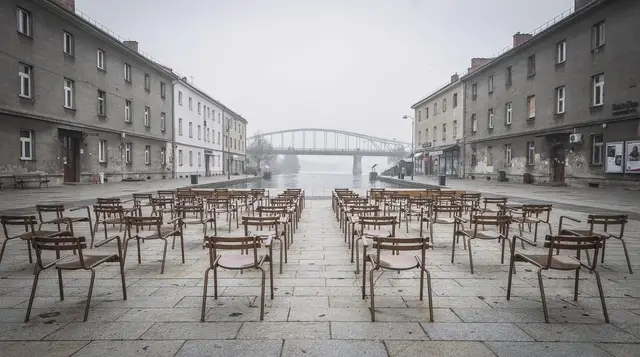
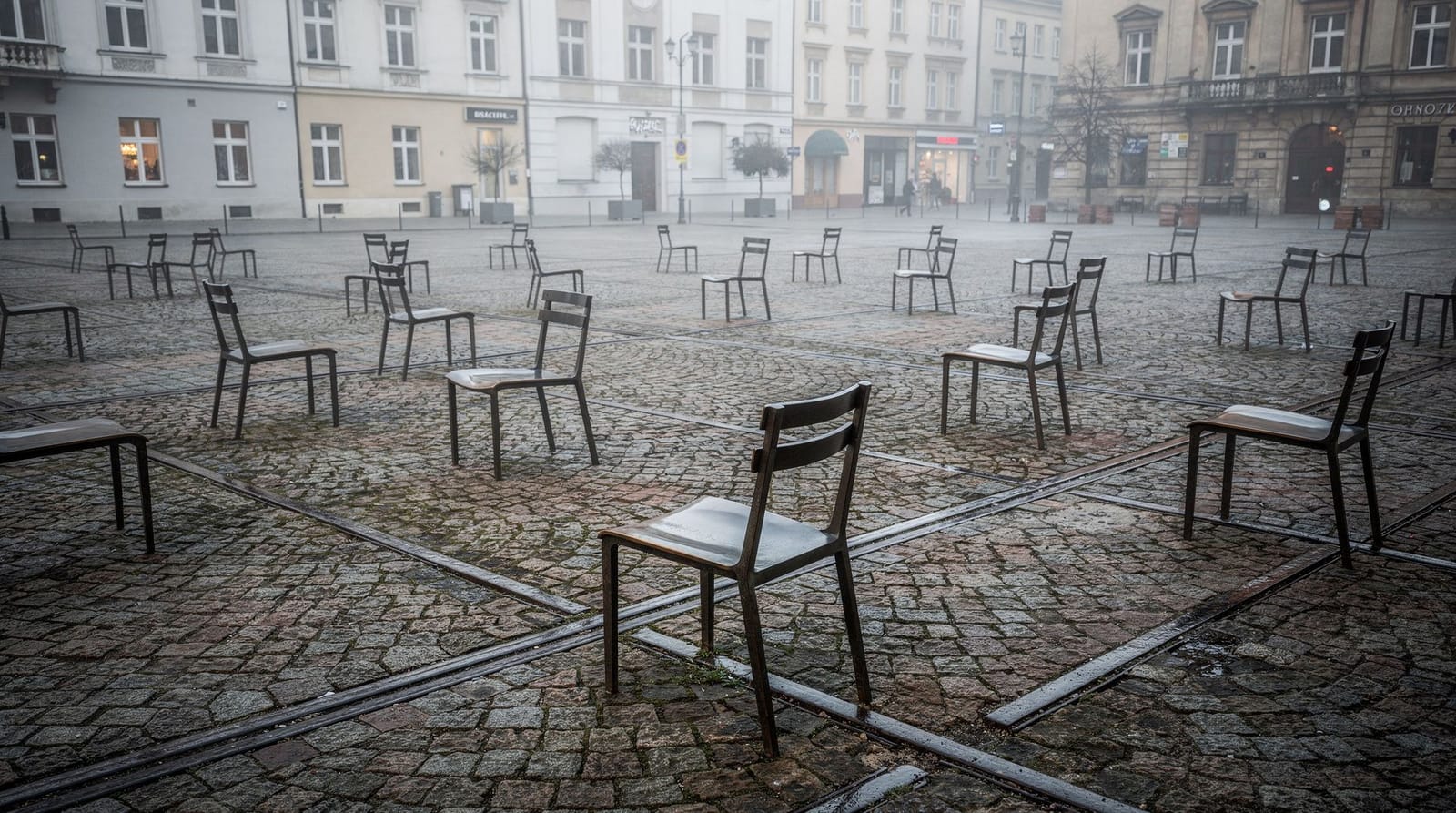
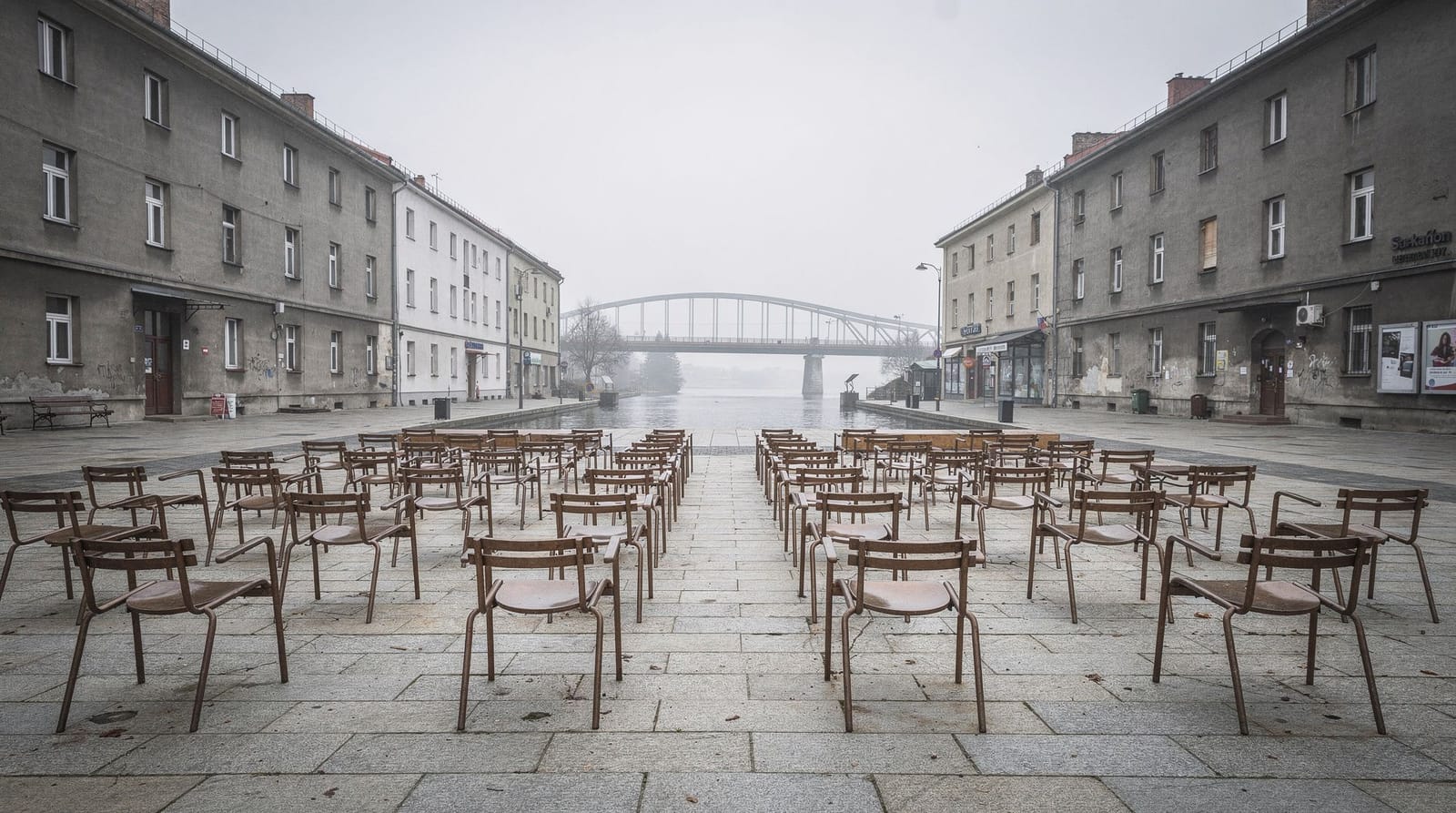
Kraków’s occupation memorials are scattered across the city rather than concentrated in one museum district, which means finding them takes some intention. The Ghetto Heroes Square (Plac Bohaterów Getta) memorial — rows of empty bronze chairs representing the furniture Jewish families were forced to abandon — is the most visually striking and easiest to find, directly in front of the tram stop of the same name. The Pharmacy Under the Eagle, on the same square, preserves the only pharmacy that operated inside the ghetto, run by a Polish pharmacist, Tadeusz Pankiewicz, who used his position to smuggle food and information.
A small plaque and fragment of the ghetto wall survive on ul. Lwowska, a short walk south. The Płaszów memorial requires more effort — no signage guides you there from the main tourist routes, and most visitors reach it as part of a guided tour that also covers the Schindler Factory Museum. At Wawel, there is no dedicated occupation memorial or plaque marking Hans Frank’s residence; the castle’s own interpretation focuses on Polish royal history, so this layer of the site’s story is something you bring with you rather than find on display.
A timeline of the occupation
| Date | Event |
|---|---|
| 6 September 1939 | German forces enter Kraków |
| 26 October 1939 | Hans Frank named Governor-General; Kraków becomes General Government capital |
| 6 November 1939 | Sonderaktion Krakau — 184 Jagiellonian University academics arrested |
| May 1940 | Mass expulsion of Jews from the city begins |
| March 1941 | Podgórze ghetto established |
| 1942 | Deportations to Auschwitz-Birkenau and Bełżec begin |
| March 1943 | Ghetto liquidated; survivors sent to Płaszów |
| January 1945 | Soviet forces liberate Kraków; the historic centre survives largely intact |
Planning a half-day occupation history walk
If you only have a half day for this history, sequence it geographically rather than chronologically. Start at the Schindler Factory Museum in Podgórze — book ahead, since it fills most summer days — and budget the full 2.5–3 hours the permanent exhibition deserves rather than rushing it. From there, walk to Ghetto Heroes Square and the surviving ghetto wall fragment on Lwowska Street, both a few minutes away. If time allows, continue to the Płaszów memorial site on foot from Podgórze; it’s unmarked and takes some effort to find, so a guided option that includes it is the more efficient choice for a first visit. Close the loop with the Kazimierz guide for the prewar Jewish neighbourhood that gives the ghetto’s story its full weight — seeing where the community lived before the war makes the Podgórze site land differently than visiting it cold.
Frequently asked questions about Kraków under occupation
Did any Poles collaborate with the Nazi occupiers?
Historical honesty requires acknowledging that collaboration occurred: some Poles denounced Jews to the Gestapo (motivated by fear, reward, or anti-Semitism), some served in auxiliary police units, and some benefited economically from the dispossession of Jewish property. However, Poland had no national government that collaborated with the Nazis (unlike France, Denmark, or Norway), and the organised resistance was substantial. The full picture includes both rescuers (Poland has the highest number of Righteous Among the Nations recognised by Yad Vashem) and perpetrators.
Was Kraków bombed during World War II?
Kraków was not significantly bombed. The German advance in September 1939 moved so quickly that the city fell before sustained aerial bombardment was needed. There were limited Polish defensive actions and some German air activity around the city’s outskirts, but the historic core sustained virtually no bomb damage. Soviet artillery in January 1945 caused some damage on the city’s eastern outskirts, but again the historic centre was largely spared.
What happened to the Jagiellonian University professors who were arrested?
Of the 184 arrested in November 1939, 21 died in the camps. The majority were released, largely due to international protests, by spring 1940. Some returned to Kraków and participated in the underground university; others remained in hiding. The university building at Collegium Maius became a German administration office; underground lectures took place in private apartments throughout the occupation.
How do Kraków residents talk about the occupation today?
The wartime period remains part of living memory — some Kraków residents are old enough to have been children during the occupation, and their testimony is regularly collected by the Schindler Factory Museum and other institutions. For younger generations, the occupation is primarily historical but carries significant emotional weight. The relationship between Polish national suffering and Jewish Holocaust memory — both real, both enormous, with different historical trajectories — continues to generate complex conversations.
How much time should I set aside for occupation-history sites in Kraków?
A half day covers the essentials: the Schindler Factory Museum (2.5–3 hours) plus a walk through Ghetto Heroes Square and the surviving wall fragment (45–60 minutes). Add the Płaszów memorial site and you’re looking at a full day. If Auschwitz is also on your itinerary, keep it as a separate day rather than combining it with the city sites.
Is the occupation history appropriate for children?
The Schindler Factory Museum’s content is intense and generally recommended for ages 12 and up, similar to guidance for Auschwitz itself. Younger children can still visit Podgórze’s outdoor sites (Ghetto Heroes Square, the wall fragment) with age-appropriate explanation, since these are public squares rather than immersive exhibitions.
Top experiences
Bookable activities with verified prices and instant confirmation on GetYourGuide.