Wieliczka Salt Mine from Kraków: complete visitor guide
From Krakow: Wieliczka Salt Mine tour & fast-track ticket
Duration: 4h
How do I get to Wieliczka Salt Mine from Kraków?
The mine is 14 km southeast of Kraków, about 25–35 minutes by road. The easiest option is a guided tour with transport from central Kraków (roughly 85–120 PLN per person including entry). Independent travellers can take tram 6 from Wielicka street or a minibus to Wieliczka town, then walk 10 minutes to the mine. Entry requires a timed guided tour — you cannot explore freely.
Why Wieliczka deserves a full half-day
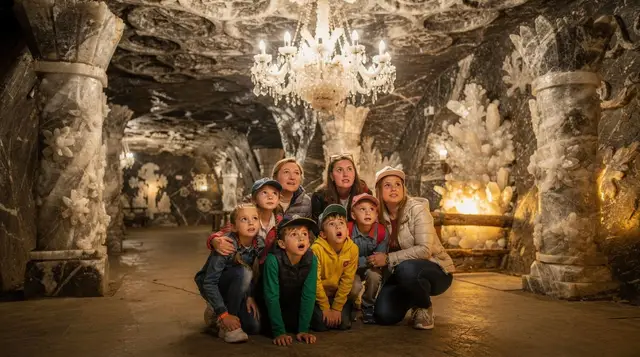
The Wieliczka Salt Mine is one of the oldest continually operating salt mines in the world, with documented mining from the 13th century through to 1996. Today it is a UNESCO World Heritage Site and one of Poland’s most-visited attractions — for good reason. Over 300 metres of underground corridors, enormous chambers carved entirely from salt, sculptures of saints and kings created by miners over centuries, and the astonishing Chapel of St Kinga, a fully equipped underground church where Mass is still celebrated today.
This is not a museum in the usual sense. It is a living monument to Polish craftsmanship, engineering, and devotion, buried 135 metres beneath the Małopolska plain.
This guide covers every practical detail: how to get from Kraków, tour options, what to see, costs in PLN, and how to avoid the main tourist traps.
| Where | Wieliczka town, 14 km southeast of Kraków |
| Cost | Around 104 PLN entry (guide required); tours from ~85 PLN |
| Time needed | 3.5–4.5 hrs including transport from Kraków |
| Getting there | Direct train to Wieliczka Rynek Kopalnia (~25 min), or tour transport |
| Best time | Weekday mornings before 10:00 or after 14:30 |
Distance and transport from Kraków
Wieliczka is 14 km southeast of central Kraków — closer than most visitors expect. Realistic journey times:
- By tram/bus (independent): Take tram 6 (Wielicka direction) or city bus 304 from the city centre to the last stop in Wieliczka town. Journey approximately 30–40 minutes. Then walk about 10 minutes uphill to the mine entrance. Cost: standard Kraków city ticket, 6 PLN (€1.40).
- By train (Kraków Główny to Wieliczka Rynek Kopalnia): Direct trains, approximately 25 minutes, 7–10 PLN (€1.70–2.40). The station is right next to the mine entrance — this is actually the most convenient option.
- By tour minibus: 25–35 minutes from central Kraków pickup points. Included in most guided tours.
- By taxi / Bolt / Uber: 20–25 minutes, approximately 35–50 PLN (€8–12) one way.
Tour options from Kraków
Fast-track guided tour (recommended)
The Wieliczka Salt Mine fast-track tour from Kraków includes a priority timed entry slot, an English-speaking licensed guide, and return transport from central Kraków. This is the best option to avoid the queues at the mine entrance, which can be substantial in July and August.
Typical price: 120–140 PLN per person (€29–33), all inclusive. Duration: 4–5 hours total (about 2.5–3 hours underground).
The mine sits south of the centre, on the river side: a Vistula cruise combined with the Wieliczka Salt Mine uses the boat as the outward leg, which turns dead transfer time into part of the visit.
Guided tour with transport
The guided Wieliczka tour with transport is similar to the fast-track option but with standard entry timing. Good value if booked in advance and visiting outside peak season.
Typical price: 85–110 PLN (€20–26) per person, including entry and transport.
Small-group tour
The Wieliczka small-group tour limits group size for a more intimate experience. The mine’s guided groups are naturally limited (about 35 people maximum per official mine group), but a smaller Kraków-based tour means fewer people on the transport and a dedicated guide for your group throughout.
Typical price: 130–170 PLN (€31–40) per person.
Skip-the-line ticket (if travelling independently)
If you make your own way to Wieliczka, the skip-the-line entry ticket with guide covers your admission and a guided group tour of the mine without the queue at the box office.
Typical price: 85–100 PLN (€20–24) per person.
What to see underground
The Tourist Route (the standard visit)
The main visitor route runs approximately 3.5 km and descends to 135 metres below ground. Key highlights:
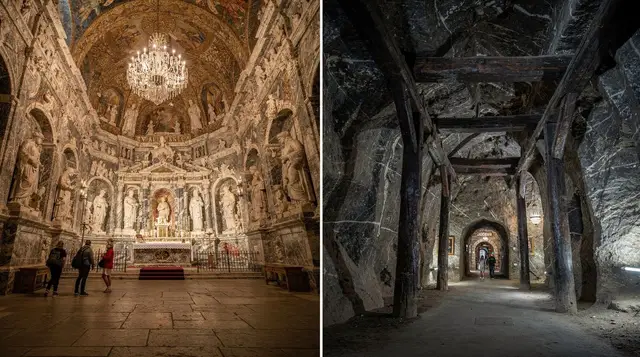
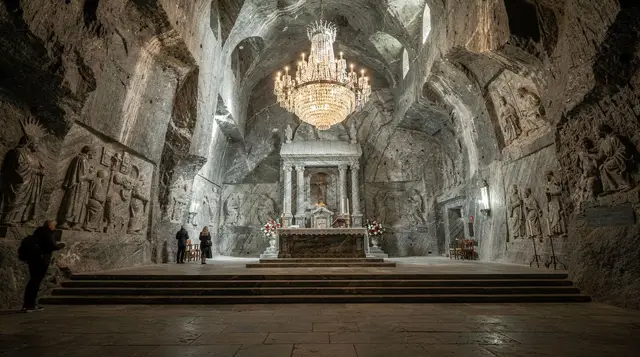
Chamber of St Kinga (Kaplica Świętej Kingi): The undisputed centrepiece. An extraordinary underground church, 54 metres long, 18 metres wide, and 12 metres high — entirely carved from green-grey salt. The floor is salt. The chandeliers are salt crystals. The reliefs on the walls, including a salt carving of Leonardo da Vinci’s Last Supper, were created by miners over generations. Mass is celebrated here on Sundays.
Copernicus Chamber: A large chamber with a salt statue of the great Polish astronomer Nicolaus Copernicus, who reportedly visited the mine in the early 16th century.
Józef Piłsudski Chamber: Named after Poland’s independence-era leader, this chamber features an elegant underground ballroom. Weddings and concerts are actually held here.
The Underground Lake: In the Weimar Chamber, a serene green brine lake reflects the salt formations above. The effect is otherworldly.
Historic Equipment and Machinery: Throughout the route, preserved mining equipment, horse-drawn salt transport mechanisms, and dioramas of mining life from different centuries illustrate how this place actually worked.
What the tour includes
All visits to the mine include a licensed guide (the mine requires this — you cannot explore freely). Standard tours cover approximately 20 of the mine’s 300+ chambers. The visit ends at Level III, 135 metres underground. A lift brings you back to the surface.
The mine maintains a constant temperature of about 14°C year-round. Bring a light jacket or layer regardless of the outside weather.
Honest assessment: what the mine does and doesn’t deliver
What it delivers: Genuine historical depth, breathtaking craftsmanship, and a completely singular underground world. The Chapel of St Kinga alone justifies the trip. Children are typically fascinated.
What it doesn’t: The tourist route is a choreographed procession. Groups move together through wide corridors — you are not spelunking or getting a genuine mining experience. The mine has approximately 3.5 million visitors per year, and in July and August it can feel crowded, even underground. The gift shop at the end (salt chocolate, salt lamps, salt crystals) is overpriced.
Comparison with Bochnia: The Bochnia Salt Mine, 40 km east of Kraków, is less visited, more adventurous (you can take a boat underground), and UNESCO-listed. Worth considering for visitors who want a less crowded experience or a second salt mine.
Practical details
Opening hours: Open daily, including weekends and most public holidays. Tours run from approximately 08:00 to 17:00 (last entry varies by season). Closed Christmas Day and a few other dates — check wieliczka-saltmine.pl.
How long: Plan 3.5–4.5 hours including transport from Kraków. The underground route itself takes about 2.5–3 hours.
Accessibility: The Tourist Route involves approximately 800 steps in total (going down and up), with some uneven surfaces. Partially accessible: there is a lift at the end to return to the surface, but the descending entry stairs are not wheelchair-accessible on the standard route. A dedicated accessibility route exists — contact the mine in advance.
Photography: Permitted throughout the mine (no tripods). The Chapel of St Kinga is the most photogenic space — the natural salt-crystal chandeliers photograph beautifully with your phone camera.
Eating: There is an underground restaurant at Level III (the “Miner’s Tavern” / Gospoda Górnicza) where you can eat before taking the lift up. Food is solid Polish cooking — bigos (hunter’s stew), żurek (sour rye soup), pierogi — at tourist-pricing (25–55 PLN / €6–13 per dish). Not required; most visitors return to Kraków for lunch.
Costs in PLN
| Option | Approx. cost per person |
|---|---|
| Entry only (self-guided not available — guided required) | Standard adult: 104 PLN (€25) |
| Guided tour from Kraków with transport | 85–110 PLN (€20–26) |
| Fast-track guided tour with transport | 120–140 PLN (€29–33) |
| Small-group tour from Kraków | 130–170 PLN (€31–40) |
| Tram/train from Kraków (independent travel) | 7–10 PLN (€1.70–2.40) |
Prices include applicable taxes. GYG tour prices typically include the mine entry fee.
Tips to avoid the crowds
- Book at least 1–2 weeks ahead in peak season. The mine operates a timed-entry system and peak morning slots sell out first.
- Go early or late. The busiest times are 10:00–14:00. An 08:30 tour or an afternoon slot after 14:30 tends to have smaller groups.
- Weekdays are quieter than weekends — unsurprisingly, given that Kraków receives many weekend city-break visitors.
- Consider Bochnia instead if your schedule is flexible. The Bochnia Salt Mine is 40 km further east but significantly less crowded.
Frequently asked questions about visiting Wieliczka Salt Mine from Kraków
Is Wieliczka worth visiting?
Yes — for the Chapel of St Kinga alone, Wieliczka is one of the genuinely unmissable experiences near Kraków. The underground world is completely unlike anything above ground, and the mine’s medieval-to-modern history is genuinely engaging. Allow a full half-day.
Can I visit Wieliczka without a guide?
No. The mine’s visitor routes require a licensed guide — independent wandering is not permitted for safety and conservation reasons. All tours include a guide; if you go independently, you join an official mine group tour at the entrance.
How cold is it underground?
Approximately 14°C year-round at visitor depths. This is cool but not cold — bring a light jacket or mid-layer. In summer, descending from 28°C outside to 14°C can feel refreshing at first and then chilly after 2–3 hours.
Is Wieliczka suitable for children?
Very much so. Children tend to be captivated by the scale, the underground lake, and the carved figures. There are no age restrictions. The steps (around 800) require reasonable fitness; push strollers are not practical. Children under 16 pay a reduced entrance fee (roughly 30% less than adult price).
Should I combine Wieliczka with Auschwitz on the same day?
This is physically possible, but we advise against it. Auschwitz is an emotionally demanding experience requiring time for reflection. Rushing from it to Wieliczka undermines both visits. If your time is limited, see our Auschwitz and Wieliczka same-day guide for a realistic assessment.
Is Wieliczka better than Bochnia Salt Mine?
They’re both genuinely worthwhile, and the choice depends on priorities. Wieliczka has the more spectacular carvings and the famous Chapel of St Kinga; Bochnia is quieter, includes a boat ride underground, and feels more like an adventure than a curated museum visit. The Wieliczka vs Bochnia comparison guide breaks down the full trade-offs if you’re deciding between the two.
How far in advance should I book a Wieliczka tour?
For July and August, book 2–3 weeks ahead if possible — timed-entry slots and fast-track tours sell out, especially for morning departures. In shoulder season (April–June, September–October), 1–2 weeks is usually enough. In winter, you can often book with less than a week’s notice, though popular dates around Christmas (with the Midnight Mass in the Chapel of St Kinga) sell out many months ahead.
The history behind the mine
Salt was medieval Poland’s most valuable commodity — so valuable it was called “white gold” (biała sól). The Wieliczka mine sits in what was once the kingdom’s treasury. Salt from here funded royal courts, paid mercenary armies, and bankrolled cathedral construction across the country. At its peak in the 14th century, the mine generated approximately one-third of all royal revenue. The Kraków–Wieliczka region, along with the nearby Bochnia mine, effectively underwrote the Polish kingdom’s golden age.
Mining operations ran continuously from the 13th century until 1996, when commercial extraction was stopped to preserve the historic workings. Today the mine extends through nine levels and over 300 km of galleries — the tourist route sees perhaps 3% of this total.
The miners’ devotion left a remarkable cultural legacy: throughout the centuries, they carved chapels, altars, and religious sculptures from the salt rock itself, turning their underground world into an act of sustained devotion. The Chapel of St Kinga, the undisputed masterpiece, was carved primarily during the late 19th and early 20th centuries under the supervision of the miner Józef Markowski. Every element — the chandeliers, the altar reliefs, the floor patterns — is made from salt.
In 1978, Wieliczka Salt Mine was among the first twelve sites inscribed on the original UNESCO World Heritage List. The inscription acknowledged both its outstanding universal value as an industrial monument and the extraordinary heritage of the miners’ devotion.
St Kinga and the mine’s founding legend
The mine’s patron saint, Kinga of Poland (1224–1292), was a Hungarian princess who married Duke Bolesław V of Kraków. According to legend, she dropped her engagement ring into a salt mine in Hungary before leaving for Poland, and miraculously the ring was found at Wieliczka when mining began. The legend explains the mine’s dedication to her — and the extraordinary chapel carved in her honour carries her name.
Her family shrine, the Church of St Clare in Stary Sącz, is still a pilgrimage destination in southern Poland today.
Visiting with children or as a family
The mine is one of the more reliably successful family day trips near Kraków — the underground lake, the sheer scale of the chambers, and the sense of adventure tend to hold children’s attention far better than a conventional museum. That said, the roughly 800 steps and 2.5–3 hours underground are a genuine physical commitment; younger children tire, and strollers cannot navigate the route. Children under 16 pay a reduced entrance fee. For pacing a full family day that includes Wieliczka alongside lighter activities, the family-friendly day trips from Kraków guide has practical suggestions for what to schedule before or after.
What makes a Wieliczka tour worth the money
Some visitors hesitate before spending 100+ PLN on a guided tour for a site they could theoretically reach by tram. Here is the honest calculation:
The guide makes the difference. The Tourist Route shows only about 20 of the mine’s 300+ chambers. A skilled guide decides which moments to dwell on, explains the geological and human stories behind specific formations, and manages the pacing of the 3.5 km underground walk. Without a guide, you are looking at salt with no context; with a good guide, you are watching centuries of human endeavour made visible.
Fast-track tickets genuinely save time. In July and August, the mine can have queues of 1–2 hours at the ticket office for walk-in visitors. A fast-track or pre-booked tour enters at a specific time and bypasses this queue. The time saving alone justifies the modest price premium.
Transport is included. The tram from Kraków to Wieliczka requires multiple changes and can take 40–50 minutes. A tour minibus does it in 25–35 minutes from central Kraków, with a pickup point close to your hotel.
It’s genuinely comparable to Kraków’s other paid museums. At 85–140 PLN for a full half-day experience including transport, Wieliczka sits in the same price bracket as a single major Old Town museum ticket plus a taxi — but delivers considerably more content and a far more memorable setting.
The Tourist Route versus the Miners’ Route
Most guided tours follow the Tourist Route (Trasa Turystyczna), which covers the upper three levels and the most historically and artistically significant chambers. It is designed for general visitors and requires no specialist equipment.
The Miners’ Route (Trasa Górnicza) is an alternative experience available on specific sessions — smaller groups, overalls, and helmets provided, with access to less-finished galleries and some physically demanding sections (low ceilings, ladders). This is for visitors who want an authentic mining experience rather than a curated cultural visit. It costs more and requires booking directly through the mine website.
A third option is the health spa route (Trasa Uzdrowiskowa), accessing the underground sanatorium and salt-saturated chambers used for respiratory treatment. Extended underground stays can be arranged for therapeutic purposes.
Combining Wieliczka with the rest of your trip
Wieliczka is a half-day commitment, which leaves the rest of the day open. Many visitors pair a morning at the mine with an afternoon back in the city centre — the Rynek Underground Museum makes an interesting contrast, since both are underground but otherwise couldn’t be more different in character. If you’re planning several day trips from your base, the best day trips from Kraków guide ranks Wieliczka against Auschwitz, Zakopane, and the other major options, and the Kraków itinerary planning guide helps slot a half-day trip like this into a 3- or 4-day visit without over-scheduling.
Seasonal notes for Wieliczka
The mine maintains a constant 14°C year-round, making it equally comfortable in January and July. The main seasonal variable is crowd size:
- July–August: Peak crowds. Timed entry is essential; walk-ins may face 2+ hour queues or be turned away. Book at least 2–3 weeks in advance.
- April–June and September–October: Manageable queues. Book 1–2 weeks ahead.
- November–March: Quieter, but the mine still receives substantial visitor numbers. Often good availability with less than a week’s notice.
Christmas at Wieliczka is a special experience — the Chapel of St Kinga holds a Midnight Mass on Christmas Eve, and the underground acoustic makes it genuinely extraordinary. Tickets sell out many months in advance.
Related guides
- Wieliczka destination
- Bochnia Salt Mine — less-crowded UNESCO alternative
- Wieliczka vs Bochnia comparison guide
- Auschwitz from Kraków — planning guide
- Day trips from Kraków
- Kraków 3-day itinerary
- Kraków with kids — family guide
- Things to do in Kraków
Top experiences
Bookable activities with verified prices and instant confirmation on GetYourGuide.