Bochnia Salt Mine day trip from Kraków: UNESCO adventure underground
Krakow: UNESCO Bochnia Salt Mine tour & boat expedition
Duration: 7h
How do I get to Bochnia Salt Mine from Kraków?
Bochnia is about 40 km east of Kraków, roughly 45–55 minutes by train (Kraków Główny to Bochnia station, 12–20 PLN each way) or road. The salt mine entrance is a 5-minute walk from the station. Guided tours from Kraków with transport and boat expedition entry cost approximately 100–140 PLN all-in. Bochnia is significantly less crowded than Wieliczka and often considered more adventurous.
| Where | Bochnia, ~40 km east of Kraków |
| Cost | Around 100–140 PLN guided all-in, or ~80 PLN entry + train independently |
| Time needed | 3–4 hrs underground, 5–6 hrs total with transport |
| Getting there | Train from Kraków Główny, ~45–55 min, then 5-min walk |
| Best time | Any season; underground is a constant 12–14°C year-round |
Why Bochnia deserves your attention
If Wieliczka Salt Mine is Poland’s most famous underground attraction, Bochnia is its lesser-known sibling — older, quieter, and arguably more interesting from an engineering and adventurous standpoint. The Bochnia Salt Mine holds the title of the oldest continuously operated salt mine in Poland, with documented mining from 1248 — making it older even than Wieliczka’s earliest records. Both are UNESCO World Heritage Sites (Bochnia was added to the Wieliczka World Heritage inscription in 2013).
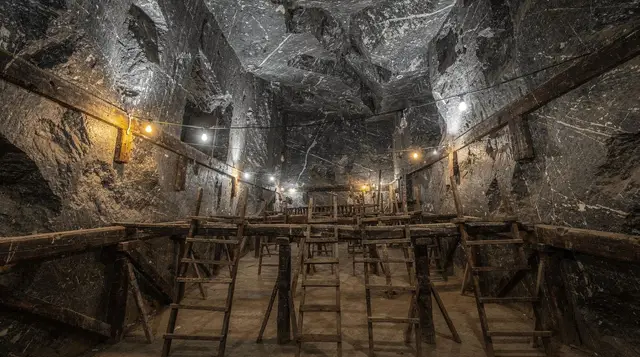
What sets Bochnia apart for the modern visitor is the experience it offers: you descend by a historic mine lift rather than a long staircase, ride a mine train to reach the deeper galleries, and (on the boat expedition route) cruise an underground lake by boat. The crowds are a fraction of Wieliczka’s — instead of thousands of visitors per day, Bochnia typically sees hundreds. The galleries are rawer and more atmospheric. It is a serious mine visit rather than a polished tourist attraction.
Distance and transport from Kraków
Bochnia is approximately 40 km east of Kraków.
- By train (PKP): Kraków Główny to Bochnia, regional trains running frequently throughout the day, journey approximately 45–55 minutes. Tickets: 12–20 PLN (€2.90–4.80) each way depending on the service. Bochnia train station is a 5-minute walk from the mine entrance.
- By guided tour from Kraków: The Bochnia Salt Mine tour with boat expedition from Kraków includes return transport and the full expedition-route entry. Convenient and comprehensive.
- By private car: approximately 45 minutes via the DK4. Parking available near the mine.
Tour options
Boat expedition tour (most popular)
The UNESCO Bochnia Salt Mine tour and boat expedition from Kraków is the signature experience. It combines return transport from Kraków, a mine lift descent, a mine train ride through the galleries, and a boat cruise on the underground lake — one of the few places in the world where you can float on a boat hundreds of metres below the surface. Guides explain the mine’s history and geology in English throughout.
Typical price: 100–140 PLN (€24–33) per person including transport. Duration: 5–6 hours total.
Train and boat tour with hotel pickup
The Bochnia Salt Mine tour with mine train, boat cruise, and hotel pickup adds hotel pickup to the above experience — useful if you prefer not to walk to a central pickup point.
Typical price: 120–150 PLN (€29–36) per person.
Private tour
The Bochnia Royal Salt Mine private tour gives your group exclusive transport and a private guide. Ideal for families or groups who want to set their own pace underground.
Typical price: 700–900 PLN total for the group (€167–214).
What to expect underground
The descent
Unlike Wieliczka (where you descend via a long staircase of approximately 380 steps before reaching the main visitor route), Bochnia uses a historic mine lift to lower visitors underground. This immediately feels more like an authentic mining experience — the shaft descends to Level IV, approximately 212 metres below the surface.
Mine train ride
A narrow-gauge mine train carries visitors through tunnels to the main visitor galleries. The train ride itself lasts about 10 minutes and is a highlight for children and adults alike — low ceilings, salt crystal walls, and the sensation of travelling deep into the earth.
The Ważyn Chamber
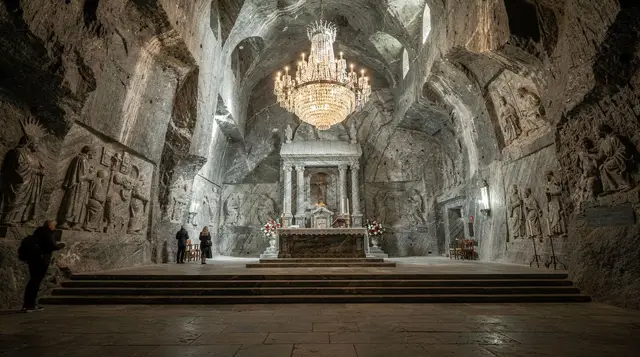
The largest chamber on the visitor route, about 80 metres long and 9 metres high, carved from salt rock over centuries of extraction. The walls shimmer with salt crystals. The chamber is used for underground concerts, sports events (including an annual underground marathon), and even has an underground sanatorium for respiratory treatments — the salt-saturated air has therapeutic properties recognised by Polish medical authorities.
The underground lake and boat expedition
The most dramatic element. An underground lake in one of the lower galleries has water so saline it is nearly saturated — the buoyancy is comparable to the Dead Sea. A small fleet of boats takes visitors across the lake, guided by torchlight reflected off the salt walls. The silence and the reflections are extraordinary.
Salt crystal formations
Bochnia’s galleries feature extensive salt crystal formations — clusters of cubic halite crystals in white and pale grey, sometimes tinged with pink or orange minerals. These are naturally occurring, unlike some of the more elaborate carved features of Wieliczka, and have a raw geological beauty.
Underground sanatorium
Bochnia has operated an underground sanatorium since the 19th century, based on the established therapeutic properties of salt-mine microclimate (very low allergen load, stable humidity and temperature, high salt mineral content in the air). Patients with respiratory conditions — asthma, bronchitis, allergies — stay underground for multi-day treatment programmes. Visitors can request a brief stay in the sanatorium galleries as part of extended tours.
Bochnia vs Wieliczka: which to choose
This is one of the most common questions from Kraków visitors considering day trips.
| Bochnia | Wieliczka | |
|---|---|---|
| Distance from Kraków | 40 km | 14 km |
| Annual visitors | ~350,000 | ~2.5 million |
| Depth | 212 m (Level IV) | 135 m (Level III) |
| Key highlight | Boat on underground lake, mine train | Chapel of St Kinga (carved church) |
| Atmosphere | Raw, adventurous | Polished, spectacular |
| Queues | Minimal | Significant in peak season |
| Price (guided tour all-in) | 100–140 PLN | 85–140 PLN |
Choose Bochnia if: You want fewer crowds, a more authentic mining experience, the boat expedition, and you don’t mind slightly more effort to get there.
Choose Wieliczka if: The Chapel of St Kinga is a priority, or you have limited time and want the closer option.
Both are UNESCO sites; neither is objectively better. They offer genuinely different experiences. If you have 3+ days in Kraków, both are worth doing on separate days.
See also: our Wieliczka Salt Mine guide and the comparison guide.
Practical details
Opening hours: Bochnia Salt Mine is open daily for guided tours. Hours vary seasonally — typically tours start from 09:00 or 10:00, last entry late afternoon. Check the official mine website (kopalnia.pl) for current schedules.
Temperature underground: A constant 12–14°C. Bring a light jacket or fleece.
Duration: Allow 3–4 hours for the underground visit including boat expedition. With transport from Kraków, plan 5–6 hours total.
Accessibility: The mine lift and mine train make Bochnia somewhat more accessible than Wieliczka’s stair-heavy entry, but the underground terrain is uneven in places. Contact the mine in advance if you have mobility requirements.
Photography: Permitted throughout. The underground lake and crystal galleries are particularly photogenic. Low light means a phone camera with night mode or a camera that handles low light well will get noticeably better results than a basic point-and-shoot on auto settings; a small, non-intrusive flashlight app can help you frame shots before the guide moves the group along.
Language: Tours are typically run in Polish with English-speaking guides available on request or on specific scheduled slots — confirm English availability when booking independently, or use one of the guided tours above, which include English commentary as standard.
What to wear: Comfortable closed shoes are essential — the mine floor is uneven in places and can be damp near the underground lake. A light jacket or fleece for the 12–14°C underground temperature is worth carrying even on a hot summer day above ground, since the contrast can be sharp after walking from the train station in the heat.
What to eat in Bochnia
Bochnia is a small town with honest Polish cooking at reasonable prices — cheaper than Kraków.
- Bar Mleczny Kujawiak (ul. Kazimierza Wielkiego) — classic milk bar, traditional Polish food, 18–28 PLN per main
- Restauracja Salina — near the mine entrance, convenient for a post-visit lunch. Standard Polish cooking, 35–55 PLN per main
- Cukiernia Wróblewska — excellent cakes and coffee if you want a sweet break
Bochnia’s food prices run noticeably below central Kraków, which makes it a sensible place to have a proper sit-down lunch rather than grabbing something quick before the train back — you’ll typically save 10–20 PLN per main compared with an equivalent Old Town restaurant.
Combining Bochnia with Ojców National Park
Travellers without a car sometimes overlook that Bochnia and Ojców National Park sit on opposite sides of Kraków, which rules out combining them in a single day trip without a very long, tiring itinerary. If both interest you, treat them as separate half-days rather than trying to force a loop — Bochnia to the east via train, Ojców to the north typically by car or organised tour. Travellers with 4+ days in the region often pair one salt mine (Bochnia or Wieliczka) with one nature day trip (Ojców or the Tatras) rather than stacking underground visits back to back, which keeps the trip varied rather than repetitive.
Costs in PLN
| Item | Approx. cost |
|---|---|
| Guided tour with boat expedition from Kraków | 100–140 PLN (€24–33) |
| Train from Kraków each way | 12–20 PLN (€2.90–4.80) |
| Mine entry (boat expedition route) | ~80 PLN (€19) at the mine |
| Private tour from Kraków | 700–900 PLN per group |
| Meal in Bochnia | 18–55 PLN (€4–13) per main |
Frequently asked questions about the Bochnia Salt Mine
Is Bochnia better than Wieliczka?
Neither is objectively better — they offer different experiences. Bochnia is less crowded, goes deeper, has a boat expedition and mine train, and feels more like a genuine mining adventure. Wieliczka’s Chapel of St Kinga is one of the most extraordinary rooms in Poland. If you can only do one, consider your priorities: spectacle and carved art (Wieliczka) or authenticity and adventure (Bochnia).
How long does the Bochnia Salt Mine tour take?
The underground expedition takes approximately 2.5–3 hours. With transport from Kraków, plan a full half-day (5–6 hours).
Is Bochnia suitable for children?
Yes — children tend to love the mine train, the boat, and the crystalline walls. The mine lift (rather than stairs) makes it accessible for those who struggle with the Wieliczka descent. There are no significant age or height restrictions.
Can I go to Bochnia independently without a guided tour?
Yes. Take the train from Kraków Główny (frequent services, 12–20 PLN each way), walk 5 minutes from Bochnia station to the mine, and buy a tour ticket at the entrance. The mine operates group guided tours at regular intervals — you join a group at the mine rather than bringing your own guide.
Is the underground boat ride included in all tours?
The boat expedition is a specific route at Bochnia, not the basic entry option. When booking, confirm that “boat expedition” (wyprawa łódkowa) is included. The tours listed in this guide include it. If visiting independently, book the “Trasa Turystyczna z Rejsem” (Tourist Route with Cruise).
The history of salt and royal monopoly
The Bochnia and Wieliczka mines were the economic engine of medieval Poland. Salt was not a luxury — it was the primary food preservative of the pre-refrigeration era, essential for meat and fish preservation, cheese-making, and pickling. Control of salt production was control of an essential commodity with no substitute.
King Bolesław V “the Chaste” granted the newly discovered Bochnia mine to the Kraków bishopric in 1248 — within a year of its founding. Subsequent kings transferred the mines to royal control and established the Żupy Krakowskie (Kraków Salt Works), a state monopoly that managed both Bochnia and Wieliczka and returned enormous revenues to the royal treasury.
The Wielkorządy Krakowskie (Grand Administration of Kraków) that managed the salt monopoly operated from the Wieliczka Saltworks Castle (Zamek Żupny) — which still stands in Wieliczka town and now houses a museum of the salt industry. The administration employed hundreds of miners, engineers, accountants, and soldiers, making it one of the most complex administrative organisations in medieval Central Europe.
The salt trade also drove the development of Kraków itself. The salt route (Solna Droga) ran from the mines through Kraków and north towards the Baltic. Merchants and warehousemen clustered in Kraków’s Old Town; the revenue from salt tolls and taxes funded the building of Wawel Castle, St Mary’s Basilica, and the Cloth Hall (Sukiennice) in its 14th-century form.
When Poland was partitioned in the late 18th century, the mines passed first to Austria (Bochnia and Wieliczka remained in the Habsburg province of Galicia) and then to various occupiers. Remarkably, both mines continued operating throughout the partition period, the World Wars, and the Communist era — a continuity of over 700 years.
Bochnia town beyond the mine
The town of Bochnia itself is worth a brief look if you have time before or after the mine. It is a modest Małopolska town with a pleasant main square (Rynek) and some interesting churches.
Bochnia Rynek: The main square dates from a 13th-century town plan — unusually regular and well-preserved for a Polish town of this size. The Town Hall (Ratusz) at the centre was rebuilt several times but retains its original proportions. Several Renaissance and Baroque merchant houses line the square.
Basilica of St Nicholas (Bazylika pw. Św. Mikołaja): The main church, a Gothic structure begun in the 14th century and expanded over subsequent centuries. It contains notable Renaissance chapel altarpieces and ceiling paintings from the 17th century. The church was elevated to the status of minor basilica in 1966.
Salt Mine Viewing Shaft: The exterior of the mine above ground includes the original winding tower, now a museum exhibit explaining the surface infrastructure of the mine’s operational history.
UNESCO World Heritage status: what it means for Bochnia
The inscription of Wieliczka and Bochnia on the UNESCO World Heritage List (originally 1978 for Wieliczka; Bochnia added to the inscription in 2013) recognises both mines as “outstanding examples of human achievement in the exploitation of mineral resources, representing a continuous process of technical and industrial development over many centuries, and demonstrating an exceptional interplay of cultural traditions and universal values.”
The inscription also brought conservation obligations that have been controversial locally. Both mines are under strict preservation rules that limit the types of tourist experiences that can be developed — some mine sections that could theoretically be opened to visitors remain closed under conservation terms. On the positive side, UNESCO status has driven investment in museum infrastructure at Bochnia and has raised the mine’s international profile, driving the visitor numbers that fund its preservation.
The Bochnia underground sanatorium
Bochnia’s underground microclimate — stable temperature of 12–14°C, relative humidity of 70–80%, essentially no allergens or pathogens, high salt mineral content in the air — has been used therapeutically since the 19th century. The salt-mine microclimate (halotherapy) is recognised in Polish medical practice as beneficial for:
- Asthma and chronic obstructive pulmonary disease
- Rhinitis, sinusitis, and allergic conditions
- Skin conditions including psoriasis and atopic dermatitis
- Recovery from respiratory infections
The Bochnia underground sanatorium offers multi-day treatment programmes in which patients sleep in underground chambers on beds provided within the mine, typically for 10–14 night stays. These are medically supervised and covered by the Polish national health service (NFZ) for qualifying patients.
Day visitors can request an extended session in the sanatorium chambers as part of specialist tour packages. The experience is also marketed to “wellness” tourists who want a few hours in the salt-saturated air without a full medical programme.
Malopolska’s salt heritage: a regional perspective
The Bochnia-Wieliczka salt belt represents an extraordinary concentration of cultural and industrial heritage in a small geographic area. Both mines, together with the adjacent Żupy Krakowskie (Kraków Salt Works) administrative heritage, formed the economic backbone of medieval and early modern Poland. The Wieliczka Saltworks Castle (Zamek Żupny), the administrative centre of the royal salt monopoly, still stands in Wieliczka town and now houses the Museum of the Saltworks. It is worth a quick visit if you go independently by train to Wieliczka.
The Małopolska salt corridor also extended east to the Drohobych salt springs (now in Ukraine) and was a major factor in the economic geography of the Polish-Lithuanian Commonwealth — explaining why Kraków, at the intersection of these salt routes, became such an important medieval commercial centre.
Combining Bochnia with the rest of your trip
Bochnia sits far enough east that it does not naturally combine with a single-day Wieliczka or Auschwitz visit — treat it as its own half-day. If you’re building a longer Małopolska itinerary, the 3-day Kraków itinerary has room for one salt-mine day without crowding out the Old Town and Kazimierz essentials. Travellers who want the full salt-heritage picture often do Wieliczka on one day (closer, more polished, better for a half-day with other Kraków sightseeing) and Bochnia on another, less rushed day — the Wieliczka Salt Mine guide covers logistics for that first visit in detail.
Is Bochnia worth it if I only have one day for a salt mine?
If you can only fit one, Wieliczka is the more time-efficient choice for most first-time visitors — closer to Kraków, faster round trip, and home to the famous Chapel of St Kinga. Choose Bochnia instead if smaller crowds and the underground boat expedition matter more to you than the single most photographed chamber, or if you’re specifically drawn to a rawer, less-visited mine.
Related guides
- Bochnia destination
- Wieliczka Salt Mine guide
- Wieliczka vs Bochnia comparison
- Day trips from Kraków
- Ojców National Park day trip
- Things to do in Lesser Poland
- Kraków itineraries
Top experiences
Bookable activities with verified prices and instant confirmation on GetYourGuide.