Ojców National Park day trip from Kraków: hiking, caves, and castles
From Krakow: Ojców National Park and Pieskowa Skała Castle
Duration: 4h
How do I visit Ojców National Park from Kraków?
Ojców National Park is about 25 km north of Kraków — the closest national park to the city. Buses run from Kraków to the village of Ojców (line 904 from the Krowodrza Górka tram stop, roughly 1 hour). By car it's 30–40 minutes. Guided day tours from Kraków cover the park plus Pieskowa Skała Castle in a half-day, often leaving afternoon free for Kraków itself.
Ojców: Poland’s smallest national park, right on Kraków’s doorstep
Ojców National Park (Ojcowski Park Narodowy) is the smallest national park in Poland by area — just 21 square kilometres — and also one of the most accessible from Kraków, lying only 25 km to the north. Despite its modest size, it punches well above its weight for natural and historical interest: a deep limestone valley carved by the Prądnik River, dramatic rock formations with evocative names (the Hercules Club, the Needle), three caves open to visitors, the ruins of a 14th-century royal castle, and the Renaissance Pieskowa Skała Castle perched on a limestone cliff above the valley.
For Kraków visitors who want a half-day or full day of nature and history without a two-hour journey, Ojców is an excellent choice. It works well as a standalone trip or combined with a morning in central Kraków.
| Where | 25km north of central Kraków |
| Time needed | Half day (3–4hrs) minimum; full day with both caves |
| Cost | Bus ~10–12 PLN each way; castle/cave entries 10–28 PLN each |
| Getting there | Bus 904 from Krowodrza Górka (~60–70min), car (30–40min), or guided tour |
| Best time | May or September–October; avoid summer weekends for fewer crowds |
For planning your wider trip, see how many days in Kraków and the best day trips from Kraków roundup, which places Ojców alongside the other main options.
Distance and transport from Kraków
Ojców is approximately 25 km north of central Kraków.
- By public bus: Bus 904 runs from the Krowodrza Górka tram terminus (reachable from central Kraków by trams 4, 14, 34). Journey to the village of Ojców approximately 60–70 minutes. Ticket: standard city-region tariff, approximately 10–12 PLN (€2.40–2.90). Buses run several times daily; check current timetable at mpk.krakow.pl as frequency varies seasonally.
- By car: 30–40 minutes via the DK94 and local roads through Wielka Wieś. Paid parking at the main Ojców village entrance.
- By guided tour: The Ojców National Park and Pieskowa Skała Castle tour from Kraków handles transport and provides a guide for both sites. A well-suited option for visitors who prefer not to navigate local buses.
- By taxi/Bolt from Kraków: Approximately 50–70 PLN (€12–17) one way.
What to see in Ojców National Park
The Prądnik Valley
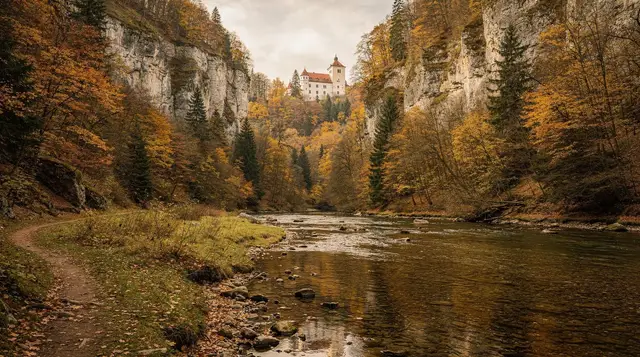
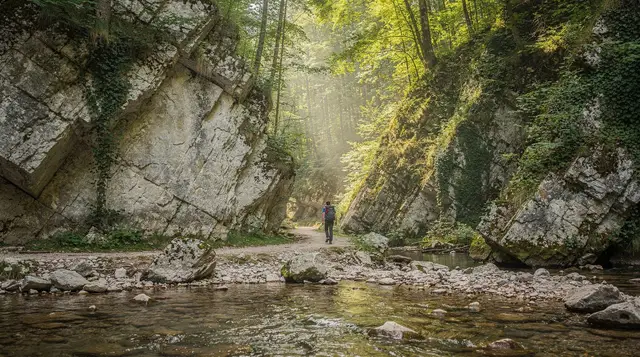
The park’s backbone is the Prądnik River valley — a narrow limestone gorge with cliffs rising 20–30 metres on either side. The valley floor is forested with oak, ash, and hornbeam; the cliff faces are colonised by rare plants and nesting peregrine falcons. The main trail through the valley from Ojców village to Pieskowa Skała covers approximately 7 km and takes about 2.5 hours at a comfortable pace.
The landscape in spring (April–May, when anemones carpet the valley floor) and autumn (October, when beeches turn golden) is exceptional. Summer is fine but busier.
Ojców Castle ruins
The ruins of the 14th-century Ojców Castle (built by King Kazimierz the Great, who also built Wawel’s current form) stand on a limestone outcrop above the village. The tower is partially intact and offers views down into the valley. Admission: approximately 10 PLN (€2.40). The castle gives its name to the village — Ojców means “father’s” in Polish, as the location was a royal favourite.
Pieskowa Skała Castle
The jewel of the area, Pieskowa Skała is a remarkably well-preserved Renaissance castle built in the 16th century under the Szafraniec family, later extended under the Padniewski family. Perched on a limestone cliff above the Prądnik Valley, it is one of the finest examples of Polish Renaissance architecture outside Kraków.
The combined Ojców and Pieskowa Skała Castle tour includes guided entry to the castle museum.
The castle houses a branch of the Wawel Royal Castle museum, with impressive collections of medieval and Renaissance furniture, tapestries, weapons, and decorative art. The courtyard, with its arcaded galleries on three levels, is modelled on Italian Renaissance design and is strikingly beautiful.
Opening hours: Tuesday–Sunday, approximately 10:00–17:00 (seasonal variation). Closed Mondays. Admission: Castle and museum approximately 28 PLN (€6.70) adults, 16 PLN (€3.80) reduced.
The Hercules Club: Nearby, a 25-metre limestone pillar nicknamed “Hercules’s Club” (Maczuga Herkulesa) stands isolated in the valley — the result of differential erosion over millions of years. It is one of the park’s signature natural landmarks.
Łokietek Cave (Jaskinia Łokietka)
Named after King Władysław Łokietek (who, according to legend, hid here from Czech troops in the early 14th century before reclaiming the Polish throne), Łokietek Cave is the larger of the two public caves in the park. A 320-metre-long passage leads through chambers with stalactites, stalagmites, and bat colonies. Guided tours only; admission approximately 22 PLN (€5.25) adults.
Opening hours: April–October daily (seasonal). Check the official park website as hours vary.
Ciemna Cave (Jaskinia Ciemna)
A shorter cave just outside Ojców village, known for yielding important Palaeolithic finds during excavations in the 19th–20th centuries. Admission approximately 11 PLN (€2.60).
Rock formations
The park contains several named limestone formations along the valley:
- Igła Deotymy (Deotym’s Needle) — a slender limestone spike
- Brama Krakowska (Kraków Gate) — a natural rock arch marking the valley entrance near Ojców village
- Rękawica (The Glove) — a multi-fingered rock formation
Suggested itinerary: one day in Ojców
Half-day (3–4 hours): Arrive at Ojców village. Walk the valley trail to Pieskowa Skała (7 km, ~2h including stops). Visit the castle. Return by the same trail or by local road. Works well as a morning excursion before returning to Kraków for lunch and afternoon.
Full day: Add Łokietek Cave to the above (allow 1.5h including queuing). Bring a picnic or eat at the simple restaurant in Ojców village. Return by late afternoon.
Practical details
Park entry: No entry fee for the park itself (just the caves, castle, and specific sites). Distance of main trail: Ojców to Pieskowa Skała, approximately 7 km one way (14 km return). Flat valley floor trail with some gentle climbs to the castle. Well-marked, family-friendly. What to bring: Comfortable walking shoes (trail is mostly gravel and packed earth), water, snacks, layers (the valley stays cooler than Kraków). In spring, rain gear is advisable. Dogs: Permitted in the park on a lead.
Guided options: The Ojców National Park full-day trip from Kraków includes transport and a park guide for the full valley route and castle.
The Ojców and Pieskowa Skała Castle trip is a slightly shorter alternative focusing on the castle and key rock formations.
What to eat near Ojców
Options are limited — Ojców is a small village. Bring a packed lunch from Kraków (Hala Targowa or Plac Nowy markets are excellent sources). If you want to eat on site:
- Restauracja Pod Kazimierzem — in Ojców village, serves Polish standards (żurek, pierogi, kotlet schabowy), 30–50 PLN per main
- Café at Pieskowa Skała — light meals and coffee available on the castle grounds, slightly tourist-priced but convenient
Kraków’s Pierogarnia Momo (Kazimierz) or the milk bars in the Old Town are better options for both quality and price — eat before or after your visit.
Ojców vs Kraków’s other main day trips
Ojców is the closest and shortest of Kraków’s popular day trips, which makes it a good pick when you have a half day rather than a full one. Here’s how it stacks up against the other most-booked options:
| Day trip | Distance | Time needed | Best for |
|---|---|---|---|
| Ojców National Park | 25km | Half day | Nature, castles, families, short trips |
| Wieliczka Salt Mine | 15km | Half day | Underground chambers, history |
| Auschwitz-Birkenau | 70km | Full day | Essential WWII history |
| Zakopane & Tatras | 100km | Full day | Mountain scenery, hiking |
| Częstochowa | 140km | Full day | Pilgrimage, the Black Madonna |
If you’re building a multi-day plan, the Kraków travel itinerary planning guide shows where a half-day trip like Ojców fits without crowding out the Old Town and Kazimierz, and the family-friendly day trips from Kraków guide is worth checking if you’re travelling with children, since Ojców is one of the easiest options for that.
Photography and best viewpoints
Ojców rewards photographers willing to walk a little further than the main trail. The view from the Ojców Castle tower down into the valley is the classic shot, best in early morning light before the trail fills with visitors. At Pieskowa Skała, the Hercules Club pillar photographs best from the small viewing platform just off the main path below the castle, with the castle itself visible in the background. Inside the courtyard, the three-tiered arcaded galleries are strikingly symmetrical — shoot from the centre of the yard for the cleanest lines. For the valley itself, the stretch just north of Ojców village, where the limestone cliffs close in tightly around the Prądnik River, is the most dramatic and least photographed section, since most visitors focus on the castle-to-castle walk. See the Kraków photography spots blog post for how this compares to the city’s own best angles.
Costs in PLN
| Item | Approx. cost |
|---|---|
| Guided tour from Kraków (Ojców + Pieskowa Skała) | 100–140 PLN (€24–33) |
| Bus from Kraków (each way) | 10–12 PLN (€2.40–2.90) |
| Pieskowa Skała Castle admission | 28 PLN (€6.70) adult |
| Łokietek Cave | 22 PLN (€5.25) adult |
| Ciemna Cave | 11 PLN (€2.60) adult |
| Ojców Castle ruins | 10 PLN (€2.40) |
| National Park entry | Free |
Frequently asked questions about the Ojców National Park day trip
How far is Ojców from Kraków?
About 25 km north of central Kraków. By road it takes 30–40 minutes; by public bus approximately 60–70 minutes from the city centre.
Is Ojców suitable for children?
Very much so. The valley walk is easy and fascinating for children, the caves are short enough not to exhaust young visitors, and the castle is engaging. Łokietek Cave is particularly popular with children (bats, stalactites, a legendary king). Bring good shoes and a torch inside the caves.
Can I combine Ojców with Pieskowa Skała Castle?
Yes — they are designed to be visited together. The castle is about 5 km along the valley from Ojców village, easily reached on foot in about 90 minutes. Most guided tours combine both automatically.
What is the best time of year to visit?
May (anemones in flower, greenery freshly out), September–October (autumn colours, fewer visitors). Summer works but can be crowded on weekends. Winter access is possible by car but limited by bus, and the cave tours may be restricted.
Is there a restaurant or food in Ojców?
There is one small restaurant in the village and a café at the castle. Options are basic. We recommend bringing a picnic or eating before you leave Kraków.
Is Ojców worth it compared to Wieliczka Salt Mine?
They’re different enough that many visitors do both on separate days. Ojców is outdoor, green, and unhurried; Wieliczka is underground, historic, and more structured (fixed-time guided entry only). If you can only choose one and prefer fresh air and castles, pick Ojców; if you want a genuinely unique underground experience, pick Wieliczka. Neither is a substitute for the other.
Ojców under the Jagiellons: a royal retreat
The Prądnik Valley attracted Polish royalty for centuries. King Kazimierz the Great (Kazimierz Wielki, 1310–1370) — the monarch responsible for the series of limestone ridge castles that form the Eagles’ Nests Trail — built the Ojców Castle as part of this defensive network and used the valley as a hunting retreat. The castle’s name, Zamek Ojców, and the village name derive from an old word meaning “father’s [castle].”
The royal connection continued under the Jagiellonian dynasty. King Władysław II Jagiełło (1352–1434), victor of the Battle of Grunwald (1410), is said to have recuperated in the Prądnik Valley after illness. The clean valley air, mineral springs, and forested isolation made the valley a natural convalescent resort in an era before formalised spa culture.
In the 19th century, under the Habsburg Partition (Galicia), Ojców became a fashionable destination for the Kraków intelligentsia — artists, writers, and academics for whom the cave, castle, and landscape represented both romantic landscape and Polish national memory in a region under foreign rule.
The legend of King Łokietek
The cave at Jaskinia Łokietka is named for King Władysław I Łokietek (“the Elbow-high,” 1261–1333), who according to tradition hid in the cave around 1305 while fleeing Czech forces before reuniting the fragmented Polish lands and having himself crowned King in 1320. The legend attributes his rescue to a spider that spun a web across the cave entrance, convincing his pursuers it was undisturbed.
The historicity of this event is disputed — some historians note the cave may not have been known or accessible in its current form in the early 14th century. But the legend is firmly embedded in Polish historical consciousness, and the cave carries his name as a living monument to that memory.
Ojców and the Eagles’ Nests Trail
Ojców is part of a broader historical landscape known as the Szlak Orlich Gniazd — the “Trail of the Eagles’ Nests.” This 164 km hiking and cycling route runs north from Kraków through the Kraków-Częstochowa Upland (Wyżyna Krakowsko-Częstochowska), linking the ruins of medieval limestone-ridge castles that were built in the 14th century under King Kazimierz the Great as part of a defensive frontier. Ojców Castle and Pieskowa Skała are two of the most intact points on this route.
The trail offers a radically different experience from the Tatra Mountains: instead of dramatic snow-capped peaks, you get a more intimate limestone landscape of white rock outcrops, beech and oak woodland, and a succession of castles in various states of preservation. For hikers who have done Zakopane and Morskie Oko and want something completely different, a section of the Eagles’ Nests Trail — even just the Ojców-to-Pieskowa Skała stretch — is extremely rewarding.
Cycling the Trail: The Szlak Orlich Gniazd is increasingly popular with cyclists. Mountain bikes or gravel bikes are appropriate for the trail surface. Bikes can be rented in Kraków. A cycling day trip covering the Ojców section (starting from outside Kraków by car or bus, riding the valley trail to Pieskowa Skała, and returning) is a full but excellent day.
Geology of the Kraków-Częstochowa Upland
The distinctive white limestone cliffs and rock formations of Ojców are the result of ancient geology. The Upland was once a shallow tropical sea bed during the Jurassic period (approximately 150 million years ago); the shells and skeletons of marine organisms accumulated in layers and compressed into the pale limestone that now forms the terrain.
Subsequent erosion — by rivers like the Prądnik, by frost, and by chemical dissolution — created the characteristic features: deep narrow valleys, isolated rock pillars and arches (monadnocks), and extensive cave systems. The Prądnik Valley in Ojców, the caves at Jaskinia Łokietka and Jaskinia Ciemna, and the Hercules Club pillar at Pieskowa Skała are all products of this long geological history.
The Jurassic limestone is also the reason for the area’s exceptional biodiversity — the alkaline soil and sheltered valley microclimates support an unusually rich flora, including many species at the northern or eastern edge of their range in Central Europe.
Wildlife in Ojców National Park
Despite its small size, Ojców is notable for wildlife. Key species:
Bats: Eleven species of bat inhabit the park’s caves and forest, making it one of the most important bat refuges in Central Europe. The caves — particularly Łokietek — are important hibernation sites. Some caves are closed during winter months to protect the hibernating colonies.
Birds: The Prądnik Valley is good for kingfishers (along the river), dippers, white-throated dippers, and several species of owl. Peregrine falcons have been recorded on the limestone cliffs at Pieskowa Skała.
Mammals: Roe deer, foxes, and badgers are common. Otters are present in the Prądnik River. The park is within range of wolves and lynx from the Beskidy, though sightings in the park itself are rare.
Flora: Sixty-five plant species in the park are protected, including several orchid species, the Ojców birch (Betula ojcoviensis, endemic to this area), and extensive stands of Dentaria bulbifera (a spring woodland flower) along the valley floor in April.
Beyond Ojców: the Kraków-Częstochowa Upland
If a day at Ojców inspires further exploration of the limestone upland:
Będzin Castle (about 40 km northwest of Ojców) — a substantial medieval castle on a hill above the Czarna Przemsza River, with a municipal museum inside. The surrounding old town is one of the better-preserved in the Silesian region.
Olsztyn Castle ruins — dramatic hilltop ruins north of Częstochowa, set amid towering limestone outcrops. Often combined with Częstochowa on a longer day trip.
Kroczyce and the Rocking Stones (Skały Kroczyckie) — a landscape of extraordinary Jurassic limestone boulders in the northern part of the Upland.
These sites are generally best explored independently by car — public transport connections in rural Małopolska and Silesia are limited.
Related guides
- Ojców National Park destination
- Zakopane from Kraków
- Bochnia Salt Mine day trip
- Częstochowa Black Madonna day trip
- Day trips from Kraków
- Mountains and nature
- Kraków with kids
Top experiences
Bookable activities with verified prices and instant confirmation on GetYourGuide.