Bochnia Royal Salt Mine — Poland's oldest, quieter than Wieliczka
Bochnia Royal Salt Mine is older than Wieliczka, UNESCO-listed, and far less crowded. Underground boat rides, mine trains, and real salt-mine atmosphere.
Krakow: UNESCO Bochnia Salt Mine tour & boat expedition
Duration: 7h
Quick facts
- Distance from Kraków
- 40 km east; 45–60 min by car or bus
- UNESCO
- Listed since 2013 (same site as Wieliczka)
- Depth
- Up to 468 m (deepest tourist route: 259 m)
- Visitor numbers
- ~200,000/year vs Wieliczka's 1.8 million
- Standout features
- Underground boat ride, mine train, health resort
- Family suitability
- Excellent — the boat and train are highlights for children
The mine that gets overlooked
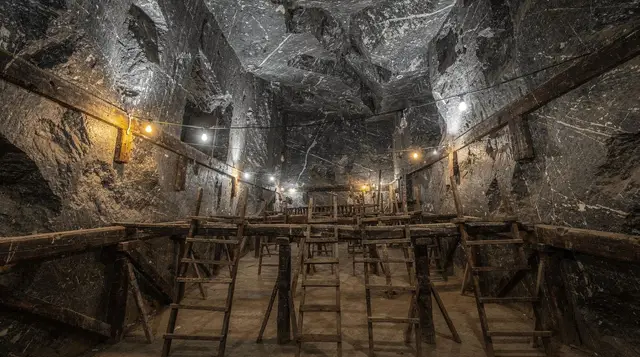
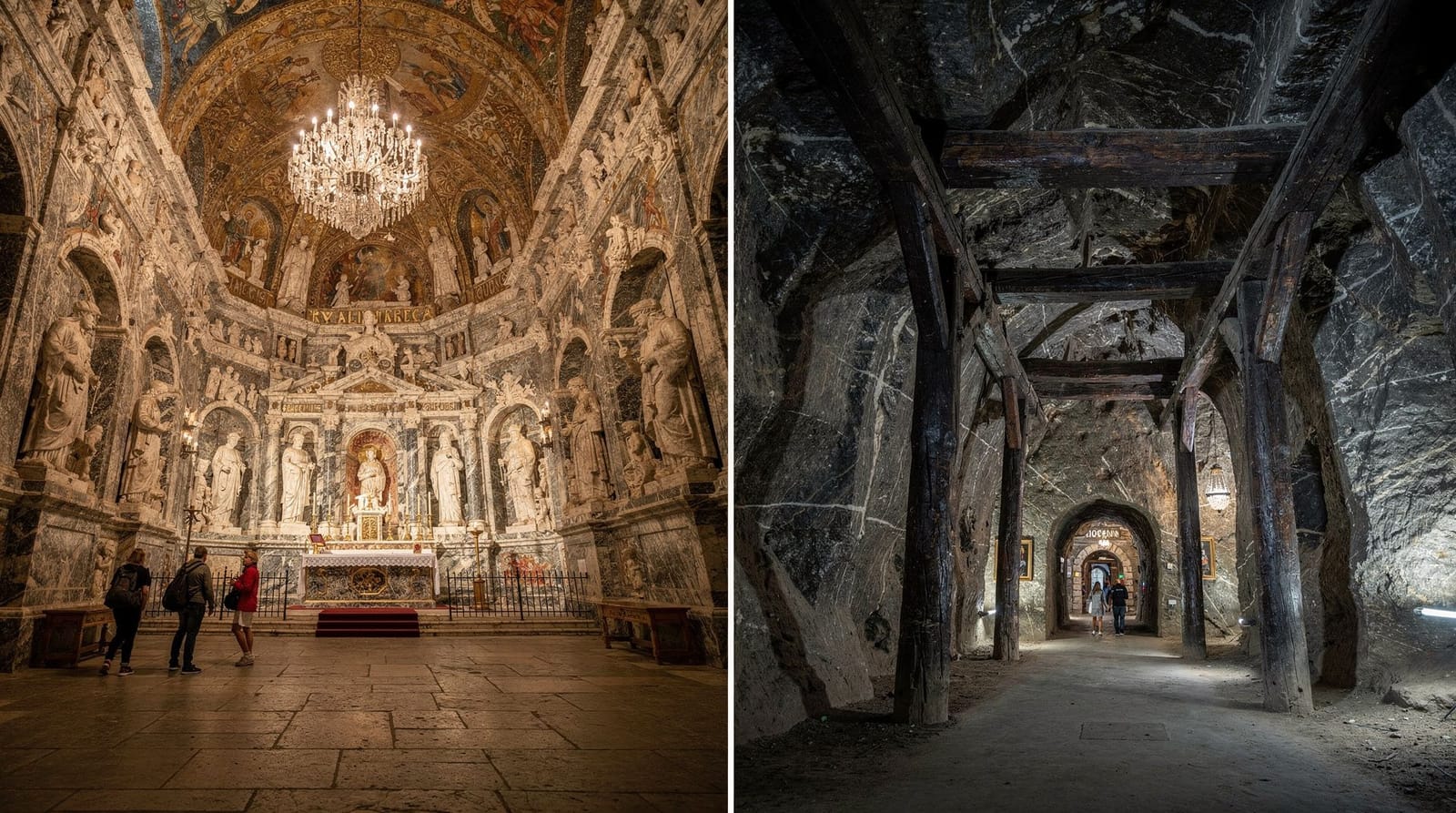
Bochnia is the oldest salt mine in Poland — older than Wieliczka by a decade, with continuous operation since 1248. It was added to UNESCO’s World Heritage List as an extension of the Wieliczka listing in 2013. It reaches deeper into the earth than Wieliczka. Its underground chambers include features that Wieliczka does not have: a working mine train, a boat ride on an underground lake, and an underground sanatorium for respiratory treatments.
And yet most visitors to Kraków go to Wieliczka without knowing Bochnia exists.
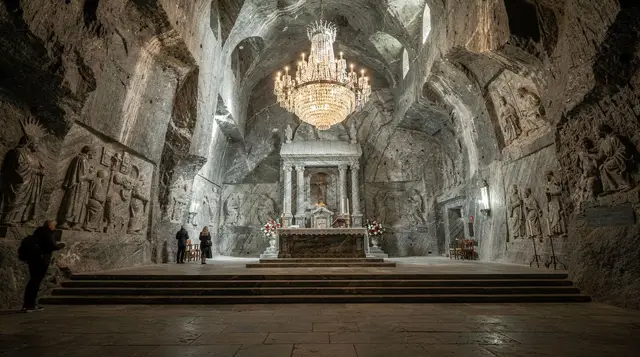
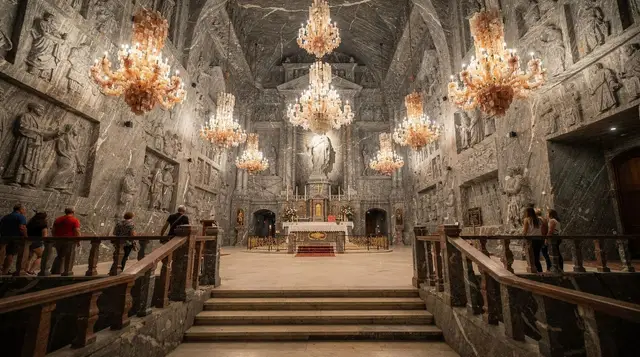
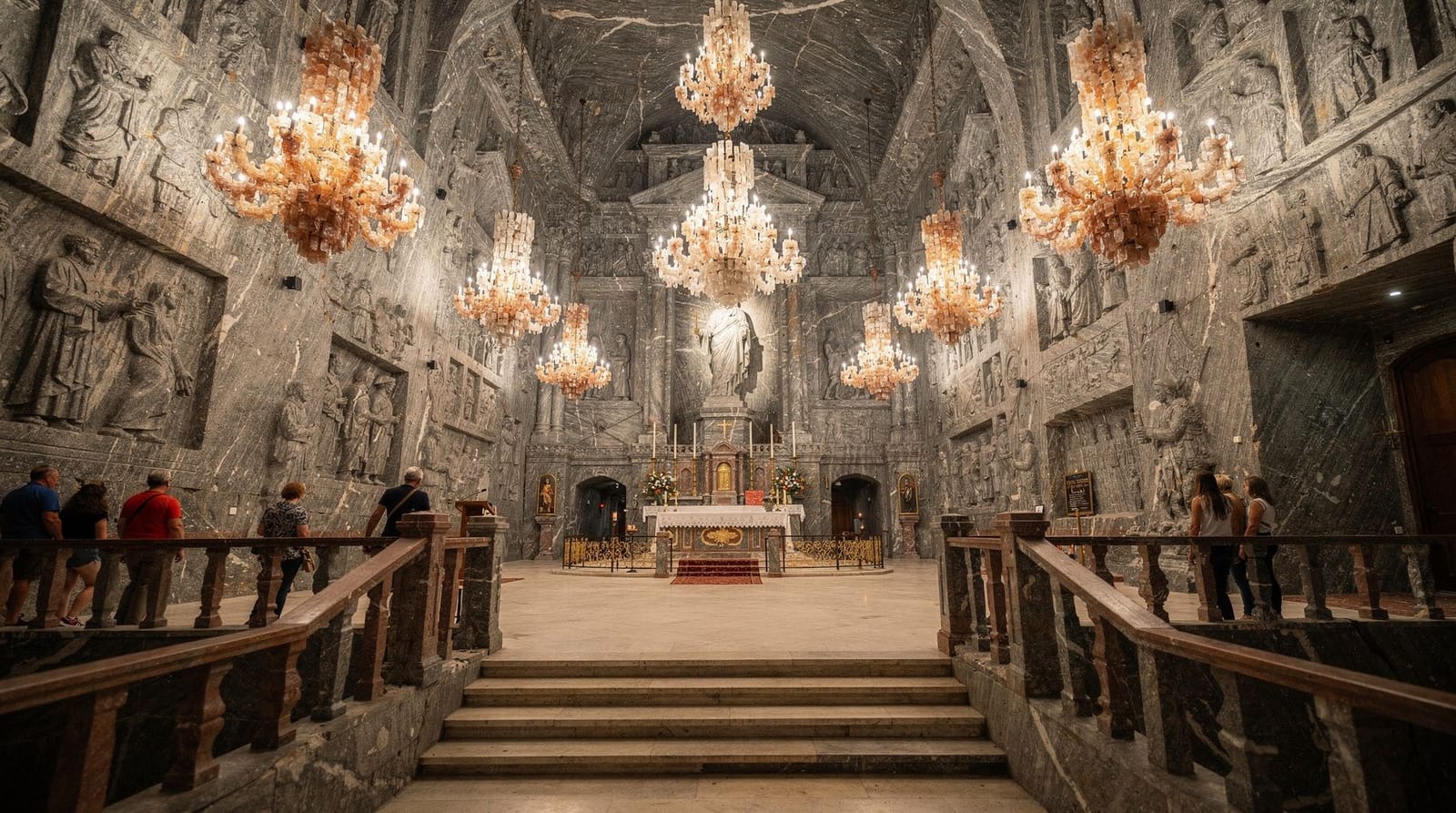
The reason is simple: Wieliczka got there first, markets more aggressively, and is closer to Kraków. Bochnia is 40 km east — 45 minutes by car — and draws about 200,000 visitors a year compared to Wieliczka’s 1.8 million. Whether that is a reason to go or to stay away depends on what you value. If you want crowds and the Chapel of St. Kinga, go to Wieliczka. If you want a more authentic underground atmosphere with space to breathe, go to Bochnia.
Both are excellent. They are different experiences.
| Where | Bochnia, 40 km east of Kraków, around 45–60 min by car or bus |
| Cost | See the official Bochnia Salt Mine website for current prices |
| Time needed | 2.5–3 hours for the main route; 1.5 hours for the Family Route |
| Getting there | Car via the A4, train to Bochnia station, or an organised tour with transport |
| Best time | Year-round; quietest outside July–August |
Getting there from Kraków
By car: The most convenient option given Bochnia’s less frequent public transport links. Take the A4 motorway east from Kraków, exit at Bochnia. Journey time approximately 45 minutes. Parking is available at the mine entrance.
By train: PKP intercity trains and regional trains run from Kraków Główny to Bochnia station (35–50 minutes, 15–25 PLN / ≈ €4–6). From the station, taxis or local buses cover the 1.5 km to the mine entrance.
By organised tour: The Bochnia Salt Mine tour and boat expedition handles transport from Kraków and includes the boat experience that is Bochnia’s signature. The mine train and boat cruise tour with hotel pickup adds the train element for a more comprehensive visit. Both are recommended for visitors who do not want to self-organise the logistics.
What makes Bochnia different
The underground boat ride
The Bochnia mine has an underground boat expedition that takes small groups across an underground lake deep in the mine system. Visitors board wooden boats and float through chambers that were once used for salt transport — a completely dark, silent journey that no other salt mine in the region offers. This is Bochnia’s signature experience and it has no equivalent at Wieliczka.
The mine train
The mine train runs through 800 m of underground tunnel — the same type of narrow-gauge train that was used for industrial transport in the mine’s working years. Visitors ride in original mine wagons, passing through chambers and galleries that are otherwise inaccessible on foot. Children consistently rate this as a highlight.
The underground health resort
The Bochnia Salt Mine operates an underground sanatorium — one of the deepest health resorts in Europe — offering therapeutic stays for people with respiratory conditions including asthma and allergic rhinitis. The salt-saturated microclimate at 259 m depth has genuine therapeutic applications. Day visitors can take shorter health sessions; multi-day therapeutic stays are available by separate booking.
The depth
The deepest tourist route at Bochnia reaches 259 m — nearly double the 135 m of Wieliczka’s Tourist Route. The deeper chambers have a more dramatic quality, the salt formations larger and more varied, the silence more complete.
Visiting Bochnia — the routes
Tourist Route “Chodnik Królewski” (King’s Gallery): The main tourist route, covering 2.5 km at depths of 180–259 m. Includes the boat ride, mine train and key historical chambers. Duration approximately 2.5–3 hours. This is the route covered by the organised tour options.
Family Route: A shorter, more accessible circuit (1.5 hours) that retains the boat ride and focuses on hands-on activities for children. The best option for families with young children.
Underground Health Centre: Half-hour to full-hour sessions in the therapeutic microclimate (advance booking required; separate from the main tourist routes).
Prices: Check current ticket prices on the official website of the Bochnia Salt Mine. The Bochnia Royal Salt Mine private tour allows a flexible, self-paced experience for groups who want to avoid being on a fixed schedule.
Bochnia for families
Bochnia is notably more family-friendly than Wieliczka in terms of the activity-to-depth ratio. Wieliczka’s primary spectacle is architectural (the carved chambers and chapels); Bochnia’s is experiential (the boat, the train, the descent into darkness). Children who might struggle with the patience required for Wieliczka’s chapel-by-chapel tour often find Bochnia more immediately engaging.
The mine also has an underground playground (part of the Family Route) and a dedicated children’s quiz programme with guides trained for young visitors.
If the children are still small, the Kraków with kids guide helps you decide how to balance a mine day against playgrounds and lighter city days, and the family-friendly day trips guide puts Bochnia next to the other excursions that suit a family pace. On a wet day, the rainy-day activities guide is a useful reminder that an underground visit is largely unaffected by the weather above.
What to bring and practical tips
Wear comfortable walking shoes — the tourist route covers 2.5 km of underground galleries, some with uneven historic flooring. A light layer helps: the constant 16°C underground feels cooler than a warm summer day above ground but is not cold enough to need heavy clothing. Photography is generally permitted without flash restrictions as strict as some other heritage sites, though check current signage on arrival. Toilets and a small café are available at the surface entrance building; there are none along the underground route itself, so plan accordingly before descending. Tickets can usually be bought on the day outside peak summer weekends, but if travelling on a fixed schedule from Kraków, booking the organised tour in advance removes any uncertainty.
Bochnia town
The town of Bochnia itself is modest but pleasant — a provincial Polish market town with a well-preserved Gothic church (St. Nicholas Basilica, 14th century) and a market square that functions as a normal Polish town square rather than a tourist zone. If you are driving and have time, the town square is worth 30 minutes. The salt shaker in the town square (a local landmark) is an obvious photograph.
Eating in Bochnia: Restaurant Sól i Pieprz near the market square is the reliable choice for traditional Polish cooking (35–55 PLN / ≈ €8–13 for a main). Several milk bars serve lunch for under 25 PLN (≈ €6). Standards are unpretentious but honest.
For the rest of your trip, the Kraków getting around guide explains how to reach the station for the train to Bochnia, and the Kraków travel itinerary planning guide shows where a half-day excursion fits among your other plans. If you are weighing how long to stay in the region, how many days in Kraków is a sensible companion read, and the 7-day Małopolska itinerary has room for both salt mines.
The underground health resort
Bochnia’s sanatorium function is one of its least-advertised but most interesting features. The microclimate at 259 m depth — constant temperature of 16°C, very high relative humidity, air saturated with sodium chloride — has been used therapeutically since the 19th century. The Bochnia mine has Polish Ministry of Health certification as an underground health resort.
Day visitors can take a 45-minute or 90-minute “speleotherapy” session in the chamber designated for this purpose — essentially sitting in the underground climate while breathing the salt-saturated air. The research basis for salt therapy in respiratory conditions is debated, but the Polish medical tradition treats it as established; doctors regularly prescribe underground stays at Bochnia for patients with asthma, chronic sinusitis and allergic conditions.
Multi-day therapeutic stays (5–14 days) are available by separate booking through the mine’s medical centre. Participants stay underground overnight in specially equipped dormitory chambers. The visitors are overwhelmingly Polish — this aspect of Bochnia is almost unknown to international tourists.
History of the Bochnia mine
The Bochnia mine predates Wieliczka in the historical record, with documentary evidence of salt mining here from 1248 — 10 years before the first mentions of Wieliczka. The mine was originally part of the same royal salt monopoly, administered by the Żupy Krakowskie alongside Wieliczka.
The Bochnia mine experienced a catastrophic flood in 1868 that damaged several lower levels and killed multiple workers. The reconstruction of the affected sections, and the engineering solutions developed to manage the water table, are part of what the mine’s history exhibition documents. The flood galleries are now among the most atmospheric parts of the tourist route.
Operations at Bochnia continued into the 1980s for commercial salt production before transitioning fully to heritage tourism. The depth advantage — 468 m total depth versus Wieliczka’s 327 m — means that some of the lower levels are still considered for brine extraction using modern methods.
Bochnia versus Wieliczka — which should you choose?
The full comparison is in the Wieliczka vs Bochnia guide. The short version:
| Wieliczka | Bochnia | |
|---|---|---|
| Visitor numbers | ~1.8 million/year | ~200,000/year |
| Signature feature | Chapel of St. Kinga, carved sculpture | Underground boat ride, mine train |
| Deepest tourist route | 135 m | 259 m |
| Distance from Kraków | ~15 km, direct tram/train | ~40 km, car or train |
| Best for | First-time visitors, limited time | Second visit, families, quieter pace |
Choose Wieliczka if: You have one salt mine in your itinerary and limited time. Wieliczka’s Chapel of St. Kinga is more spectacular than anything at Bochnia; the mine has more elaborate sculpture and more consistent English-language tour provision. The Wieliczka from Kraków guide covers the logistics.
Choose Bochnia if: You have visited Wieliczka before; you are travelling with children who want activity over spectacle — see the Wieliczka with children guide for how that mine compares on the family front; you want a quieter experience; or you are genuinely interested in the history and working conditions of a salt mine rather than its decorative legacy.
Choose both if: You have 4–5 days in the Kraków area and enjoy underground heritage. They complement each other well and are genuinely different experiences. The Wieliczka tour vs independent guide is useful if you are planning both and weighing guided versus self-organised logistics for each.
Getting the most from a Bochnia visit
Bochnia works well as a standalone half-day excursion or combined with the nearby town of Tarnów (a beautiful but rarely-visited Polish city with a significant Jewish heritage site, 45 km east of Bochnia). The Tarnów day trip guide covers that pairing in detail — the combination makes a full day trip from Kraków without feeling rushed.
It also combines naturally with a morning in Wieliczka if you are sufficiently energetic — take Wieliczka in the morning (30 min from Kraków), drive east to Bochnia in the afternoon (50 min from Wieliczka). Tiring but feasible.
For a Kraków day-trips overview, Bochnia is listed alongside Wieliczka as one of the best value half-day excursions for independent travellers.
Frequently asked questions about Bochnia Salt Mine
How does Bochnia compare to Wieliczka?
Both are UNESCO World Heritage Sites and both are genuine working salt mines turned into tourist destinations. Wieliczka is grander and more famous, with elaborate carved chapels and approximately 9× the visitor numbers. Bochnia is older, deeper, less crowded and offers experiences (boat ride, mine train) that Wieliczka does not. For a first visit to the region, Wieliczka is the stronger single choice; for a second visit or with children, Bochnia is often preferred.
Is Bochnia suitable for young children?
Very much so. The boat ride and mine train are highlights for children; the Family Route is specifically designed for families with young children. The underground descent is not frightening in the way some visitors might fear — the routes are well-lit, the temperature is constant (a mild 16°C), and guides keep the pace appropriate for families.
Do I need to book in advance for Bochnia?
Less urgently than for Wieliczka. Bochnia’s visitor numbers are low enough that walk-up tickets are usually available on weekdays outside summer peak. At weekends in July and August, booking 1–2 weeks ahead is sensible. Organised tour bookings should be made further in advance.
Is Bochnia accessible by public transport from Kraków?
Yes, by train from Kraków Główny (35–50 minutes). The mine is 1.5 km from Bochnia station, reachable by taxi or local bus. Less convenient than Wieliczka (which has a direct train from central Kraków), but manageable for independent travellers.
Top experiences
Bookable activities with verified prices and instant confirmation on GetYourGuide.