Morskie Oko hike from Kraków: complete guide to the Eye of the Sea
From Krakow: Morskie Oko lake tour in the Tatra Mountains
How do I visit Morskie Oko from Kraków?
Take a guided tour or drive south to the Palenica Białczańska car park (about 2 hours by road), then walk 8 km each way to the lake on a well-maintained road/path gaining 430 metres altitude. Allow 4–5 hours for the round trip. Guided tours from Kraków handle transport and logistics (120–160 PLN all-in); drivers park at Palenica (36–75 PLN, reserved online) and walk or take a horse-drawn carriage to the lake.
| From Kraków | around 2 hours by road to Palenica Białczańska |
| Trail | 8 km each way, 430 m elevation gain |
| Time needed | 4–5 hours round trip walking, plus travel |
| Cost | Guided tour 120–200 PLN; self-drive: parking (36–75 PLN, reserved online) + park entry 11 PLN |
| Best months | June and September for fewer crowds |
Morskie Oko: the most famous lake in Poland
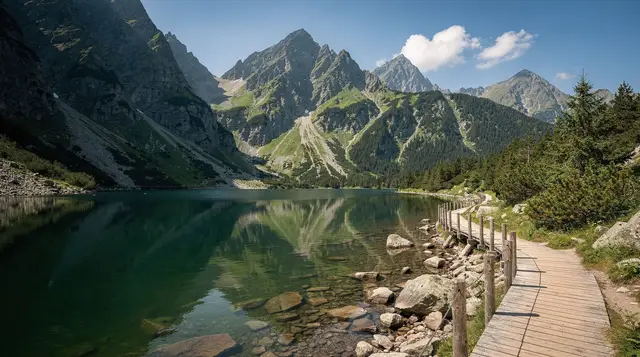
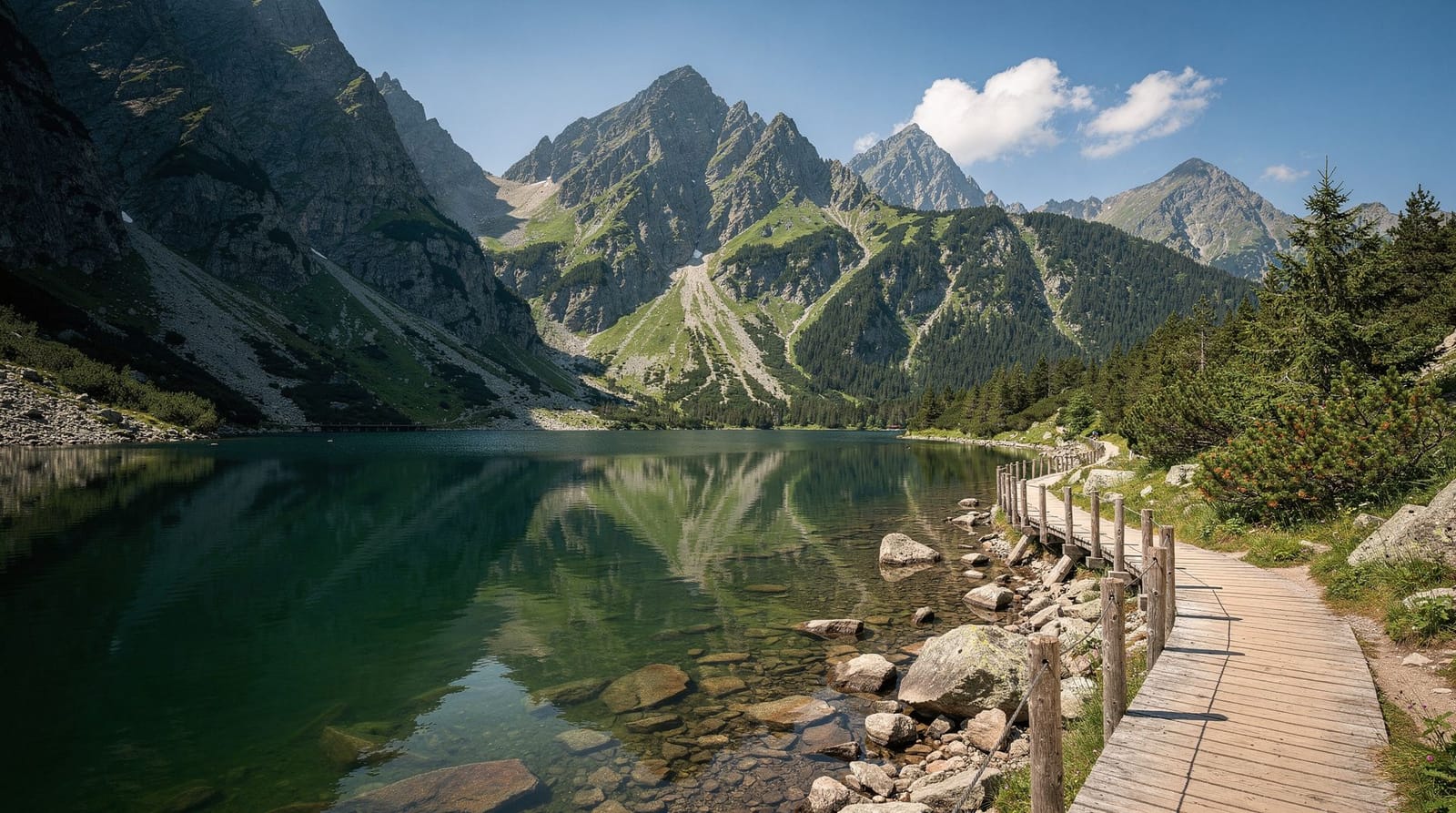
Morskie Oko — “Eye of the Sea” — is the largest and most celebrated lake in the Polish Tatra Mountains. Situated at 1395 metres above sea level in a glacially carved cirque, surrounded by the highest peaks of the Polish Tatras (including Rysy, at 2499 m, the highest point in Poland), it is one of the country’s most iconic landscapes. The water is a deep, transparent emerald-green; the surrounding walls of grey limestone and granite rise sharply above; a wooden mountain hostel (schronisko) on the shore provides coffee, hot soup, and a place to sit and absorb the setting.
The walk to reach it is neither short nor particularly difficult — 8 km each way on a wide, well-marked road through the Rybi Potok Valley, gaining 430 metres in altitude. In peak season (July–August), it can feel crowded; in spring and autumn, it offers genuine mountain solitude. Either way, it remains one of the most rewarding day trips in the Kraków region.
Distance and logistics from Kraków
The access point for Morskie Oko is the Palenica Białczańska car park, approximately 95 km south of Kraków (about 20 km southeast of Zakopane town). Realistic journey times:
- By guided tour from Kraków: Approximately 2 hours each way. The Morskie Oko lake tour in the Tatra Mountains from Kraków handles all transport, deposits you at Palenica, and waits while you complete the hike.
- By car: Approximately 2 hours from central Kraków via the DK47 from Nowy Targ to Bukowina Tatrzańska, then the mountain road to Palenica. Parking at Palenica costs 36–75 PLN depending on season and demand and must be reserved online at tpn.gov.pl/parkingi-morskie-oko. The road beyond Palenica is closed to private vehicles — you must walk or take the horse-drawn carriage.
- From Zakopane town: Local buses (zakopiańska komunikacja) run from Zakopane to the Palenica parking area, approximately 30 minutes. If combining with a Zakopane visit, this is a practical approach.
Important: You cannot drive to Morskie Oko. The road from Palenica Białczańska is restricted to the horse-drawn carriage service and walkers. This is a deliberate conservation measure by the Tatra National Park.
Tour options from Kraków
Standard lake tour
The Morskie Oko lake tour from Kraków is the most straightforward option — transport from Kraków, a guide who explains Tatra mountain ecology and history on the journey, and time at the lake. This is a guided transport option, not a guided hike — the walk itself you do independently.
Typical price: 120–150 PLN (€29–36) per person. Total day: Approximately 10–11 hours door-to-door.
Tatra Mountains and Morskie Oko hike
The Tatra Mountains and Morskie Oko hike from Kraków includes an actual hiking guide for the mountain route, not just transport. Suitable for visitors who want expert knowledge of the flora, geology, and alpine conditions along the way.
Typical price: 140–175 PLN (€33–42) per person.
Morskie Oko with thermal baths
The Morskie Oko lake tour and thermal baths visit combines the hike with an afternoon at thermal baths in the Podhale region — a popular combination for visitors who want to soak tired hiking muscles before the drive back to Kraków.
Typical price: 160–200 PLN (€38–48) per person.
Morskie Oko and Zakopane day trip
The Morskie Oko and Zakopane day trip from Kraków combines both the lake and a Zakopane town visit. A long day (11–12 hours) but doable for active visitors who want to maximise their time in the Tatras.
Typical price: 150–180 PLN (€36–43) per person.
The hike: what to expect
Route overview
Start/end point: Palenica Białczańska car park (parking area / bus stop), elevation approximately 970 metres. Destination: Morskie Oko lake shore, elevation 1395 metres. Distance: 8 km each way (16 km round trip). Elevation gain: 430 metres (gradual — the route never exceeds moderate gradient). Time: 2–2.5 hours each way for most fit adults walking at a comfortable pace. Allow 3 hours each way if you stop frequently.
The trail character
The route follows a sealed road for much of its length — wide enough for the horse-drawn carriages and emergency vehicles. It is not a wilderness trail but it is clearly mountain walking: gradual ascent through Carpathian spruce forest, increasingly dramatic rock scenery, and a final approach where the mountains close around you. In summer the route is busy; arrive before 09:00 to avoid the peak crowds.
Key points along the route
Wodogrzmoty Mickiewicza waterfall (km 3.5): Three-section waterfall visible from a small bridge. A natural stopping point.
Włosienica meadow (km 6): The forest opens onto a clearing with the first mountain views. Wooden shelter here. The final 2 km to the lake becomes more dramatic.
Morskie Oko lake (km 8): The lake occupies 34.5 hectares with a maximum depth of 50 metres. The water is fed by snowmelt and springs, and stays cold (surface temperature rarely above 10°C even in August). The hostel (PTTK Schronisko Morskie Oko) is the oldest continuously operating mountain hostel in Poland, serving żurek (sour rye soup), tea, coffee, and simple meals.
Horse-drawn carriages
For those unable or unwilling to walk the full 16 km round trip, horse-drawn carriages (bryczki) have run from Palenica to Włosienica, but a Tatra National Park pilot from 1 September 2026 shortens the route to Wodogrzmoty Mickiewicza (about 2.9 km). Check current routes and prices on tpn.gov.pl. The final stretch to the lake is on foot. The carriages are a traditional and scenic option — they are not a shortcut to the lake itself.
Optional extension: Czarny Staw (Black Lake)
Above Morskie Oko, a further 30–45 minute climb (well-marked trail, gaining about 200 metres) leads to Czarny Staw pod Rysami (Black Lake below Rysy), at 1580 metres. This smaller, darker lake beneath near-vertical rock walls is even more dramatic than Morskie Oko and receives far fewer visitors. Highly recommended for fit hikers with time.
Practical preparation
Footwear and clothing
Proper hiking shoes or boots are strongly recommended — the route is wide but the surface becomes loose stone and gravel in places, and the terrain around the lake is uneven. Trainers are marginal; flip-flops are genuinely dangerous on the upper section.
Layers are essential regardless of the season. At 1400 metres, temperatures can be 10–12°C cooler than Kraków (even in summer), and mountain weather changes rapidly. A waterproof jacket is standard kit.
In winter conditions (November–April): The route above 1000 metres can have snow and ice. Crampons are required if the path is icy — these can be rented at the start. Do not attempt the route in winter conditions without checking trail status.
What to bring
Water (at least 1.5 litres per person — there is no reliable water source on the trail), snacks or a packed lunch, sunscreen (altitude increases UV exposure), a small first aid kit for blisters.
Tatra National Park entry
The route to Morskie Oko passes through Tatra National Park (Tatrzański Park Narodowy). Entry fee: 11 PLN (€2.60) per person (5.50 PLN reduced), payable at the ticket booth near the start of the route or contactless at kiosks along the way.
Seasonal conditions
June–September: The main hiking season. July and August are the busiest months — plan to start walking by 08:00 to stay ahead of the crowds. June and September offer similar weather with fewer people.
April–May: Snow can be present above 1200 metres. The route to the lake is usually passable but conditions vary. Check the Tatras snow reports (tpn.pl) before going.
October: Autumn colours make this one of the most beautiful months for mountain hiking. Cooler temperatures, clear air, light crowds.
November–March: Snow and ice are the norm above 1000 metres. The lake is often frozen. Only for experienced winter mountain walkers with appropriate equipment. The horse carriage service does not operate. Guided tours do not run in winter.
Morskie Oko hostel
The PTTK Schronisko na Morskim Oku is a large wooden mountain hostel dating from the 1870s (rebuilt after fires, most recently after WWII). It offers:
- Hot drinks (tea, coffee): 8–15 PLN (€1.90–3.60)
- Żurek soup: 18–25 PLN (€4.30–6.00)
- Bread with cheese or sausage: 12–18 PLN
- Limited overnight accommodation (dormitory, basic rooms) — requires advance booking, very popular
- Souvenir shop
On a cold day, a hot żurek in the hostel before beginning the descent is one of the simpler pleasures of mountain travel in Poland.
Costs in PLN
| Item | Approx. cost |
|---|---|
| Guided tour from Kraków (transport + guide) | 120–175 PLN (€29–42) |
| Morskie Oko with thermal baths | 160–200 PLN (€38–48) |
| Car park at Palenica | 36–75 PLN (€8.60–17.90), reserved online |
| Horse-drawn carriage | check tpn.gov.pl |
| Tatra National Park entry | 11 PLN (€2.60) |
| Soup and drink at hostel | 18–25 PLN (€4.30–6.00) |
Frequently asked questions about the Morskie Oko hike from Kraków
How difficult is the Morskie Oko hike?
Moderate difficulty by Polish hiking standards — long (16 km round trip) but with gradual ascent on a wide path. Most fit adults with no hiking experience can complete it. The challenge is primarily distance and altitude change rather than technical terrain.
Can I visit Morskie Oko in winter?
Yes, but only for experienced winter mountain walkers. The route becomes icy and snow-covered, crampons are necessary, and conditions change rapidly. Guided tours do not operate in winter. The lake is often frozen and the surrounding cirque is spectacular in snow — but the risk level is significantly higher than summer.
Is Morskie Oko worth the long journey from Kraków?
Yes, for most visitors. The combination of a well-maintained mountain trail, dramatic alpine scenery, and an attainable destination (no technical climbing required) makes it uniquely accessible for a high-altitude mountain experience. The lake itself, framed by the grey Tatra peaks, is genuinely beautiful.
How do I get from Zakopane to Morskie Oko?
Local buses run from Zakopane bus station to Palenica Białczańska (the starting point), approximately 30 minutes, several departures per day. This is a convenient option if you are already staying in Zakopane. See the Zakopane guide for transport details.
Can children hike to Morskie Oko?
Children aged 8 and above who are used to walking can usually complete the hike. The route is wide and well-maintained. Allow more time with children and bring more food and water than you think you need. The horse-drawn carriage option for part of the route reduces the walking distance for smaller children.
Is Morskie Oko better as a self-drive trip or a guided tour?
For most visitors without a car, a guided tour is simpler and not much more expensive once you factor in fuel, parking, and the mental overhead of navigating rural roads and the Palenica car park in peak season. Self-driving gives you flexibility on timing and lets you leave earlier than most tour departures, which matters if beating the crowds is your priority — but it means 4 hours of driving on top of the hike itself.
What’s the best short extension if I have extra energy?
Czarny Staw pod Rysami, 30–45 minutes above Morskie Oko, is the clear choice — significantly fewer visitors, a darker and more dramatic setting, and a well-marked trail that doesn’t require technical skill. It’s the natural next step for anyone who reaches the main lake with energy to spare.
The geology of Morskie Oko’s cirque
The lake and its dramatic rock setting are the product of the last glacial maximum, approximately 20,000 years ago. The Tatra Mountains — the highest range of the Carpathians, straddling the Polish-Slovak border — were extensively glaciated during this period. Glaciers carved the U-shaped valleys (doliny) and the deep cirques (kotły) that give the range its character.
Morskie Oko occupies a glacial cirque — a semi-circular bowl formed by a glacier’s erosive action on three sides, creating the steep headwall and side walls visible behind the lake. The cirque is bounded by the ridges leading up to Rysy (2499 m, the highest point in Poland, accessible via a marked trail for experienced climbers from the Morskie Oko hostel) and Mięguszowieckie Szczyty.
The lake itself was formed when the glacier retreated and the cirque filled with meltwater and precipitation. Its maximum depth of 50 metres and the consistent cold temperature (surface never more than 10°C) reflect the alpine altitude and limited solar warming.
The name “Morskie Oko” — Eye of the Sea — comes from an old belief that the lake was connected underground to the Adriatic Sea. The legend held that fishermen on the Adriatic occasionally pulled up items from Morskie Oko in their nets, and vice versa. The geological reality (completely separate watersheds) is less romantic, but the name has endured.
Tatra National Park: conservation context
Tatra National Park (Tatrzański Park Narodowy) was established in 1954 and covers 21,164 hectares of the Polish Tatras. Since 1992 it has had UNESCO Biosphere Reserve status.
The park faces significant management challenges from its own popularity. Morskie Oko receives approximately 2 million visitors per year — the most visited single trail destination in Poland. The main access road from Palenica to the lake was sealed to reduce erosion from the volume of foot traffic, but this has created its own tensions: the sealed surface accelerates visitors but also concentrates them, and the lake environs have significant litter and erosion problems around the shoreline.
Park management since 2019 has trialled visitor limits on the most popular trails (including Rysy and some ridge routes), mandatory guide requirements for specific technical sections, and seasonal trail closures for habitat recovery. These measures are broadly welcomed by conservation organisations but create frustration for independent hikers planning spontaneous visits.
Respect the wilderness: The Tatra Wildlife — chamois (kozica), marmots (świstak), golden eagles, and brown bears (rare but present) — depends on the preservation of undisturbed habitat. Stay on marked trails. Do not feed wildlife. Carry out all litter (including fruit peels and food wrappers, which attract and habituate wildlife).
Above Morskie Oko: high Tatras for experienced hikers
Morskie Oko is accessible for most fit adults. The routes above it require genuine mountain experience, appropriate equipment, and good weather conditions.
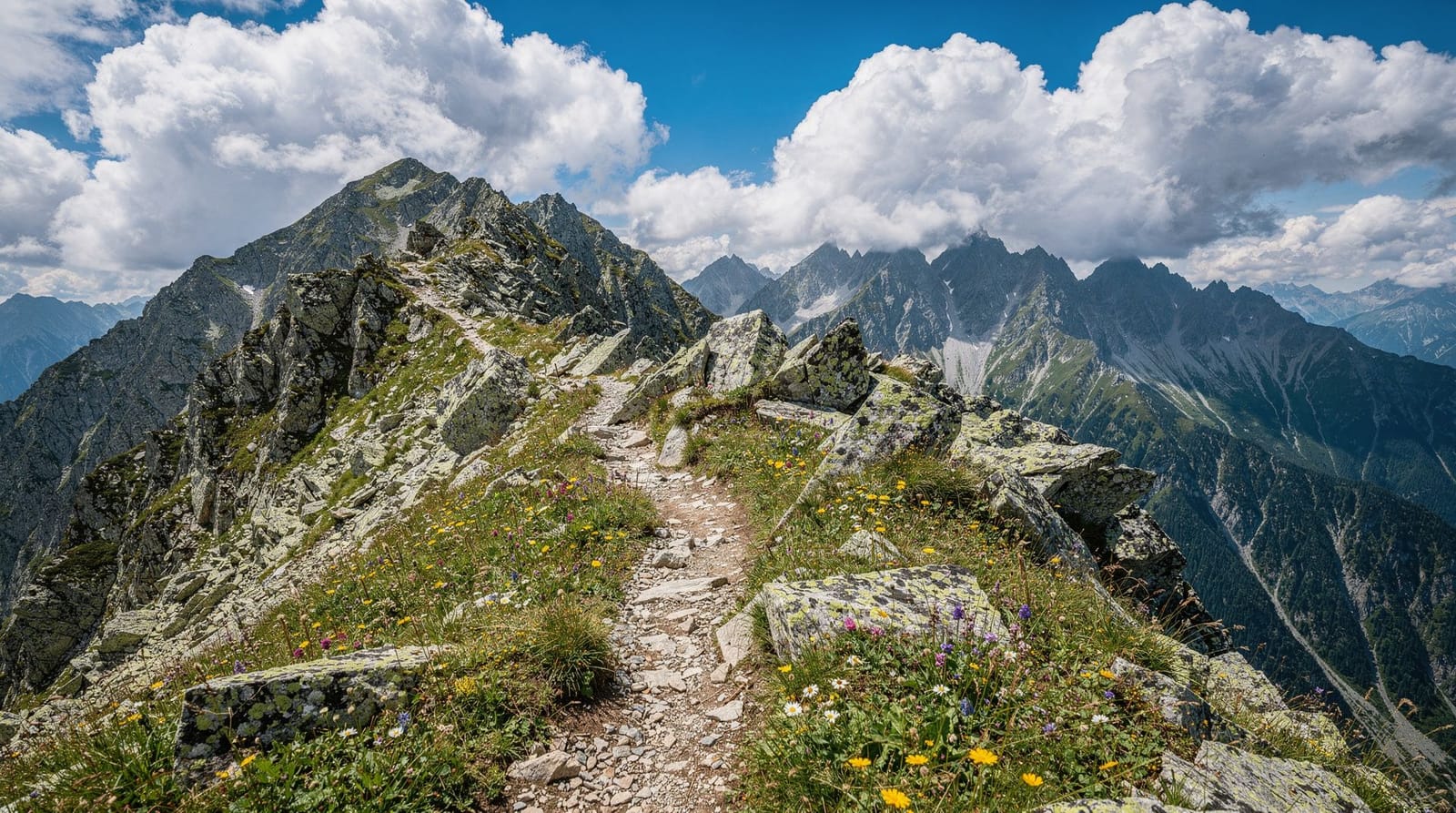
Rysy (2499 m) — the highest point in Poland: A 5–6 hour round trip from the hostel, involving a well-marked but steep and at times scrambling ascent. The final section involves fixed chains on the rock. Only for confident hikers with mountain experience. The summit offers views of the entire Polish Tatras, the Slovak High Tatras, and on clear days, the Beskids to the north. Accessible June–October; dangerous in any snow or ice conditions.
Szpiglasowa Przełęcz (2110 m): A ridge pass above Morskie Oko, with a trail leading into the Dolina Pięciu Stawów Polskich (Valley of the Five Polish Lakes) — one of the wildest and most beautiful valleys in the Tatras. A classic 2-day route for experienced mountain walkers, with overnight at the Schronisko Pięciu Stawów Polskich hut.
Czarny Staw pod Rysami (1580 m): The more accessible extension above Morskie Oko — 45 minutes of steady climbing on a well-marked trail. Significantly fewer visitors than the lake below. A deep, dark lake in an enclosed cirque beneath the Rysy massif. Highly recommended for those with the time and energy.
Wildlife at Morskie Oko
The most commonly encountered large wildlife on the route:
Marmots (świstaki): Ground-dwelling squirrel relatives that inhabit rocky slopes above 1500 metres. They emit sharp warning whistles when disturbed. Often seen near the Czarny Staw approach trail. Do not feed them — a fed marmot loses its natural food-finding behaviour and struggles to survive winter.
Chamois (kozice): The Tatra chamois is a subspecies found only in the Tatras. They inhabit the rocky terrain above the treeline; you may spot them on the slopes above Morskie Oko or on the approach to Czarny Staw. Excellent eyesight — they will see you long before you see them.
Eagles and raptors: Golden eagles nest in the Tatras; their territory ranges widely and sightings from the ridge trails are occasional. Kestrels are more common around the lower valley sections.
Brown bears: Present in the Polish Tatras at low densities. Encounters are rare but not unknown on remote trails. Standard bear precautions apply: make noise, do not hike alone at dawn/dusk, store food correctly at hut overnight stops.
Photography notes for the lake
The classic reflection shot — peaks mirrored perfectly in still water — depends almost entirely on wind conditions, not just light. Early morning (before 9 AM) is best not only for crowds but because Tatra winds typically pick up through the day, breaking the water’s surface by late morning. The north shore near the hostel is the standard viewpoint and the most crowded; walking a third of the way around the lake circuit toward the western shore gets you a similar angle with noticeably fewer people in frame. A polarising filter cuts glare on the water and deepens the emerald colour that gives the lake its reputation. In autumn, the forest below the treeline turns gold and rust, giving the approach walk itself more photographic interest than in high summer, when everything is uniformly green.
Pairing the hike with a wider Tatras day
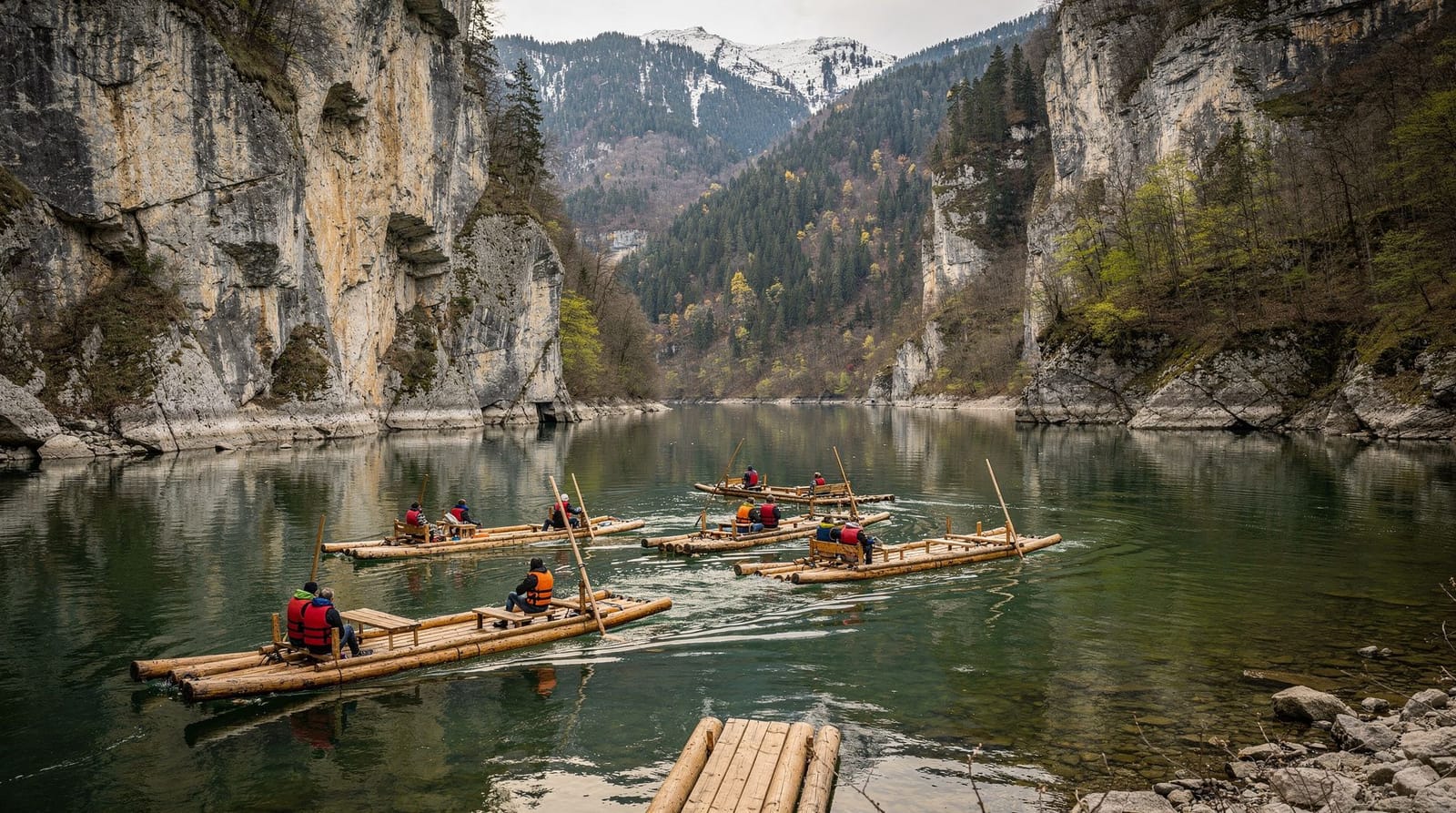
Most visitors don’t do Morskie Oko in isolation — it pairs naturally with other Tatra experiences depending on your energy afterward. If your legs are done after the 16 km round trip, a soak is the obvious finish; the thermal-baths tour option above handles that directly. For a very different day-trip flavour that doesn’t involve hiking at all, the Dunajec River rafting day trip covers the gentler, boat-based way to see the mountains. If you’re staying over in the region rather than doing a single day trip from Kraków, Zakopane makes a natural base — closer to Palenica than Kraków is, and useful if you want an early start without the 2-hour drive first. For a broader framework of how this fits a multi-day Kraków trip, the Kraków 3-day itinerary shows where a Tatras day slots in alongside the city’s other essentials.
Related guides
- Morskie Oko destination guide
- Zakopane from Kraków
- Tatra Mountains guide
- Dunajec River rafting day trip
- Day trips from Kraków
- Active things to do in the Kraków region
- Kraków 3-day itinerary
Top experiences
Bookable activities with verified prices and instant confirmation on GetYourGuide.