Dunajec River rafting day trip from Kraków: Pieniny gorge guide
From Krakow: Dunajec River rafting
How do I do Dunajec River rafting from Kraków?
The Dunajec raft landing at Sromowce Niżne (Kąty) is about 120 km south of Kraków, roughly 2 hours by road. Traditional wooden-raft trips run from April to October and take 2–2.5 hours on the water through the Pieniny gorge. Guided day tours from Kraków are the most convenient option (130–160 PLN all-in); independent visitors can drive or take a combination of trains and local buses to reach the landing point.
The Dunajec gorge: rafting through a Polish-Slovak border canyon
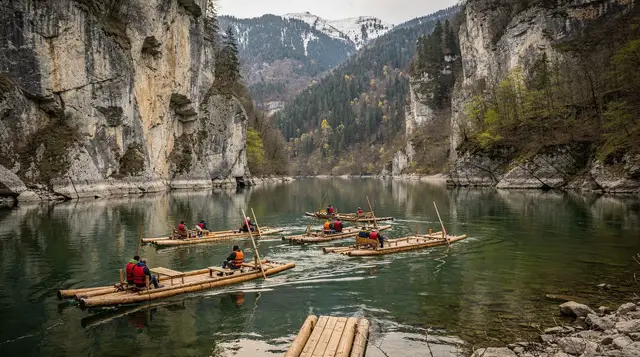
The Pieniny Mountains form one of Poland’s most dramatic limestone landscapes — a compact range of white rock peaks rising sharply from the valley floor along the Polish-Slovak border. Through the heart of this landscape, the Dunajec River carves a serpentine gorge of extraordinary beauty: sheer limestone cliffs towering 300–350 metres above the river, forested slopes, and a river that alternates between calm glides and faster riffles.
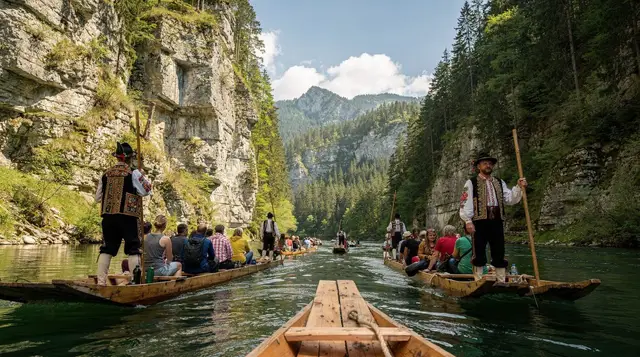
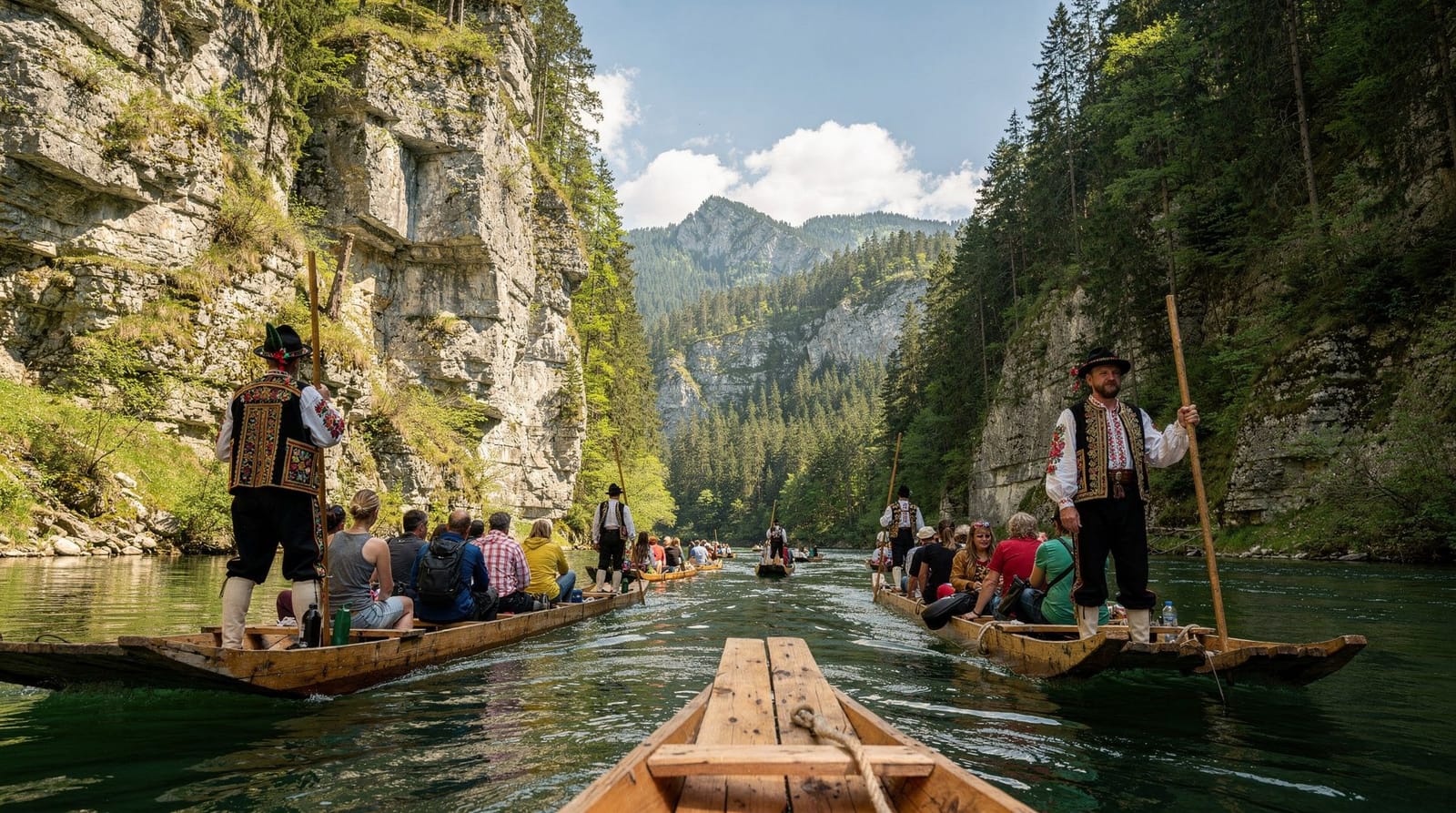
The traditional way to experience the Dunajec Gorge is on a wooden raft (flisacka tratwa), poled by two rafters in traditional Podhale dress. This is not whitewater kayaking — it is a leisurely, scenic journey through one of Central Europe’s finest river gorges. The tradition of Pieniny rafting dates to the 17th century; it became popular as a tourist attraction from the mid-19th century and has run continuously, weather permitting, every year since.
A Dunajec rafting trip from Kraków is one of the most distinctive day trips available from the city — combining mountain scenery, river travel, and a genuinely rooted local tradition.
| Where | Sromowce Niżne landing, ~120–130 km south of Kraków |
| Cost | around 130–170 PLN guided; raft-only price set each season (check the rafters’ official website) |
| Time needed | 9–10 hours door-to-door (2–2.5 hrs on the water) |
| Getting there | Guided minibus (easiest) or car via Nowy Targ |
| Best time | June, July, September; season runs April–October |
Distance and transport from Kraków
The main rafting departure point is at Sromowce Niżne (landing area “Kąty”), approximately 120–130 km south of Kraków. The trip ends at Szczawnica, a small spa town, about 18 km downriver.
- By guided tour from Kraków: The most practical option. Most tours take about 2 hours to reach the departure point and include return transport from Szczawnica to Kraków. The Dunajec River rafting day trip from Kraków covers all logistics.
- By car: Approximately 2 hours via Nowy Targ and Krościenko nad Dunajcem. Park at the landing point (small fee). After the raft trip, you need to arrange return to your car — either by taxi from Szczawnica (~15 km, approximately 30–40 PLN) or by taking the return mini-bus service that many operators offer.
- By train/bus combination: Kraków to Nowy Targ by train (1h45), then local bus to Sromowce or Krościenko. Feasible but involves multiple connections and is only practical if you enjoy independent logistics.
The rafting itself takes about two hours, which leaves half a day loose: a Dunajec rafting trip that adds Zakopane town fills it rather than returning early to Kraków.
Tour options from Kraków
Standard rafting day trip
The Dunajec River rafting day trip from Kraków is the straightforward option — return transport from Kraków, the full 18 km raft journey through the gorge, and time in Szczawnica at the end. A guide is on the minibus but not on the raft itself (your raftsmen/women are the guides on the water).
Typical price: 130–160 PLN (€31–38) per person. Duration: 9–10 hours door-to-door.
Rafting with gorge tour guide
The Dunajec River Gorge rafting tour from Kraków adds a dedicated guide who explains the gorge geology, the history of Pieniny rafting, and the Polish-Slovak border context. Good for visitors who want more than a scenic float.
Typical price: 140–170 PLN (€33–40) per person.
Dunajec rafting with wooden raft emphasis
The Dunajec River Gorge wooden raft river cruise specifically emphasises the traditional craft — the hand-built pine log rafts, the traditional dress of the rafters (brightly embroidered waistcoat, felt hat with shells), and the historical context of the flisak (raftsman) tradition.
Typical price: 130–155 PLN (€31–37) per person.
Rafting and Zakopane combination
The Dunajec River Gorge and Zakopane full-day trip from Kraków combines both the gorge raft trip and a visit to Zakopane in one long day. Possible, but a full 11–12 hours. Only worth doing if you have a single free day and want to cover both highlights.
Typical price: 170–200 PLN (€40–48) per person.
What the rafting experience is like
The raft
Traditional Dunajec rafts are constructed from five or six pine log sections lashed together — flat-bottomed, slightly curved at the bow, no motor. Two rafters stand at either end, steering with long wooden poles. The raft carries up to 12 passengers who sit on wooden benches.
Despite appearances, the construction is stable and river-tested over centuries. You will not get significantly wet under normal conditions (light spray is possible in faster sections). It is not an adrenaline experience but a scenic one.
The 18 km route
The route begins at Sromowce Niżne (Kąty landing) and ends at Szczawnica. The full journey takes 2–2.5 hours on the water. Key moments:
- Sokolica Peak views: The white limestone peak of Sokolica (747 m) rises dramatically above the first major bend in the gorge. This is the iconic view, reproduced in postcards for 150 years.
- Three Crowns (Trzy Korony) massif: The highest and most recognisable formation of the Polish Pieniny, a triple-peaked limestone ridge visible from the river.
- Slovak bank: The right bank of the Dunajec is Slovak territory throughout the gorge. You can see the Slovak village of Červený Kláštor (Red Monastery) on the opposite bank.
- Limestone cliffs: At their most dramatic in the middle section of the gorge, where the river winds in tight S-bends between near-vertical rock faces.
- Wildlife: Cormorants, herons, and dippers are commonly seen. If you are lucky, you may spot a peregrine falcon on the cliff faces.
Szczawnica arrival
The raft journey ends in Szczawnica, a pleasant small spa town with a 19th-century character. Allow 30–60 minutes after the raft to explore the main promenade, try the mineral spring water (several springs are freely accessible), or eat at one of the restaurants before the coach returns to Kraków.
Season and conditions
Season: April to October, weather permitting. The busiest period is June–August.
High water: After heavy rain or spring snowmelt, the river can run too high for rafting and the service is suspended. April and May carry a higher risk of high-water cancellations than summer. Most tour operators provide weather cancellation policies — check before booking.
Best months: June, July, and September offer the best combination of reliable water levels, warm weather, and (for September) slightly reduced crowds.
Winter: The rafting service does not operate from November through March. The gorge is beautiful in winter but only accessible on foot via the Pieniny hiking trails.
Combining with a hike in the Pieniny
If you drive independently or have extra time, the Pieniny National Park offers excellent hiking above the gorge. The most popular route:
Three Crowns (Trzy Korony): From Krościenko nad Dunajcem, a 2–3 hour round trip to the summit at 982 metres. The views down into the gorge and across to the Tatras are excellent. Moderately strenuous; proper footwear required.
Sokolica: A shorter ascent (about 1.5 hours return) to 747 metres, with arguably the best view of the gorge’s most dramatic bend.
A Tatra National Park entry ticket (11 PLN, 5.50 PLN reduced) is not required for Pieniny National Park; Pieniny charges 8 PLN (4 PLN reduced) for the Dunajec gorge water route from 1 April to 31 October, and no entry fee for the park itself.
Practical details
What to wear: Comfortable clothes you do not mind getting slightly damp. Layers are advisable — the gorge can be cooler than the valley in the morning. Waterproof jacket if weather is uncertain. Secure shoes (no flip-flops — the raft loading point can be muddy). Sunscreen for the exposed riverside sections.
What to bring: Camera (the gorge is consistently photogenic), water, a light snack, cash for Szczawnica refreshments.
Photography: Some of the best shots come from the bends where the limestone cliffs tower overhead. Ask your raftsperson to signal the best viewpoints.
Costs in PLN
| Item | Approx. cost |
|---|---|
| Guided day trip from Kraków (rafting) | 130–170 PLN (€31–40) |
| Rafting and Zakopane combo tour | 170–200 PLN (€40–48) |
| Raft ticket only (if arriving independently) | Set each season; check the rafters’ official website |
| Pieniny National Park, Dunajec water route fee | 8 PLN (€1.90) per person (4 PLN reduced) |
| Meal in Szczawnica | 30–55 PLN (€7–13) per main |
Frequently asked questions about Dunajec River rafting from Kraków
Is Dunajec rafting suitable for children?
Yes — the traditional wooden rafts are stable and the journey is gentle. Children love the experience. There is no minimum age, though very small children should be kept seated and supervised. Rafting is a very popular family activity in Poland.
Is Dunajec rafting dangerous?
Under normal conditions, no. The current is gentle and the rafts are designed for safety. The main risk is high water after heavy rainfall, at which point operators suspend the service. Standard life jackets are available but not compulsory on the traditional raft service (they are offered to those who want them).
How far is the Dunajec from Kraków?
About 120–130 km south of Kraków, approximately 2 hours by road. It is one of the more distant day trips from the city — the journey time is worth it, but do not underestimate the total day length (9–10 hours including transport).
Can I do Dunajec rafting and Zakopane in one day?
Yes, combination tours exist for this. It makes for a long day (11–12 hours) but it is manageable. The rafting typically runs first in the morning, with Zakopane in the afternoon, or vice versa depending on the tour. Not ideal if you want to hike seriously in Zakopane or spend real time on the raft.
What happens if it rains?
A light rain does not cancel the rafting — you get the gorge to yourself in dramatic lighting. Heavy rain or flood-level water does cause cancellations. Most tour operators have cancellation or rescheduling policies for weather-related stoppages. Always check the policy when booking.
Is the Dunajec raft trip better than the Slovakia Treetop Walk?
They serve different moods rather than one being objectively better. Dunajec rafting is a low-effort, scenic day suited to families and anyone who prefers sitting and looking rather than walking; the Slovakia Treetop Walk is more physically active, with elevated platforms and a stronger adventure-park feel. If you only have time for one gorge day trip and value a genuine local tradition over a built attraction, Dunajec edges ahead.
The Pieniny Mountains: what they are
The Pieniny (pronounced “pye-NEE-nee”) are a small but distinctive mountain range that straddles the Polish-Slovak border in the area between Zakopane and Nowy Sącz. They are geologically separate from the main Tatra range — older limestone rather than granite and schist — and form a compact cluster of white rock peaks that rise sharply from the Dunajec River valley.
The highest point on the Polish side is Trzy Korony (Three Crowns, 982 m), a massif with three separate rocky summits visible from most of the rafting route. The Slovak side of the border is marked by the village of Červený Kláštor (Red Monastery), a 14th-century Carthusian monastery whose distinctive red-roofed buildings are visible from the river.
The Pieniny National Park (Polish side) was established in 1932, making it one of Poland’s oldest protected areas. It covers only 23.5 sq km on the Polish side but has exceptionally high biodiversity — the combination of limestone substrate, sheltered valley, and varying altitude creates many distinct microhabitats. The park contains over 1,000 species of vascular plants (including several found nowhere else in Poland), over 700 species of butterfly and moth, and over 150 bird species.
The history of Dunajec rafting
The Dunajec flisacy (raftsmen) have been transporting goods and people on the river since at least the 17th century. The wooden rafts were originally working craft — carrying timber, stone, and produce from the highland interior to markets downriver. When the Galician aristocracy began visiting the Pieniny as a fashionable resort in the 1820s–1830s, the raftsmen began offering passenger services.
The first formally organised tourist rafting service was established in 1832 by the Pieniny Raftsmen’s Company (Stowarzyszenie Flisacy Pienińscy), making it one of the oldest continuously operating tourist services in Central Europe. The company survives today, operating out of the Sromowce Niżne landing point with fleets of traditionally constructed rafts.
The traditional dress worn by raftsmen — the white felt trousers (spodnie z białego sukna), embroidered waistcoat, wide leather belt, and felt hat decorated with cowrie shells — is the costume of the Podhale highlander (góral), slightly different from the Kraków-area traditional dress. Modern raftsmen wear this costume as part of the service, maintaining a visual tradition that dates back over a century.
Szczawnica: the arrival town
The town of Szczawnica, where the raft journey ends, is worth 30–60 minutes of exploration before the return coach to Kraków. It is a small spa town with a 19th-century character, established around its mineral springs in the 1830s–1850s.
The mineral springs: Szczawnica has several naturally carbonated mineral springs (żeleźniak, siarczysty) with distinctly different mineral profiles. They are freely accessible at the spa pavilions on the main promenade. Locals drink them for digestive health; tourists drink them for the experience of tasting naturally effervescent water directly from a spring. The water is distinctly mineral-tasting — acidic, slightly metallic — and an acquired taste. Try the “Siarczysty” spring for the most dramatic flavour.
The promenade (Deptak): The tree-lined pedestrian promenade running through the spa complex dates from the 1840s and is well-preserved in its 19th-century character. The Zakład Przyrodoleczniczy (hydrotherapy centre, still operating) and several historicist villas line the route.
Eating in Szczawnica: Several cafés and restaurants on the promenade, priced at a slight tourist premium. Oscypek cheese and other Podhale specialities are sold at roadside stalls. A quick lunch or coffee here before the bus back to Kraków is a pleasant way to close the day.
Rafting etiquette and tips
A few things that will make the experience better for you and your fellow passengers:
- Sit down and stay seated. The raftsmen will tell you this, but it bears emphasis — standing on a moving raft is genuinely dangerous.
- Keep belongings secure. Waterproof bags or dry pouches are advisable for phones, cameras, and anything you cannot afford to get wet. Light spray is possible in faster sections.
- Tip your raftsmen. The traditional wooden raft service is maintained by a workforce that takes genuine pride in the tradition. A 20–40 PLN (€5–10) tip shared between the two raftsmen per boat is appropriate and appreciated.
- Photography early. The best scenery is in the middle section of the gorge. Take your photos when the cliffs are dramatic; by the time you reach Szczawnica, the valley has widened and the drama reduced.
- Arrive on time. Your tour operator’s coach will not wait; the raft departure times are scheduled.
Dunajec rafting vs the Slovakia Treetop Walk
Both are river-gorge day trips from Kraków that pair mountain scenery with a distinctive activity, and both are frequently cross-shopped by visitors deciding between a calmer or more active outdoor day.
| Dunajec rafting | Slovakia Treetop Walk | |
|---|---|---|
| Activity level | Low — seated, scenic | Moderate — walking, elevated platforms |
| Distance from Kraków | ~120–130 km | ~110 km |
| Typical price | 130–170 PLN | 130–165 PLN |
| Best for | Families, relaxed scenery | Active travellers, treetop views |
| Season | April–October | Year-round (weather dependent) |
For a full breakdown of the treetop route, see the Slovakia Treetop Walk day trip guide. Travellers who cannot decide often default to Dunajec for its stronger cultural and historical dimension — the raftsmen’s tradition is unique to this river.
Slovakia Treetop Walk day trip from KrakówRelated guides
- Dunajec Gorge destination
- Zakopane from Kraków guide
- Morskie Oko hike from Kraków
- Tatra Mountains
- Day trips from Kraków
- Active things to do in Kraków region
- Kraków 3-day itinerary
Top experiences
Bookable activities with verified prices and instant confirmation on GetYourGuide.