Dunajec Gorge: traditional raft rafting through the Pieniny
Traditional wooden-raft rafting through the Pieniny limestone gorge, 2 hours from Kraków. Steered by góral boatmen, season runs April–October.
From Krakow: Dunajec River rafting
Quick facts
- Distance from Kraków
- ~120 km south-east (about 2 hours)
- Rafting season
- April–October (May–September ideal)
- Raft route
- Sromowce Niżne to Szczawnica: ~18 km, about 2–2.5 hours
- Traditional rafts
- Wooden dugouts lashed together, steered by góral boatmen
- Cost
- Check current prices on the official rafting association website
River rafting through limestone cliffs
The Dunajec River forms the border between Poland and Slovakia for much of its course through the Pieniny Mountains, and for about 18 of those kilometres it has carved one of the most beautiful gorges in Central Europe. The rafting route from Sromowce Niżne to Szczawnica passes beneath 300-metre limestone cliffs, through narrow bends where the river slows to a glide and the forested slopes press in on both sides, and past the ruined castle of Czorsztyn before widening into the broad Szczawnica valley.
| Where | Sromowce Niżne to Szczawnica, ~120 km south-east of Kraków |
| Cost | Raft prices vary by season (check the official rafting association website); 200–350 PLN with transport from Kraków |
| Time needed | 2–2.5 hours on the water; a full day if combined with Zakopane |
| Getting there | Car via Nowy Targ, or an organised tour (most convenient) |
| Best time | May–September; April and October possible but cooler and weather-dependent |
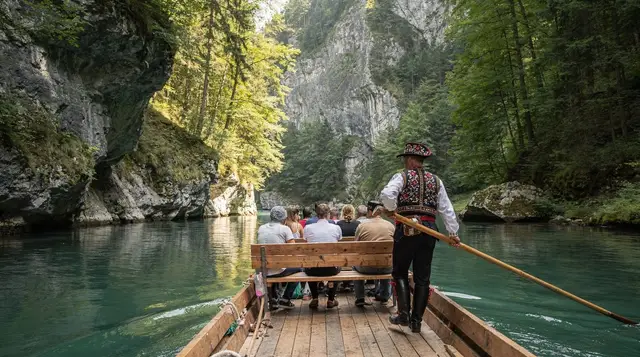
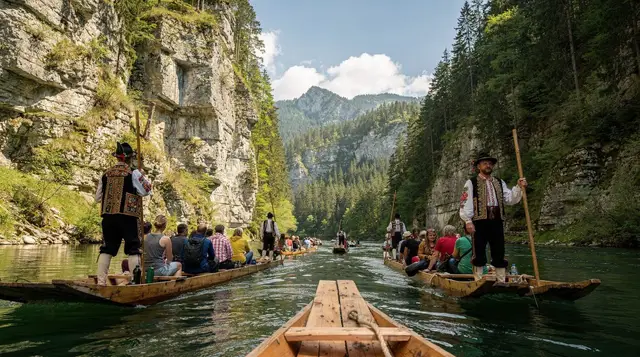
The experience is distinctive because of the traditional transport: wooden dugout rafts lashed together in sets of two, steered by góral (highlander) boatmen wearing traditional black-felt felt hats, white loden trousers with black trim, and leather moccasins. They use wooden poles to navigate the current rather than paddles. The technique has been used on this river for centuries, and watching a boatman navigate a tight bend by reading the water is genuinely impressive.
This is not white-water rafting — the Dunajec is generally calm and the experience is closer to a scenic river cruise than an adventure sport. Families with young children, older travellers, and anyone who wants dramatic mountain scenery without physical exertion will enjoy it. That said, it is a mountain river and conditions vary: spring snowmelt (April–May) can raise water levels and the current, while late summer (August–September) sometimes drops the level enough to require occasional wading.
The route: Sromowce Niżne to Szczawnica
The standard route starts at the Flisacy raft station at Sromowce Niżne (also called Kąty) on the Polish bank, opposite the Slovak village of Červený Kláštor. The Carthusian monastery at Červený Kláštor — visible across the river in Slovakia — dates to the fourteenth century and is one of the best-preserved medieval monastery complexes in Slovakia. It is worth a brief stop if you have time.
The raft journey takes approximately 2 to 2.5 hours for the 18 km route. Highlights along the way:
- The Three Crowns massif (Trzy Korony) — three limestone peaks rising 982 metres, the most iconic silhouette of the Pieniny. A trail from Sromowce leads to the summit; allow 2–3 hours round trip if you want to hike it before the raft.
- The Sokolica cliff — a sheer limestone wall rising directly from the river’s edge.
- The ruins of Czorsztyn Castle and Niedzica Castle — two medieval fortresses facing each other across the Czorsztyn Reservoir, a short detour from the main river route.
- The narrowest section of the gorge, where the cliffs close to within a few dozen metres and the river is forced into a series of bends.
The route ends in Szczawnica, a small spa town at the junction of the Grajcarek stream and the Dunajec. Szczawnica has several mineral springs, a pleasant promenade, and good restaurants. Return to the starting point is by bus (included in most organised tours) or by taking the tourist railway from Szczawnica to Krościenko and then by road.
Dunajec River rafting from Kraków — guided excursionPractical logistics
From Kraków: The Dunajec Gorge is about 120 km south-east of Kraków, in the Pieniny Mountains between the main Tatra range to the south-west and the Beskid Sądecki hills to the north-east. By car, the journey takes approximately 2 hours via Nowy Targ. The raft departure point at Sromowce Niżne is accessible by road; parking is available (small fee in season).
By public transport, reach Nowy Targ by PKS bus from Kraków (about 1.5 hours), then a connecting minibus to Sromowce Niżne or Szczawnica. This is doable but complex; most visitors use an organised tour.
Organised day trip: By far the most convenient approach. Most tour operators combine the Dunajec raft with a morning stop in Zakopane, making for a logical and satisfying full day — highlands culture and mountain scenery in the morning, river scenery in the afternoon.
Dunajec River Gorge and Zakopane combined day trip from KrakówCombined tours: Dunajec plus Zakopane
The most popular combination is Zakopane in the morning, Dunajec rafting in the afternoon. This works geographically because Zakopane is about 40 km west of Sromowce Niżne — a 50-minute drive. Typical schedule:
- 07:30 — Depart Kraków
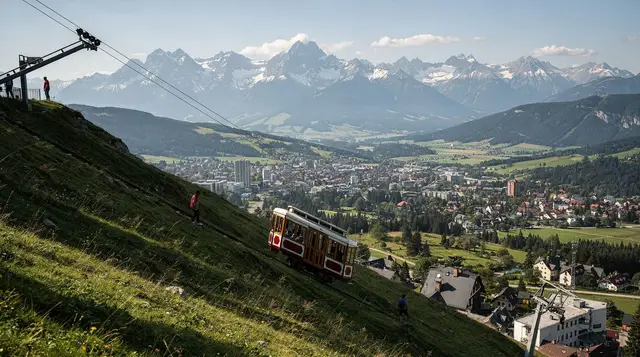
- 09:30 — Arrive Zakopane; Gubałówka funicular, Krupówki, oscypek lunch
- 13:30 — Drive to Sromowce Niżne
- 14:30 — Raft departure
- 17:00 — Arrive Szczawnica; bus back to Sromowce or tour vehicle
- 19:30–20:00 — Return to Kraków
It is a long day (12 hours) but extraordinarily varied, moving from highland town to mountain views to river gorge in a single excursion. Most participants rate it among the best days of their Poland trip.
Dunajec rafting with a treetop walk
An alternative combination adds the Slovakia Treetop Walk at Bachledka — a suspended walkway through the forest canopy on the Slovak side of the Tatras, with views across the Pieniny and Tatra ranges. The treetop walk is a 45-minute experience and pairs naturally with the Dunajec raft geographically.
Dunajec rafting and Slovakia Treetop Walk — combined tour from KrakówSeason and weather considerations
| Month | Conditions | Crowds |
|---|---|---|
| April | Season opens; high water from snowmelt, faster current; mornings 5–10°C | Very quiet |
| May–June | Ideal conditions; water levels normalise, wildflowers on the cliffs | Building from mid-May |
| July–August | Warmest weather, 25–30°C | Peak season — book ahead |
| September | Excellent; crowds drop, autumn colour begins late in the month | Quiet, comfortable |
| October | Season closes by end of month; unpredictable weather, water may be low | Very quiet, check conditions first |
April: The raft service opens for the season. Water levels are high from snowmelt; the current is faster than in summer. Mornings can be cold (5–10 °C); bring a jacket. The gorge is spectacularly quiet — very few tourists.
May–June: Ideal conditions. Water levels normalise, temperature is comfortable, wildflowers are out on the cliffs above the river. The tourist season builds from mid-May.
July–August: Peak season. Warmest weather (25–30 °C), busiest crowds, most departures. Rafts can be full; book ahead for popular tour operators.
September: Excellent. Crowds drop, autumn colours begin on the upper slopes by late September, temperatures are still comfortable for the river. One of the best months.
October: The season closes by the end of October; some operators stop in mid-October. Weather is unpredictable. Water may be low. Worth checking current conditions before booking.
For the fuller picture of what a Dunajec day includes, the Dunajec Gorge rafting guide and Dunajec river rafting day trip guide both cover route variations and operator differences in more depth, and the Pieniny and Dunajec Gorge guide puts the rafting in the context of the wider national park.
What to bring
- Waterproof jacket even in summer — the boatmen’s poles create some spray in faster sections, and the gorge creates a wind-tunnel effect that amplifies the chill.
- Sun protection — you are sitting in open boats for 2+ hours, often in direct sunlight.
- Cash — the raft departure point has a small snack stall; some operators accept only cash.
- Comfortable shoes — you will walk a short distance between the tour vehicle and the raft launch point; the terrain is easy but can be wet.
- Camera or phone in a waterproof case — the gorge views are outstanding and the raft ride creates some gentle spray.
Niedzica Castle
If your tour route passes near Czorsztyn Reservoir, the Niedzica Castle (Zamek Dunajec) on the Polish bank is worth a short detour. The fourteenth-century fortress sits on a rocky promontory above the reservoir, with excellent views of the water, the Pieniny, and the Tatra range to the south-west. The castle houses a small museum. Check current prices and opening days on the castle’s official website.
The Pieniny National Park
The rafting route runs through the Pieniny National Park (Pieniński Park Narodowy), established in 1932 as one of Poland’s oldest protected areas. The park covers only 23.5 km² — even smaller than Ojców National Park — but its combination of dramatic limestone terrain and river scenery makes it punching well above its weight. Hiking trails climb from the valley to the Three Crowns massif and along the ridge; the 4-hour circuit from Krościenko is the most popular route.
Planning the gorge into a longer Kraków trip
The gorge works best as one day among several rather than the whole point of a journey. If you are still deciding how to spread your time, the Kraków itinerary planning guide and the best day trips from Kraków show where a river day fits next to the salt mines, Auschwitz and the mountains. The Kraków and Zakopane 5-day itinerary builds the Dunajec into a wider highlands loop, which suits travellers who would rather not rush the road in a single day.
Travelling with children is straightforward here, since the float is calm and seated. The Kraków with kids guide and the family-friendly day trips put the raft in context with other outings that work for mixed ages. If you enjoy being outdoors more generally, the nature near Kraków guide lists other green escapes, and the best time to visit Kraków helps you judge whether your travel dates line up with the raft season.
Pairing the gorge with the wider Tatras
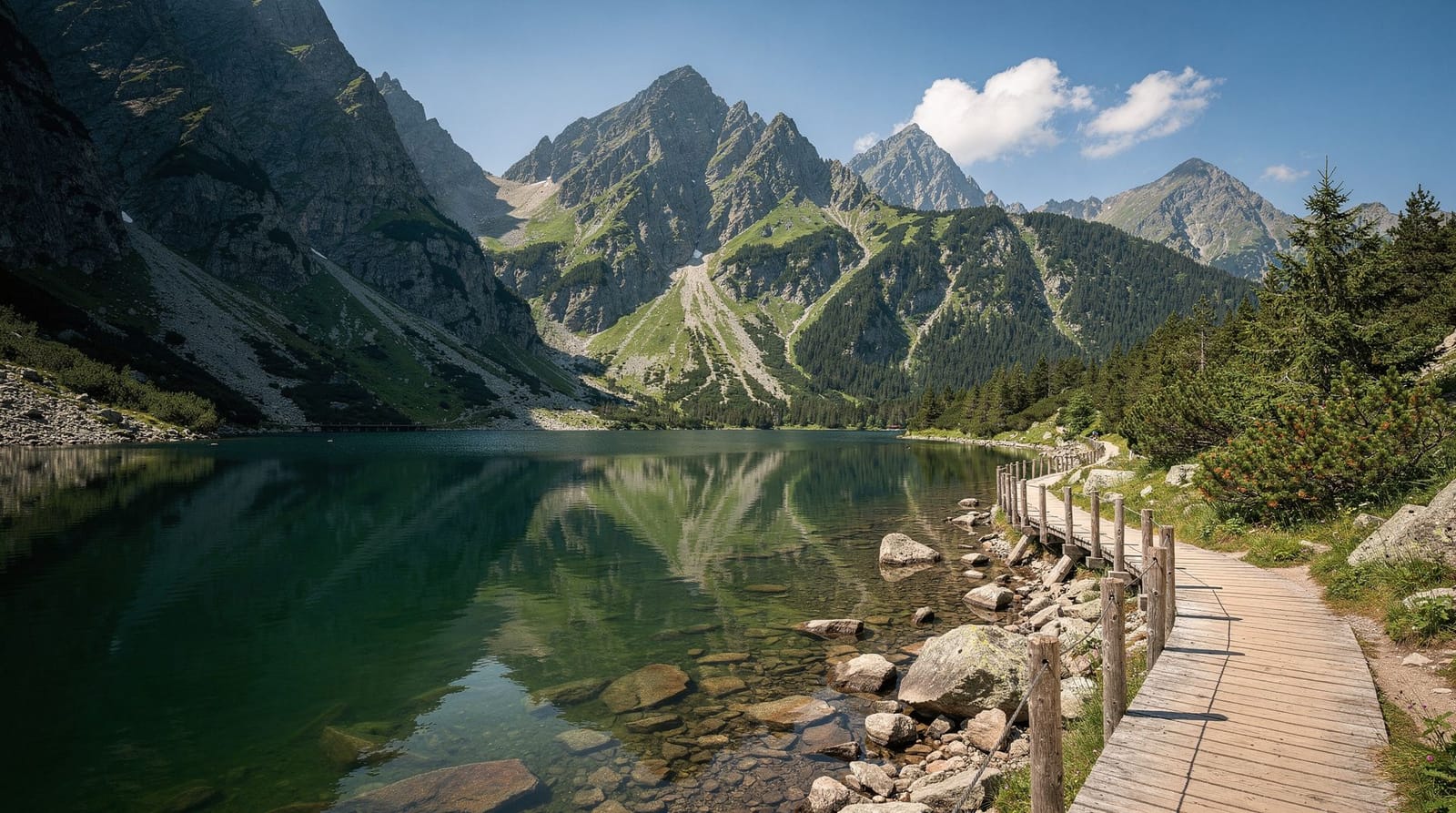
If you have more than a day in the region, the Dunajec Gorge sits naturally alongside two other highlights: Zakopane, the highland capital about 40 km west, and the Tatra Mountains themselves, with trailheads reachable from Zakopane. Hikers chasing the region’s most photographed lake often add Morskie Oko as a separate full day, since it does not combine comfortably with rafting in a single itinerary. The Zakopane from Kraków guide and Tatra Mountains day trip guide both help with planning a multi-day highlands trip that includes the gorge.
Frequently asked questions about the Dunajec Gorge
Is Dunajec rafting suitable for children and non-swimmers?
Yes. The rafts are wide, stable wooden platforms with wooden benches, and the Dunajec is not white-water — the current is calm for most of the route. Life jackets are provided. Children from about 3 years old can participate safely; there is no minimum age. The experience is entirely suitable for families.
When does the rafting season run?
The raft service typically runs from April to October, with the peak season from May to September. Some operators close in mid-October when water levels drop too low. Always confirm with your tour operator before booking in April or October.
How much does the Dunajec raft trip cost?
The raft trip itself (without transport from Kraków) costs a seasonal per-adult fare; check the official rafting association website for current prices. Organised tours from Kraków including transport, guide, and raft ticket cost approximately 200–350 PLN (~48–83 €) per person depending on whether Zakopane is included.
Can I do the Dunajec Gorge independently without a tour?
Yes, but it requires some planning. Drive to Sromowce Niżne, purchase tickets at the Flisacy raft station, raft to Szczawnica, and take the bus back to your car. The main challenge is reaching Sromowce without a car — public transport connections from Kraków are indirect and infrequent. For most visitors, an organised tour is significantly more convenient.
Top experiences
Bookable activities with verified prices and instant confirmation on GetYourGuide.