Traditional Polish dishes in Kraków: what to eat and where
Krakow: guided Polish food and culture tour with tastings
Duration: 3h
What are the must-try traditional Polish dishes in Kraków?
Start with żurek (sour rye soup), pierogi ruskie (potato-cheese dumplings) and bigos (hunter's stew). Then try gołąbki (stuffed cabbage), kotlet schabowy (breaded pork) and oscypek (smoked sheep's cheese). Milk bars are the best places to try multiple dishes cheaply — a full meal costs 20–35 PLN (≈ €5–8).
Polish cuisine: Central European, hearty, and underrated
Polish cuisine is the product of a cold climate, agricultural abundance and centuries of foreign influence — Germanic, Jewish, Ukrainian and Ottoman. It is a cuisine of preservation (fermentation, smoking, pickling), of hearty carbohydrates against winter, and of unexpected elegance in the details. In Kraków, you eat it at its best.
The city sits at the intersection of several distinct food traditions: the urban Central European cooking of the royal capital, the Jewish culinary heritage of Kazimierz, and the highland Góral (mountain shepherd) food of the Tatras to the south. This guide covers the essential dishes you will encounter — what they are, what to expect, and where to eat them well without overpaying.
| Where | milk bars (cheapest), gospodas, and modern Polish restaurants city-wide |
| Cost | around 20–35 PLN for a full milk-bar meal; 80–180 PLN per main at modern Polish restaurants |
| Time needed | 30 minutes (milk bar) to 2 hours (multi-course dinner) |
| Payment | milk bars are often cash-only; carry PLN |
| Best time | lunch (12:00–15:00) for milk bars, before the local rush |
The soups
Żurek — the king of Polish soups
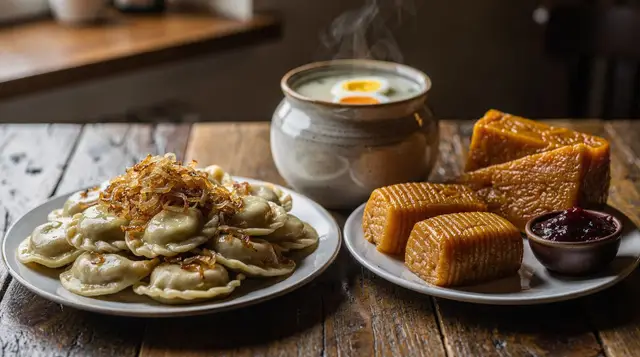
Żurek is Kraków’s most distinctive soup: a pale, slightly sour broth made from fermented rye flour (zakwas), served with sliced hard-boiled egg, white kiełbasa sausage, and often a piece of bacon or pork. It is sour, filling, earthy and deeply comforting. In many restaurants it comes in a hollowed bread bowl, which is theatrical and traditional.
Cost: 18–28 PLN (≈ €4–7) at a good restaurant; 12–18 PLN at a milk bar. Bar Mleczny Pod Temidą (ul. Grodzka 43) and Restauracja Smak Ukraiński (ul. Kanonicza 15) both do excellent versions. This is the breakfast/brunch soup of Kraków — eaten year-round but especially in winter and at Easter.
Barszcz czerwony — beetroot broth
Clear, deep-crimson beetroot soup, intensely flavoured and served either as a starter with uszka (tiny dumplings filled with mushroom and sauerkraut) or on its own as a drink from a cup. A Christmas Eve staple. The creamy variant, barszcz z uszkami, is the restaurant version; pure barszcz czerwony at a milk bar costs 6–10 PLN (≈ €1.50–2.50).
Kapuśniak — sauerkraut soup
Sour cabbage soup with pork or smoked sausage, root vegetables and sometimes potatoes. Thick, warming, deeply savoury. A milk bar staple at 8–12 PLN. Naturally vegetarian if made with vegetable stock (ask: “czy bez mięsa?”).
Flaki — tripe soup
Not for the faint-hearted: a thick soup of sliced beef tripe in a rich broth with vegetables and marjoram. A traditional hangover cure and a genuine taste of old Polish cooking. Ask at a milk bar — Bar Mleczny Pod Temidą usually has it. Try once; you may be converted.
The main dishes
Pierogi — the national dumpling
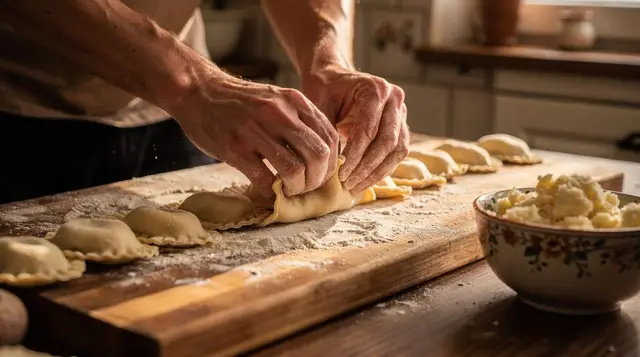
Polish dumplings deserve their own guide — and they have one at /guides/best-pierogi-krakow/. The key types:
- Ruskie — potato, cottage cheese and fried onion. The classic. Always start here.
- Z kapustą i grzybami — sauerkraut and forest mushroom. Richer, earthier.
- Z mięsem — ground pork and beef. Hearty.
- Z szpinakiem i serem — spinach and cheese. A modern but popular variant.
- Słodkie — sweet fillings (strawberry, blueberry, sweet cheese) served with soured cream and sugar.
A portion of 8–12 pierogi costs 25–38 PLN (≈ €6–9). They are boiled, then optionally fried in butter for a crisp skin (smażone — ask for these). Pierogarnia Mandu (ul. Szewska 26), Pierogi Mr Vincent (ul. Bożego Ciała 12, Kazimierz) and Starka (ul. Józefa 14) are the best dedicated pierogarnia spots.
Bigos — hunter’s stew
The unofficial national dish: a long-simmered stew of fermented sauerkraut (kapusta kiszona) and fresh cabbage with smoked meats, pork, kiełbasa and often dried mushrooms and plums. No two recipes are identical. Real bigos should be sour, slightly sweet, smoky and complex — it improves over several days of reheating. Find it at traditional restaurants rather than milk bars; Wierzynek (Rynek Główny 15) and Gospoda CK Dezerter (ul. Bracka 6) do reliable versions.
Kotlet schabowy — Polish pork schnitzel
The everyday workhorse of Polish cooking: a pork loin cutlet, breaded and pan-fried in lard, served with mashed potato (ziemniaki puree) and cooked beetroot or sauerkraut salad. Simple, satisfying, ubiquitous. At a milk bar: 18–25 PLN. At a traditional restaurant: 35–50 PLN. Not revolutionary, but honest.
Gołąbki — stuffed cabbage rolls
Cabbage leaves stuffed with a mix of pork mince and rice, braised in a tomato sauce. A Sunday-lunch staple across Poland. Milk bars typically offer them 2–3 per portion for 20–28 PLN. Warming and substantial.
Kiełbasa — Polish sausage
Polish sausage culture is encyclopaedic: kabanos (thin, dried, smoky), biała kiełbasa (white, unsmoked — served in żurek or grilled), myśliwska (hunter’s sausage with juniper), kiełbasa krakowska (the thick Kraków-style sausage with garlic and pepper). Buy from Hala Targowa market or eat grilled at a street stall. A grilled kiełbasa with bread costs 12–18 PLN (≈ €3–4).
Kotlet z piersi kurczaka — fried chicken breast
Less poetic but common: a breaded chicken breast, Poland’s casual everyday option. Present at every milk bar, usually the cheapest protein at 18–22 PLN.
The sides and accompaniments
Surówki — raw vegetable salads: shredded carrot with raisins, white cabbage with apple, beetroot with horseradish. Always offered with mains; usually 4–8 PLN extra.
Kopytka — potato dumplings (similar to Italian gnocchi but Polish, served fried in butter with breadcrumbs or mushroom sauce). Often appear as a side or a cheap main at milk bars.
Kluski śląskie — Silesian dumplings: round potato dumplings with a dimple in the centre. Served with a butter and onion topping.
Highlander food: Góral specialities
Zakopane and the Tatras bring mountain food to Kraków. The signature ingredient is oscypek — smoked sheep’s milk cheese, produced only in the Tatra highlands under protected designation of origin. It has a distinctive floral pattern from the carved wooden mould and a firm, slightly rubbery texture with a light smokiness. Eaten grilled with cranberry jam (żurawina), it is a revelation: 8–14 PLN per piece. See the full guide at /guides/oscypek-cheese-highlander-food/.
Jagnięcina (highland lamb), baranina (mutton) and game are also highlander staples. In Zakopane (see /destinations/zakopane/), these are served at wood-panelled karczma (taverns) with folk music. In Kraków, Restauracja Góralska (ul. Szpitalna 38) or the stalls at the Rynek’s edges sell grilled oscypek.
Jewish-influenced dishes
Kazimierz’s Jewish culinary heritage survives in several dishes that are now part of the general Kraków food scene. Cholent (bean and barley stew, slow-cooked) appears on menus at Klezmer-Hois (ul. Szeroka 6) and Ariel (ul. Szeroka 17/18). Gefilte fish (stuffed carp), tzimmes (sweet carrot stew) and various schmaltz-based recipes are offered at both restaurants, though these are tourist-oriented interpretations rather than strictly authentic.
The intersection of Kraków’s food history with the broader food scene is explored on the Polish food and culture tour with tastings, which includes both Old Town and Kazimierz food stops and provides good historical context.
Where to eat: venue type guide
Bar mleczny (milk bar): best for cheap, authentic, cash-only everyday Polish. No atmosphere, no waiters, extraordinary value. Full guide: /guides/milk-bars-bar-mleczny-guide/.
Gospodas and traditional restaurants: mid-range, table service, broad menu of Polish classics. Prices 40–80 PLN per main. Better atmosphere and larger portions than milk bars. Best picks: /guides/best-restaurants-old-town/.
Modern Polish (kuchnia polska nowoczesna): a growing category of restaurants doing creative takes on traditional ingredients — duck rillettes, kopytka with truffle, bigos deconstructed. Pod Baranem (ul. Św. Gertrudy 21) and Bottiglieria 1881 (ul. Bonerowska 1) are the Kraków exemplars. Expect 80–180 PLN per main; book in advance.
Jewish restaurants in Kazimierz: atmospheric, tourist-priced, variable quality. The live klezmer music at dinner is enjoyable; the food quality at Ariel and Klezmer-Hois is adequate rather than outstanding. Worth one visit for the atmosphere; don’t expect the best food in the neighbourhood (for that, walk to the quieter streets around ul. Józefa and ul. Estery).
Drinks to pair with Polish food
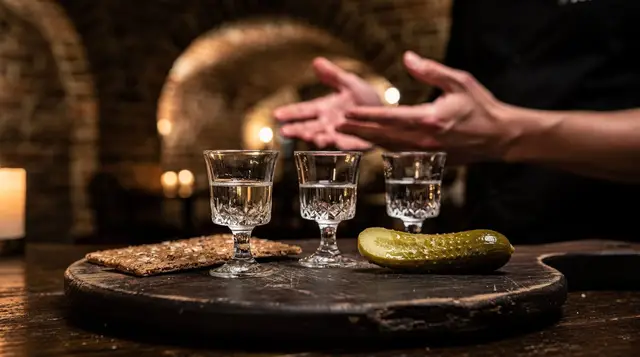
Polish food and Polish drink are inseparable. Beer (piwo) is the everyday accompaniment — Żywiec, Tyskie and Okocim are the widely available lagers, usually 10–15 PLN for a 0.5L glass. Vodka (wódka) is the more ceremonial pairing, traditionally drunk neat and cold alongside fatty, savoury food rather than as a cocktail base; flavoured varieties like żubrówka (bison grass) and miodowa (honey) are worth trying alongside a proper meal rather than as shots alone. Kompot — a lightly sweet stewed-fruit drink, served hot or cold — is the traditional non-alcoholic pairing and appears at most milk bars and gospodas.
Combining food with the rest of your Kraków day
Food naturally threads through the rest of a Kraków itinerary rather than sitting apart from it. A milk bar lunch fits neatly into an Old Town walking tour, and Kazimierz’s food scene pairs well with an afternoon exploring the Jewish quarter. If you’re heading south for a Tatra day trip, expect to eat highlander food in Zakopane itself rather than in Kraków — the oscypek and żurek there are made with genuine mountain provenance. The Kraków food guide has the fuller citywide picture beyond just traditional dishes, including cafes, modern dining and craft beer.
Food tours for traditional dishes
The most efficient way to cover multiple traditional dishes in one session is a guided food tour. The 3-hour traditional food tour focuses specifically on Polish cooking heritage — milk bars, pierogi, soup and beer. The 6-course full Polish food tour with vodka tasting is the premium version for serious eaters: a formal multi-course progression through the full range of traditional dishes, paired with curated vodka shots.
Frequently asked questions about traditional Polish dishes
What is the best Polish dish to try first?
Start with żurek (sour rye soup) and pierogi ruskie (potato-cheese dumplings). They are the most representative, the most widely available, and the most likely to convert you to Polish food. If you only have one meal at a milk bar, order these two.
Are Polish dishes good for vegetarians?
Several traditional dishes are vegetarian: pierogi ruskie, pierogi z kapustą i grzybami, barszcz czerwony, many surówki salads, and kopytka. However, much of the menu relies on pork. Vegetarians eat better at the modern Polish restaurants than at traditional milk bars.
Where can I buy Polish food to take home?
Hala Targowa market (open Monday–Saturday) sells kiełbasa, pickles, smoked cheeses and preserves. The shop at Jan Kuchnia Polska (ul. Szpitalna 38) stocks good jarred products. Kabanos sausage travels well vacuum-packed. Oscypek cheese lasts up to 10 days unrefrigerated in cooler weather.
How spicy is Polish food?
Generally not spicy at all. The main flavours are sour (fermentation, sauerkraut), smoky (meat, cheese), earthy (mushrooms, beets) and savoury. Horseradish (chrzan) provides heat with certain dishes. If you want spice, head to the international restaurants in Kazimierz.
Can I take a cooking class to learn Polish recipes?
Yes — Kraków has several good options for hands-on pierogi making and broader Polish cooking classes. See /guides/polish-cooking-classes-krakow/ for the full breakdown with prices and booking advice.
Do milk bars accept card payment?
Increasingly yes, but not universally — some of the older, most traditional milk bars are still cash-only or have unreliable card terminals. Carry enough PLN in cash to cover a meal, just in case, especially outside the main tourist streets.
What’s the difference between a milk bar and a gospoda?
A milk bar (bar mleczny) is a subsidised, canteen-style eatery with self-service and minimal atmosphere — the cheapest way to eat traditional Polish food. A gospoda is a proper sit-down restaurant with table service and a fuller menu, at roughly double to triple the price. Both serve genuinely traditional dishes; the difference is comfort and price, not authenticity. See the milk bars guide for specific recommendations.
Top experiences
Bookable activities with verified prices and instant confirmation on GetYourGuide.