Auschwitz-Birkenau history: understanding what happened and why it matters
From Krakow: Auschwitz-Birkenau guided tour & hotel pickup
Duration: 3.5h
What was Auschwitz-Birkenau and why is it significant?
Auschwitz-Birkenau was the largest Nazi German concentration and extermination camp, where an estimated 1.1 million people — the vast majority of them Jews — were murdered between 1940 and 1945. It stands as the most documented site of the Holocaust and is now a UNESCO World Heritage Site and memorial museum visited by over 2 million people annually.
The history you need to know before you visit
Visiting Auschwitz-Birkenau is one of the most important things a traveller can do in this part of Europe. Understanding the site’s history beforehand transforms the visit from a passive tour into an act of genuine witness. This guide is written with that goal in mind — clear, factual, and respectful of those who died there.
| Where | Oświęcim, around 70 km / 1.5hrs west of Kraków |
| Entry | free, but an entry card booked online is required (guided tours cost extra) |
| Time needed | 5–7 hours including travel, for both camps |
| Getting there | organised tour, or public bus from Kraków MDA / Główny |
| Best time | early morning slots are calmer and less crowded |
The name “Auschwitz” refers to a complex of over 40 concentration and sub-camps, but three sites are central: Auschwitz I (the main camp), Auschwitz II-Birkenau (the largest extermination complex), and Auschwitz III-Monowitz (a forced labour camp). The Memorial and Museum that visitors access today encompasses Auschwitz I and Auschwitz II-Birkenau, located about 3 km apart in the town of Oświęcim, 70 km west of Kraków.
How it began: the camp’s establishment, 1940
Auschwitz I was established in June 1940, initially to imprison Polish political prisoners — intellectuals, members of the resistance, clergy, and military officers — not primarily Jews. The site had formerly been Polish army barracks. Heinrich Himmler, head of the SS, ordered its opening to deal with the massive influx of Polish prisoners following the German invasion of Poland in September 1939.
The first transport arrived on 14 June 1940: 728 Polish political prisoners from Tarnów. They were mostly students and young professionals. The very first prisoner registered — number 31 — was Stanisław Ryniak, a secondary school student. By the end of 1940, the camp held over 7,000 prisoners.
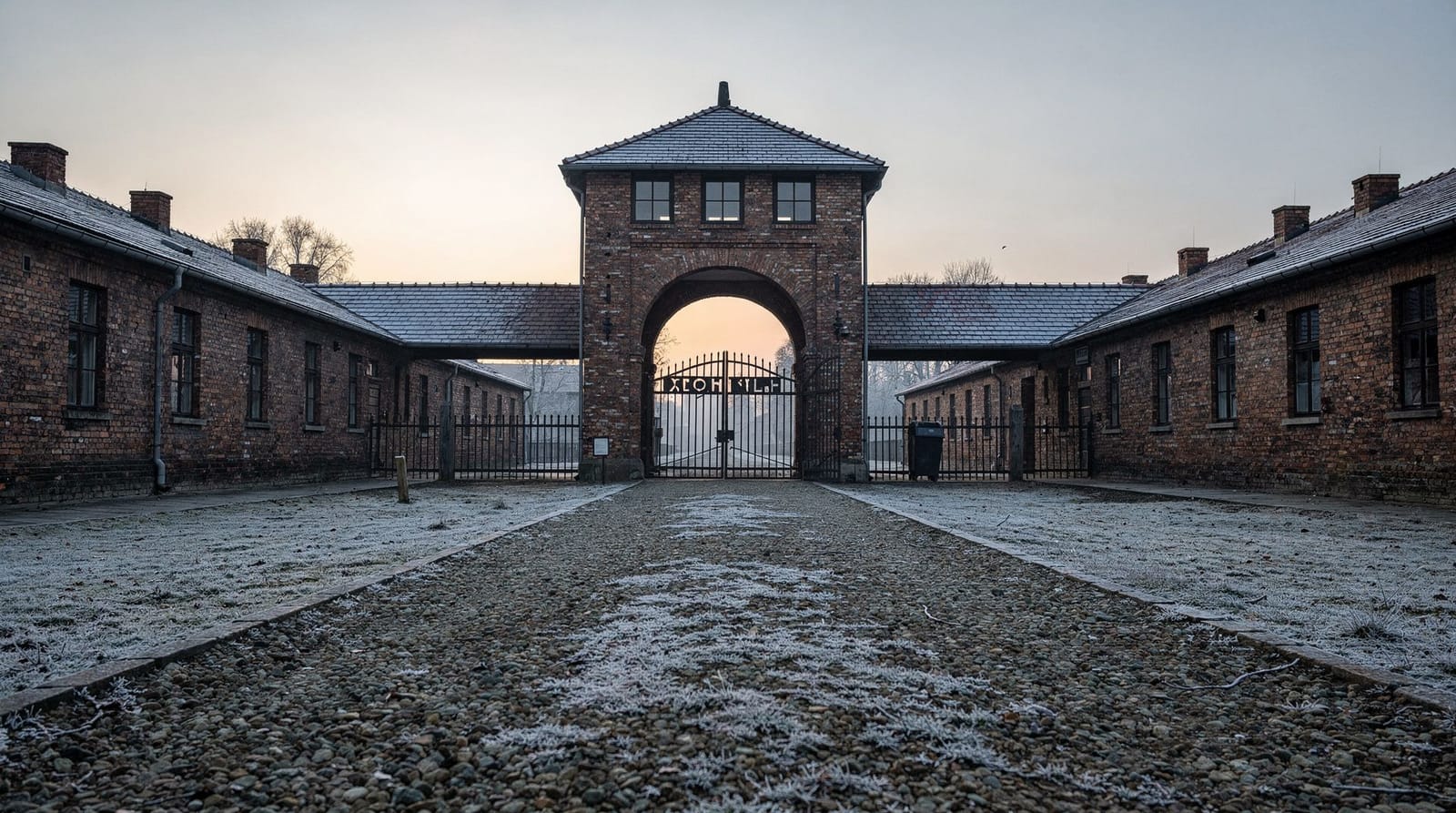
The notorious sign above the main gate — “Arbeit macht frei” (“Work sets you free”) — was commissioned by the camp’s first commandant, Rudolf Höss, and installed in June 1940. It was, from the start, a lie. Forced labour in the camp served primarily to dehumanise and exhaust prisoners; survival was not its purpose.
The expansion to Birkenau and the Final Solution, 1941–1942
In October 1941, construction began on a vastly larger second camp at the nearby village of Brzezinka (Birkenau in German). The decision reflected a fundamental shift in Nazi policy: the Wannsee Conference of January 1942 formalised the “Final Solution to the Jewish Question,” committing the Nazi state to the systematic murder of all European Jews.
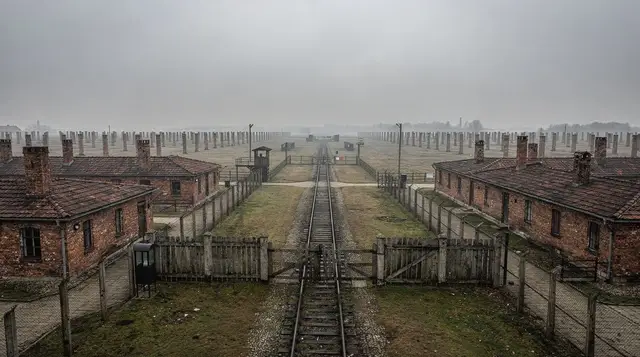
Birkenau was built specifically for mass murder at an industrial scale. By 1944 it covered 175 hectares with over 300 barracks. At its peak in 1944, the camp held over 90,000 prisoners. The four main crematoria at Birkenau, equipped with gas chambers disguised as shower rooms, could kill and cremate the bodies of several thousand people per day.
The killing process was bureaucratically organised. Transports arrived by train directly to a purpose-built ramp inside Birkenau from 1944 onwards. A “selection” took place on the ramp: SS doctors — most notoriously Josef Mengele — determined who would be sent to forced labour and who would be killed immediately. Older people, children, pregnant women, and those deemed unfit for work were directed to the gas chambers, typically within hours of arrival. They were told they were going to shower.
Who was killed at Auschwitz-Birkenau?
The victims came from across German-occupied Europe and beyond. Historical research, compiled by the Auschwitz-Birkenau State Museum, estimates the following breakdown of the approximately 1.1 million people murdered at the camp:
Jews from across Europe constituted the largest group — approximately 1 million people from Poland, Hungary, France, the Netherlands, Greece, Czechoslovakia, and many other countries. Hungarian Jews were deported in especially large numbers: between May and July 1944 alone, over 430,000 Hungarian Jews were transported to Auschwitz-Birkenau, and most were killed immediately upon arrival.
Roma and Sinti people were imprisoned in a designated section called the Zigeunerlager (Gypsy camp). Approximately 23,000 Roma were brought to Auschwitz; most died of disease, starvation, or were murdered in the gas chambers. The liquidation of the Gypsy camp on 2–3 August 1944 — known to Roma as the “Black Night” — saw the remaining 4,200–4,300 residents gassed in a single night.
Soviet prisoners of war, Polish political prisoners, Jehovah’s Witnesses, homosexual men, and people with disabilities were also imprisoned and murdered at the camp complex.
The evidence: what survived
The Auschwitz Memorial Museum preserves an extraordinary archive of physical evidence. Block 5 in Auschwitz I contains glass cases displaying 7,000 kilograms of human hair shaved from victims before they were killed, 110,000 pairs of shoes, 12,000 kitchen utensils, 3,800 suitcases, and vast quantities of clothing. These belongings were systematically looted by the SS and, in many cases, shipped back to Germany for redistribution.
The camp records were meticulously maintained by the SS. Approximately 400,000 prisoners were officially registered and given tattooed numbers (those murdered immediately upon arrival were never registered). The International Tracing Service archive, now accessible to researchers, holds approximately 30 million documents relating to Nazi persecution and forced labour.
The four crematoria at Birkenau were blown up by the SS in January 1945 as Soviet forces approached, in an attempt to destroy evidence of the mass murders. The ruins are preserved and visible to visitors today.
Liberation and the post-war reckoning
Soviet forces of the 1st Ukrainian Front liberated Auschwitz on 27 January 1945. They found approximately 7,000 survivors too ill to march, along with warehouses containing 370,000 men’s suits, 836,000 women’s garments, 44,000 pairs of shoes, and 7.7 tonnes of human hair — goods that the retreating SS had not had time to transport.
The Nuremberg Trials (1945–1946) established legal accountability for the Holocaust at the highest level. Rudolf Höss, commandant of Auschwitz from 1940 to 1943, was tried separately by a Polish court, convicted, and hanged at Auschwitz I on 16 April 1947 — steps from the crematorium he had ordered built.
Poland established the Auschwitz-Birkenau State Museum at the site in 1947. In 1979, UNESCO inscribed it as a World Heritage Site under the name “Auschwitz Birkenau: German Nazi Concentration and Extermination Camp (1940–1945).” The site receives over 2 million visitors per year.
The relationship between Auschwitz and Kraków
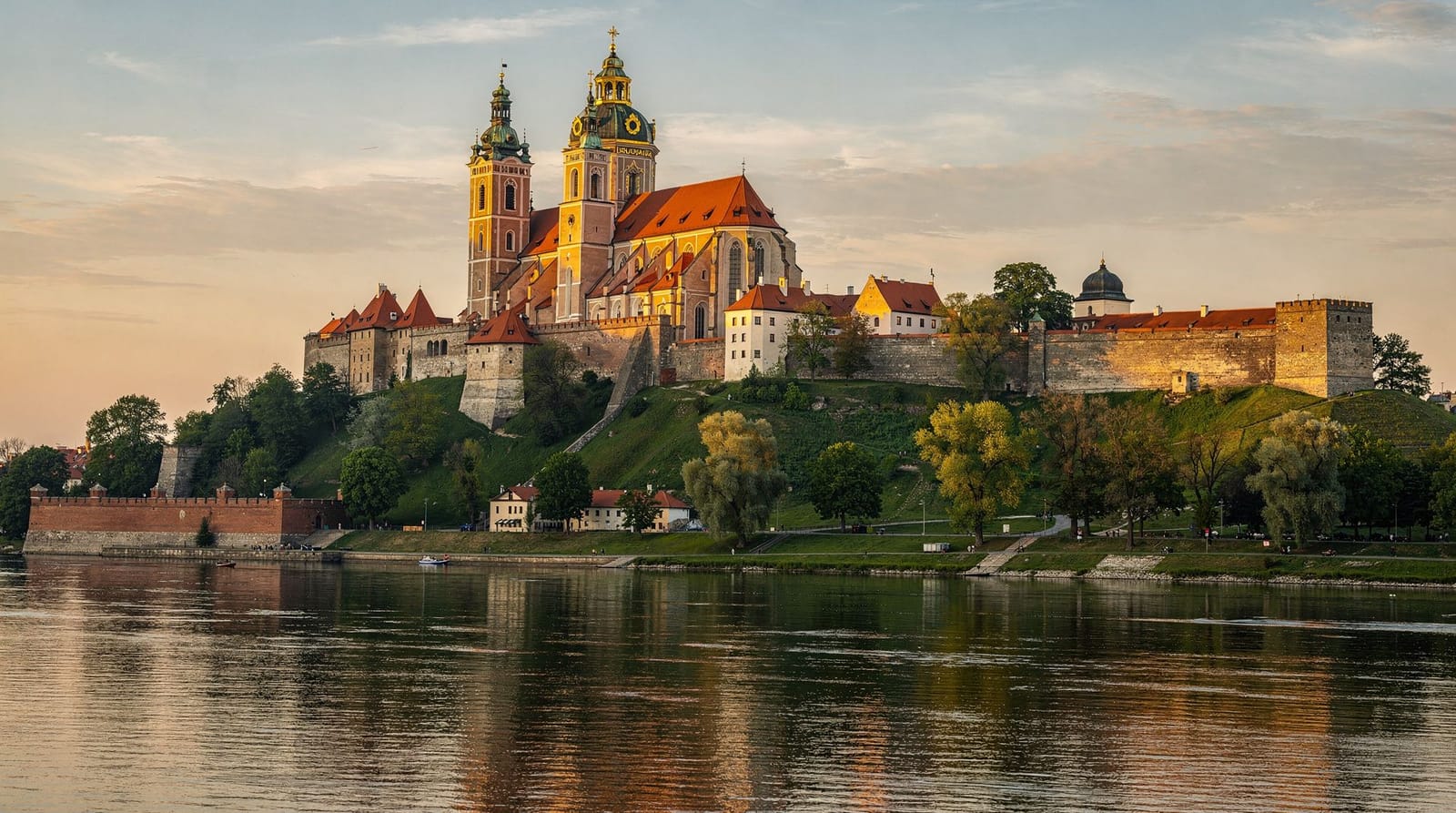
Kraków was the administrative capital of the Nazi-occupied “General Government” from 1939 to 1945. The SS and the German civilian administration operated from Wawel Castle, directly overseeing the terror apparatus that included Auschwitz. Kraków’s Jewish community — one of the largest in Poland before the war — was systematically dispossessed, confined to the Podgórze ghetto, then deported to Auschwitz and other extermination camps beginning in 1942.
The Kraków Ghetto in Podgórze and Oskar Schindler’s enamel factory on Lipowa Street are today among the most visited sites in Kraków, offering a direct human-scale counterpoint to the overwhelming scale of Auschwitz. A guided tour of Schindler’s Factory Museum focuses specifically on the experience of Kraków’s Jews under occupation and the complex figure of Schindler himself.
For the broader context of wartime Kraków, the guide to Kraków under Nazi occupation provides a neighbourhood-by-neighbourhood account.
Visiting with the right preparation
The Memorial and Museum at Auschwitz-Birkenau is open every day except 1 January, Easter Sunday and 25 December. Entry to the site itself is free, but a personalised entry card must be booked online in advance (none are sold at the site); guided tours are strongly recommended. Book through the official site at visit.auschwitz.org, not through street vendors or unofficial agents in Kraków.
A guided Auschwitz-Birkenau tour with hotel pickup is the most convenient option from Kraków: transport is included (about 1.5 hours each way), and a licensed guide provides context that the exhibits alone cannot. The full visit covers both Auschwitz I and Birkenau and takes 5–7 hours total. Allow a full day.
The Auschwitz-Birkenau Memorial and Museum tour — bookable directly via GetYourGuide — includes access to both camps with an officially licensed guide and typically departs from a central Kraków meeting point.
For those combining their visit with Kraków’s wartime history, the guide to WWII Kraków covers the city’s occupation, the ghetto, and the resistance. For a fuller account of the resistance movement itself, see the guide on Home Army resistance in Kraków.
Choosing how to visit: your options compared
Once the history is clear, the practical decision is how to structure the visit itself. The main approaches, compared:
| Option | Best for | Trade-off |
|---|---|---|
| Guided group tour with hotel pickup | First-time visitors wanting full context | Fixed schedule, larger group |
| Private guided tour | Flexibility, deeper Q&A with the guide | Higher cost per person |
| Self-guided with public bus | Independent travellers, tighter budgets | No guide narration; book timed entry yourself |
| Combined with Wieliczka Salt Mine | Visitors with one spare day for both sites | Long day (10+ hours), less time at each |
The guided vs self-guided comparison and the group vs private tour guide go deeper on each trade-off. If you are weighing a combined day with the salt mine, see Auschwitz and Wieliczka in one day for whether that pace actually works. For full transport logistics from Kraków, the Auschwitz from Kraków guide covers bus times, tour pickup points and timed-entry booking in detail.
Etiquette and practical information
Auschwitz-Birkenau is a place of mourning and a graveyard for over a million people. The Memorial Museum asks visitors to behave accordingly. Dress modestly; shoulders and knees should be covered. Selfies, especially inside the gas chambers and crematoria ruins, are considered deeply disrespectful and should not be taken.
Photography is permitted in most areas but not in some of the exhibit rooms in Auschwitz I. Follow guide instructions. Smoking and eating are prohibited on the grounds.
Children under 14 are not recommended by the museum, though the final decision rests with families. Families with children should review the museum’s guidance on the official website.
Auschwitz is approximately 70 km from Kraków. By organised tour, the round trip takes about 5–6 hours of travel; allow the full day. By public bus (from Kraków’s main bus station MDA, or from Główny railway station), the journey takes about 1.5–2 hours each way; check current fares with the carrier. Independent visitors must book an entry card online in advance; in peak season these fill weeks ahead.
The perpetrators: who ran Auschwitz?
The camp was run by the SS (Schutzstaffel), the ideological and security force of the Nazi state. Rudolf Höss served as commandant from 1940 to 1943 and again briefly in 1944. His memoirs, written while awaiting trial and published as “Commandant of Auschwitz,” provide one of the most disturbing documents in the Holocaust archive: an unrepentant bureaucrat describing mass murder in the language of administrative efficiency.
The camp’s medical staff conducted experiments on prisoners without consent: Josef Mengele’s experiments on twins are the most notorious, but other SS doctors also conducted pseudo-scientific research on prisoners. The experiments were recorded meticulously and serve today as documented evidence of the relationship between Nazi racial ideology and its murderous implementation.
Below the SS command, the camp also relied on prisoner functionaries — Kapos — who supervised labour details. These prisoner functionaries occupied an agonising moral position: some used their limited power to protect fellow prisoners; others were as brutal as any SS guard. The complexity of their situation is part of what makes Auschwitz such a profound moral landscape.
The camp in numbers: a factual summary
Understanding Auschwitz requires some grounding in its physical and administrative dimensions:
- Operating period: June 1940 (Auschwitz I opens) to January 1945 (liberation)
- Peak population: approximately 90,000 prisoners at Birkenau in summer 1944
- Total registered prisoners: approximately 400,000 (those who were tattooed and officially recorded)
- Total killed: approximately 1.1 million (the large majority killed immediately without being registered)
- Gas chambers in use: 4 main crematorium complexes at Birkenau, plus earlier facility at Auschwitz I
- Nationalities: Jews from across Europe (including Poland, Hungary, France, the Netherlands, Greece, Italy, Germany); Soviet POWs; Polish political prisoners; Roma and Sinti; others
The Hungarian Jewish deportations of 1944 represent the single most concentrated phase of killing. In 56 days between May and July 1944, approximately 438,000 Hungarian Jews were deported to Auschwitz-Birkenau; an estimated 320,000 were murdered on arrival.
The written record: how we know what happened
Holocaust deniers have, for decades, attempted to claim that the documented evidence is insufficient to establish the reality of what occurred at Auschwitz. The historical record is, in fact, extraordinarily comprehensive.
The Nuremberg Trials (1945–1946) established legal culpability based on captured German documents, including the SS’s own meticulous records. Rudolf Höss’s testimony at Nuremberg was delivered by Höss himself, not under coercion; he confirmed the figures and the methods.
The Sonderkommando — the prisoner work details forced to operate the crematoria — left written testimonies buried in the ground at Birkenau. Several of these manuscripts were discovered after the war; their direct eyewitness accounts of the gas chambers and cremation process leave no room for ambiguity.
Survivor testimony is recorded in thousands of documented accounts held by Yad Vashem in Jerusalem, the USC Shoah Foundation, and the Auschwitz-Birkenau State Museum itself. The consistency of these accounts across people who had no contact with each other after the war is itself evidence of their truth.
What you will actually see, camp by camp
Auschwitz I, the original camp, is the more compact and museum-like of the two sites: brick barrack blocks now house permanent exhibitions, including the Block 5 belongings display, Block 11 (the “Death Block” used for punishment and executions), and the reconstructed gas chamber and crematorium adjacent to the camp commandant’s former villa. Most visitors spend around 1.5–2 hours here.
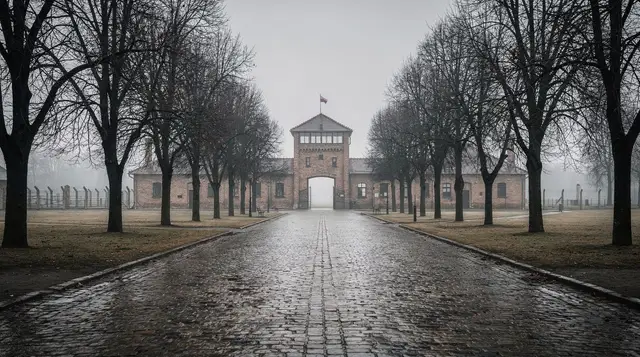
Birkenau, 3 km away and reached by a short shuttle or walk, is a different experience entirely: a vast, largely open site with the iconic brick gatehouse, railway tracks running directly into the camp, rows of wooden and brick barracks (many now just chimneys, as the wooden structures were dismantled or destroyed), and the ruins of the four crematoria blown up by the retreating SS. The scale here — 175 hectares — is what communicates the industrial nature of the killing in a way Auschwitz I alone cannot. Most visitors spend 1–1.5 hours at Birkenau, though the site rewards a slower, quieter walk if time allows.
Commemoration and education today
The Memorial and Museum at Auschwitz-Birkenau runs extensive educational programs, including teacher training, university partnerships, and the “March of the Living” annual commemoration held on Yom HaShoah (Holocaust Remembrance Day), which brings thousands of Jewish young people from around the world to walk from Auschwitz I to Birkenau.
International Holocaust Remembrance Day is observed on 27 January — the anniversary of liberation. In 2020, on the 75th anniversary of liberation, world leaders including representatives of countries that had been victims of Nazi aggression gathered at Auschwitz for a ceremony that drew global attention.
Poland’s own relationship with the memorial is complex: the site is on Polish territory, the victims were largely from countries other than Poland, and the question of how to balance Polish national victimhood with the specific Jewish experience of the Holocaust continues to generate political debate. The best guided tours navigate this complexity with honesty.
Why Auschwitz history connects to Polish history broadly
The fate of Auschwitz is inseparable from the broader sweep of Polish history — a country that spent the Second World War under both Nazi German and Soviet occupation, losing an estimated 6 million citizens (roughly 17% of its pre-war population, the highest proportional loss of any country in the war). Understanding this context makes Kraków itself more comprehensible as a city: the emptied streets of Kazimierz, the rebuilt post-war city, the communist-era Nowa Huta steel town built on the rubble of pre-war certainties.
The guide to Polish history for visitors provides an accessible timeline from the Piast dynasty through Solidarity and the post-1989 transformation, helping visitors place Auschwitz within Poland’s full historical arc.
Before Auschwitz: Jewish life in Kraków
To understand what was destroyed, it helps to understand what existed before. Kraków’s Jewish community, centred on the Kazimierz district, had a documented presence stretching back over 600 years and numbered around 60,000–70,000 people — roughly a quarter of the city’s population — on the eve of the Second World War. The Jewish Krakow history overview traces this community from its medieval origins through its near-total destruction in the Holocaust, giving essential context that the Auschwitz visit alone cannot provide. Visiting Kazimierz before or after Auschwitz — rather than treating the two as unrelated stops — makes both places more legible.
Frequently asked questions about Auschwitz-Birkenau history
How many people were killed at Auschwitz-Birkenau?
The Auschwitz-Birkenau State Museum’s historical research, based on detailed analysis of transport records, places the total at approximately 1.1 million people, of whom around 1 million were Jews. Earlier estimates of 4 million victims, based on Soviet-era data, were revised downward after access to more complete records following the end of communism.
Did any prisoners escape from Auschwitz?
Approximately 802 escape attempts were recorded, of which 144 succeeded. The most famous escape was that of Witold Pilecki, a Polish resistance operative who deliberately had himself arrested and sent to Auschwitz in September 1940 to gather intelligence and organise an underground resistance network inside the camp. He escaped in April 1943 and delivered detailed reports about the extermination process to the Polish underground and Allied governments — reports that were largely disbelieved in the West at the time.
What does “Auschwitz” mean and why is the town called Oświęcim?
The town’s original Polish name is Oświęcim (pronounced approximately oh-SHVEN-cheem). “Auschwitz” is the German rendering of the name, used by the occupying forces. After liberation, the town reverted to its Polish name, which is why you will see both names used. The memorial uses “Auschwitz-Birkenau” internationally, following UNESCO convention.
Was Auschwitz the only Nazi extermination camp?
No. The Nazis operated six extermination camps, all on occupied Polish territory: Auschwitz-Birkenau, Treblinka, Sobibor, Belzec, Chelmno, and Majdanek. Together they were responsible for approximately 3 million Jewish deaths as part of Operation Reinhard and broader Holocaust policy. Auschwitz-Birkenau was the largest and longest-operating of these camps.
Why is it important to visit Auschwitz rather than just read about it?
Physical presence at the site communicates scale and reality in ways that text and film cannot. Standing in the actual gas chambers, walking the vast empty grounds of Birkenau, seeing the physical belongings in Block 5 — these experiences tend to make the historical reality concrete in a way that reading does not. The Memorial Museum’s survivor testimonies, collected over decades, give individual faces and voices to history that statistics risk rendering abstract.
Should children visit Auschwitz-Birkenau?
The museum does not recommend visits for children under 14, though it is ultimately a family decision. For those under this age, the Jewish Krakow history overview and age-appropriate materials in Kazimierz offer a gentler way to introduce the history before a possible visit when the child is older.
How much of this history will a guided tour actually cover?
A licensed guide typically covers the establishment of the camp, its expansion into an extermination centre, the mechanics of the selection process, and the post-war reckoning, tailoring the depth to the group. Reading this history beforehand means you can ask sharper questions on the day rather than absorbing the basics for the first time on site — most guides welcome that.
Top experiences
Bookable activities with verified prices and instant confirmation on GetYourGuide.