My pierogi cooking class diary: learning to make Poland's most famous dish
I nearly cancelled this class thinking three years of eating pierogi in Kraków restaurants had already taught me everything. It hadn’t, and here’s what three hours of dough and burst seams actually changed.
| Where | Kazimierz district, small-group home kitchen |
| Cost | around 180 PLN per person, ingredients + meal included |
| Time needed | around 3 hours |
| Group size | up to 8 participants |
| Best time | any season; book a few days ahead |
The class I almost skipped
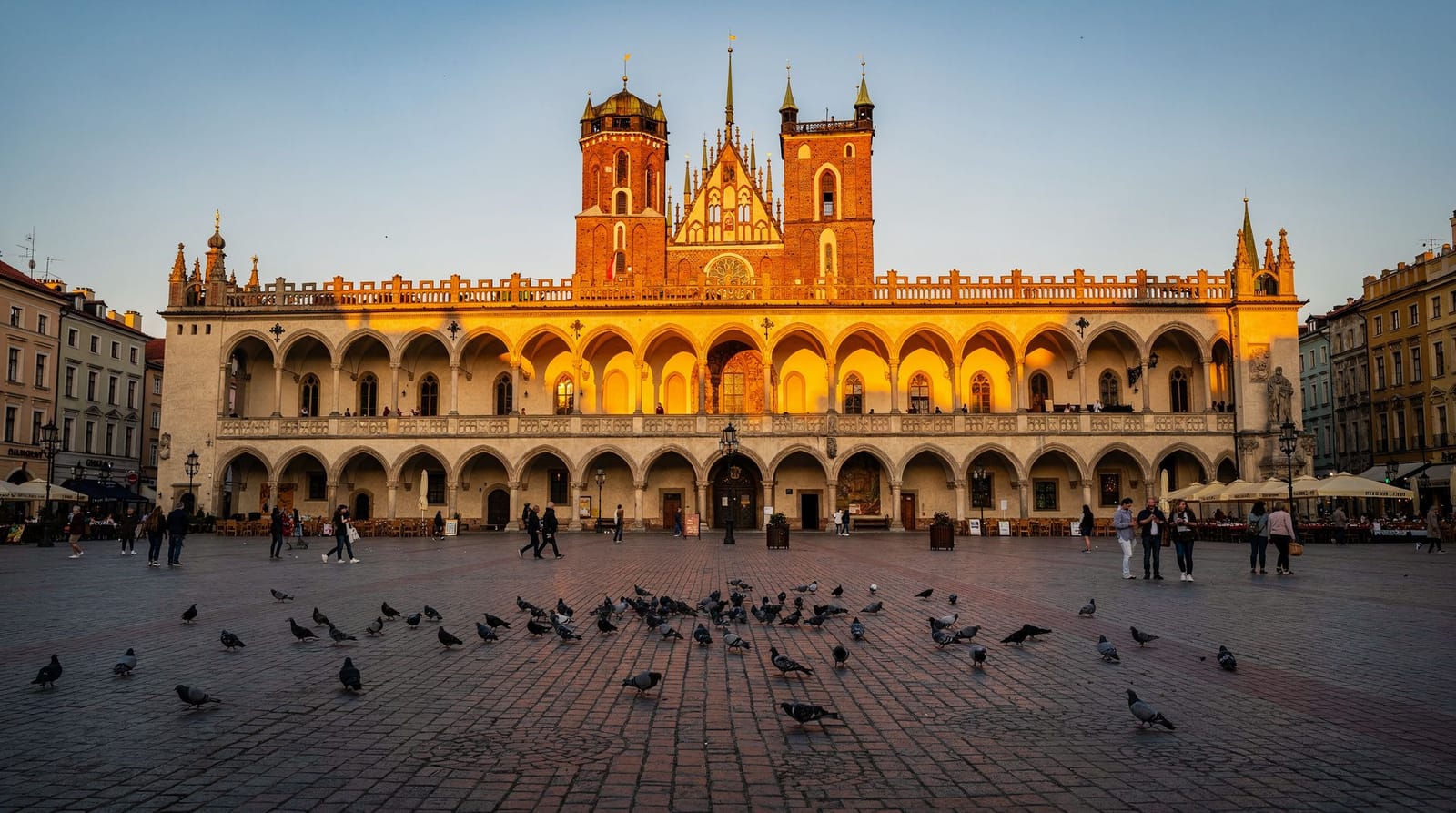
I had come to Kraków in December primarily for the Christmas markets and the cold air and the amber glow of the Rynek Główny at night, when the market stalls line the square and mulled wine (grzaniec) costs 12 PLN (3 €) from stalls that also sell oscypek cheese and hand-carved wooden ornaments. The pierogi cooking class was in the original itinerary as a placeholder — something to do on the afternoon of Day Two that was indoors and educational and would occupy three hours without requiring anything strenuous.
I almost cancelled it on Day One, having eaten too many pierogi in the city’s restaurants and wondering whether making them would add anything to the understanding I thought I had already acquired.
I did not cancel. This was correct.
Finding the class and what to expect
For a different hands-on food class in the city, there is also a traditional obwarzanek baking workshop with tasting in Kraków, built around the city’s braided bread ring rather than dumplings.
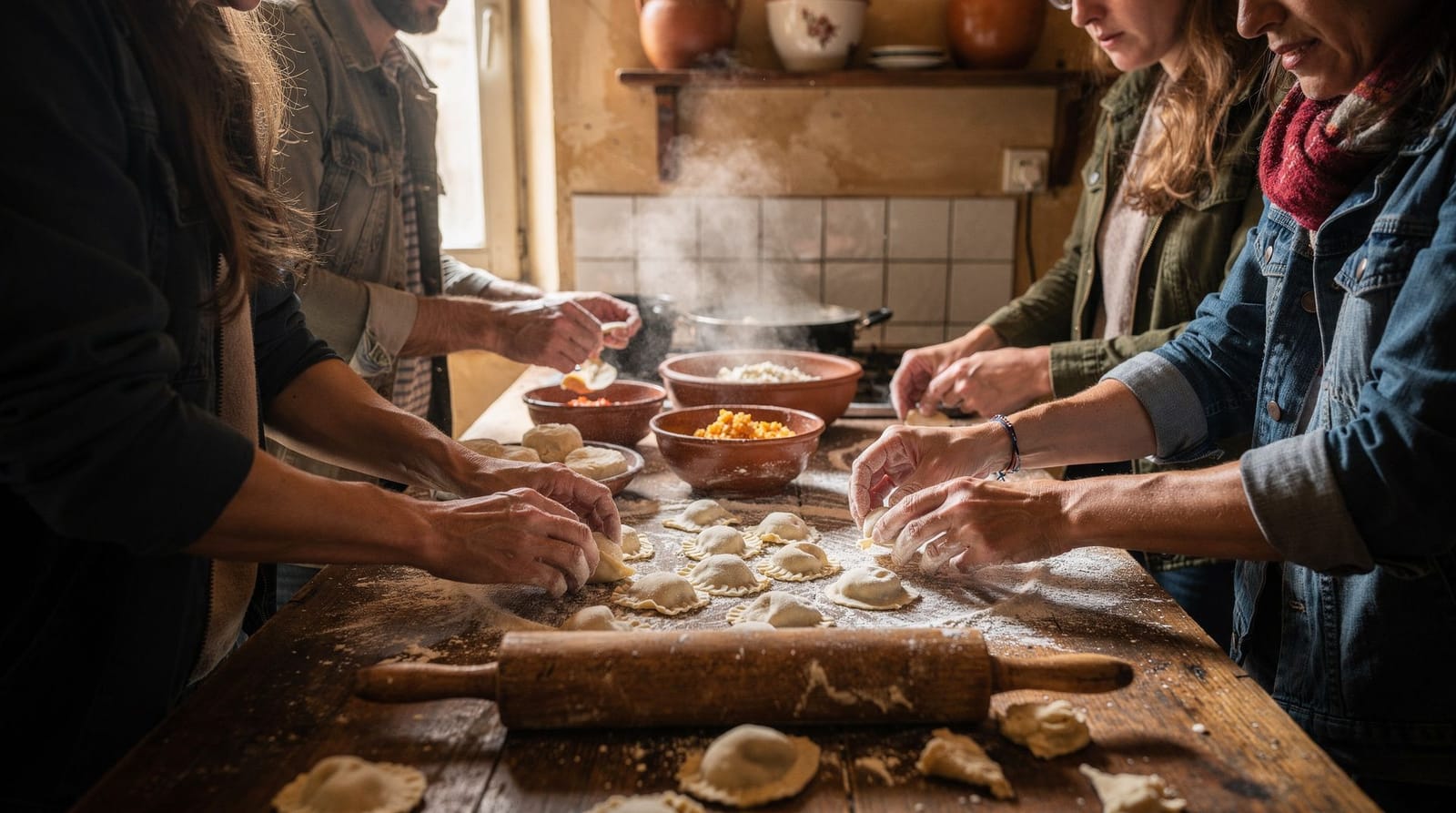
The class I booked was a home cooking class in the Kazimierz district — a small-group format (eight participants maximum, my session had six) held in a converted apartment with a proper kitchen. The host was a Polish woman in her forties who had been running the class for several years and who introduced herself by explaining that she had grown up making pierogi with her grandmother and had subsequently concluded that most people were making them wrong.
This turned out to be an accurate framing.
The dough: where most people go wrong
The class began with flour, and the lesson that followed was the first useful thing I learned.
Pierogi dough is, in principle, simple: flour, an egg, salt, and warm water. In practice, the ratio matters enormously, and the principal failure mode of home-made pierogi is a dough that is too thick, which produces dumplings that are gummy and dense rather than tender.
Our host measured nothing. This was initially alarming and ultimately instructive. She demonstrated the consistency she was aiming for — smooth, slightly elastic, not sticky — and showed us how to adjust: more water if it crumbles, more flour if it sticks to everything, and rest it for at least thirty minutes under a cloth before rolling. The resting is the thing most shortcut recipes omit, and the resting is the thing that makes it workable.
We each made our own portion of dough. The instructor moved through the group, observing, occasionally pressing a thumb into someone’s dough and saying something in Polish that was translated as “add a little more water.” By the end, six different people had six slightly different doughs, all of which worked.
The fillings: ruskie, meat, and something unexpected
The class covered three fillings.
Ruskie is the standard: mashed potato, white twaróg (farmer’s cheese), and caramelised onion. The filling is seasoned with salt, pepper, and a judgement call about how much onion, which varies by preference and by grandmother. Our host’s grandmother apparently liked a lot of onion. This was the filling that produced the most confident results from the group — it is forgiving and can be adjusted at the tasting stage before the dumplings are sealed.
Meat filling — mielone — uses ground pork and beef, cooked with onion and mushroom, and seasoned with marjoram. The technique for this one involved a proper sauté rather than just mixing; the mushroom needs to cook off its moisture before the meat or the filling becomes wet and makes the dough difficult to seal. A wet filling is the other major failure mode of home pierogi, apparently.
The unexpected third filling was sauerkraut and wild mushroom (kapusta z grzybami) — a Christmas filling, the instructor explained. Traditional Christmas Eve in Poland involves twelve meatless dishes, a religious obligation that historically pushed vegetable and mushroom preparations to creative heights. The sauerkraut and mushroom combination has an intensity — sour and earthy and deeply savoury — that surprised most of the group, who had expected something milder.
“This one you cannot make if you do not like flavour,” the host said. Several people tried it and revised their preference.
The shaping: twelve attempts and one acceptable result
Rolling the dough to 3-4mm thickness is a skill. I have now rolled many circles of dough to various thicknesses and can report that consistency is harder than it appears. A rolling pin on a floured surface, turned frequently, works; a pasta machine, if the class has one, is considerably more reliable. Ours did not.
We used a round cutter to portion the dough into circles of approximately 8-10cm. Each circle receives a spoonful of filling in the centre — not too much — and is then folded and sealed. The sealing is the part that looks simple and is not.
The edge seal for a pieróg requires pressing firmly enough to fuse the dough without tearing it, then crimping the edge with a twisted fold that produces a decorative border and also prevents the boiling water from penetrating the seam. Our host demonstrated this at a speed that suggested thirty years of muscle memory. I managed something approximately functional after about the fourth attempt. The first two split in the water and produced what she diplomatically called “pieróg soup.”
By the twelfth dumpling — we each made approximately fifteen — the technique was legible, if not elegant. The class’s best technical performance was a Danish architecture student who produced dumplings of uncanny consistency. She seemed equally surprised by this as everyone else.
The cooking, the tasting, and the sour cream question
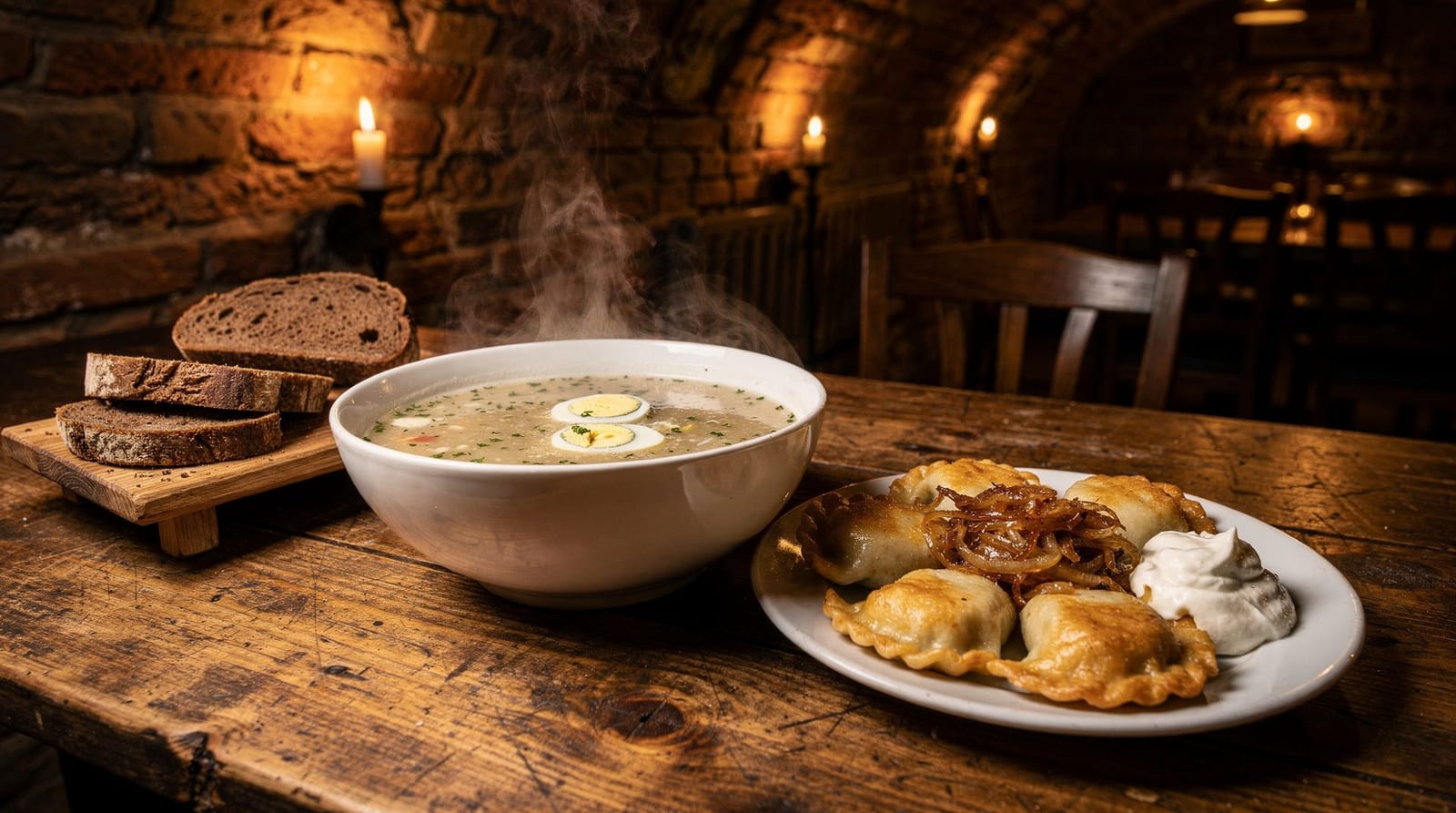
Pierogi are boiled in salted water until they float and then for one additional minute — total cooking time is roughly four to six minutes from cold water. The second approach, which we also tried, is to pan-fry after boiling in a small amount of butter until the bottom develops a light golden crust. The pan-fried version is not traditional for fresh pierogi but is widely done and creates a textural contrast — crispy exterior, soft interior — that is excellent.
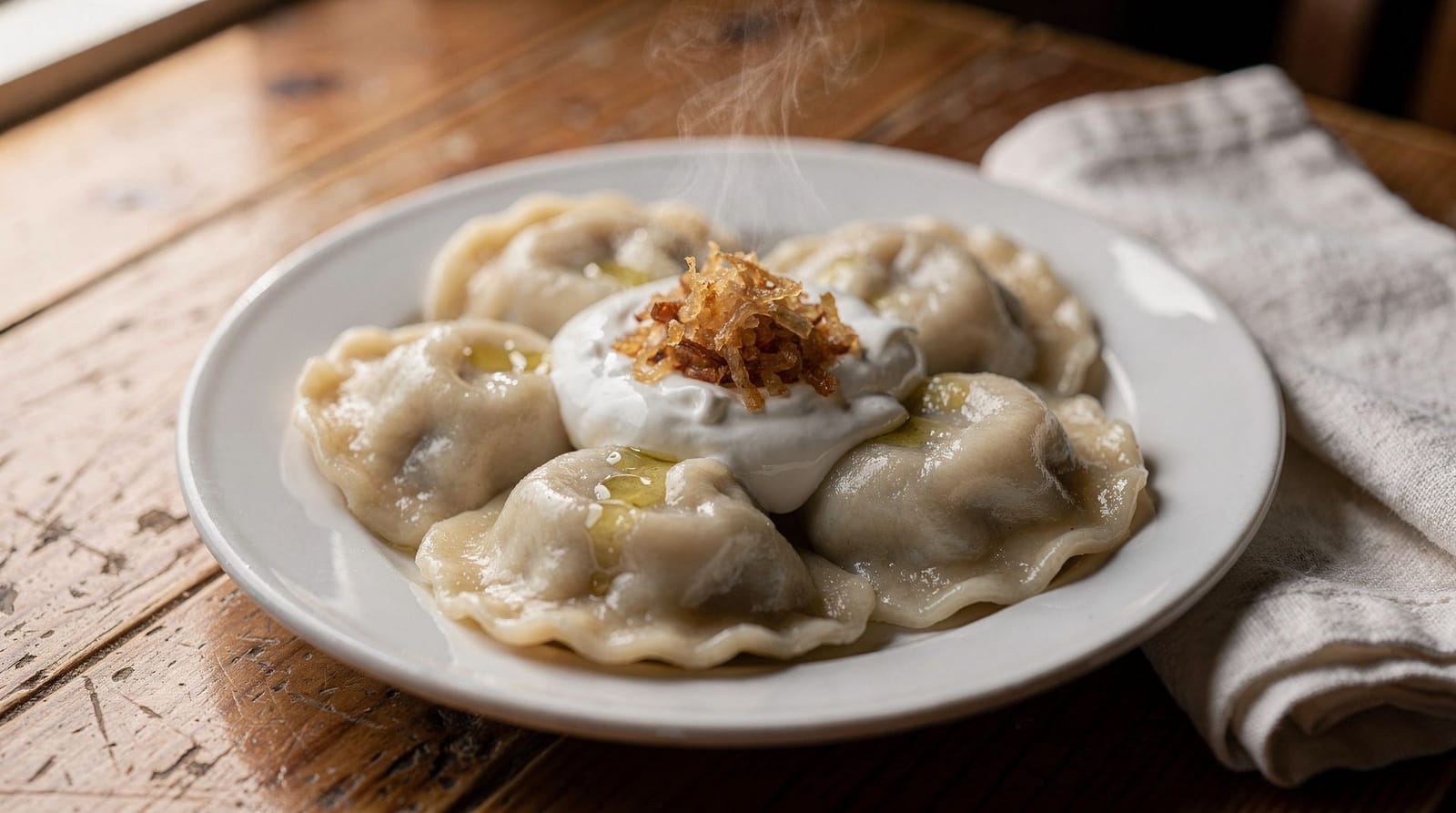
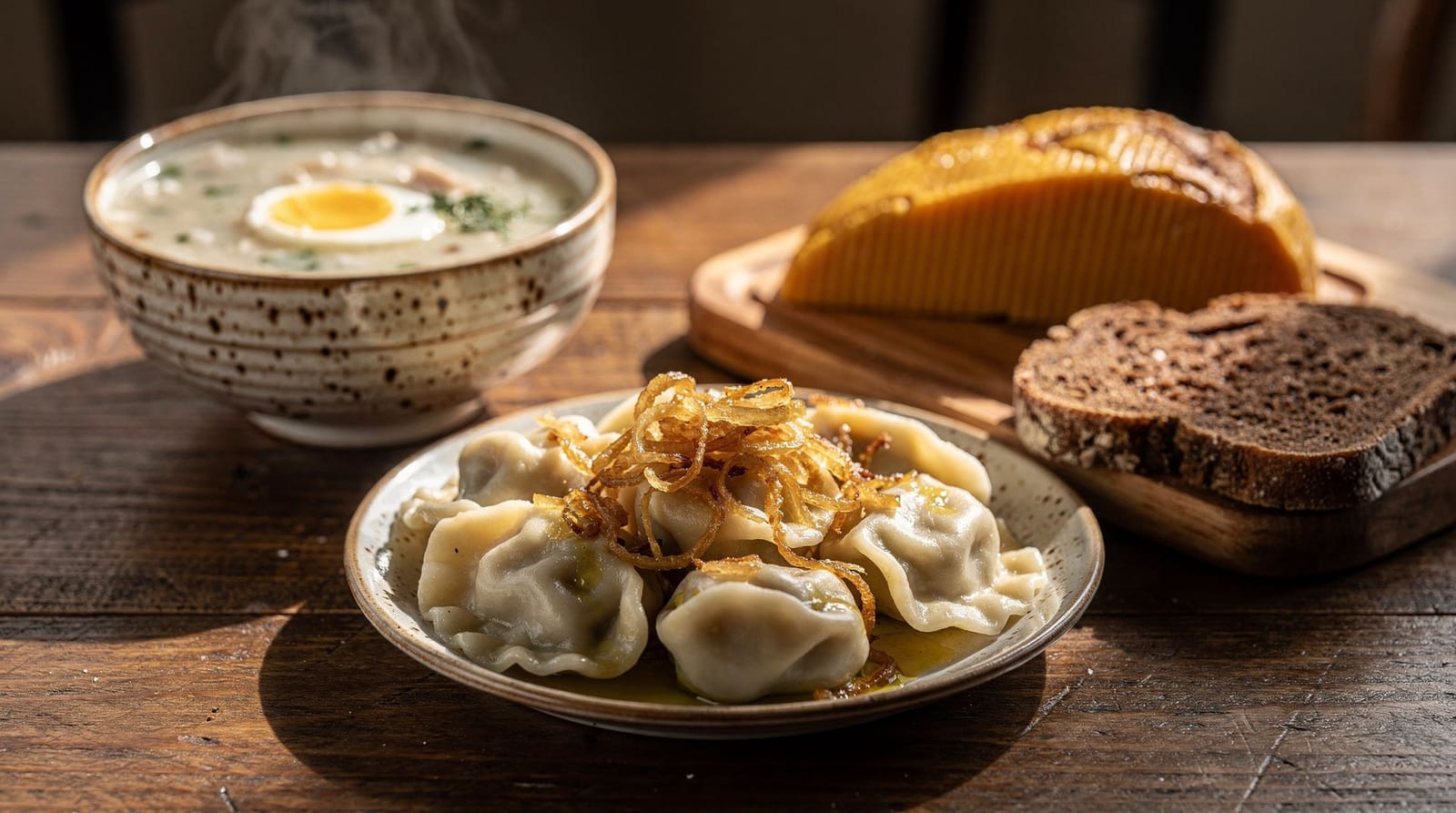
Each participant ate their own creations with śmietana (sour cream) for dipping, caramelised onions, and fried bacon bits (skwarki) on top. This combination is the standard restaurant presentation in Kraków, and it works because the richness of the sour cream balances the savoury filling and the bacon adds texture.
The ruskie were, by consensus, the most immediately satisfying. The meat filling was more complex and more divisive. The kapusta z grzybami was the one that generated the longest conversation about what we had just eaten, which is its own form of success.
What the class actually taught
I arrived thinking I knew what pierogi were. I ate them regularly at Pierogarnia Mandu and other restaurants in Kazimierz, and I had developed views on the subject.
The cooking class taught me three things that eating in restaurants does not:
First, the quality difference between fresh, properly made pierogi and the commercial frozen versions sold throughout Europe is not subtle — it is categorical. The dough is incomparably tender; the filling retains its individuality; the seal holds rather than having been machine-crimped and refrozen. This sounds obvious but is more impactful as an experience than as a statement.
Second, pierogi are not a difficult dish but they are a time-consuming one. The class ran nearly three hours for a portion that would serve two at a normal meal. The tradition of making them at scale — for family gatherings, for Christmas Eve — makes sense only when you have spent time doing it yourself and understood the economics of the process.
Third, the regional and family variation is real and significant. The host’s recipe was her grandmother’s. The recipe I have subsequently found in Polish cookbooks differs in ratio and seasoning. There is no canonical pierogi ruskie; there is your grandmother’s version, which is correct, and everyone else’s, which is also correct within its own logic.
Practical notes
The class I attended ran from 14:00 to approximately 17:00 and cost around 180 PLN (43 €) per person, including all ingredients and the meal. This is towards the upper end of what you will pay for a cooking class in Kraków. The Polish cooking classes guide covers the range of options and price points, from shorter one-topic classes to longer full-menu experiences.
For the best-value route to understanding Kraków’s pierogi scene, the combination of one meal at a proper pierogarnia followed by a cooking class is the most efficient path from consumer to practitioner. The restaurants do the dish justice — particularly Pierogarnia Mandu on ul. Józefa in Kazimierz, and Pierogi Mr. Vincent in the Old Town — but they cannot show you the process.
What to do with the knowledge afterwards is your own problem. I have since made pierogi twice at home, with approximately 70% success on the seals and 100% success on the eating.
Choosing between class formats
Not every pierogi class in Kraków runs the same format, and it’s worth knowing the difference before booking. Home-kitchen classes like the one I took emphasise the family-recipe angle and run in small groups; some operators offer larger, more theatrical sessions in a dedicated cooking studio, which can be livelier but less personal. A few combine the pierogi lesson with a broader Polish cuisine menu — soup, a main, sometimes a dessert — stretching the session closer to four hours; if that appeals, a pierogi lesson combined with a wider Polish menu is the format to look for. If your main goal is genuinely learning the technique rather than an entertaining afternoon, ask in advance how hands-on the class is; some “classes” are closer to a demonstration with a shaping station at the end, which is a different and lesser experience.
Doing it yourself afterward
If you want to replicate the class at home, the two failure points the instructor flagged repeatedly are worth writing down: don’t skip the dough’s thirty-minute rest, and don’t let the filling stay wet — both cause more torn seals than any shaping mistake. Beyond that, the ratio of flour to water is genuinely forgiving once you’ve felt the right dough consistency once in person, which is the strongest argument for taking a class rather than learning from a recipe alone. A kitchen scale helps for the first few attempts; after that, you’ll likely do what our host did and stop measuring.
Where to eat pierogi if you skip the class
Not everyone wants to spend an afternoon making dinner. If a class doesn’t fit your schedule, the best pierogi in Kraków guide covers where to eat them properly, and the broader Kraków food guide situates pierogi within the wider culinary picture. Pierogarnia Mandu and Pierogi Mr. Vincent, both mentioned above, remain reliable choices in Kazimierz and the Old Town respectively. If you would rather taste several dishes in one outing than stand over a single dough, a guided Polish food walk with pierogi, history and a few shots is a sociable alternative, and the food tours guide compares the options. For something different on the same trip, the Polish vodka tasting guide and the traditional Polish dishes page round out the picture.
Fitting the class into the rest of your trip
A class like this works best as the indoor anchor of a day that is otherwise spent outside. If you are still working out how many days you need, the how many days in Kraków guide helps, and the 2-day itinerary leaves room for a slow afternoon in a kitchen. Because the class is in Kazimierz, it pairs naturally with a walk through the Kazimierz Jewish Quarter beforehand, and with the Kazimierz food scene afterwards if you still have room for more.
Cooking and eating also work well in colder months. When the weather turns, the rainy day activities list and the Kraków in winter guide suggest other indoor options, and the milk bar guide is a good companion if you want to compare your own dumplings with the cheap, no-frills versions served across the city. For a friendlier, more personal account of eating your way through the city, see the milk bar experience diary.