Kraków Christmas markets: the complete visitor's guide
Krakow: highlights of Old & New Town private walking tour
When do Kraków's Christmas markets run and what can I expect?
Kraków's main Christmas market on Rynek Główny opens in late November and, in 2026/27, runs from 27 November to 6 January. Expect around 100 wooden stalls selling oscypek, mulled wine (grzaniec), honey liqueur, crafts, and nativity scenes. The market is free to enter, atmospheric after dark, and set among the square's historic buildings. Book accommodation early — December is the city's busiest month for short breaks.
Why Kraków’s Christmas market stands out
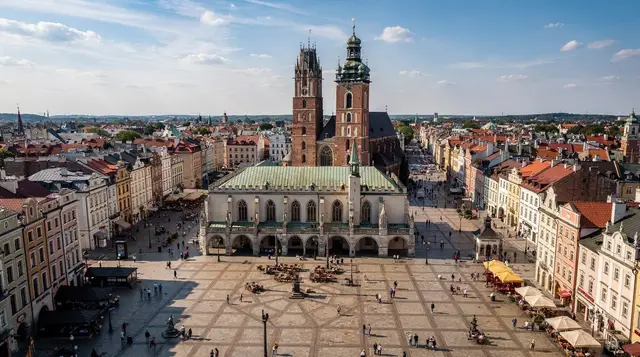
Kraków hosts one of the most authentic Christmas markets in Central Europe, and consistently ranks in the top five on the continent by travel writers and visitors alike. Unlike the heavily commercialised markets of Prague or Vienna, the Kraków edition maintains a strong locally made character: the stallholders are predominantly Polish artisans and food producers, and the setting — Rynek Główny, the largest medieval town square in Europe — provides a backdrop that no fabricated Christmas village can replicate.
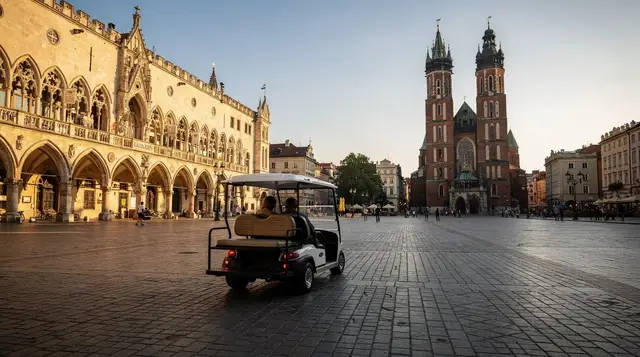
The Sukiennice (Cloth Hall), illuminated in warm amber light, anchors the square. Around it, roughly 100 wooden chalets form concentric arcs, their roofs dusted with (real or artificial) snow, steam rising from mulled wine cauldrons. St. Mary’s Basilica watches over the scene from the northeastern corner, its twin towers and Gothic brick façade glowing against the winter sky. At the top of each hour, the Hejnał Mariacki — a trumpet call that breaks off mid-phrase, commemorating a 13th-century bugler shot by a Tartar arrow — echoes across the square. In December, that melody sounds more poignant than ever.
The market is free to enter. There is no fence, no wristband, no entry queue. You walk in, wander, and leave as you please.
If the square itself is new to you, the Rynek Główny guide explains what you are looking at, and the Cloth Hall guide covers the building that anchors the stalls.
| Where | Rynek Główny, Old Town |
| Dates | 27 November 2026 to 6 January 2027 |
| Cost | free to enter; food and drink around 8–25 PLN per item |
| Best time to visit | weekday evening, 17:00–20:00 |
| Book ahead | accommodation, 2–3 months for December |
For the fuller seasonal picture beyond the market itself, see the Kraków in winter guide, and for other events happening the same month, the festivals and events calendar.
Dates and opening hours
The market typically opens on the last Friday or Saturday of November — in recent years this has been 28–30 November. The 2026/27 market runs from 27 November 2026 to 6 January 2027; dates can change, so check Kraków’s official city tourism portal (visitkrakow.com) from October onwards.
Opening hours: Official hours are 10:00–20:00 daily, with food stalls serving until at least 22:00. The final days (26–31 December) are busy and stalls keep longer hours. Christmas Day (25 December) sees reduced but not absent trading — a handful of food stalls remain open.
The square is at its most atmospheric between 17:00 and 20:00, when daylight has faded, the lights are fully lit, and the early-evening crowd has not yet thinned. Aim for a weekday evening if you want space to browse; weekends in December, especially before Christmas, are exceptionally crowded.
What to eat and drink
The food at Kraków’s Christmas market is genuinely worth seeking out, provided you focus on a few reliable categories.
Grzaniec galicyjski — Galician mulled wine — is the queen of the market. The Kraków version differs from its Austrian or German counterparts: it is richer, spiced with cloves, cinnamon, and cardamom, and sometimes strengthened with śliwowica (plum brandy). A mug costs 12–18 PLN (≈€3–4). Most stalls serve it in the same ceramic mugs, kept warm over open flames.
Oscypek — smoked sheep’s milk cheese from the Tatra highlands — is sold by highlander (górale) vendors in traditional dress. The classic version is grilled on a small brazier and served with cranberry jam. One piece costs 8–12 PLN (≈€2–3). Real oscypek carries a EU Protected Designation of Origin label; the stalls at the Christmas market are generally authentic. The highlanders also sell bundz (fresh sheep’s cheese) and bryndza (salty, spreadable).
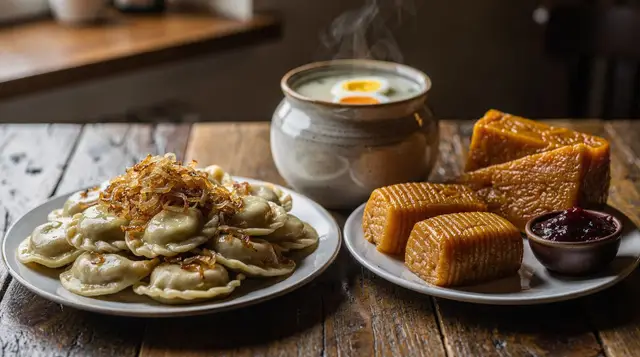
Pierogi — Poland’s signature stuffed dumplings — appear at several stalls, with fillings ranging from ruskie (potato and cheese) to mushroom-and-sauerkraut (a Christmas Eve tradition) to sweet versions with fruit and cream. A portion of six costs 15–20 PLN (≈€4–5).
Kiełbasa z grilla — grilled sausage — is ubiquitous. Go for the ones made with pork and smoked over wood, not the generic bratwurst-adjacent versions. Served in a bun (bułka) with mustard and horseradish: 10–15 PLN (≈€2.5–4).
Miód pitny — Polish mead — is sold by specialist honey producers from the Małopolska region. The varieties range from półtorak (the strongest, 1 part honey to 0.5 parts water) to czwórniak (1:3, lighter and more suitable for cold afternoons). A tasting flight of three small cups costs around 20–25 PLN (≈€5–6).
Avoid the stalls selling generic tourist snacks — the pretzels, churros, and “Krakow gifts” chocolates have no local character and are overpriced. Stick to Polish-made food and drink. For more on the dishes behind the stalls, the traditional Polish dishes guide and the oscypek guide are good companions.
What to buy
The craft stalls vary significantly in quality. The best buys at Kraków’s Christmas market:
Kraków nativity scenes (szopka krakowska): These elaborate miniature architectural models — representing Kraków’s churches and towers in a nativity tableau, decorated with foil, beads, and coloured cellophane — are a UNESCO Intangible Cultural Heritage of Humanity. Genuine szopki are made by craftsmen from the Kraków region; the market typically includes a competition display in front of the Mickiewicz statue. Prices range from 50 PLN (≈€12) for small versions to several hundred złoty for larger, more intricate models.
Handmade ornaments and decorations: Look for blown-glass baubles from the workshops around Małopolska, hand-painted wooden figures, and straw stars. Prices from 15–40 PLN (≈€4–10).
Amber jewellery: Poland is one of the world’s leading producers of Baltic amber. The Christmas market has several amber stalls. Buying amber here is generally safer than the Sukiennice shops, but still be cautious of fakes (see the fake amber guide) — genuine amber floats in saturated saltwater and is warm to the touch. A tested piece from a reputable stall costs from 60–80 PLN (≈€14–19) for a simple pendant.
Pottery from Bolesławiec: The distinctive white-and-cobalt blue stamped pottery from the Bolesławiec region in Lower Silesia appears at several stalls. Dishwasher- and oven-safe; a small mug costs 40–60 PLN (≈€10–14).
The ice rink
Check visitkrakow.com for this year’s ice rink locations, hours and prices; the city portal lists a small rink at the Galeria Krakowska Christmas market. Rinks are not large — queue times are reasonable on weekday mornings but long on weekend evenings. Children under 10 should be accompanied on the ice.
Beyond Rynek Główny: other Christmas events
The main market is not the only festive event in December.
St. Andrew’s Eve (Andrzejki, 29–30 November): The night before the market opens, bars and clubs across the city hold Andrzejki parties — a Polish tradition involving fortune-telling, wax-pouring (lanie wosku), and general pre-Christmas celebration. It overlaps with the market’s opening days.
Szopka Krakowska competition: Every first Thursday of December, the szopka-makers parade their creations from Krowodrza to the Mickiewicz monument for judging. A public ceremony follows; the winning szopki are exhibited at the Historical Museum (Muzeum Historyczne Miasta Krakowa) in the Krzysztofory Palace on Rynek Główny for the rest of December.
Christmas Eve (Wigilia, 24 December): Many restaurants in the Old Town offer a special Wigilia menu — the traditional Polish Christmas Eve dinner of twelve meatless courses including barszcz (beetroot soup), carp, pierogi with mushroom and sauerkraut, herring, and kutia (sweet wheat pudding). Book weeks in advance; restaurants like Miód Malina (ul. Grodzka 40) and Szara Gęś (Rynek Główny 17) are popular for this. The market is less busy on the 24th, as many visitors have left or are dining; a late evening stroll around the lit-up square is magical.
Midnight Mass (Pasterka): Wawel Cathedral and St. Mary’s Basilica both hold Midnight Mass on 24–25 December. St. Mary’s is particularly atmospheric. No reservation is needed but arrive by 23:00 to find a seat.
Guided tours worth taking
A walking tour during Christmas market season adds historical context to what you see. The private walking tour of the highlights of Old & New Town is not a Christmas market tour as such, but it gives you the story of the city around the square before or after you browse the stalls. If you want a broader introduction to the Old Town, the Old Town guided walking tour operates year-round and works well as an orientation before self-guided market exploration.
For visitors interested in combining market visits with Polish food culture, the 4-hour Polish food tour includes tastings at milk bars, traditional restaurants, and specialist food stalls — several stops align well with the products you’ll find at the market.
When to go: crowd levels week by week
| Period | Crowd level | Notes |
|---|---|---|
| Opening weekend (late Nov) | Moderate | Festive buzz, stalls still settling in |
| Early December weekdays | Low | The best window for unhurried browsing |
| 8 December (public holiday) | Very high | Immaculate Conception; avoid if possible |
| Mid-December weekends | High | Book restaurants and tours ahead |
| Week before Christmas | Very high | Locals shopping alongside tourists |
| Christmas Eve–Day | Low–moderate | Many stalls scale back; magical and quieter |
| 26 Dec–1 Jan | High | New Year crowds return in force |
Photographing the market
The best light for photos is the hour after stalls light up but before full darkness — roughly 15:30–16:30 in December. Shooting from the raised steps of the Adam Mickiewicz monument gives a wide view over the stalls toward the Sukiennice and St. Mary’s Basilica. A tripod isn’t practical in the crowds, so a fast lens or a camera with good low-light performance helps. For a quieter, more considered visit that combines photography with historical context, the best restaurants in Old Town guide and a slow dinner afterward pairs well with an early-evening market walk, and the 3-day Kraków itinerary shows how to fit the market into a longer winter trip.
Practical logistics
Getting there: The Old Town is car-free (the getting around Kraków guide covers the options). Trams 1, 2, 6, 8, and 13 stop near the ring road (Planty) around the Old Town. From the main train station (Kraków Główny), it is a 10-minute walk via the underground shopping passage. From Kraków airport (KRK Balice), take the train to Kraków Główny (~20 minutes, ~22 PLN / ≈€5) then walk.
Crowds: The market is extremely busy on weekends from early December. The worst congestion occurs on 8 December (Immaculate Conception public holiday in Poland), the weekends of 13–14 December and 20–21 December, and Christmas Eve. For browsing comfort, visit on a weekday afternoon or evening.
Weather: Kraków in December averages -2 to +4°C, with wind. Dress in proper winter layers — down jacket, hat, gloves, and waterproof boots. The cobblestones become slippery when wet or icy; choose footwear with grip.
Pickpockets: The market crowd in December is dense enough to attract opportunistic theft. Keep your phone in a front pocket or zipped bag, and be aware at busy stalls where jostling is unavoidable. The Kraków scams guide lists other things worth knowing before you arrive.
Accommodation: December is the city’s highest-demand month. Book at least 2–3 months in advance. Hotels on or near Rynek Główny — the Wentzl (Rynek Główny 19), Pod Różą (ul. Floriańska 14), and Copernicus (ul. Kanonicza 16) — offer premium location but charge accordingly (from 600 PLN/€140 per night in December). Budget options in Kazimierz and Podgórze are more available and offer 15-minute tram access.
Frequently asked questions about Kraków’s Christmas markets
When exactly do the Christmas markets open in 2026?
The 2026/27 market runs from 27 November 2026 to 6 January 2027, according to the official city tourism portal (visitkrakow.com). Dates are subject to change, so check the portal before you travel.
Is it worth visiting both weekends before Christmas?
The first weekend after opening is atmospheric but less crowded than the final weekend. If you have flexibility, 1–2 December or early-week dates in the second week of December offer the best balance of festive atmosphere and manageable crowds.
Are there any free events during the market?
Yes — the Szopka parade and competition ceremony (first Thursday of December), the Hejnał at St. Mary’s Basilica (top of every hour), the Wianki boat displays on the Vistula in June (unrelated to Christmas), and the Rynek light installations are all free. Many of the market stalls require no minimum purchase to browse.
Can I visit with young children?
Yes — the market is very family-friendly. The ice rink has children’s sessions, the szopki competition is fascinating for kids, and the food stalls offer non-alcoholic options like hot chocolate and świeżo wyciskane soki (fresh juices). Push a pram if your child is young enough to sit; the cobblestones are manageable but uneven.
What is grzaniec and how does it differ from Glühwein?
Grzaniec galicyjski is Poland’s version of mulled wine, with roots in the Galicia region (now split between southern Poland and western Ukraine). It is generally richer and spicier than German Glühwein, often incorporating śliwowica (plum brandy) or miód (honey) alongside the wine. The Kraków version typically uses dry or semi-dry red wine rather than sweet wine. It is served hot in ceramic mugs.
Is the market worth visiting if I’ve already seen Vienna’s or Prague’s?
Yes, and for a different reason: Kraków’s market feels less commercialised, with a higher proportion of genuinely Polish-made food and crafts rather than generic imported Christmas-village goods. If you’ve found other cities’ markets repetitive, Kraków’s stronger local character is a real point of difference.
How many hours should I budget for the market itself?
Two to three hours covers a proper visit — browsing the stalls, eating, watching the ice rink, and taking in the square after dark. Combine it with the festivals and events calendar if you want to build a full winter day around it, or the best restaurants in Old Town guide for a sit-down dinner afterward.
Top experiences
Bookable activities with verified prices and instant confirmation on GetYourGuide.