Wadowice and John Paul II day trip from Kraków
From Krakow: Wadowice and Pope John Paul II route day trip
How do I visit Wadowice from Kraków?
Wadowice is approximately 50 km southwest of Kraków, about 1 hour by bus or road. PKS buses run several times daily from Kraków's MDA bus station (roughly 12–18 PLN each way). Guided day trips from Kraków handle transport and include the Family Home Museum and key papal sites. The main attraction is the John Paul II Family Home Museum and the Basilica of the Presentation of the Virgin Mary.
Wadowice: the birthplace of a pope
Karol Józef Wojtyła was born on 18 May 1920 in a second-floor apartment in Wadowice, a small town in the Małopolska region of southern Poland. He grew up here, attended school here, and served at the local basilica before leaving for Kraków to study philosophy and literature. In 1978 he became Pope John Paul II — the first non-Italian pope in 455 years — and served as head of the Catholic Church for nearly 27 years until his death in 2005.
Wadowice has not changed dramatically since his childhood. The town square (Rynek) is still dominated by the Basilica of the Presentation of the Virgin Mary where he was baptised. His family apartment, across the square from the church, is now a superb museum. And the local kremówka cream pastry — which he famously praised in a 1999 speech recalling his Wadowice youth — is still sold at every bakery in town.
Whether you visit for religious pilgrimage, historical interest, or simply curiosity about the man who shaped 20th-century Poland, Wadowice is a rewarding half-day from Kraków.
| Where | 50 km southwest of Kraków |
| Cost | around 12–18 PLN each way by bus; 110–160 PLN for a guided day trip |
| Time needed | 2.5–3.5 hours, more with Kalwaria Zebrzydowska added |
| Getting there | PKS bus from MDA station, guided tour, or self-drive (around 50 minutes) |
| Best time | year-round; 18 May and 22 October draw larger pilgrimage crowds |
Distance and transport from Kraków
Wadowice is approximately 50 km southwest of Kraków.
- By PKS bus: Regular services from Kraków’s MDA bus station (Dworzec Autobusowy) to Wadowice, journey approximately 1 hour to 1h15. Tickets: 12–18 PLN (€2.90–4.30) each way. Buses typically run every 1–2 hours. The bus stop in Wadowice is on the main square.
- By guided tour from Kraków: The Wadowice and John Paul II route day trip from Kraków handles transport and includes an English-speaking guide for both the museum and the basilica.
- By car: Approximately 50 minutes via the DK7. Parking is available around the Wadowice Rynek.
- By train: There is a train station at Wadowice but services are infrequent and slower than the bus — the bus is preferable for most visitors.
Tour options from Kraków
John Paul II route day trip
The Wadowice and John Paul II route day trip is the standard guided option, covering the Family Home Museum, the basilica, and the key sites on the papal route in Wadowice. Good for visitors who want historical and religious context without navigating independently.
Typical price: 110–140 PLN (€26–33) per person including transport.
Wadowice with Kalwaria Zebrzydowska
The Wadowice and Kalwaria Zebrzydowska combination tour pairs Wadowice with the UNESCO-listed pilgrimage sanctuary at Kalwaria Zebrzydowska, about 20 km away. Kalwaria was a formative spiritual place for young Karol Wojtyła — he returned there many times throughout his life. This combination provides a fuller picture of the landscape that shaped him.
Typical price: 130–160 PLN (€31–38) per person.
Family home of John Paul II day trip
The family home of John Paul II day trip from Kraków focuses specifically on the museum and family apartment, with more time inside the building and detailed explanation of Wojtyła’s early life.
Typical price: 100–130 PLN (€24–31) per person.
What to see in Wadowice
John Paul II Family Home Museum
The museum occupies the Wojtyła family apartment at ul. Kościelna 7, directly on the Rynek, as well as the surrounding building. It opened in 2014 after a major renovation and is one of the best-designed biographical museums in Poland.
The exhibition covers five themes: origins and family, education and youth, spiritual life and vocation, the path to papacy, and the pontificate. It uses personal objects, photographs, documents, film, and immersive reconstructions to trace Karol Wojtyła’s life from birth to death. Particularly affecting are the boyhood rooms, the photographs of the Rynek as it looked in the 1930s, and the documentation of his role in Polish resistance to both Nazi occupation and Communist rule.
Opening hours: vary by season and weekday; check the official website of the museum (domjp2.pl) before you go. Admission: check current prices on the official website of the museum (domjp2.pl). Audio guides available. Time needed: 1.5–2 hours.
Basilica of the Presentation of the Virgin Mary
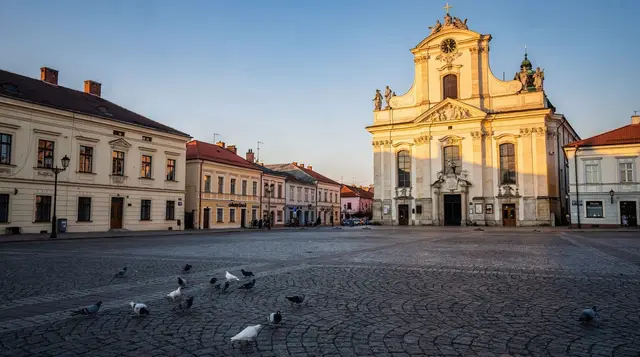
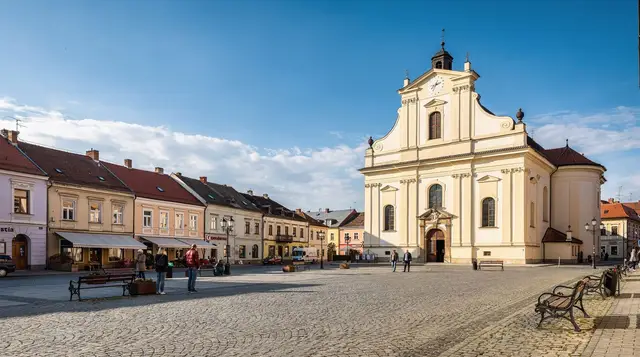
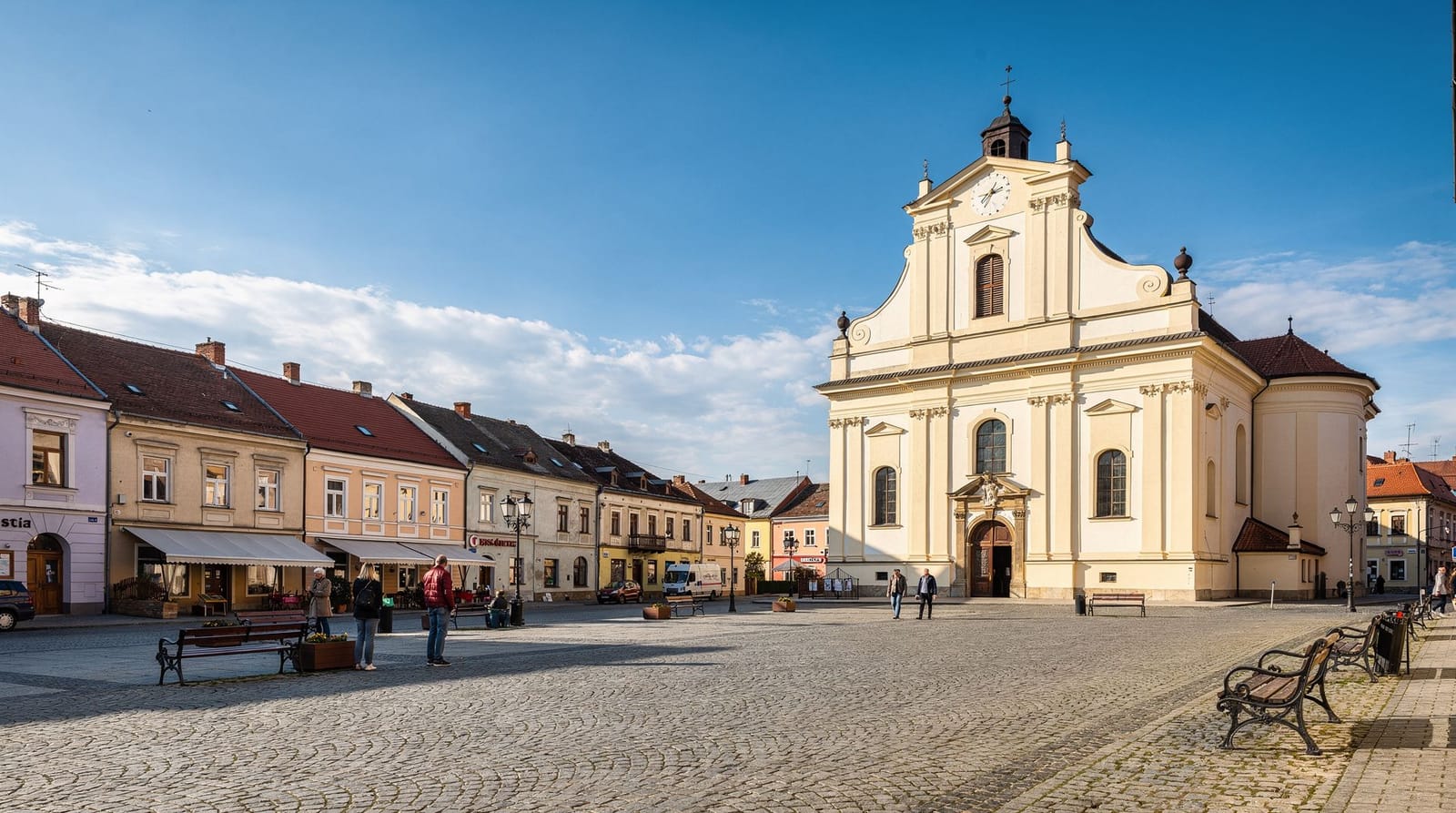
The large brick basilica facing the Rynek is where Karol Wojtyła was baptised on 20 June 1920, received his first communion, and regularly attended Mass as a boy. His baptismal font is preserved and visible in the church. The interior has several papal relics and commemorative elements.
Photography: Permitted in the nave; follow church guidelines near the altar.
The Rynek (main square)
Wadowice’s town square is pleasant and human-scaled. A large bronze statue of John Paul II stands near the centre. The surrounding architecture is typical small-city Małopolska — coloured facades, arcaded ground floors, a mix of Baroque and 19th-century styles.
Kremówka: Every bakery and café around the Rynek sells kremówka — a layered cream pastry (sometimes translated as papal cream cake or Napoleon) that John Paul II mentioned fondly in a 1999 address, setting off a local cottage industry. The most famous bakery is Cukiernia Pod Wzgórzem at Rynek 23 (2–5 PLN per slice). They sell very well and the quality is consistent. Buy one; it is genuinely good.
Kalwaria Zebrzydowska (nearby)
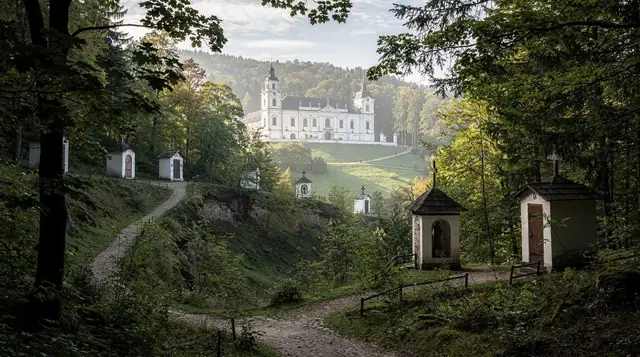
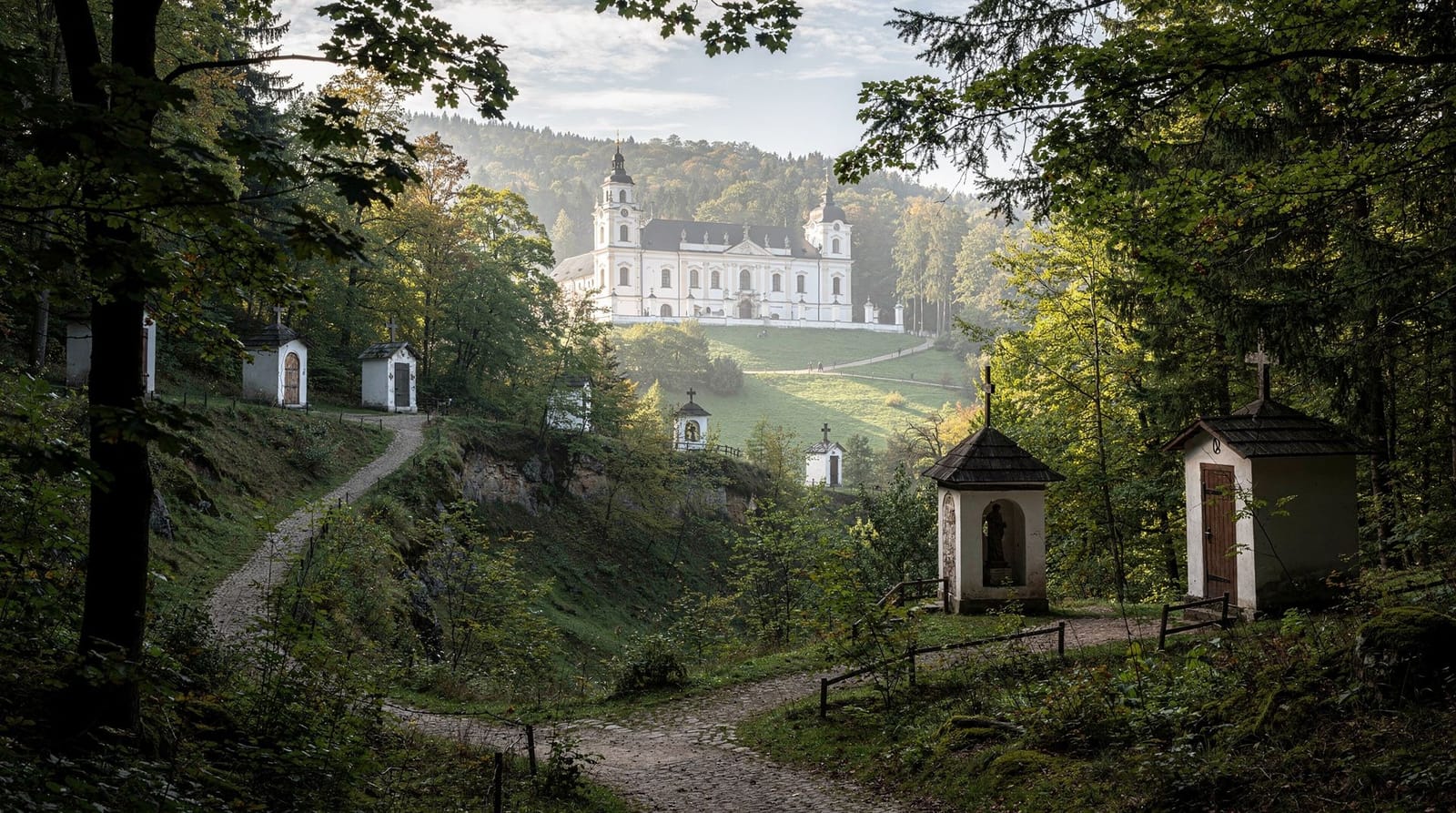
The Kalwaria Zebrzydowska sanctuary, about 20 km from Wadowice, is a UNESCO World Heritage Site — a complex of 42 chapels and churches spread across a hillside landscape, built in the early 17th century as a representation of the Via Dolorosa in Jerusalem. It was a pilgrimage destination that Karol Wojtyła visited throughout his life, from childhood through the papacy. If combining Wadowice with Kalwaria, allow an additional 2 hours.
What to eat in Wadowice
Wadowice is a modest Polish town and eating options are simple and inexpensive.
- Kremówka — mandatory. Every bakery sells it; Cukiernia Pod Wzgórzem is the most famous.
- Bar Mleczny Rynek — traditional milk bar on the main square. Cheap Polish standards, 15–25 PLN per main.
- Restauracja Pod Wieżą — full service restaurant near the church, Polish regional cooking, 35–55 PLN per main.
- Café Nostalgia — café near the museum, good for coffee and cakes after the tour.
If you’re travelling with children or want a quicker option, several small bakeries and kiosks around the Rynek sell simple sandwiches and pastries suitable for a fast lunch before catching the bus back to Kraków — useful if your day trip also includes Kalwaria Zebrzydowska and time is tight.
Practical details
How long: Allow 2.5–3.5 hours in Wadowice including the museum, basilica, and a kremówka. With travel from Kraków, a half-day is comfortable; with Kalwaria added, plan a full day.
Seasonal notes: Wadowice is visited year-round. Pilgrimage groups are common in spring and summer, particularly around 18 May (John Paul II’s birthday) and 22 October (his feast day). These dates see larger crowds but also a particularly alive atmosphere.
Religious context: Even if you are not Catholic, the museum works well as a portrait of 20th-century Polish history and identity. John Paul II’s role in supporting Solidarity, his influence on the peaceful transition from Communism, and his relationship with Poland throughout his papacy are covered with clarity and honesty.
Combining Wadowice with other sites
Wadowice combines naturally with:
- Kalwaria Zebrzydowska: 20 km from Wadowice, 40 minutes by car or local bus. UNESCO-listed pilgrimage sanctuary, essential for understanding the papal landscape of the region.
- Kraków’s Łagiewniki (Divine Mercy Sanctuary): On the southern edge of Kraków, accessible on the return journey. Dedicated to Sister Faustina Kowalska, whose Divine Mercy devotion John Paul II elevated internationally. A logical pairing.
- Częstochowa: Further afield (2+ hours from Wadowice) but the third corner of a Polish Catholic triangle. Better saved for a separate day.
Costs in PLN
| Item | Approx. cost |
|---|---|
| Guided day trip from Kraków | 110–160 PLN (€26–38) |
| Bus from Kraków (each way) | 12–18 PLN (€2.90–4.30) |
| Family Home Museum admission | see domjp2.pl |
| Kremówka pastry | 2–5 PLN (€0.50–1.20) |
| Meal in Wadowice | 15–55 PLN (€4–13) per main |
Frequently asked questions about the Wadowice day trip from Kraków
Is Wadowice worth visiting?
For visitors interested in John Paul II, Polish 20th-century history, or Catholic pilgrimage, absolutely yes. The museum is genuinely excellent — not just devotional but historically substantive. For visitors with no particular interest in the subject, Wadowice is a pleasant small town but not a destination in itself; the museum is the draw.
How long should I spend in Wadowice?
2.5–3 hours covers the museum, basilica, Rynek, and a kremówka break comfortably. Add an hour if you are a thorough museum visitor. Allow more time if combining with Kalwaria Zebrzydowska.
Is the John Paul II museum appropriate for children?
Yes, for older children (10+) who have some context. The museum is thoughtfully designed with multimedia elements. Very young children may find the exhibition content difficult to engage with, but the Rynek itself (with its statue and bakeries) is accessible for any age.
Can I visit Wadowice without a guide?
Yes — the museum has audio guides in English and the town is small enough to navigate independently. The bus from Kraków is straightforward. A guided tour adds context that the audio guide alone does not provide, particularly for the historical and political dimensions of the papacy.
What is kremówka and should I try it?
Kremówka (also known as napoleonka) is a double-layered vanilla cream pastry between puff pastry sheets. It is essentially the Polish version of the French mille-feuille. John Paul II mentioned in a 1999 speech that he and his classmates would race to buy them after school from a bakery near the Rynek. The association has become part of Wadowice’s identity. Yes, try one.
Should I combine Wadowice with Kalwaria Zebrzydowska on the same day?
If you have a full day and an interest in the region’s broader Catholic pilgrimage landscape, yes — it deepens the picture of the places that shaped young Karol Wojtyła. If you’re tight on time, treat Wadowice as a standalone half-day and consider Kalwaria Zebrzydowska separately or skip it; rushing the UNESCO sanctuary in 30–40 minutes doesn’t do it justice.
Is it better to visit Wadowice independently or with a tour?
Independent visits work well since the museum has English audio guides and the bus connection is simple. A guided tour adds most value for visitors who want the historical and political context of the papacy explained rather than just the biographical facts — worthwhile if this period of Polish history is new to you.
Wadowice during the Second World War
The Nazi occupation of Wadowice began on 4 September 1939. The town, known in German as Freistadt, was incorporated into the Third Reich (not the General Government, as Kraków was). This distinction had immediate consequences: the systematic expulsion of Poles and Jews, the imposition of racial laws, and the persecution of the local Catholic church.
Karol Wojtyła was 19 at the occupation’s start, studying at the Jagiellonian University in Kraków. He returned to find his hometown transformed. Many of his Jewish classmates and neighbours had been killed or deported — including the Kluger family (his close friend Jerzy survived the war and reconnected with Wojtyła decades later, eventually visiting him at the Vatican multiple times). The local Catholic clergy was targeted for arrest and deportation to concentration camps.
The family apartment at ul. Kościelna 7 was shared with his father at this time; his mother had died in 1929, his older brother Edmund in 1932. In 1941, his father died in the apartment — leaving Karol Wojtyła, at 21, the sole surviving member of his immediate family. He later described his wartime experiences, including this personal loss, as formative to his understanding of suffering and resilience.
The museum at Wadowice addresses this period with care — including the town’s Jewish history before and during the war, the fate of the Jewish community (almost entirely murdered), and Wojtyła’s later efforts as Pope to advance Jewish-Catholic reconciliation, including his 1986 visit to Rome’s Great Synagogue and his 2000 pilgrimage to Yad Vashem in Jerusalem.
Karol Wojtyła in Kraków: before the papacy
Before John Paul II became a global figure, he was Karol Wojtyła — an academic, playwright, poet, priest, and bishop deeply rooted in Kraków’s intellectual and spiritual life. Visitors to Kraków who want to follow his footsteps will find traces throughout the city:
Wawel Cathedral: Wojtyła was ordained as a priest in Wawel Cathedral in 1946 and as Archbishop of Kraków in the same building in 1964. It was here, more than anywhere outside Rome, that his role in Polish church life was centred. See the Wawel Castle guide for visiting details.
Episcopal Palace (Pałac Arcybiskupi), ul. Franciszkańska 3: The official residence of Kraków’s Archbishop, where Wojtyła lived from 1964 until his election as Pope in 1978. The famous window — from which he would address crowds in the courtyard below — is a pilgrimage point in its own right. The tradition of “window appearances” from this exact window has been continued by his successors.
Church of St Francis of Assisi (Kościół Franciszkanów): Adjacent to the Episcopal Palace, this was Wojtyła’s parish church in his years as Archbishop. The Wyspiański Art Nouveau stained glass windows here are among the finest in Poland.
Jagiellonian University: Wojtyła studied Polish philology and literature at the Jagiellonian University before WWII, then theology at the clandestine seminary established by Archbishop Sapieha during the Nazi occupation. The Collegium Novum on Gołębia Street houses administrative offices; nearby Collegium Minus holds the academic traditions he was part of.
Divine Mercy Sanctuary, Łagiewniki: On the southern outskirts of Kraków (accessible by tram), this sanctuary is dedicated to the Divine Mercy devotion of Sister Faustina Kowalska, which Wojtyła championed internationally as both Archbishop and Pope. The modern basilica designed by Witold Cęckiewicz (consecrated by John Paul II on his last visit to Kraków in 2002) is one of the most significant contemporary religious buildings in Poland.
Poland’s relationship with John Paul II
The election of a Polish pope on 16 October 1978 sent shockwaves through Communist Poland. The government was caught off-guard; the people were electrified. His first pilgrimage to Poland in June 1979, during which he addressed millions across nine days, is widely credited by Polish historians as the moment that turned the tide against the Communist regime — not through direct political action, but through the vivid demonstration that the Polish nation existed and had an identity independent of its imposed government.
His relationship with Solidarity — officially at arm’s length but in practice one of moral support and theological legitimacy — helped sustain the movement through martial law (1981–1983) and the negotiations that led to the Round Table Agreements and Poland’s democratic elections of 1989.
Within Poland, debates about John Paul II’s legacy have become more complex in recent years. Recent investigative journalism and church documents have raised serious questions about how he handled knowledge of clerical sexual abuse when he was Archbishop of Kraków and later as Pope. These questions are contested but significant, and Polish society is undergoing a serious re-examination of the figure who was, for decades, treated as beyond criticism. A thoughtful visit to Wadowice and Kraków’s John Paul II sites is richer for being aware of this complexity.
What makes Wadowice worthwhile for all visitors
Whether you are Catholic, broadly religious, or entirely secular, Wadowice and its museum offer something specific that other Polish history museums typically do not: an intimate, biographical account of a single 20th-century Polish life that intersects with almost every major historical event of the century — Nazi occupation, Communism, Cold War, détente, the fall of the Soviet bloc, and globalisation.
The museum does not shy away from difficulty. The section on the Nazi occupation of Wadowice — the deportation and murder of the town’s Jewish community, including Wojtyła’s childhood friend Jerzy Kluger — is handled with honesty. The section on his papacy acknowledges the scale of his global influence without hagiography. It is an unusually mature museum by Polish standards.
Wadowice versus following the Kraków papal trail
If a full day trip to Wadowice doesn’t fit your schedule, you don’t have to skip Karol Wojtyła’s story entirely — much of his adult life is documented within Kraków itself. Wawel Cathedral (where he was ordained), the Episcopal Palace window, and the Church of St Francis of Assisi are all reachable on foot from the Rynek in an afternoon. Wadowice adds the childhood and family dimension that Kraków’s sites don’t cover, which is why the two complement each other rather than substitute for one another. If you have only one day for this theme, decide first whether the origin story (Wadowice) or the adult career (Kraków) interests you more.
Related guides
- Wadowice destination guide
- Częstochowa Black Madonna day trip
- Kalwaria Zebrzydowska
- Kraków Old Town and Wawel
- Day trips from Kraków
- Kraków 3-day itinerary
- Polish history for visitors guide
Top experiences
Bookable activities with verified prices and instant confirmation on GetYourGuide.