Obwarzanek krakowski: the ring bread of Kraków
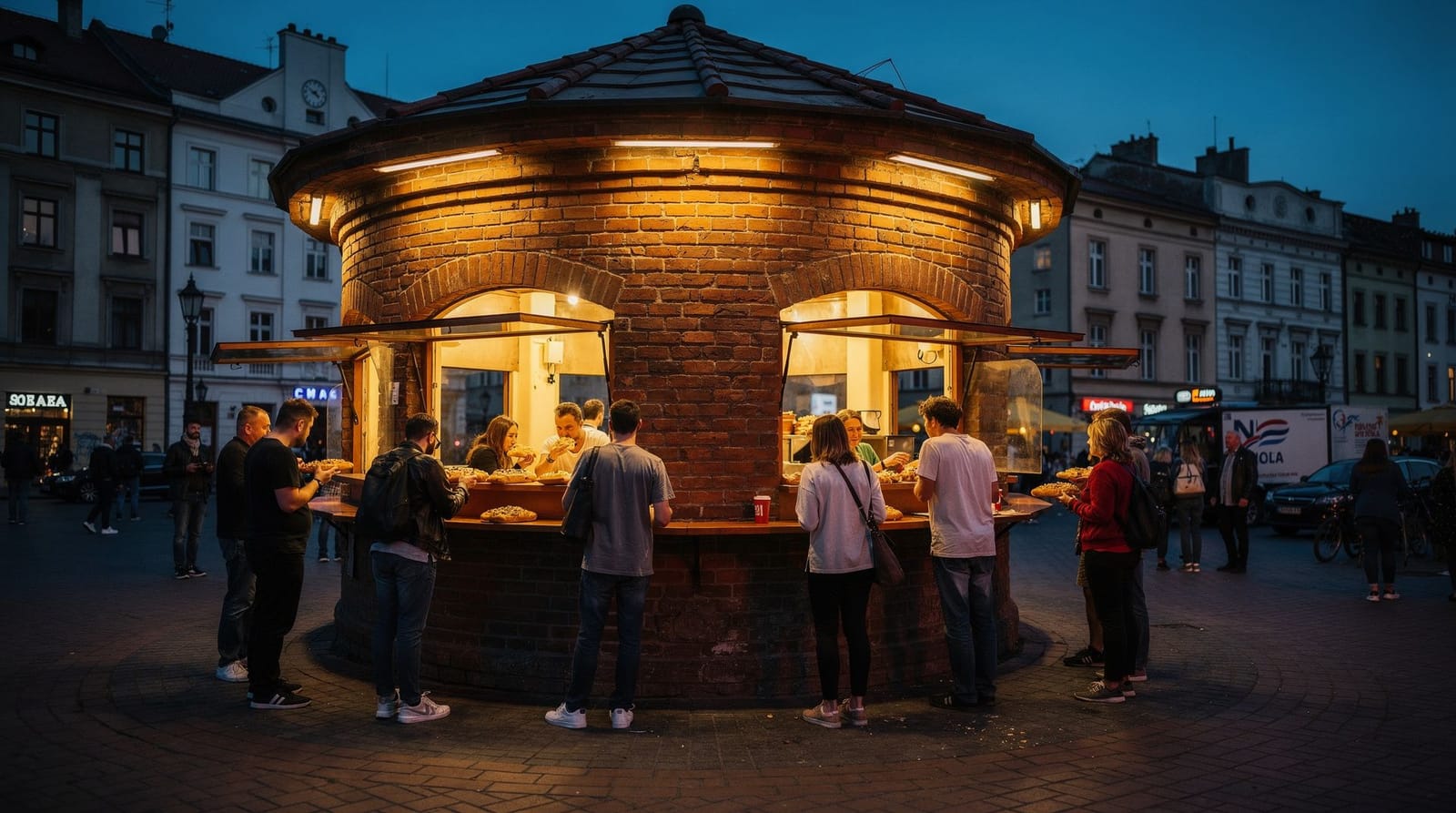
Krakow: late night bites Polish street food and drinks tour
What is an obwarzanek krakowski and where can I buy one?
The obwarzanek krakowski is Kraków's iconic plaited ring bread — scalded, baked, and sprinkled with sesame, poppy seeds or salt. Protected by EU geographical indication since 2010. Buy from the orange street carts found across the city for 3–5 PLN (≈ €0.70–1.20). Eat fresh, the same day.
What is an obwarzanek?
The obwarzanek krakowski is one of the oldest continuously produced foods in Poland and perhaps the most emblematic edible symbol of Kraków. A plaited ring of wheat dough, scalded (obwarzany — hence the name: “scalded”) in boiling water before baking, it emerges from the oven with a firm crust, slightly chewy interior, and a dusting of sesame seeds (sezamowy), poppy seeds (makowy) or coarse salt (solony).
The word obwarzanek is related to “wrzeć” (to boil) and the scalding process — which is also what distinguishes it from a bagel and from other ring breads. The scalding gelatinises the outer layer before baking, creating the distinctive crust. The result is slightly sweeter and lighter than a bagel, with a more open crumb and a less dense chew.
Historical records of the obwarzanek in Kraków date to 1394, when they appear in accounts of the royal court. By the 19th century they were a staple of Kraków street culture, sold by vendors who carried them on long poles or pushed carts through the streets. The orange carts you see today are the modern version of a tradition that is over 600 years old.
| Where | Orange carts across the Old Town — Rynek Główny, Floriańska, near Wawel |
| Cost | Around 3–5 PLN per ring, cash only |
| Best time | Morning, straight from the first bakery delivery |
| Eat within | 2–4 hours of buying, before the crust softens |
| Varieties | Poppy seed (makowy), sesame (sezamowy), salt (solony) |
EU protected status
Since 2010, the obwarzanek krakowski has been protected by EU geographical indication (PGI) — the same status as Champagne, Parmigiano Reggiano and Prosciutto di Parma. This means that only obwarzanki produced in the Kraków municipality and surrounding powiat, following specific production rules (the scalding process, the plaiting technique, the approved ingredients), can legally carry the name.
The production is licensed: approximately 150 registered bakers produce obwarzanki for the city’s street vendors. Each vendor sells only from licensed producers; the certification number is visible on the cart. The production is tracked — Kraków consumes an estimated 150,000–180,000 obwarzanki per day.
This is not marketing — it is genuine food culture protection of a product that has existed, largely unchanged, for six centuries.
The orange carts: how to find them
The orange push-carts selling obwarzanki are one of the most visible sights in central Kraków. There are approximately 170 licensed vendors operating in the city. They are found:
- Rynek Główny (the Main Market Square) — always multiple carts, open from early morning
- Ul. Floriańska and the main pedestrian routes into the Old Town
- The approaches to the Barbican and Florian Gate
- Pl. Szczepański and the museum area
- Near the Wawel Hill entrance
- Around the train station (Kraków Główny) and Galeria Krakowska
- Kazimierz, around Plac Nowy and Plac Wolnica
The carts operate roughly 6am–8pm (earlier in winter, later in summer). A few run until late evening near nightlife areas.
How to buy and eat
Buying: point at the variety you want (makowy = poppy seed, sezamowy = sesame, solony = salt; the carts usually display their options, and the visible rings make it clear). Hand over 3–5 PLN. No negotiation, no receipt.
Eating: obwarzanki are eaten as-is, carried in hand or in the paper bag. No spreads or fillings are traditional — this is bread as a standalone snack, not a vehicle for other things. Eat it fresh; it is at its best within 2–4 hours of baking, before the crust softens. Do not refrigerate.
Which variety? Poppy seed is the traditional default and the most popular. Sesame is slightly richer. Salt is the simplest and best when very fresh (the coarse salt crystals contrast with the mild bread). At your first cart, buy one of each.
Is it the same as a bagel? Related but distinct. The bagel originated partly from the obwarzanek — Jewish bakers in Poland adapted the form into the hand-held morning roll that became the New York bagel. The obwarzanek predates the bagel; it is larger, flatter, less dense, with a more delicate crust. The two are cousins, not twins.
Obwarzanek culture in Kraków
The ring shape has made the obwarzanek a gift and a symbol — children wear them as bracelets, visitors photograph them, and locals eat them daily. The vendors’ carts are a piece of the streetscape that locals feel genuinely protective of. There have been periodic attempts by commercial bakeries to sell cheaper, industrial obwarzanki-style products; they are not covered by the PGI designation and Kraków residents treat them as impostors.
The proper obwarzanek is handmade: the dough is plaited by hand, scalded, and baked. The texture of a handmade versus industrial version is immediately distinguishable — the handmade version has slight irregularities in the plait, a more complex crust and a better flavour. All licensed street cart obwarzanki are handmade.
The food tour context
Most of the main Kraków food tours include an obwarzanek stop as part of the experience. The late night bites Polish street food and drinks tour is an evening alternative that focuses on Polish street food and drinks, and the obwarzanek fits naturally into that kind of street food conversation. The street food walking tour gives particular emphasis to street food culture including the obwarzanek’s history.
The Polish food and culture tour with tastings places the obwarzanek in its historical context as part of Kraków’s long food culture narrative.
Obwarzanek and Kraków’s food landscape
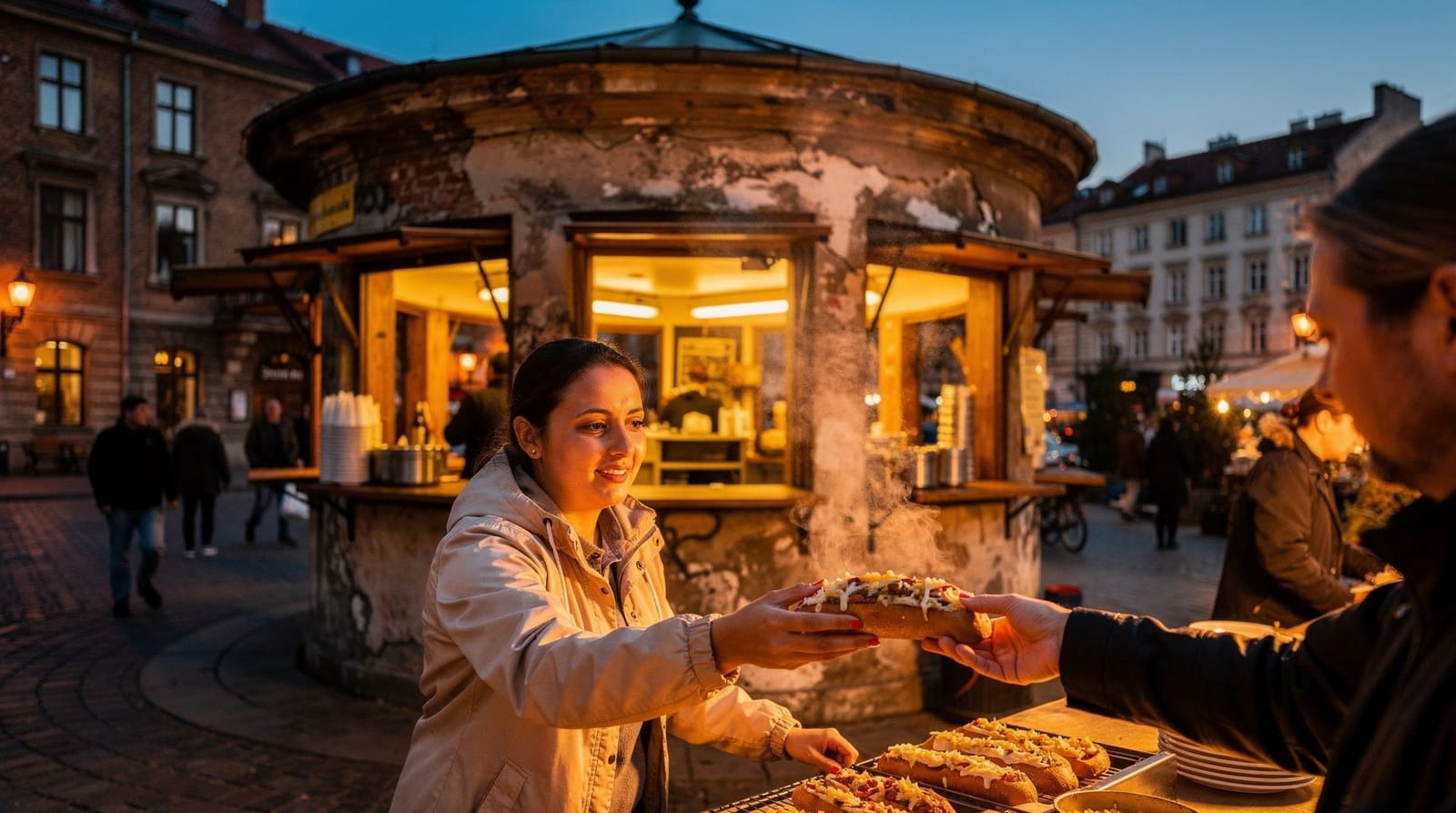
The obwarzanek sits alongside a handful of other quintessentially Kraków food experiences: the zapiekanka at Plac Nowy (see Zapiekanka: Kraków’s street food icon at Plac Nowy), the pierogi at the city’s pierogarnie (see Best pierogi in Kraków: the honest guide to dumplings), and the oscypek sold by Góral vendors from the Tatras (see Oscypek and Góral highlander food: the taste of the Tatras). Together these four define Kraków’s street food identity.
All four feature on the comprehensive food guide at Krakow food guide: the honest eater’s handbook.
Practical information for visitors
Price: 3–5 PLN (≈ €0.70–1.20). Prices are posted at the cart and vary slightly by vendor.
Payment: cash only at street carts. Have small coins and low-denomination notes ready.
Fresh vs stale: the difference matters. An obwarzanek from a morning cart at 8am is significantly better than one sitting in a plastic bag in a souvenir shop. Street carts receive fresh deliveries from the bakeries; shop versions may have been sitting for days.
Souvenir obwarzanki: ceramic versions of the obwarzanek are sold in souvenir shops throughout the city. These are safe to bring home; they are not food.
Pairing: the traditional street pairing is nothing (it is standalone bread). Some Kraków people eat it with butter or cream cheese at home. With coffee is common. With a can of cold Żywiec on a hot afternoon is excellent.
Obwarzanek etiquette and buying tips
Buying from a cart is simple, but a few small habits mark out a considerate visitor rather than an oblivious one. Queue if there is one — carts near Rynek Główny can have a short line during breakfast hours. Have coins ready rather than making the vendor break a large note for a 3 PLN purchase. Point clearly at the variety you want if your Polish is limited; vendors are used to this and it is not considered rude. Do not haggle — the price is fixed and regulated, and attempting to negotiate marks you as unfamiliar with the product’s status.
If you’re combining an obwarzanek with a walk, it pairs naturally with the Old Town walking tour — buy one at a cart near the Barbican and eat it as you walk the Royal Route — or with a stroll through Planty Park, the green ring circling the Old Town where several carts operate. For the square itself, the Rynek Główny main square guide has the full picture of what else to see nearby.
Obwarzanek vs its cousins
| Bread | Origin | Texture | Where to find in Kraków |
|---|---|---|---|
| Obwarzanek krakowski | Kraków, documented since 1394 | Plaited, chewy crust, light crumb | Orange street carts citywide |
| New York bagel | Descended from the same tradition, evolved in emigrant communities | Denser, rounder, no plait | Not a Kraków street food |
| Pretzel (precel) | Central European, distinct product | Twisted knot shape, often glazed | Occasional bakery stalls, not the same carts |
Fitting an obwarzanek into your day
The obwarzanek works best as a small pause between bigger stops rather than a destination of its own. A ring from a cart on the way to the Wawel Castle guide sights makes a simple breakfast, and another is easy to pick up after a visit to St. Mary’s Basilica or the Cloth Hall, all of which sit within a short walk of the carts around the square.
In Kazimierz, the carts near Plac Nowy pair naturally with a wander through the Kazimierz Jewish Quarter guide streets, and with the Kazimierz food scene if you want something more substantial afterwards. The obwarzanek is a snack, not a meal, so plan on following it with a proper stop at a milk bar or one of the traditional Polish dishes the city is known for.
If you are building a longer trip around eating well on a modest budget, the Krakow budget travel guide shows how a cart snack fits alongside other inexpensive meals, and the Krakow for first-timers page puts the obwarzanek in the wider context of a first visit.
Verdict and common mistakes
Frequently asked questions about the obwarzanek krakowski
Why does the obwarzanek look different from a New York bagel?
The obwarzanek is larger (typically 14–18 cm in diameter), flatter, and has a distinctive plaited (braided) ring rather than a smooth ring. The crust is more pronounced and the interior less dense. The two breads share a common ancestor in the Jewish-Polish baking tradition of the 16th–17th centuries, but developed differently: the obwarzanek in Kraków, the bagel in Jewish communities that emigrated to Eastern Europe and eventually America.
Can I take obwarzanki home?
Fresh obwarzanki do not travel well — they are best the day of purchase. In cool weather they stay reasonable for a day or two in a paper bag; they harden significantly and become unpleasant for eating rather than decoration. Do not bother trying to bring them home; eat them while you are there.
Are obwarzanki available year-round?
Yes — the carts operate every day of the year, including in winter when the vendors use heated cart variants. Production volume decreases slightly in winter but availability is not an issue.
Is the obwarzanek the same as the Kraków pretzel?
Confusingly, visitors sometimes conflate the obwarzanek with the soft pretzel (precel). They are different products: the obwarzanek is a ring with a specific scalding process and plaiting method; pretzels are twisted and have a distinctive shape. The obwarzanek is the Kraków-specific product; pretzels are found broadly across Central Europe.
Where is the best obwarzanek cart in Kraków?
Honest answer: any licensed cart sells the same quality (same producers, same production standards). The best obwarzanek is always the one that is freshest — a cart that is clearly popular and moving through stock quickly is better than an isolated cart near a tourist monument with 20 rings sitting unsold. Ask to see one before buying if the selection looks old.
Is the obwarzanek vegan?
Yes, in its plain forms — the classic dough recipe is flour, water, yeast and salt, with no eggs, milk or butter. This makes the poppy, sesame and salt varieties suitable for vegans and vegetarians without any special request. It is one of the easiest traditional Kraków foods for plant-based travellers to enjoy without needing to check ingredients.
Top experiences
Bookable activities with verified prices and instant confirmation on GetYourGuide.