Kraków in spring: why April and May are the best months to visit
Krakow: Old Town guided walking tour
Duration: 3h
Is spring a good time to visit Kraków?
Spring — especially April and May — is widely considered the best overall time to visit Kraków. Temperatures are mild (12–20°C), the Planty gardens bloom, Wawel Castle queues are short, and accommodation costs 20–30% less than peak summer. Easter in Kraków is a major cultural event, and the Jewish Culture Festival warm-up programme begins in late spring. May is particularly ideal: long days, light crowds, great weather.
| Where | Planty park, Rynek Główny, Vistula embankment |
| Cost | Accommodation 20–30% below summer peak; March is the annual low |
| Time needed | A standard 3–4 day trip; add a day for Easter-week events |
| Getting there | Same year-round access; Tatra high trails reopen gradually April–May |
| Best time | May for warmth and daylight; April for value and quieter museums |
Why spring is Kraków’s best-kept seasonal secret
Ask experienced Kraków visitors when they prefer to travel, and the consistent answer is April or May. The tourist industry doesn’t push spring the way it sells the Christmas markets or the summer festival season, but the arithmetic of a spring visit is compelling: temperatures of 12–20°C (occasionally 22°C in May), the Old Town’s Planty park in full green-and-blossom, minimal queues at Wawel and the underground museums, accommodation at 20–30% below summer prices, and enough cultural programming to fill a week without effort.
March is the transition month and can still be cold (3–10°C) and grey. The shift comes in early April, when the first warm stretches arrive and the horse-chestnut trees along the Planty begin flowering. By mid-May, Kraków is at its most photogenic and most liveable — long days (sunset after 20:30), cafe terraces open, the Vistula embankment beginning its slow awakening.
March: the cold shoulder worth braving
March is technically spring but behaves like a late winter extension. Average temperatures run 3–9°C, nights can drop below freezing, and snow is possible in early March. What makes it interesting:
March is the cheapest month to visit Kraków, with accommodation at its annual low outside of perhaps January. A double room in a three-star Old Town hotel may cost 200–250 PLN (≈€47–60) per night — roughly half the August rate.
Museums are at their emptiest. The Rynek Underground Museum, Schindler Factory, and Czartoryski Museum (with the Leonardo da Vinci Lady with an Ermine) are walk-in accessible without pre-booking on most days.
The Wieliczka Salt Mine and Auschwitz operate normally. Both are underground or outdoor heritage sites unaffected by weather; March crowds are low enough that Wieliczka tour slots are available same-day (though booking ahead is still recommended).
The Planty park in March is bare but not unpleasant — the exposed structure of the lime trees and chestnut avenues has its own austere beauty. Wawel Castle’s State Rooms and Armoury are open; the Dragon’s Den sometimes has limited access in icy conditions.
Easter in Kraków: a genuine cultural event
Easter (Wielkanoc) is a major occasion in Kraków, and worth timing a visit around if you have flexibility. The specific dates vary by year (Easter Sunday falls between 22 March and 25 April on the Gregorian calendar); in 2026, Easter Sunday is 5 April.
Holy Week observances: Kraków’s many churches hold elaborate Holy Week services. The most atmospheric are at Wawel Cathedral, St. Mary’s Basilica, and the Franciscan Church (ul. Franciszkańska 2). The Franciscan Church’s Good Friday Way of the Cross (Droga Krzyżowa) procession through the Old Town streets draws thousands of participants and observers.
Emaus market (Easter Monday): On Poniedziałek Wielkanocny (Easter Monday, always a public holiday in Poland), a traditional fair called Emaus takes place near the Salvatorian Church in the Zwierzyniec neighbourhood. This 600-year-old tradition involves craft stalls, folk entertainment, and the sale of traditional Easter decorations — pisanki (painted eggs) and wooden toys. It is free, local, and charming.
Rękawka: The Tuesday after Easter, on Krakus Mound (Kopiec Krakusa) in Podgórze, Kraków holds Rękawka — a pre-Christian Slavic spring festival. Craftspeople, re-enactors in early medieval dress, and folk music performers gather around the ancient mound. This is one of the most unusual free cultural events in the city and one most visitors entirely miss. Take tram 3 or 50 to Limanowskiego and walk 10 minutes to the mound.
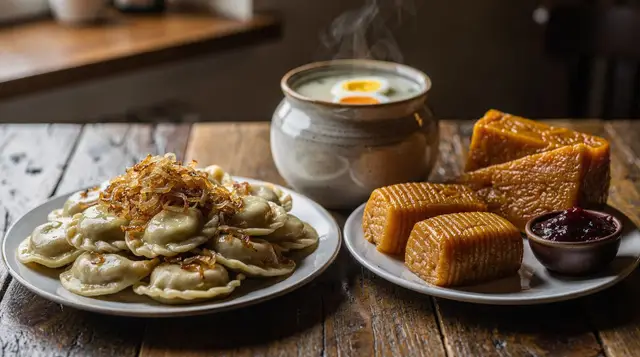
Easter food: Kraków’s bakeries and food markets fill with Easter specialities in Holy Week — żurek (sour rye soup), biała kiełbasa (white sausage for Easter breakfast), mazurek (flat almond or caramel tart), babka wielkanocna (yeast cake). The Stary Kleparz market (near the Barbican) and Hala Targowa on Grzegórzecka are the best places to shop for these.
April: the sweet spot begins
By mid-April, Kraków’s spring has properly arrived. The horse-chestnut trees along the Planty are flowering white and pink; outdoor cafe terraces begin extending their hours; the Vistula embankment, still quiet, offers long evening walks under early green foliage.
Tatra Mountains in April are in transition. Low trails are clear and walkable; Morskie Oko is accessible from mid-April onwards, though the lake may still have residual ice early in the month. High mountain trails above 1,800 m often require trekking poles and good boots until May. The cable car to Kasprowy Wierch operates but conditions vary — check TOPR (Tatrzańskie Ochotnicze Pogotowie Ratunkowe, the mountain rescue service) weather reports before heading up.
Day trips in April:
- Wieliczka Salt Mine: fully accessible year-round; easier to book in April than summer
- Zakopane: mountain town walks and highland culture without summer crowds
- Ojców National Park: limestone ravines and wildflowers at their spring best
- Auschwitz-Birkenau Memorial: open year-round; April visits feel appropriately solemn without summer’s queuing pressure
A practical note on Auschwitz in spring: guided tours (required for foreign visitors outside of free-entry periods) are bookable with 1–2 weeks’ notice in April rather than the 4–6 weeks needed in July–August. See our Auschwitz day trip guide for full logistics.
May: the peak of spring and arguably the best month
May is when Kraków performs at its best. Temperatures reach 16–22°C by day (occasionally 25°C), evenings are mild enough for outdoor dining, and the tourist wave is building but has not crested.
Constitution Day (3 May) is a national public holiday — parade down the Royal Route (ul. Grodzka and ul. Floriańska to Rynek Główny), with historical re-enactors, brass bands, and a large free outdoor celebration. The parade is worth watching; the square afterward is busy but festive.
The Juvenalia student festival (dates vary by university, usually early-mid May) sees Kraków’s universities — led by the Jagiellonian University, Poland’s oldest, founded 1364 — hold their traditional spring festival. Students process through the streets, open-air concerts fill the city, and the atmosphere in Kazimierz and around the Jagiellonian campus is particularly lively. This is genuinely local and free.
Walking the Planty in May is one of the great free pleasures in Kraków. The 2 km green ring of parkland encircling the Old Town is in full bloom, with chestnut and lime trees providing shade, park benches occupied by students and pensioners, and the medieval city walls visible through the foliage. The walk takes 45–60 minutes at a leisurely pace; free, always open.
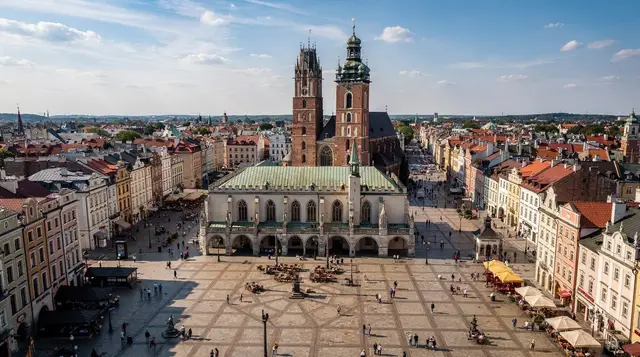
Rynek Główny in May has the cafes open and the crowds at a pleasant level — busy enough to feel alive, not so crowded that the square loses its grandeur. The St. Mary’s Basilica Hejnał (the truncated trumpet call from the tower, every hour) is audible across the square. Entry to the Basilica is 15 PLN (≈€3.5); arrive before 09:00 for a near-empty interior.
Spring food and drink moments
Kraków’s food culture in spring opens in ways that winter forecloses.
Zapiekanki at Plac Nowy (Kazimierz): The round building at the centre of Plac Nowy serves as the starting point for Kraków’s most iconic street food — the zapiekanka, an open baguette topped with sautéed mushrooms, melted cheese, and various combinations. Eat standing at the market edge for 10–16 PLN (≈€2.5–4). In spring, the surrounding market has early-season vegetables and strawberries from local growers.
Obwarzanek vendors return to street corners from early spring. The obwarzanek krakowski — a pretzel-like bread ring, slightly chewy, covered with poppy seeds, sesame, or salt — is a medieval institution unique to Kraków and protected by EU geographical indication. A vendor’s cart near Rynek Główny or the Barbican sells them for 3–4 PLN (≈€0.7–1). Eat within 20 minutes of purchase.
Roślinny Bar (ul. Szpitalna 38): Kraków’s food culture has expanded well beyond traditional milk bars. This plant-based restaurant near the Old Town serves seasonal Polish cooking adapted for a modern palate — spring soups with nettles and sorrel, asparagus (szparagi) in May, local mushroom risotto. A full meal costs 35–55 PLN (≈€8–13).
Getting to Kraków in spring: the practical side
Flights in April–May are more expensive than January–February but significantly cheaper than July–August. Book 6–10 weeks ahead for the best combination of price and choice. Ryanair, Wizz Air, and LOT Polish Airlines all serve KRK from major Western European hubs.
A guided walking tour is especially effective in spring, when the weather is comfortable and the Old Town can be walked in full. The Old Town guided walking tour is the best orientation for first-time visitors — it covers Rynek Główny, St. Mary’s Basilica, the Barbican, and the Royal Route in approximately 2 hours. The Kazimierz Jewish Quarter walking tour pairs well with it for a full first day.
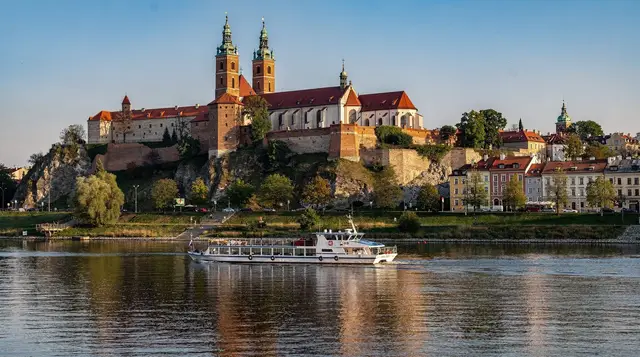
The Vistula in spring: The river’s embankment begins to come alive in late April. The sightseeing cruise by the Vistula River provides a perspective on Wawel Hill and the Old Town skyline that you cannot get from street level. In spring, with the trees freshly green and the water levels reflecting winter snowmelt, the views are at their most dramatic.
Spring day trips
Morskie Oko opens from mid-April. The classic route is the 8 km paved road from Palenica Białczańska car park to the lake — a 2–2.5 hour walk each way. The alpine lake is surrounded by snow-capped peaks in April and early May, with the ice gradually melting. Horse-drawn carriages cover the route if walking is not your preference (80 PLN / ≈€19 per person return). See our Morskie Oko guide.
Ojców National Park in spring: the Ojców valley erupts with wildflowers in April and May — wood anemones, primroses, and spring gentians on the limestone slopes. The park is 25 km north of Kraków and accessible by local bus or via a tour. Pieskowa Skała Castle’s cliff-top position above the Prądnik River is breathtaking in spring light.
Polish food and culture are well suited to a spring walking tour. The 4-hour Polish food tour visits milk bars, traditional food producers, and Kazimierz food stalls — in spring, the full tour can be done comfortably without heat fatigue.
Spring month by month
| Month | Temp | Crowds | Highlight |
|---|---|---|---|
| March | 3–10°C | Lowest of the year with January | Cheapest hotels, empty museums |
| April | 9–18°C | Low, rising toward Easter | Easter traditions, Planty blossom begins |
| May | 16–22°C | Building but still comfortable | Constitution Day, Juvenalia, full bloom |
Spring versus the other shoulder season
Spring and autumn are Kraków’s two shoulder seasons, and they suit slightly different travellers. Spring’s advantage is daylight and forward momentum — the city is visibly waking up, terraces are opening for the first time all year, and the Tatra trails are reopening rather than closing. Autumn, covered in the Kraków in autumn guide, trades that energy for mushroom-season food and dramatic foliage colour. If your dates are flexible and you’re choosing between the two, May slightly edges out September on daylight hours and blooming greenery, while September edges out May on cultural programming density.
Packing for a Kraków spring trip
March demands a proper winter coat still — this is the month visitors most often underestimate, arriving in a light jacket expecting spring and finding near-freezing mornings. By mid-April, a mid-weight jacket with layers underneath is enough, though evenings still call for something warmer than a T-shirt. May is the first genuinely light-packing month: a light jacket for evenings, comfortable walking shoes, and sun protection are usually enough. Across the whole season, waterproof footwear is worth it — spring showers are frequent even on otherwise warm days, and the Old Town’s cobblestones pool water quickly.
Frequently asked questions about Kraków in spring
What is the weather like in April in Kraków?
April averages 9–15°C, with a mix of sunny and cloudy days. Rain is possible but rarely sustained. Evenings can still be cool (5–8°C); a mid-weight jacket is necessary. By late April, daytime temperatures often reach 16–18°C and outdoor dining becomes comfortable.
Is Easter a good time to visit?
Yes, if you can plan around the logistics. Public holidays (Good Friday is not a Polish public holiday; Easter Monday is) mean some shops and a few restaurants close, but the cultural events — the Emaus market, Rękawka festival, church processions — more than compensate. Hotels raise prices during Easter week; book 2–3 months ahead.
Are Tatra Mountain trails safe in April?
Lower trails (below 1,500 m) are generally clear and safe by mid-April. High trails (above 1,800 m) may still have snow and ice requiring crampons and experience. Morskie Oko (1,395 m) is accessible with hiking boots by mid-April. Always check TOPR mountain weather reports (topr.pl) before heading above the treeline. See our full guide at /destinations/tatra-mountains/.
When do the outdoor terraces open in Kraków?
Most café and restaurant terraces on Rynek Główny, ul. Floriańska, and in Kazimierz open from April 1 weather permitting — this is a legally regulated date in Kraków’s Old Town conservation zone. Many operators have outdoor heat lamps allowing terrace use even on cool April evenings.
Is May better than April for visiting?
May is warmer (16–22°C vs 9–15°C in April) and has more cultural programming. For first-time visitors who want the complete experience — good weather, walking comfort, outdoor eating, cultural events — May edges ahead. For those prioritising value and emptier museums, April is better. Both are significantly better than July–August for crowds and prices.
How does spring compare to autumn for a Kraków visit?
Both are shoulder seasons with similar crowd and price advantages over summer. Spring offers longer daylight, blooming greenery, and reopening mountain trails; autumn offers dramatic foliage, mushroom-season food, and festivals like Sacrum Profanum. See the Kraków in autumn guide for the full comparison — neither is objectively better, but May and September are usually rated the two strongest single months.
Is March worth visiting despite the cold?
Yes, for a specific kind of traveller: those prioritising rock-bottom prices and empty museums over comfortable weather. March hotel rates run roughly half of August’s, and sites like the Rynek Underground Museum are walk-in accessible most days. If mild weather and outdoor terraces matter more, wait until mid-April.
Top experiences
Bookable activities with verified prices and instant confirmation on GetYourGuide.