Wawel Castle state rooms: tickets, routes and what to see
Krakow: Wawel Castle skip-the-line guided tour
Duration: 2h
Do you need to book Wawel State Rooms tickets in advance?
Yes — the State Rooms have a strict daily visitor limit and sell out in summer by late morning. Book at wawel.krakow.pl at least 3–7 days ahead from June through August. Off-season (November–March) you can usually buy on arrival, but online booking is still recommended to guarantee your preferred time slot.
Wawel Castle: Poland’s royal seat
Wawel Hill, rising 228 metres above sea level at the southern edge of Kraków’s Old Town, was the seat of Polish kings from the 10th century until the capital moved to Warsaw in 1596. The castle complex that stands here today — rebuilt largely in the Italian Renaissance style during the reign of Zygmunt I the Old (1507–1548) — is the most historically significant building in Poland.
For visitors, Wawel functions as a museum complex with multiple separate ticketed routes. The most important of these for cultural and historical depth is the State Rooms (Komnaty Królewskie) circuit, which takes you through the royal apartments on the upper floors of the castle’s main wing. Adjacent is the Royal Private Apartments route, which requires a separate ticket and guide.
This guide focuses on the State Rooms and Royal Private Apartments — the interior of the castle rather than the cathedral (which has its own separate ticketing) or the Dragon’s Den.
| Where | North and east wing, upper floors of Wawel Castle |
| Cost | 57 PLN State Rooms (reduced 43); 57 PLN Private Apartments |
| Time needed | 60–90 min State Rooms; +45 min for the Apartments |
| Getting there | 10-min walk south from Rynek Główny along ul. Grodzka |
| Best time | Weekday mornings, April–May or September–October |
The State Rooms (Komnaty Królewskie)
The State Rooms circuit covers the ceremonial apartments on the first and second floors of the north and east wings of the castle. These are the rooms in which the Polish court functioned for over two centuries: receiving ambassadors, passing legislation, hosting coronation banquets, and conducting the diplomatic business of a major European power.
The Entry Hall (Sala Turniejowa): the lowest level of the State Rooms, used for tournaments and ceremonies. The room is enormous — roughly 30 by 17 metres — with a stone floor and vaulted ceiling.
The Tournament Hall and adjoining rooms: the sequence of reception rooms on the first floor, hung with some of the most important tapestries in the world.
The Flemish tapestries: Wawel’s tapestry collection is the centrepiece of any visit. Zygmunt August commissioned over 300 tapestries from Flemish workshops in Brussels and Mechelen in the mid-16th century. Around 136 survive (most were saved from Swedish and later Russian seizures and eventually returned). They cover the walls floor-to-ceiling in several rooms, depicting biblical scenes — the story of Noah, the Tower of Babel, paradise landscapes — with extraordinary detail and vivid colour that has barely faded in nearly five centuries. These are among the finest surviving examples of 16th-century Flemish textile art.
The Deputies’ Hall (Sala Poselska): the official hall for receiving foreign ambassadors, with a carved stone portal from the original medieval castle and an extraordinary coffered wood ceiling. Look up: the ceiling beams are carved with 30 human heads, each with an individual expression. These are 16th-century carvings; the faces range from serene to suffering and have provoked centuries of interpretation.
The Senate Hall (Sala Senatorska): the largest room in the castle, where the Polish Senate met. The room retains much of its Renaissance decoration.
The Bird Room and the Study: smaller, more intimate rooms used by the king for private business, decorated with the finest tapestries and Renaissance furnishings in the collection.
The Royal Private Apartments
The Royal Private Apartments (Prywatne Apartamenty Królewskie) cover the south wing and require a separate guided tour — self-guided visits are not permitted. A guide accompanies each group and provides context unavailable from the panels alone.
These rooms contain the more personal historical artefacts: furniture, portraits, personal objects. The atmosphere is different from the formal grandeur of the State Rooms — smaller spaces, more intimate scale, and a sense of the castle as a place people lived rather than a ceremonial machine.
The guided tour of the Private Apartments takes approximately 45 minutes. Tours run in Polish and English (check the day’s schedule at the ticket office).
Other Wawel routes
Wawel Cathedral (separate ticket, 26 PLN): the Cathedral deserves at least 45 minutes. The royal tombs — Polish kings and national heroes including Tadeusz Kościuszko and Józef Piłsudski — are here. The Sigismund Bell (Dzwon Zygmunt), the largest in Poland, hangs in the cathedral tower and is included in the cathedral ticket. See the Archdiocesan Museum guide for a related visit nearby.
Dragon’s Den (Smocza Jama): the cave in the hill below the castle, associated with the legendary Kraków dragon. Short (about 10 minutes), popular with children. Entry 15 PLN (open seasonally, closed 1 November–31 December). Exit is via a spiral metal staircase emerging directly at the Vistula riverbank.
Lost Wawel: an archaeological exhibition in the basement showing the foundations of the 10th-century Rotunda of the Virgin Mary, the oldest known religious building on Wawel Hill.
Crown Treasury and Armoury: the collection of royal regalia, weapons, and armour. The Szczerbiec coronation sword (used at Polish royal coronations from 1320) is here.
Tickets and the timed-entry system
Wawel uses a strict timed-entry system for each route to limit crowding. Tickets are purchased at wawel.krakow.pl (recommended) or at the ticket office on site (queue in summer).
Castle 2nd floor (State Rooms and Oriental Art): adult 57 PLN (≈ €13.60), reduced 43 PLN. Royal Private Apartments: adult 57 PLN, reduced 43 PLN, guided only. A combined castle ticket (first and second floors) is 95 PLN adult, 71 PLN reduced. Payment on site is by card in PLN only.
The most practical approach for a first visit is a guided tour that includes Wawel Castle with skip-the-line access — this handles the complex ticketing system and provides historical context.
For those who want to combine the Castle with the Cathedral in a single booking, a combined Wawel Castle and Cathedral guided tour is the efficient option. And if you want the full Wawel Hill experience with flexible exploration, this tour of Wawel Royal Hill with optional Castle and Cathedral offers a guided overview.
State Rooms vs. Royal Private Apartments: which to book
| State Rooms | Royal Private Apartments | |
|---|---|---|
| Format | Self-guided, audio guide optional | Guided only, small groups |
| Highlight | Flemish tapestries, coffered ceilings | Personal furniture, intimate scale |
| Time | 60–90 min | 45 min |
| Best for | First-time visitors, tapestry/art interest | Repeat visitors, deeper royal-life detail |
| Booking pressure | Sells out by noon in summer | Sells out faster — smaller group sizes |
If you can only book one and this is your first Wawel visit, choose the State Rooms — the tapestries alone justify the ticket, and the self-guided format lets you linger where you want. Save the Private Apartments for a second visit or if guided storytelling matters more to you than visual grandeur.
Daily visitor limits — why they matter
The State Rooms admit a maximum of approximately 850 visitors per day. This is not a commercial limit — it reflects conservation requirements for the tapestries, which deteriorate with humidity and light exposure above certain thresholds. The limit is enforced regardless of demand.
In July and August, the daily allocation typically sells out by noon. Visiting mid-week (Tuesday–Thursday) and arriving early (opening is at 9:00) dramatically improves your chances of getting the slot you want.
Getting to Wawel
Wawel Hill is a 10-minute walk south of Rynek Główny along ul. Grodzka. The main visitor entrance is via the western ramp (ul. Droga do Zamku), which climbs the hill from the Vistula embankment.
The hill is pedestrianised — no cars or bicycles inside the castle walls. Bolt/Uber drops you at the bottom of the hill. From Kazimierz, the walk north along the Vistula embankment takes about 12 minutes.
When to visit
Best time: April–May and September–October. Queues are manageable, the castle courtyard is beautiful in spring and autumn light, and the tapestries look their best in the warm afternoon sun that comes through the north-wing windows.
Avoid: Saturday and Sunday afternoons in July–August. The castle courtyard is simply too crowded to be enjoyable, and the tapestry rooms feel cramped at peak visitor density.
Winter: the castle is open Tuesday–Sunday from 09:00; check wawel.krakow.pl for closing and last-admission times. Daily limits are lower but demand is also much lower, and walk-in tickets are usually available. The cathedral is worth particular attention in winter, when the dark interior and candlelit chapels have a quality of atmosphere you lose in the daylight crowds of summer.
Note on closures: Wawel Castle closes for state events approximately 4–6 times per year (including the Corpus Christi procession in June and occasional state funerals or ceremonies). Check the website before visiting.
Combining Wawel with other museums
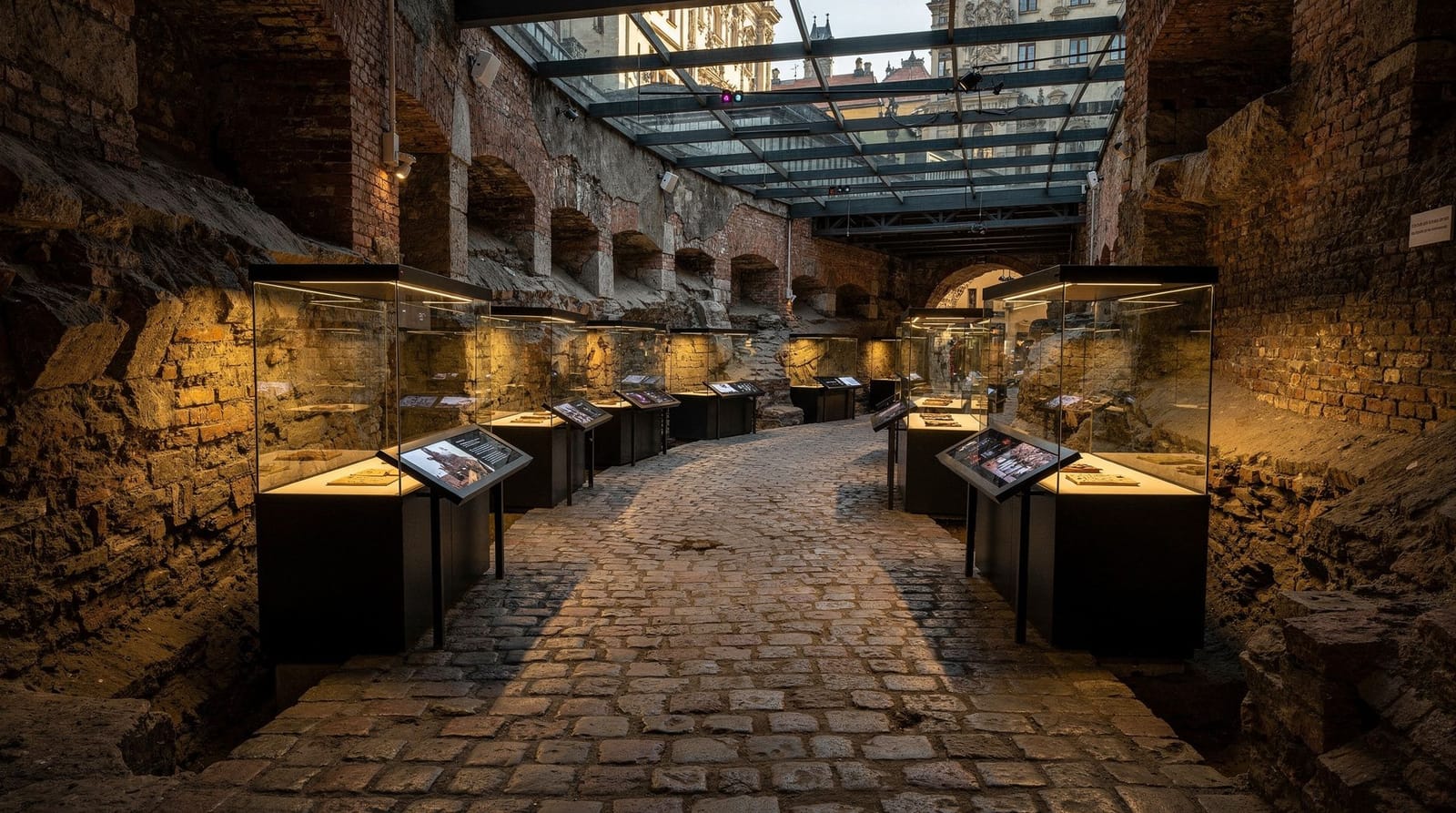
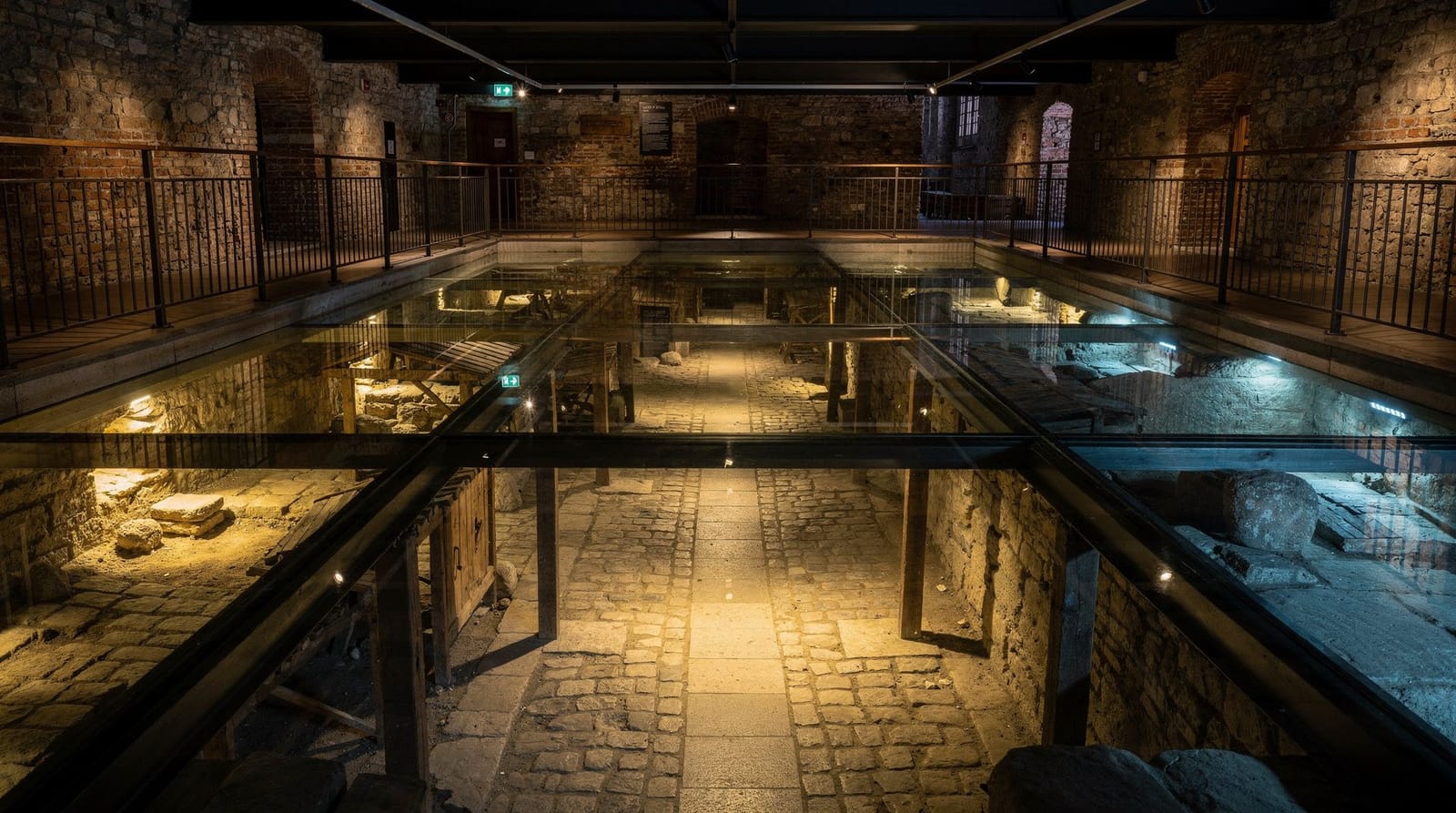
Wawel pairs naturally with the Rynek Underground Museum — the two together trace medieval Kraków from its commercial heart (the underground) to its political centre (the castle). A morning at the Rynek Underground followed by an afternoon at Wawel is a classic first-day programme.
For a deeper medieval experience, the Szołayski House branch of the National Museum holds the best Gothic collection in Kraków.
Museum pass holders should compare the Kraków Museum Pass against Wawel’s own ticket system — Wawel is separately managed and not always included.
For visitors weighing which of Kraków’s paid museums deserve a slot in a short trip, the best museums in Kraków guide ranks the State Rooms against the city’s other major collections, and the Kraków Old Town walking tour guide helps sequence Wawel alongside the rest of a first day in the city.
Frequently asked questions about Wawel State Rooms
How long does a State Rooms visit take?
The State Rooms circuit is self-guided and takes 60–90 minutes for a thorough visit. The Royal Private Apartments guided tour adds 45 minutes. If you are combining both routes, budget 2–2.5 hours plus time in the courtyard.
Are the tapestries original 16th-century pieces?
Yes. The surviving tapestries are originals woven in Brussels and Mechelen circa 1550–1570, commissioned by King Zygmunt August. They were looted multiple times over the centuries and spent time in France, Russia and Canada before their final return to Poland. The conservation work to maintain their condition is ongoing.
Can I visit Wawel without a guide?
Yes — the State Rooms are self-guided with audio guide available. Only the Royal Private Apartments require a guide. If this is your first visit and Polish history is not familiar territory, a guide adds significant value.
Is there a café or restaurant at Wawel?
There is a café inside the castle walls (in the Governor’s House) open during visitor hours. A better option is to have lunch in Kazimierz or in a restaurant on ul. Grodzka after descending — the Cherubino restaurant at ul. Kanonicza 15 and the Trufla restaurant at ul. Szewska 3 are consistently good at mid-range prices (mains 45–75 PLN / ≈ €10.70–17.85).
What is the difference between the State Rooms and the Royal Private Apartments?
The State Rooms are the public ceremonial spaces where the court functioned officially. The Private Apartments are the residential quarters used by the king and royal family. The State Rooms are more visually dramatic (the tapestries, the coffered ceilings); the Private Apartments are more personal and intimate in scale.
Do I need to book the State Rooms and Cathedral separately?
Yes. The State Rooms are part of the castle museum’s ticketing system, while Wawel Cathedral is a separate institution with its own ticket office and hours tied to Mass times. A combined guided tour can bundle both into one booking, but independent ticket purchases require two separate transactions.
Is the Wawel State Rooms visit suitable for children?
It can be, though the pace and content (Renaissance decorative art, tapestries depicting biblical scenes) suit older children and teenagers better than toddlers. Younger children often respond better to the shorter, more visual Dragon’s Den and the Crown Treasury’s weapons and armour than to the State Rooms’ room-after-room format.
Top experiences
Bookable activities with verified prices and instant confirmation on GetYourGuide.