Avoid Rynek restaurant overpricing: how to eat well near the main square
Krakow: guided Polish food and culture tour with tastings
Duration: 3h
Are the restaurants on Kraków's Rynek Główny worth it?
Mostly no. The Rynek ring restaurants charge 80–130 PLN (≈ €19–31) for main courses that cost 40–65 PLN on streets just off the square. Two exceptions — Wierzynek and Hawełka — are genuinely good. Move to ul. Grodzka, ul. Bracka, ul. Szewska or Kazimierz for much better value.
The economics of Rynek Główny dining
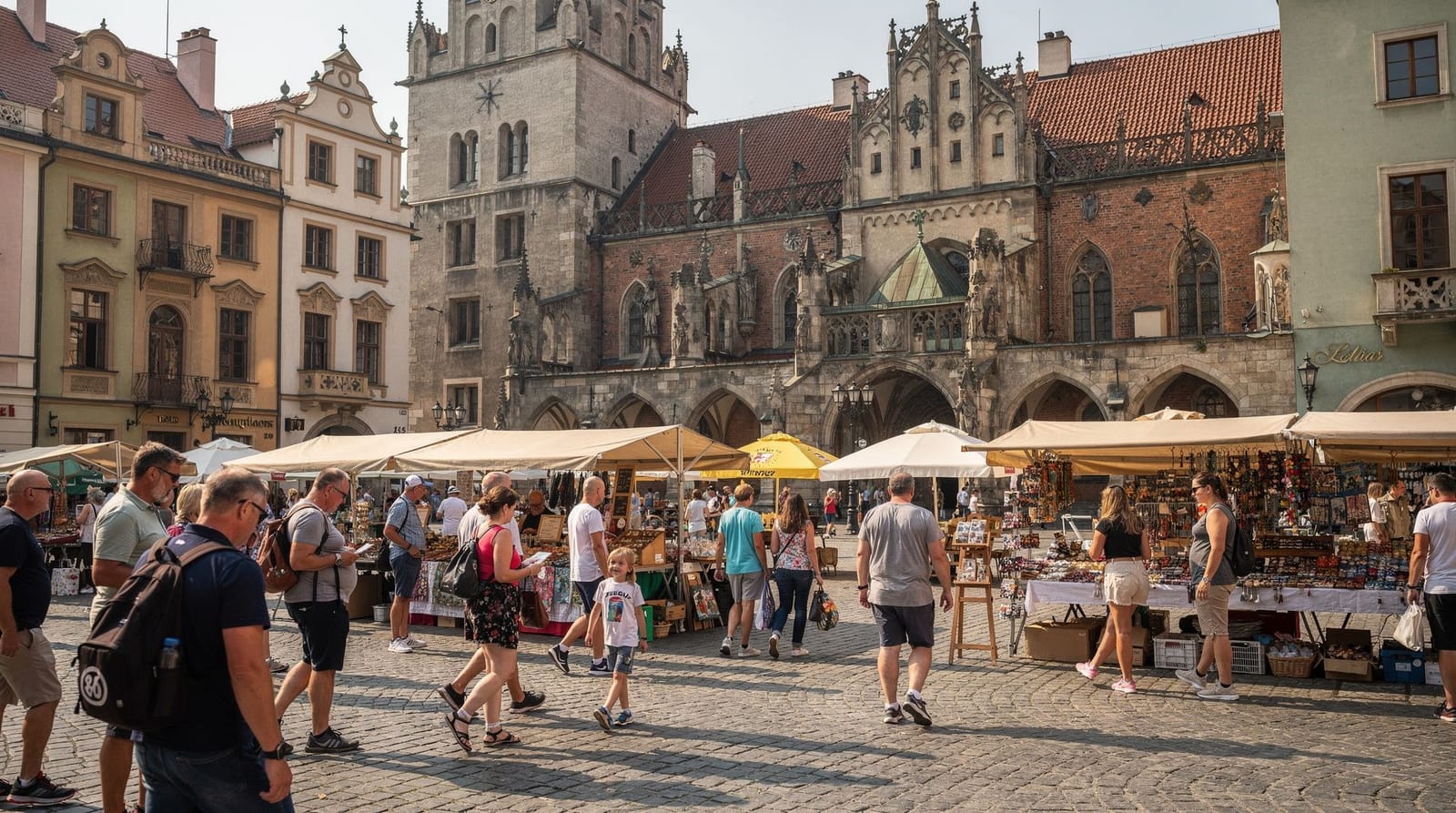
Rynek Główny is one of the most beautiful public spaces in Europe — a medieval market square measuring 200 × 200 metres, ringed by merchant houses and dominated by the Renaissance Sukiennice (Cloth Hall). It is also the most expensive place in Kraków to eat lunch or dinner, for reasons that have nothing to do with food quality.
| Where | Rynek Główny ring vs. streets 2 minutes off it |
| Rynek premium | around 2–3× side-street prices for mains |
| Worth it for | Wierzynek and Hawełka only |
| Better value | ul. Grodzka, ul. Szewska, ul. Sławkowska, Kazimierz |
| Best time | shoulder season narrows the premium slightly |
The restaurants with tables on the Rynek — the outer ring of the square — charge for proximity to the view and the foot traffic. Their clientele turns over constantly: 15 million tourists visit Kraków annually, and many of them eat at the first restaurant they see after arriving at the square. This creates a business model based on high volume and low accountability. The restaurant does not need repeat business; there are always more arrivals.
The result: main courses average 80–130 PLN (≈ €19–31) at Rynek-ring restaurants, compared with 40–65 PLN (≈ €10–15) on ul. Grodzka or in Kazimierz for comparable or better food. The premium is 2–3× the standard Kraków restaurant rate for no corresponding improvement in quality.
What the Rynek premium buys you
To be fair to the Rynek restaurants: the setting is genuinely beautiful. Eating on the main square of a UNESCO-listed medieval city on a warm summer evening is a specific pleasure, and it has a price. The problem is not that the Rynek is expensive — it is that most visitors do not know the Rynek is expensive, and assume they are paying local prices.
If you want to eat on the Rynek knowing what it costs, that is a legitimate choice. If you want comparable food at a fraction of the price, two minutes’ walk in any direction solves the problem entirely.
The two exceptions on the Rynek worth knowing
Wierzynek (Rynek Główny 15)
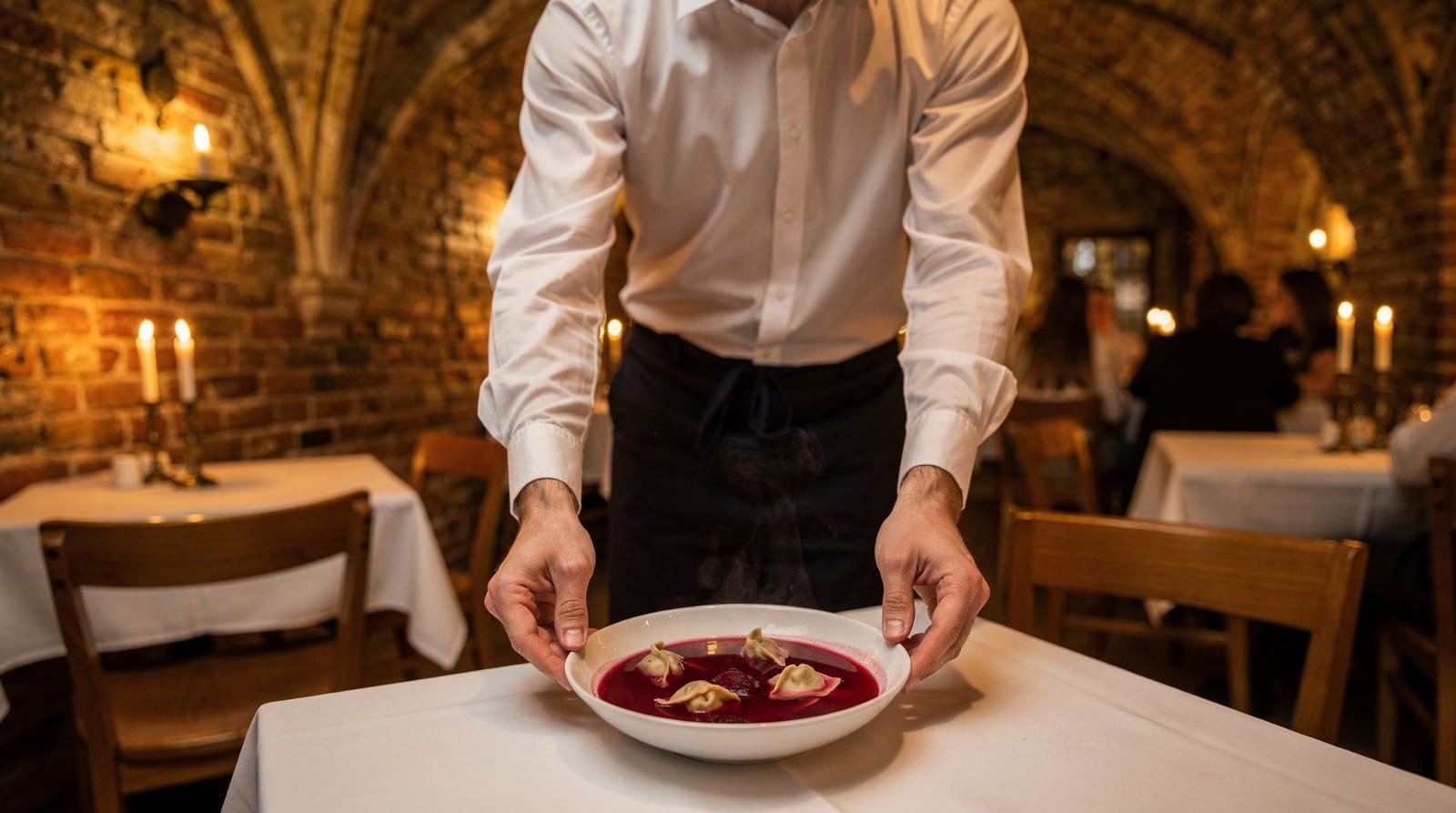
Wierzynek is the oldest restaurant in Poland still in operation, with a history stretching to 1364 when a feast for European monarchs was held here. It serves high-level traditional Polish cuisine: roast wild boar, duck in plum sauce, żurek (rye soup) in a bread bowl, and an extensive regional menu sourced from across Małopolska. Mains run 90–180 PLN (≈ €21–43). It is unambiguously a special-occasion restaurant — formal service, excellent food, beautiful historic rooms. If you are going to spend money on the Rynek, this is the one justified destination.
Hawełka (Rynek Główny 34)
Hawełka has operated on the Rynek since 1876 and has maintained a quality standard that most of its neighbours abandoned long ago. The cooking is solid traditional Polish — bigos, pierogi, żurek, roast duck — at prices somewhat below Wierzynek but still elevated (75–130 PLN for mains). The atmosphere is warm, the service professional, and the food reliably good. Reserve for dinner Thursday–Sunday.
All other Rynek-ring restaurants: Proceed with caution. Not all are bad — some are competent, overpriced restaurants with pleasant service — but none offer value for money relative to what you get one street away.
Where to eat instead: the honest list
Ul. Grodzka (the main street south from Rynek to Wawel)
Ul. Grodzka is the Royal Route’s southern axis — the most historically significant street in the Old Town, connecting the Rynek to Wawel Castle. It is also one of the best streets for eating, with restaurants at every price point:
Gospoda CK Dezerter (ul. Bracka 6, corner of Grodzka): One of the best traditional Polish restaurants in the Old Town. Vaulted cellar, proper bigos, roast duck, reliable service. Mains 45–70 PLN (≈ €11–17). Consistently better value than anything on the Rynek itself.
Restauracja Smak Ukraiński (ul. Kanonicza 15): Polish-Ukrainian cuisine in a beautiful vaulted room on the prettiest street in the Old Town. The borscht and varenyky are excellent. Mains 45–70 PLN.
Ul. Szewska and ul. Sławkowska
Two streets running north from the Rynek that have a better range of honest mid-range restaurants:
Metropolitan (ul. Sławkowska 3): Mid-range restaurant with a reliable menu between traditional Polish and Central European. Good for groups. Mains 55–90 PLN.
Indus Tandoor (ul. Sławkowska 13): Best Indian restaurant in Kraków. Better value than anything on the Rynek and genuinely good cooking. Mains 40–65 PLN.
Milk bars: the best-value option
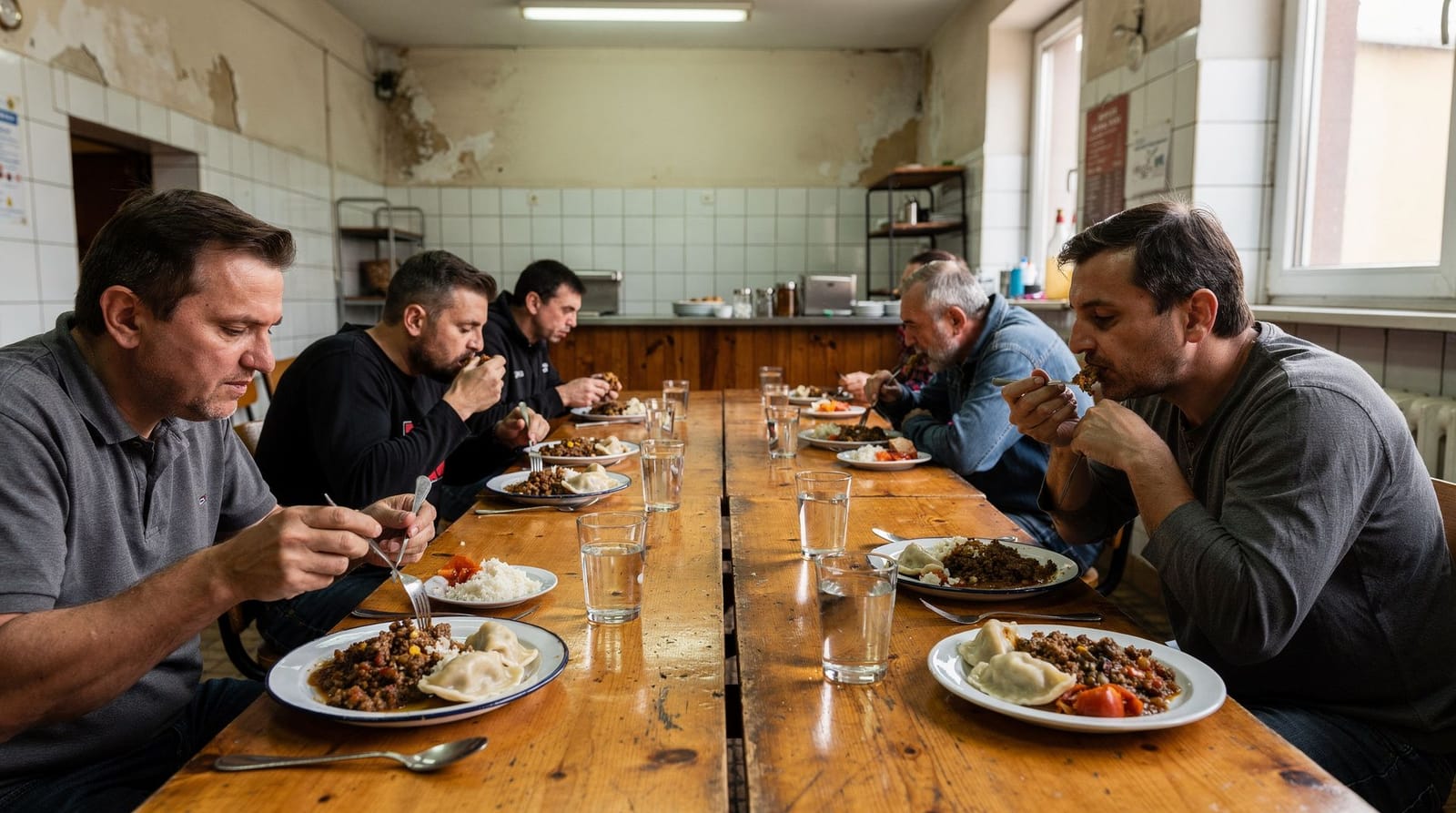
Bar Mleczny Pod Temidą (ul. Grodzka 43) is the best-regarded milk bar in the Old Town. Milk bars — bar mleczny — are communist-era workers’ cafeterias that have survived as subsidised canteens serving authentic Polish food at near-cost prices. Main courses 18–28 PLN (≈ €4–7). Cash only; typically no English menu but picture menus or pointing is universal.
For the full milk bar guide, see Milk bars (bar mleczny) in Kraków: the complete guide.
Kazimierz: the best neighbourhood for honest eating
Kazimierz — 15 minutes’ walk south of the Rynek, or a short tram ride — is where Kraków’s best value-to-quality restaurant scene is concentrated. Ul. Józefa, ul. Szeroka, and the area around Plac Nowy have an excellent range from milk bars to serious modern Polish restaurants, all at prices 30–50% below the Old Town equivalent:
Pierogarnia Mandu (ul. Józefa 26, Kazimierz): Outstanding pierogi at 28–38 PLN for a portion. Queue is normal and worth it.
Hala Targowa market (ul. Grzegórzecka): Food stalls at the covered market, 10 minutes east of Kazimierz. The most local-facing food experience accessible from the centre.
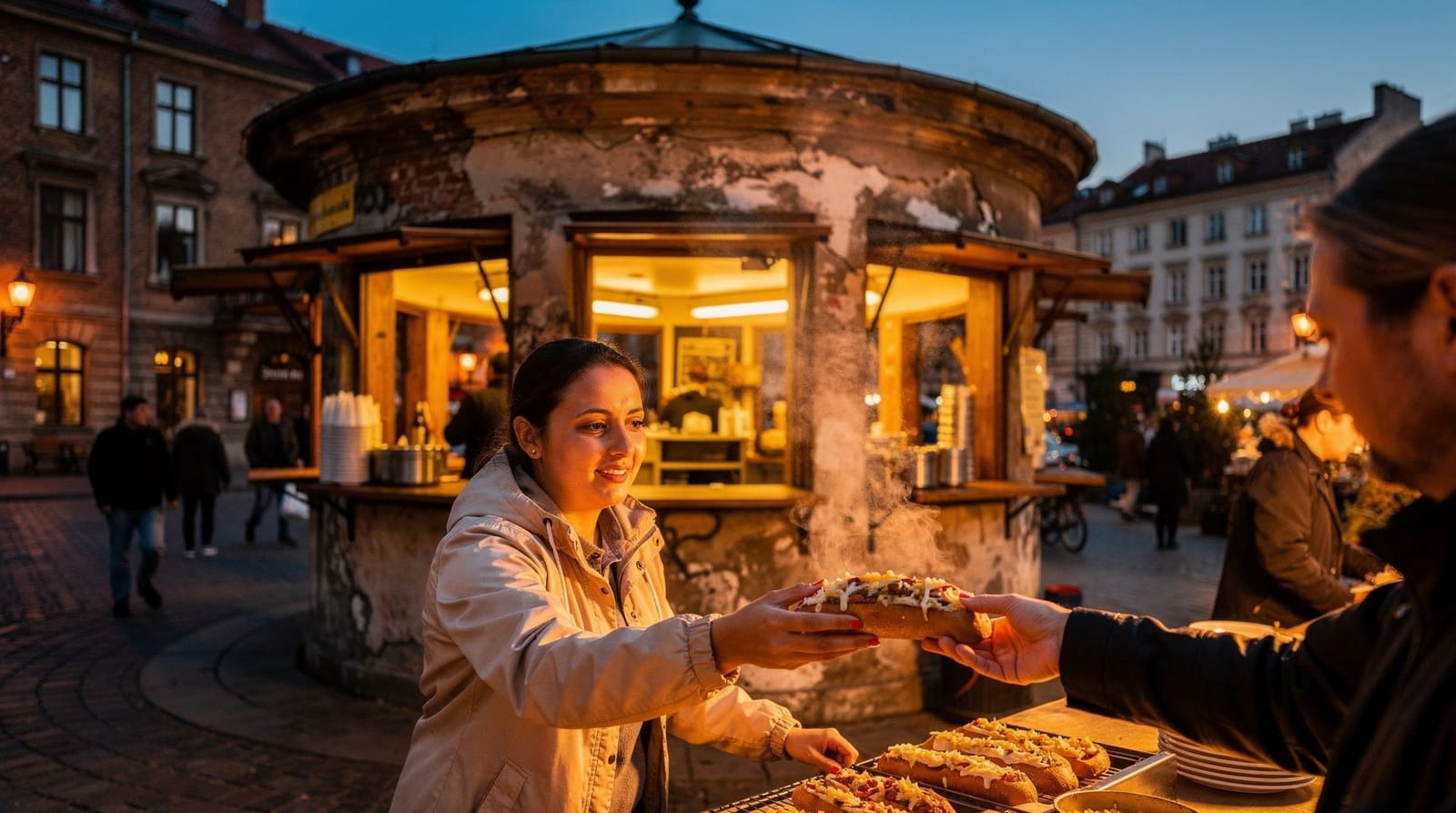
Plac Nowy zapiekanki: The half-baguette with toppings (zapiekanka) sold from the circular market building at Plac Nowy is the iconic Kazimierz street food. 12–22 PLN and genuinely good.
See Kazimierz food scene: the best restaurants and bars for the complete Kazimierz food guide, and the best restaurants in Old Town guide for a curated list beyond just the Rynek-avoidance angle. If pierogi specifically are your priority, the best pierogi in Kraków guide ranks the top spots city-wide, most of them off the square.
How to read a Kraków menu
A few terms that help navigate what you are ordering:
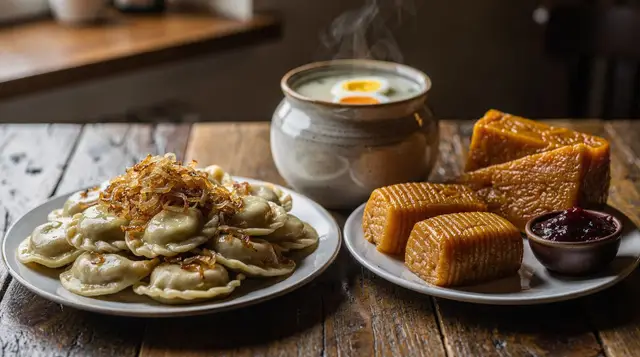
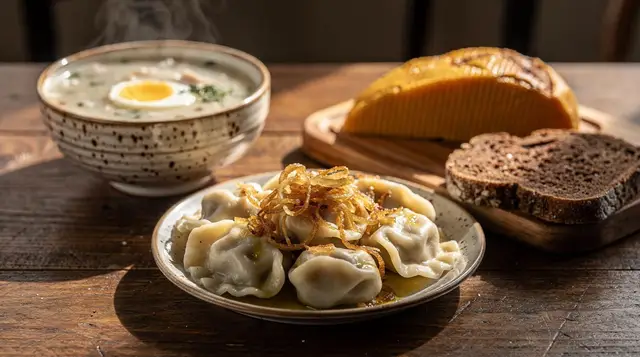
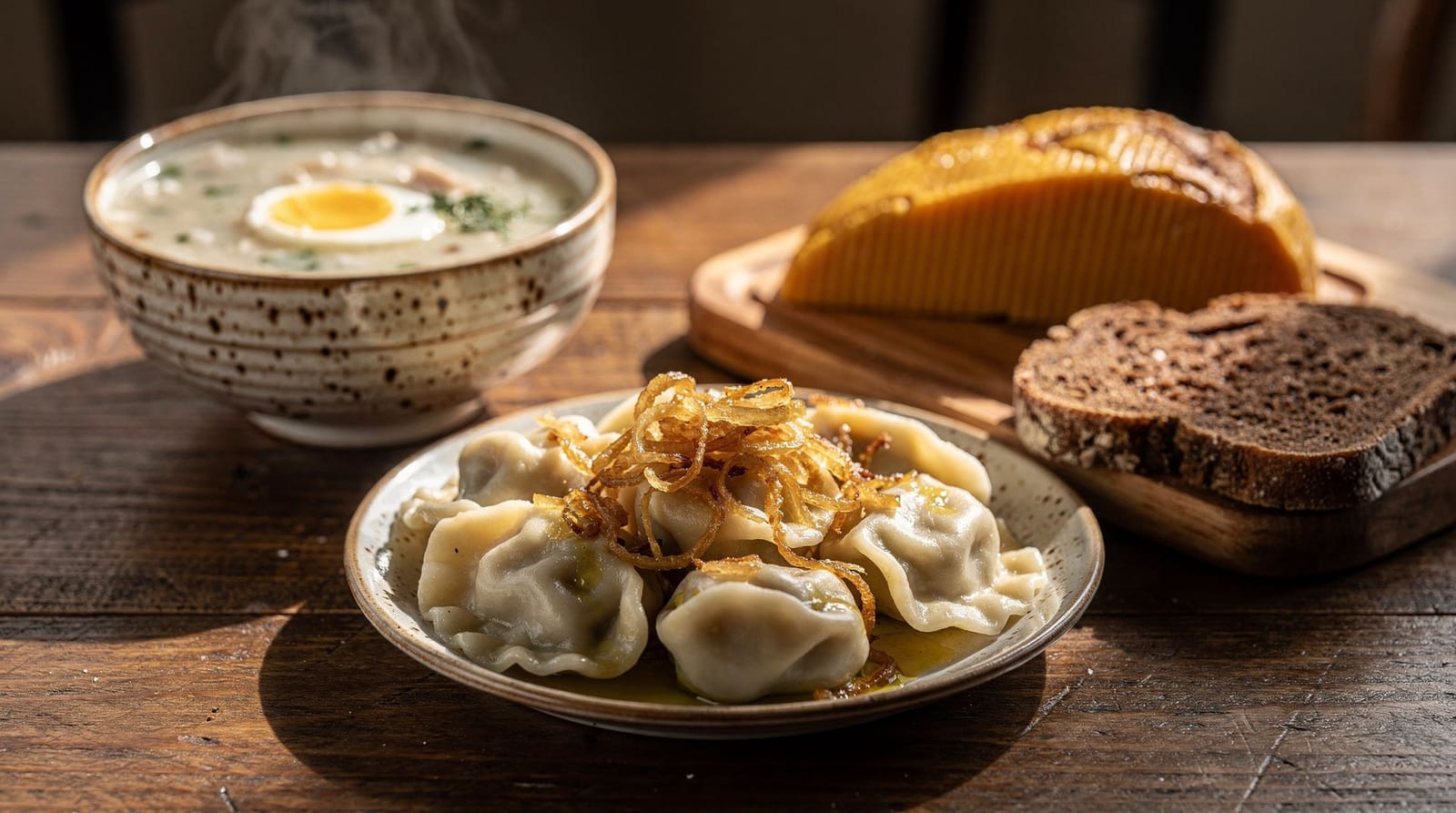
Żurek: Rye sourdough soup with hard-boiled egg and white sausage. The defining Polish soup. 18–28 PLN at an honest restaurant; 35–55 PLN at a Rynek restaurant for the same dish.
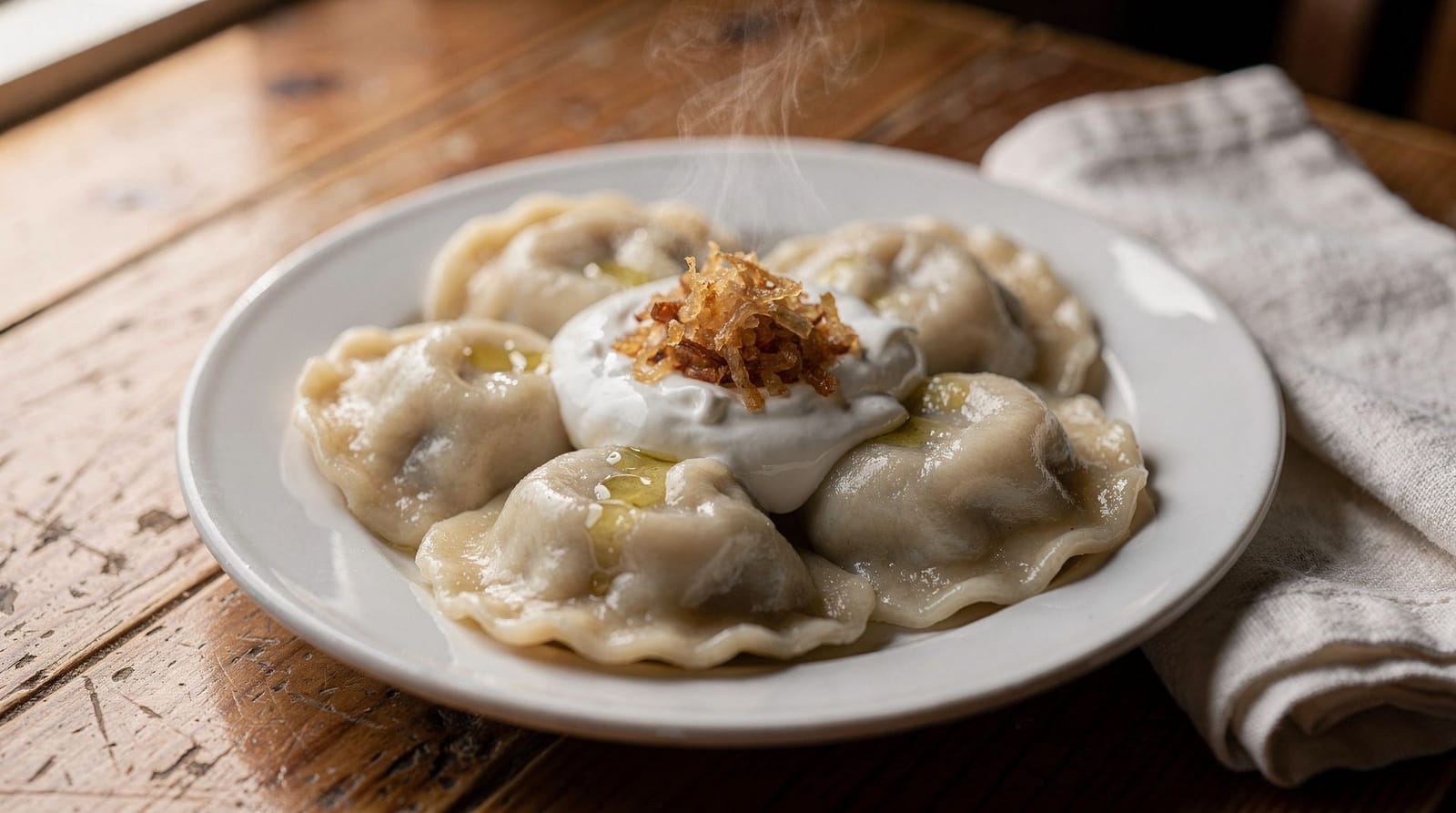
Pierogi: Filled dumplings — most commonly ruskie (potato and cottage cheese with fried onion), meat, or mushroom and cabbage. A portion (8–10 pieces) runs 25–40 PLN at a good pierogi restaurant; 45–80 PLN at Rynek establishments.
Bigos: Hunter’s stew with cabbage and mixed meats. A national dish and the barometer of a Polish kitchen — takes hours to make properly. A 15–20 PLN version and a 65 PLN version are not the same dish.
Oscypek: Smoked sheep’s cheese from the Tatras, typically served grilled with cranberry sauce. Available across the Old Town for 18–28 PLN at street stalls and 35–60 PLN at restaurants.
A neighbourhood-by-neighbourhood eating guide
The Rynek restaurant problem is concentrated in a specific zone. Understanding Kraków’s eating landscape by neighbourhood makes the solution obvious:
Old Town (Stare Miasto) — honest options
The Old Town has good restaurants. They are just not the ones directly facing the Rynek.
Ul. Grodzka (the Royal Route south to Wawel): The highest concentration of good Old Town restaurants. CK Dezerter, Restauracja Smak Ukraiński, several milk bars, good cafes. Budget 45–70 PLN for a main.
Ul. Kanonicza: Kraków’s most beautiful street, less commercially busy than ul. Grodzka. A few excellent restaurants (including Smak Ukraiński at No. 15) and the quietest setting in the Old Town.
Ul. Sławkowska and ul. Szewska: More mixed — some tourist-facing, some genuinely good. Metropolitan (ul. Sławkowska 3), Indus Tandoor (ul. Sławkowska 13), and Bar Mleczny Czerwony Kapturek (ul. Mikołajska 19) are all worth knowing.
Ul. Floriańska: Primarily tourist-facing. Better for coffee than for serious eating.
Kazimierz — the best-value neighbourhood
Kazimierz is where Kraków residents eat well at honest prices. The 15-minute walk from the Rynek (or a short tram) is the best food decision you can make in this city.
Ul. Józefa: The best restaurant street in Kazimierz. Pierogarnia Mandu (No. 26) for pierogi; several good Jewish cuisine restaurants; coffee shops that serve actual local clientele.
Plac Nowy: The circular market building (Okrąglak) is the centre of the Kazimierz street food scene. The zapiekanki sold from the hatches in the building walls — half-baguette with mushrooms, cheese, and toppings — are the defining Kazimierz street food. 12–20 PLN. Eat standing up; this is not a sit-down experience.
Ul. Szeroka: Traditionally the main street of the Jewish Quarter. Several restaurants here specialise in Jewish and Polish cuisine with genuine connection to the neighbourhood’s history. Café Alef and Klezmer-Hois have been operating for decades; the prices are higher than ul. Józefa but the quality and atmosphere justify it.
Podgórze — for the local experience
Across the Vistula from Kazimierz, Podgórze is a residential neighbourhood with a good cafe and restaurant scene that serves almost no tourists. The area around Plac Bohaterów Getta (Ghetto Heroes Square) has several excellent coffee shops. If you are visiting the Schindler Factory Museum (which is in Podgórze, not Kazimierz), lunch on Plac Bohaterów Getta is convenient, honest, and much cheaper than the Old Town equivalent.
Reading Polish menus for the uninitiated
Polish menus at non-tourist restaurants are often only in Polish. A few terms that help navigate without a translation app:
Zupa (soup): The first section. Żurek (rye soup with egg and sausage), barszcz (beet soup — czerwony = red, z uszkami = with ear-shaped dumplings), bigos (hunter’s stew), rosół (chicken broth).
Dania główne / dania drugie (main courses): Usually divided into mięso (meat), ryby (fish), and wegetariańskie (vegetarian).
Pierogi: Filled dumplings — ruskie (potato/cheese/onion), z mięsem (meat), z kapustą i grzybami (cabbage and mushroom). Smażone = pan-fried; gotowane = boiled.
Surówki (salads/sides): Side salads, typically coleslaw, beet salad, and similar. Ordered separately from the main.
Kompot: A cold drink made from boiled fruit — sweet, low-alcohol, common in milk bars. Not a complaint; a very Polish thing to order.
Combining sightseeing with a better meal
The easiest way to avoid the Rynek premium is to plan your meals around your sightseeing rather than around where you happen to be standing when hunger hits. Spend the morning on the square itself, using the Rynek Główny main square guide to decide what to see, then step inside the Cloth Hall or climb up for a view of St. Mary’s Basilica before walking away from the ring to eat. Arriving at a side-street restaurant already knowing your afternoon plan makes the whole day feel less rushed, and a rushed visitor is exactly the customer the first table on the square is waiting for.
If your afternoon is on the hill, the Royal Route leads naturally towards Wawel, and ul. Grodzka sits right on the way. The Royal Route walking guide shows how a lunch stop fits into that walk without any detour. For a longer stay, the Old Town walking tour guide is a good way to see which streets have the restaurants locals actually use.
Learning the dishes before you order
Much of the overpricing works because visitors do not know what a fair plate of Polish food looks like. A little preparation changes that. The traditional Polish dishes guide explains what to expect from the classics, and the broader Kraków food guide places them in the context of the city’s wider eating scene. Once you know what a proper bowl of żurek or a plate of pierogi should contain, a menu with unexplained prices and vague descriptions becomes easy to spot.
For street food, the Plac Nowy zapiekanki guide covers the best-known Kazimierz snack in detail, which makes it a cheap and satisfying lunch when you would rather not sit down at all.
Money, cards and avoiding surprises
Paying sensibly is part of eating sensibly. The Kraków money and currency guide covers how cash and cards work in the city, which matters for cash-only milk bars as much as for card terminals that prompt for a tip. If a bill ever feels off, remember that restaurant overcharging is one of several patterns described in the Kraków scams guide, and the same habit of reading the menu and the bill carefully protects you in all of them. For a tighter overall budget, the budget travel guide shows how dining choices fit into the rest of your spending.
The food tour alternative
A food tour is the best single investment for understanding Kraków’s eating landscape. It takes you to multiple spots in a few hours, explains what Polish food actually is (beyond the Rynek’s tourist-facing versions), and establishes your price benchmarks. The guided Polish food and culture tour with tastings covers Old Town and Kazimierz stops at verified quality venues.
The guided food tour with tastings is another option for sampling local dishes with a guide. The late night bites Polish street food and drinks tour suits an evening out, when you want street food and drinks instead of a sit-down dinner.
When the Rynek is worth using
For coffee: the Rynek has several good cafes (as opposed to restaurants) where the pricing premium for the view is smaller. A coffee and cake for two on the Rynek terrace in summer costs maybe 40–60 PLN; the same in a side street cafe costs 30–45 PLN. The gap is real but not shocking.
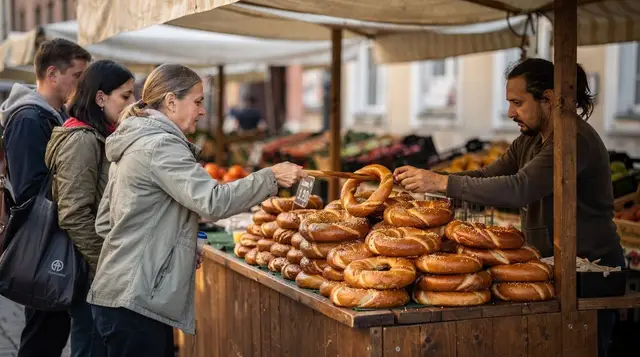
For the market itself: the Sukiennice stalls inside the Cloth Hall are a legitimate craft market, though you should verify amber authenticity (see Fake amber souvenirs in Kraków: how to spot the difference). Food stalls at the outdoor Christmas market (27 November 2026 to 6 January 2027) are one of the best food experiences in the city.
For a drink after dinner: the outdoor bar terraces on the Rynek are pleasant on summer evenings. For a single glass of wine or local beer (10–20 PLN), the location premium is manageable.
Seasonal variation in Rynek restaurant pricing
The Rynek premium is not uniform throughout the year, and understanding the seasonal pattern helps you plan:
June–August (peak): Maximum pricing, maximum upselling, outdoor terrace surcharges in full effect. The Rynek tables with parasols command the highest prices of the year. Some Rynek-ring restaurants also implement minimum spend requirements during peak weekends — not always disclosed until the bill arrives.
December (Christmas market): The Rynek hosts one of Poland’s best Christmas markets (27 November 2026 – 6 January 2027). During this period, the outdoor food stalls selling oscypek, mulled wine (grzane wino), and pierogi are some of the best value eating on the Rynek all year — traditional food at honest market prices. The restaurants behind the market stalls are still overpriced; the market stalls themselves are not.
April–May and September–October (shoulder season): The Rynek premium narrows somewhat. Restaurants are still more expensive than side streets, but the pressure to upsell and the density of visitors both reduce. This is the best time to try Hawełka or Wierzynek specifically — they are more relaxed and still at their quality standard.
November–February (low season): Some Rynek restaurants operate with reduced menus or seasonal closures. The outdoor terrace surcharge becomes irrelevant. Prices remain elevated but the premium feels less extreme. Good time for Wierzynek’s winter menu.
What to do if you have already ordered and the bill is wrong
If your bill does not match the menu prices you were shown:
- Ask for the menu and compare line by line, aloud, with the server present
- If there are charges for items you did not order (bread, “cover charge,” mineral water not requested), question them directly — in Poland, unordered items are not obligatory charges
- If a service charge was added without disclosure when ordering, politely dispute it — Polish consumer law requires disclosure of service charges before the transaction
- Pay by card rather than cash so there is a transaction record
- If the overcharge persists and you cannot resolve it, the Polish consumer ombudsman (Rzecznik Praw Konsumenta) has a formal complaint mechanism accessible via the UOKiK website
In practice, most billing disputes at restaurants are resolved by the server correcting an error. Genuine overcharges that resist correction are rare at established restaurants; they are more common at the lower tier of tourist-facing Rynek operations.
The best solo dining experience near the Rynek
Travelling alone and looking for the best seat-down meal near the Rynek without feeling like you are being managed:
Bar Mleczny Pod Temidą (ul. Grodzka 43): Point at what you want, collect a ticket, take it to a seat. No table service, no upselling, no expectations of a tip. The quietest way to eat near the Old Town.
Indus Tandoor (ul. Sławkowska 13): Solo travellers are welcomed, the menu is available in English, and the kitchen is reliable. 40–65 PLN for a main.
Café Camelot (ul. Anny 8): More of a cafe than a restaurant, but the kitchen serves good sandwiches, soups, and cakes. One of the few places in the Old Town that feels genuinely local regardless of what time of year you visit. Good for lunch or a late breakfast.
A quick price comparison, dish by dish
Seeing the actual numbers side by side makes the gap concrete:
| Dish | Rynek-ring price | Side-street price (Grodzka/Kazimierz) |
|---|---|---|
| Żurek (rye soup) | 35–55 PLN | 18–28 PLN |
| Pierogi (8–10 pieces) | 45–80 PLN | 25–40 PLN |
| Bigos (hunter’s stew) | around 65 PLN | 15–20 PLN (milk bar) to 35 PLN (restaurant) |
| Roast duck main | 90–140 PLN | 55–80 PLN |
| Coffee and cake for two | 40–60 PLN | 30–45 PLN |
The gap narrows for coffee (where the location premium is smallest) and widens for full mains — which is exactly why the advice in this guide focuses on where you eat your main meal, not where you grab a coffee.
Tipping and paying without being overcharged
Tipping in Kraków restaurants generally follows a 10% guideline for good service, given in cash or added when paying by card if the terminal prompts for it — it is not obligatory in the way US tipping is, and nobody will chase you for it. At Rynek-ring restaurants specifically, double-check whether a service charge has already been added to the bill before tipping again on top; some venues do add it automatically, and tipping twice is an easy mistake for visitors unfamiliar with the practice. At milk bars and counter-service spots, tipping is not expected at all.
Frequently asked questions about Rynek restaurant pricing
Why are the Rynek restaurants so expensive compared to side streets?
It is purely location economics. A restaurant paying premium rent for a Rynek-facing address passes that cost to diners, and can do so because new visitors arrive constantly without price knowledge. There is no quality justification for the markup.
Is it rude to walk off the Rynek for a cheaper restaurant?
Not at all. No restaurant on the Rynek has any claim on your patronage. Walk off the square, look at two or three menus, and choose the one that looks good. This is how locals eat.
Are there good restaurants on the Rynek for special occasions?
Wierzynek (open since 1364) is a genuinely excellent special-occasion restaurant. If you are celebrating something in Kraków and want a memorable location, it justifies its prices. For a less formal special meal, Pod Baranem (ul. Św. Gertrudy 21, just outside the Planty) is the best modern Polish restaurant in the area.
What is the cheapest decent lunch near the Old Town?
Bar Mleczny Pod Temidą (ul. Grodzka 43) serves a full Polish lunch for 18–28 PLN per person. This is the most extreme value in the Old Town. Chimera Salad Bar (ul. Anny 3) offers a salad buffet at similar prices. Both are genuine, consistently good options.
Do prices at Rynek restaurants include service?
Generally no — a 10–15% service charge is expected on top of the listed prices. At a restaurant where you paid 120 PLN per person for a main, starter and drink, add 12–18 PLN for service. This is standard Polish practice, not Rynek-specific.
Are there other tourist-pricing traps in Kraków besides restaurants?
Yes — restaurant overpricing is one of several patterns worth knowing before you arrive. The Kraków tourist traps to avoid guide covers the broader picture, including amber authenticity (see fake amber souvenirs) and other common overpricing patterns around the Old Town.
Top experiences
Bookable activities with verified prices and instant confirmation on GetYourGuide.