Nowa Huta — Kraków's socialist-realist planned town
Nowa Huta is Poland's best-preserved communist-era district: Plac Centralny, the steelworks, Trabant tours, and a story stranger than fiction.
Krakow: Nowa Huta former communist neighborhood walking tour
Quick facts
- Distance from centre
- 8 km east; ~25 min by tram 4 or 10
- Time needed
- Half day (3–4 hours)
- Built
- 1949–1956, expanded through the 1970s
- Population
- ~200,000 (Kraków's second-largest district)
- Must-see
- Plac Centralny, Sendzimir Steelworks Museum, Arka Pana Church
The town that shouldn’t exist
Nowa Huta (literally “New Steelworks”) was not supposed to have happened to Kraków. In 1949, Poland’s communist government decided to build an enormous steel mill east of the city and populate it with a model socialist town. Kraków was historically Catholic, bourgeois, and suspicious of the new regime; Nowa Huta was designed as an ideological counterweight — a workers’ paradise that would dilute the old city’s reactionary character.
| Where | 8 km east of central Kraków |
| Cost | Free to walk around; check museum prices on the official website |
| Time needed | Half day (3–4 hours); the Trabant tour adds about 3.5 hours |
| Getting there | Tram 4 or 10 from the centre, ~25 minutes |
| Best time | Year-round; late afternoon light is best for photography |
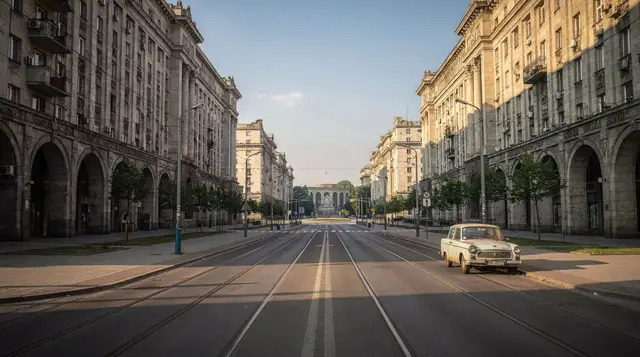
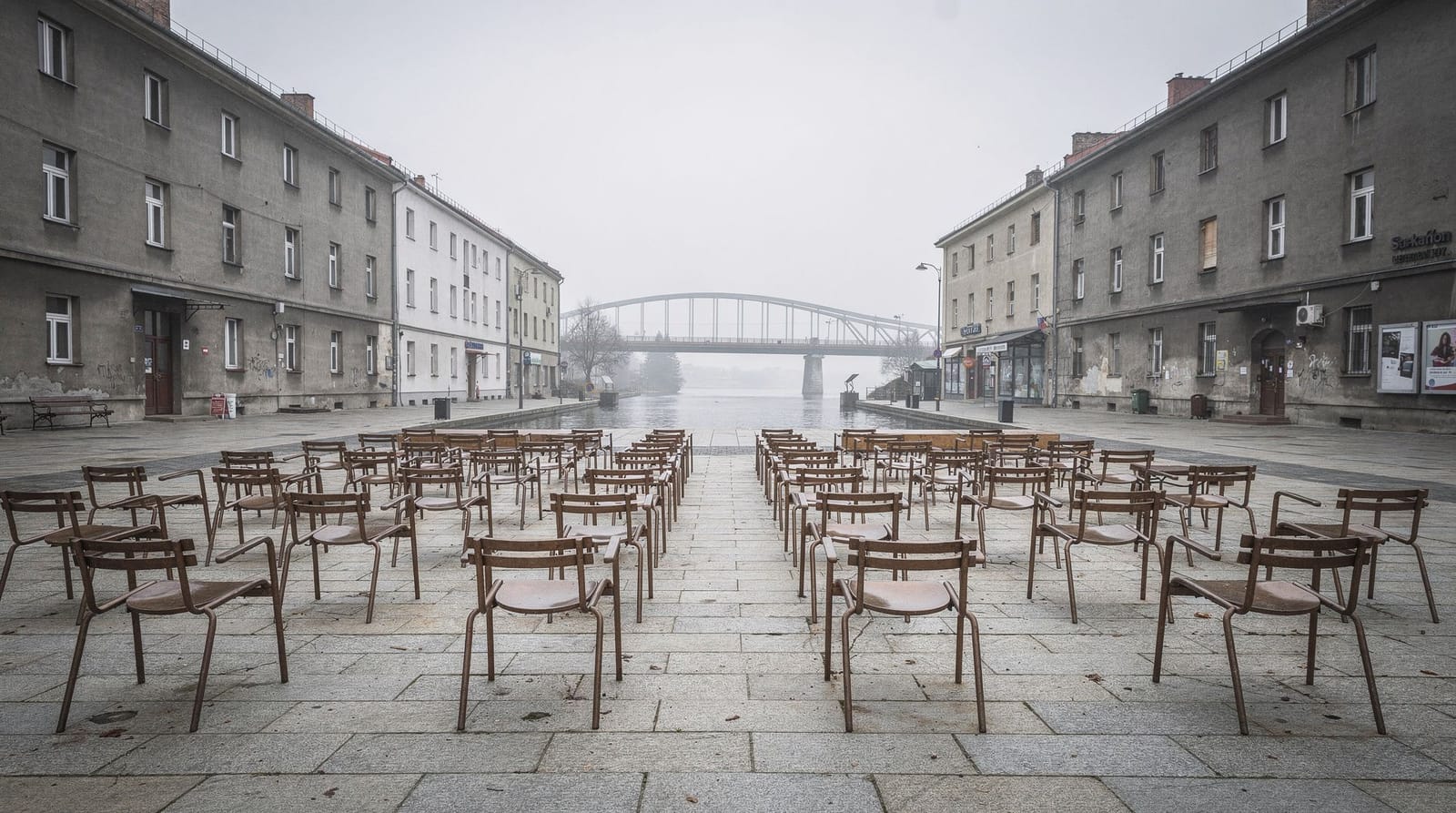
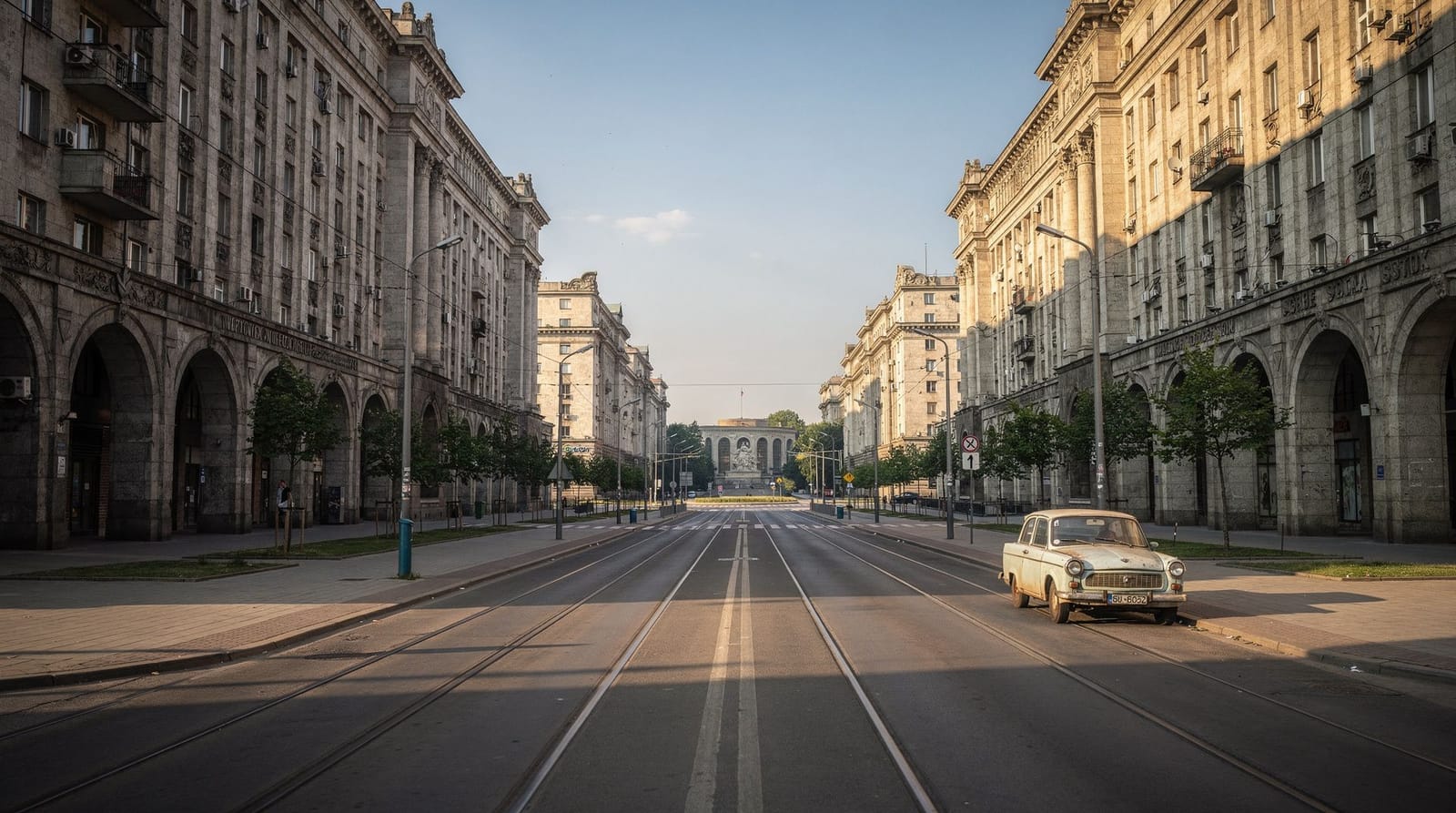
The plan produced something genuinely extraordinary: 8 km of radial boulevards, grand neoclassical apartment blocks, parks, cinemas, cultural centres and sports facilities — all designed to house 100,000 workers in conditions dramatically better than the rural poverty most of them came from. There was one thing missing in the original design: a church.
The residents spent 20 years demanding one. The communist authorities refused. The struggle became a flashpoint of Polish resistance. In 1977, the Arka Pana church was finally consecrated — a victory that preceded Solidarity and the eventual collapse of the regime. Pope John Paul II (then Archbishop of Kraków Karol Wojtyła) was closely involved in the church campaign; Nowa Huta is one of the reasons he mattered to Polish political history.
The result is a neighbourhood unlike anywhere else in Central Europe: a perfectly preserved fragment of a social experiment that failed, inhabited by 200,000 people who now live in it without irony.
Getting there
Tram 4 or 10 from the city centre (ul. Basztowa or Plac Wszystkich Świętych) takes about 25 minutes to Plac Centralny. The journey costs 6 PLN (≈ €1.40) with a single-ride ticket. Do not take a taxi or Bolt — the whole point of Nowa Huta is the approach through its own spatial logic, which makes no sense from a car window.
If you are unsure how the tram fits into your wider plans, the public transport guide explains tickets and routes, and getting around Kraków compares the other options. Riding the tram is also the cheapest way to see how far the district sits from the historic centre.
Plac Centralny (Central Square)
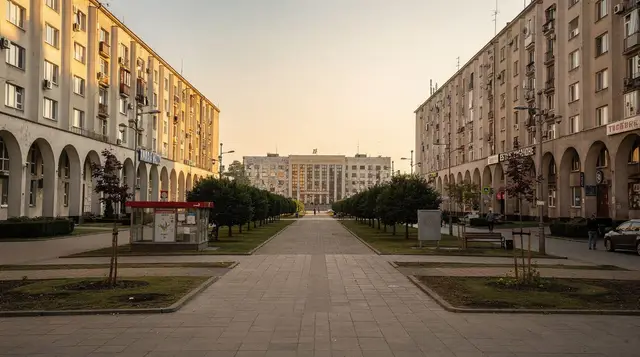
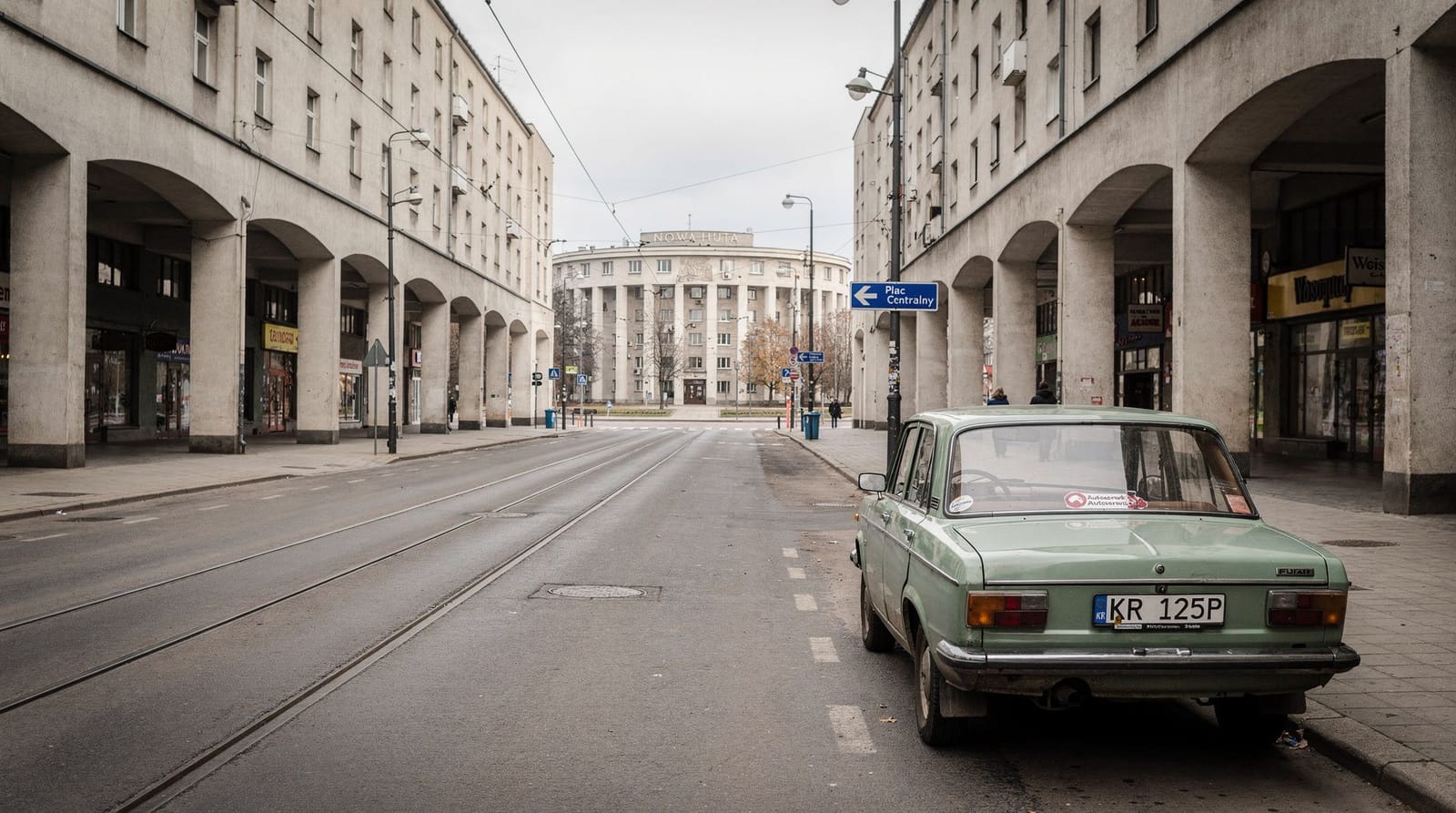
Plac Centralny is the formal heart of Nowa Huta: a large semi-circular plaza modelled on Socialist Realist planning principles, with wide streets radiating outward like spokes of a wheel. The scale is deliberately grand — designed to project state power and to make individuals feel appropriately small.
The square was renamed Plac Ronalda Reagana in 2004, in recognition of the US president’s role in supporting Solidarity (a decision that generated its own controversy). Most people still call it Plac Centralny.
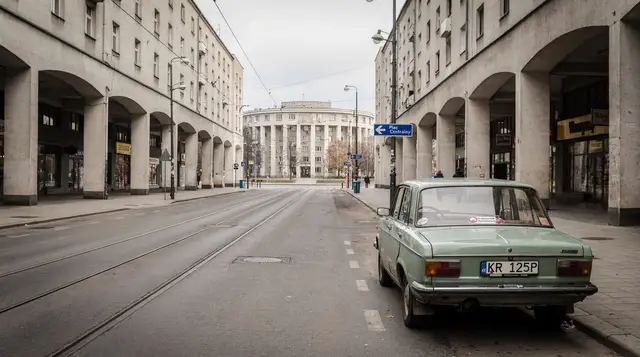
The surrounding streets — al. Róż (Avenue of Roses), al. Solidarności — are lined with the characteristic Nowa Huta apartment blocks: five or six storeys, limestone-faced, with decorative Soviet-inspired friezes and surprisingly generous flat sizes by communist-era standards. Many have been renovated; some retain their original appearance. Walk slowly and look at the details.
Practical orientation before you go
Nowa Huta’s street plan can feel disorienting on a first visit because it follows a radial, planned logic rather than the organic layout of the Old Town. Plac Centralny is the reference point for everything: al. Róż runs north-west toward the residential blocks, al. Solidarności runs south, and al. Jana Pawła II runs east toward the Arka Pana church and, further still, the steelworks itself. Free paper maps are available at the Nowa Huta Museum information desk, and mobile signal throughout the district is reliable enough that offline map apps are rarely necessary. Public toilets are limited outside the museum and a handful of cafés, so plan accordingly if visiting for a full afternoon.
The Sendzimir Steelworks
The Tadeusz Sendzimir Steelworks (formerly the Lenin Steelworks) was the economic reason for Nowa Huta’s existence. At its peak in the 1970s, it employed over 40,000 workers and produced more steel than the whole of Poland had done before the war. Its decline since 1989 reduced the workforce to around 2,000. The steelworks museum (inside the complex) documents the industrial history of the plant and the social history of the workers who ran it. Check opening times before visiting as they vary.
The steelworks was also a centre of Solidarity activity — one of the major strike sites of 1980. The political history of Nowa Huta is inseparable from the history of Polish democratic resistance.
Arka Pana Church
The Arka Pana (Ark of the Lord Church, ul. Obrońców Krzyża 1) is the architectural statement of Nowa Huta’s resistance to communism. Designed by Wojciech Pietrzyk, the building looks nothing like a traditional church — it resembles a ship’s prow rising from the flat landscape, built from two million stones collected by Polish pilgrims from around the world. The foundation stone was laid by Cardinal Wojtyła in 1967; the church was consecrated in 1977.
The interior is worth seeing: dark, unusually proportioned, dominated by a crucifixion sculpture. Free entry; modest dress required. A 20-minute walk from Plac Centralny along al. Jana Pawła II.
How to explore Nowa Huta
On foot: Plac Centralny and the immediately surrounding streets can be explored in 1.5–2 hours. The neighbourhood is flat and the scale of the streets is designed for pedestrian use — paradoxically, despite being built by communists for workers who mostly didn’t own cars, Nowa Huta is better for walking than driving.
By Trabant: The most popular way to visit with a guide. The communism Trabant tour covers the main sites in a fleet of East German Trabant cars — an experience that is simultaneously educational and absurd, which is exactly right for a neighbourhood like Nowa Huta. The tour includes Plac Centralny, the steelworks exterior, the Arka Pana church and the main residential zones. Highly recommended for the combination of content and entertainment.
Walking tour: The Nowa Huta former communist neighbourhood walking tour is the more serious alternative — a guided walk with a specialist in communist-era architecture and political history. Covers the same sites with more depth.
Museum: The Nowa Huta Museum (skip-the-line) is a branch of the Historical Museum of Kraków, housed in one of the original residential buildings on Plac Centralny. The exhibition covers the planning of the town, the lives of its residents, and the political struggles that defined it. Check current prices and opening status on the official website of the Museum of Krakow; allow 60–90 minutes. Closed Mondays.
Nowa Huta in context — connecting it to the rest of Kraków
Nowa Huta makes most sense when you visit Podgórze and Kazimierz first and understand Kraków’s prewar and wartime history before encountering communist reconstruction. The progression — medieval Kraków, wartime destruction of its Jewish community, communist social engineering — gives Nowa Huta its proper weight.
The itinerary for communist Kraków history combines Nowa Huta with a visit to the Museum of Municipal Engineering (al. św. Wawrzyńca 15, Kazimierz) and the Schindler’s Factory occupation exhibition — a full-day route through 20th-century Kraków. The Nowa Huta communism guide and the wider communist Kraków tour guide go further into the political history summarised here, including the full story of the Solidarity strikes at the steelworks.
A suggested half-day plan
| Time | What to do |
|---|---|
| Arrival | Tram 4 or 10 to Plac Centralny (~25 min from centre) |
| First 30 min | Walk Plac Centralny and al. Róż, noting the socialist-realist facades |
| Next 60–90 min | Nowa Huta Museum for historical context |
| Next 30 min | Walk to Arka Pana Church along al. Jana Pawła II |
| Late afternoon | Return via tram, or continue with a Trabant tour for a longer visit |
Practical tips
Eating in Nowa Huta: There are few tourist restaurants. Bar Centralny on Plac Centralny is the obvious choice — a classic milk bar with proper communist-era ambience and prices to match (15–25 PLN / ≈ €4–6 for a full meal). Treat it as part of the experience.
Photography: Nowa Huta is one of the most photogenic neighbourhoods in Poland. The wide boulevards, socialist-realist facades, and the contrast between communist-era architecture and ordinary contemporary life make for genuinely interesting images. The best light is in the late afternoon when the low sun catches the limestone apartment blocks.
Combining with a day trip: Nowa Huta is best visited as a half-day excursion from the city centre, combined with a morning in Kazimierz or an afternoon after returning from Wieliczka. Trying to fit it into the same day as Auschwitz-Birkenau makes for an exhausting and disrespectful combination — these are very different emotional experiences.
The residents — what it is like to live in Nowa Huta
Nowa Huta today is neither a museum nor an ironic exercise in communist nostalgia. It is home to roughly 200,000 people, most of whom live there because housing costs are significantly lower than the Old Town, tram connections are reliable, and the neighbourhood has parks, schools and services that densely touristed districts lack.
The social profile has shifted over decades. The original steelworker population has aged; younger residents who cannot afford central Kraków rents are moving in. There are independent coffee shops now (Alchemia Nowej Huty, near Plac Centralny), a small arts scene, a cinema (Kino Sfinks, which has operated since 1951). The communist-era cinema programme still appears on the walls in the main streets — propaganda posters that nobody has bothered to remove.
Visitors who want to understand why the district matters beyond its architecture can pair it with the story of Pope John Paul II in Kraków, whose role in the Arka Pana campaign runs through the whole neighbourhood. For a lighter view of the city’s other districts, where to stay in Kraków shows how Nowa Huta compares with the central areas, and the Polish history primer gives the wider background to the communist period.
The result is a neighbourhood that is lived-in in a way that the Old Town is not. Tourists walk through but do not stay. The social texture — the pensioners on the benches in the Avenue of Roses, the children in the parks, the market at Plac Centralny on weekday mornings — is that of an ordinary Polish city neighbourhood, which happens to look like nothing else in Central Europe.
Nowa Huta in Polish popular culture
Nowa Huta has been the setting for Polish films, novels and music since the 1950s. The Łódź film school graduate Andrzej Wajda was among the first directors to use the neighbourhood as setting — his 1958 film “Ashes and Diamonds” captures the period of Nowa Huta’s early years obliquely. More recently, the neighbourhood has appeared in Polish crime fiction and television drama as the quintessential non-Old-Town Kraków location.
The communist propaganda films produced about Nowa Huta in the early 1950s are also worth knowing about: they present the neighbourhood as a paradise of rational urban planning and worker solidarity, with faces that look genuinely convinced. The Nowa Huta Museum shows some of them.
Photographers looking for more unusual angles on the city might also enjoy the Kraków photography spots guide, which lists Nowa Huta alongside the city’s other most photogenic corners, and a first-hand blog account of Nowa Huta captures the same reaction most first-time visitors have.
Frequently asked questions about Nowa Huta
Is Nowa Huta worth visiting?
Yes — emphatically. It is the most surprising neighbourhood in Kraków and one of the best-preserved examples of socialist-realist urban planning in the world. Most visitors who make the journey describe it as a highlight of their trip. The usual reaction is: “I didn’t expect this at all.”
How long does a visit to Nowa Huta take?
Half a day is sufficient for most visitors: the walk around Plac Centralny (30 minutes), the museum (60–90 minutes) and the Arka Pana church (30 minutes). The Trabant tour adds about 3.5 hours and covers more ground. If you want to explore the residential streets independently, allow a full morning.
Can I visit Nowa Huta without a guide?
Yes — the neighbourhood is easy to navigate independently. Plac Centralny has information panels, and the Nowa Huta Museum provides solid context. That said, the guided Trabant tour or the walking tour adds a layer of interpretation that makes the architecture and history considerably more legible.
What is the best way to get from Kraków centre to Nowa Huta?
Tram 4 or 10 from the centre — a 25-minute ride that costs less than €1.50. Do not take a taxi. The tram ride itself, passing through ordinary Kraków neighbourhoods before arriving at Plac Centralny, is part of the experience.
Is there anything to eat in Nowa Huta?
Bar Centralny on Plac Centralny is the best option for authenticity and price. Beyond that, options are limited — eat before you go or bring something. The neighbourhood is not set up for tourism in the way the Old Town is, which is part of its appeal.
Top experiences
Bookable activities with verified prices and instant confirmation on GetYourGuide.