Częstochowa: Jasna Góra monastery and the Black Madonna
Poland's top pilgrimage site, 2 hours from Kraków. Jasna Góra monastery holds the Black Madonna icon and draws over 4 million visitors a year.
Częstochowa from Krakow: the Black Madonna day tour
Quick facts
- Distance from Kraków
- ~140 km north-west (about 2 hours by car)
- Central site
- Jasna Góra Monastery — open daily, free entry
- The icon
- The Black Madonna (Czarna Madonna), chapel open daily
- Annual pilgrims
- Over 4 million visits per year; Poland's most visited pilgrimage site
- Major feast
- Assumption of Mary on 15 August — hundreds of thousands attend
Poland’s most important pilgrimage destination
Częstochowa lies about 140 km north-west of Kraków, near the northern end of the Kraków-Częstochowa Upland — the same Jurassic limestone belt that runs south through Ojców National Park. The city is unremarkable as Polish cities go: a post-industrial centre of about 215,000 people, known primarily for steel and textiles. What draws over four million visitors a year is not the city but the hill at its edge: Jasna Góra, the Pauline monastery that has been the spiritual centre of Polish Catholicism for over 600 years.
For most international visitors, Częstochowa is a half-day or full-day excursion from Kraków — not a destination that requires an overnight stay. The monastery complex is accessible in under two hours from Kraków by car on the A1 motorway or by fast train (PKP Intercity, approximately 1 hour 20 minutes, tickets from about 35–60 PLN, ~8–14 €). Organised guided tours make the journey and the complex considerably more manageable for visitors unfamiliar with the site.
| Where | Jasna Góra Monastery, ~140 km north-west of Kraków |
| Cost | Free grounds and chapel; museum areas charge separately; check the official Jasna Góra website |
| Time needed | Half-day to full day; 3–4 hours at the monastery itself |
| Getting there | Car on the A1, fast PKP Intercity train, or an organised day tour |
| Best time | Year-round; avoid 14–15 August and 26 August unless you want the pilgrimage crowds |
Jasna Góra monastery
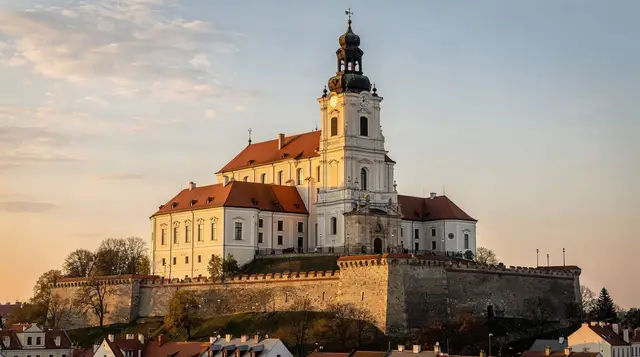
Jasna Góra (Bright Mountain) rises about 20 metres above the surrounding city on a low limestone ridge, visible from a considerable distance. The Pauline monastery was founded here in 1382; it grew rapidly after the icon of the Virgin arrived in 1382 and miraculous healings were attributed to it. By the fifteenth century it was the most important Marian shrine in Poland.
The monastery survived a famous siege in 1655 during the Swedish invasion — the successful defence of Jasna Góra, with a tiny Polish garrison holding off a large Swedish army, was subsequently mythologised as a turning point in Poland’s survival as a nation, and the monastery became synonymous with Polish national identity as well as religious devotion. The connection between the faith and the nation has been inseparable ever since; during the communist period, John Paul II’s 1979 visit to Jasna Góra — his first pilgrimage to Poland as pope — drew over a million people and was a pivotal moment in the eventual collapse of the regime.
The complex includes the Chapel of the Miraculous Image (housing the Black Madonna), the Baroque basilica, an arsenal and museum, fortification walls, and a treasury of gifts from world leaders, monarchs, and ordinary pilgrims. Entry to the monastery grounds is free; specific museum areas charge small admission fees.
Częstochowa and the Black Madonna — guided day tour from KrakówThe Black Madonna icon
The Czarna Madonna (Black Madonna) is a painted icon of the Virgin Mary with the infant Jesus, approximately 122 cm by 82 cm, on a linden-wood panel. The dark colouration of the faces — which gives the icon its name — is the result of centuries of candle smoke, varnish layers, and the materials used in fifteenth-century repainting after the original was damaged in a fourteenth-century robbery. Scientific analysis suggests the original painting dates to at least the medieval period; tradition claims it was painted by Saint Luke and brought from Jerusalem via Constantinople, though this cannot be verified.
The icon is housed in the Chapel of Our Lady (Kaplica Cudownego Obrazu), attached to the main basilica. It is displayed behind an elaborate golden baroque frame and is covered by a metal screen (sukienka) except during specific revelation times: typically around 06:00, then again in the late morning, afternoon, and evening — the exact schedule varies; check at the monastery entrance. The revelation is accompanied by the ringing of bells and a brief ceremony; the atmosphere in the crowded chapel during this moment is remarkable.
Access to the chapel requires modest dress (knees and shoulders covered); scarves and wraps are available at the entrance for visitors who need them. The chapel is almost always crowded; pilgrims queue for access, and the experience of standing in a packed space with several hundred people in collective prayer is both overwhelming and memorable.
Black Madonna Sanctuary of Częstochowa — guided day tour from KrakówThe basilica and monastery complex
The Basilica of the Holy Cross and the Nativity of the Blessed Virgin Mary is the main church of the complex, a Baroque structure built over successive centuries with an ornate interior. The decorated barrel vaults, side chapels, and the collection of votive offerings — gold and silver objects, military decorations, jewellery — left by pilgrims over six centuries line the walls in an overwhelming accumulation of devotion.
The treasury and arsenal display the monastery’s historical weapons collection and the most significant votive gifts, including papal gifts and royal donations. The 600th Anniversary Museum provides historical context for the site’s role in Polish history. Both charge separate admission; check current prices on the official Jasna Góra website.
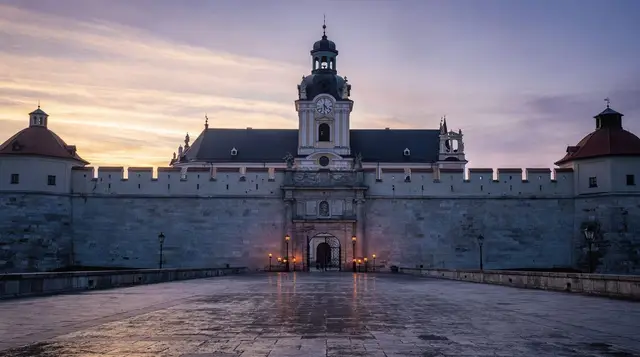
The fortification walls that encircle the monastery are substantial and can be walked; they represent Poland’s only well-preserved example of a defended monastery complex in the Italian bastion style, built in the seventeenth century following the Swedish siege.
The 15 August pilgrimage
The single most significant event in the Jasna Góra calendar is the Feast of the Assumption on 15 August, which draws hundreds of thousands of pilgrims — many of whom walk on foot from Warsaw (250 km), Kraków, and other cities across Poland, arriving after multi-day journeys. The atmosphere on 14–15 August is extraordinary: tens of thousands of people on the hill, outdoor masses, national hymns, and a collective devotional intensity unlike anything in everyday Polish life.
If you want to witness this, plan far in advance (accommodation in Częstochowa and surrounding towns fills weeks ahead). If you want to visit the monastery peacefully, avoid 14–15 August and also 26 August (the feast of Our Lady of Częstochowa on the liturgical calendar, only slightly less crowded).
| Period | What to expect |
|---|---|
| 14–15 August | Feast of the Assumption — hundreds of thousands of pilgrims, extraordinary but very crowded |
| 26 August | Feast of Our Lady of Częstochowa — busy, though noticeably calmer than mid-August |
| Weekends, year-round | Moderately busy with domestic pilgrims and day-trippers |
| Weekday mornings, outside August | Quietest window for an unhurried visit to the chapel |
| Winter months | Cold but calm; the chapel and basilica are indoors and heated |
A blog account of the mid-August pilgrimage gives a first-hand sense of what the peak crowds actually feel like, if you are weighing whether to time your visit around it.
Częstochowa Black Madonna painting — guided day trip from KrakówGetting there from Kraków
By car: Take the A4 motorway west from Kraków, then north on the A1 towards Łódź/Częstochowa. Journey time approximately 2 hours (tolls approximately 20–25 PLN, ~4.70–6 €). The monastery is well-signed from the city; parking is available at the foot of Jasna Góra.
By train: Fast PKP Intercity trains run from Kraków Główny to Częstochowa in 1 hour 20 minutes to 1 hour 40 minutes. Tickets approximately 35–60 PLN (~8–14 €). The train station is about 1.5 km from the monastery; bus or taxi from the station.
By organised tour: Tours from Kraków handle all transport and typically include a guide who provides historical and religious context, which significantly enriches the visit.
What to see beyond Jasna Góra
The monastery is the primary reason to visit Częstochowa, but a full-day visit leaves time to explore the wider city:
Aleja Najświętszej Marii Panny (the Avenue of the Blessed Virgin Mary): the main boulevard leading from the city centre to the monastery hill, lined with lime trees and flanked by nineteenth-century tenement buildings. The route is the traditional approach for pilgrims arriving on foot; walking it adds something to the overall experience.
The Pauline Fathers’ archive: a small but significant collection of historical documents relating to the monastery’s history; visit by appointment.
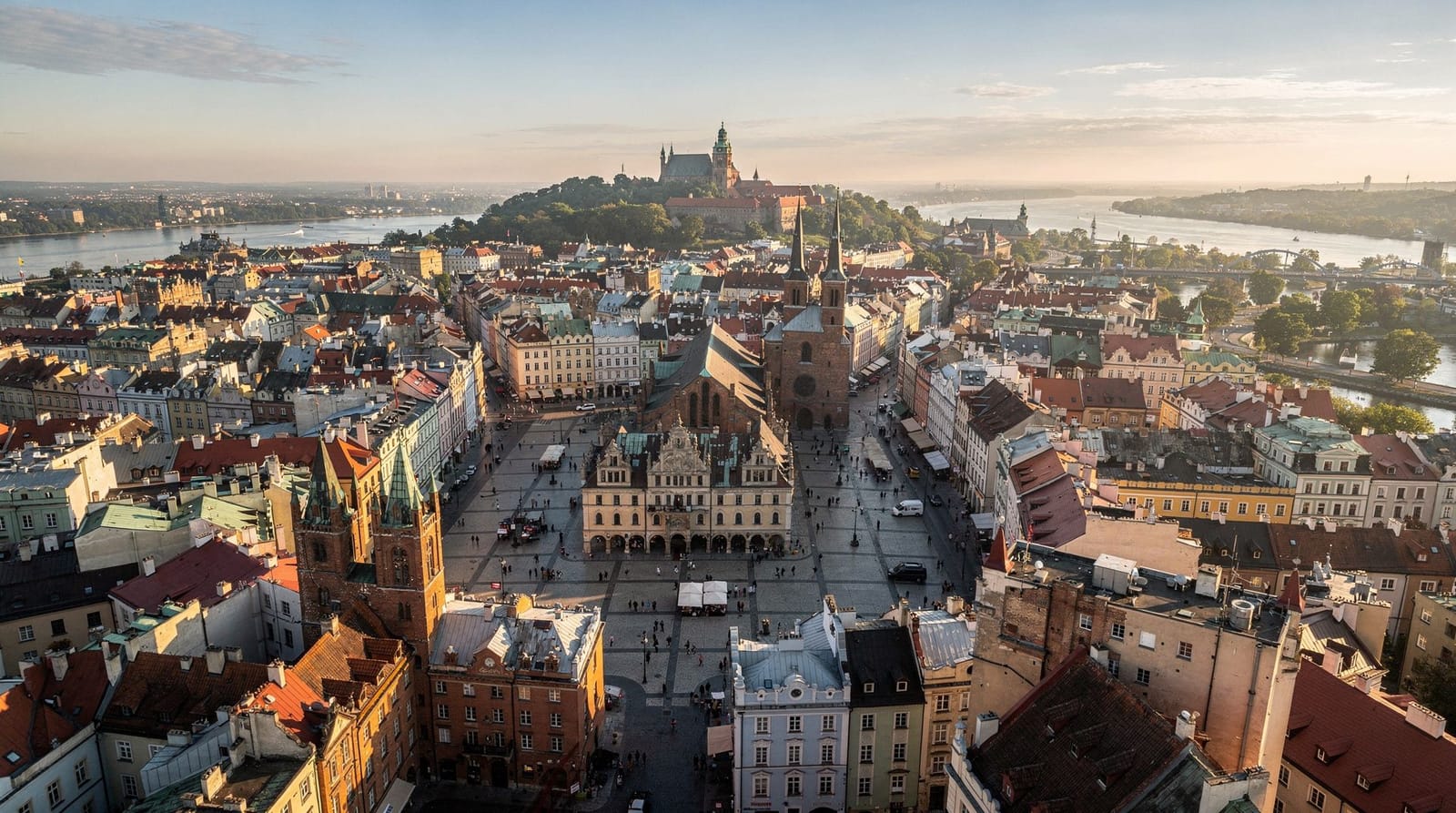
The city market (Stary Rynek): a modest but pleasant square with a few restaurants and cafés, about 15 minutes’ walk from the monastery.
For food, the monastery area has several restaurants catering to pilgrims and tourists; quality is mixed. For a more reliable meal, try Pod Ratuszem on the Stary Rynek (traditional Polish food, approximately 40–65 PLN, ~9.50–15 € for a main course) or one of the cafeterias along the main boulevard.
Practical tips for the visit
Modest dress is required to enter the Chapel of the Miraculous Image — knees and shoulders covered for both men and women. Scarves and wraps are available near the entrance for anyone caught out, but bringing your own saves a queue. The complex is largely accessible for visitors with mobility limitations on the main routes, though some fortification-wall sections involve uneven surfaces and steps. Free public toilets are available near the monastery entrance; the area around the boulevard has more facilities than the hilltop itself. Mobile signal and English signage are both reliable, and English-language information panels are present in the main museum areas, though a guide adds considerably more context than the panels alone.
Honest assessment
Częstochowa is not a conventionally attractive destination. The city itself is industrial, the approach streets are nondescript, and for visitors with no connection to Polish Catholicism, the experience of Jasna Góra may feel less accessible than Kalwaria Zebrzydowska or Wadowice. The Black Madonna icon is small and often partially obscured by crowds; the revelation ceremony is brief.
What Jasna Góra does offer — and offers nowhere else in Poland — is a direct encounter with the intersection of faith and national identity that has defined Poland for six centuries. The monastery is not a museum of religion; it is a living pilgrimage site actively used by millions. For visitors willing to engage with that on its own terms, it is genuinely moving.
Combining Częstochowa with Kraków
Most visitors arrive from Kraków on a day trip. The journey is straightforward, and four to six hours at Jasna Góra is sufficient for a thorough visit. If you are interested in the John Paul II connection, consider combining Częstochowa with Wadowice and Kalwaria Zebrzydowska over two days — the three sites together trace the geography of a Polish Catholic identity that Karol Wojtyła embodied and propagated. The Wadowice and John Paul II day trip guide and the Pope John Paul II in Kraków guide both help connect the dots between the three sites.
For logistical planning of day trips from Kraków more broadly, the best day trips from Kraków guide covers all the main excursion options with practical comparison of distances and times, and there is a dedicated Częstochowa Black Madonna day trip guide with a fuller step-by-step itinerary. Travellers building a longer regional trip may also want the 7-day Małopolska itinerary, which places Częstochowa within a wider week across the region.
Frequently asked questions about Częstochowa
Is Jasna Góra monastery free to visit?
Entry to the monastery grounds and the Chapel of the Miraculous Image (Black Madonna) is free. Specific areas — the treasury, the 600th Anniversary Museum, the arsenal — charge separate admission; check current prices on the official Jasna Góra website.
When can I see the Black Madonna icon?
The icon is revealed (the covering screen lowered) at specific times throughout the day: typically around 06:00 for the morning mass, then several times during the day and evening. The exact schedule varies by season and liturgical calendar. Check at the monastery information centre upon arrival. The revelation is brief — 15–20 minutes — and is accompanied by bells and a brief ceremony.
How long should I plan for a visit to Częstochowa?
Most visitors spend three to four hours at Jasna Góra itself — the chapel, basilica, museum areas, and fortifications. Add an hour for the journey into and through the city and a lunch stop, and a half-day excursion (five to six hours total at the destination) covers the essential experience. A full day allows a more leisurely pace and time to walk the boulevard approach and explore the city.
Is Częstochowa worth visiting if I am not religious?
Jasna Góra’s significance is hard to fully appreciate outside its religious context, but the site is historically important regardless of belief. The fortifications, the Baroque basilica, the treasury, and the six centuries of accumulated pilgrimage culture are genuinely interesting from a cultural-historical perspective. The experience of the Chapel of the Black Madonna — crowded, incense-heavy, emotionally intense — is one of the more striking cultural encounters in Poland. Most secular visitors find it worth a visit; few would describe it as the highlight of their trip.
Top experiences
Bookable activities with verified prices and instant confirmation on GetYourGuide.