The best photography spots in Kraków: a practical guide beyond the postcard
| Where | Rynek Główny, Wawel, Kazimierz, Podgórze, Nowa Huta |
| Cost | Free for most spots; Town Hall Tower 22 PLN |
| Time needed | A full day to cover the main districts properly |
| Getting there | Walkable in the centre; tram (lines 4/15) to Nowa Huta |
| Best time | Golden hour and blue hour; before 7:30am for the Rynek without crowds |
The shots everyone takes and why they still work
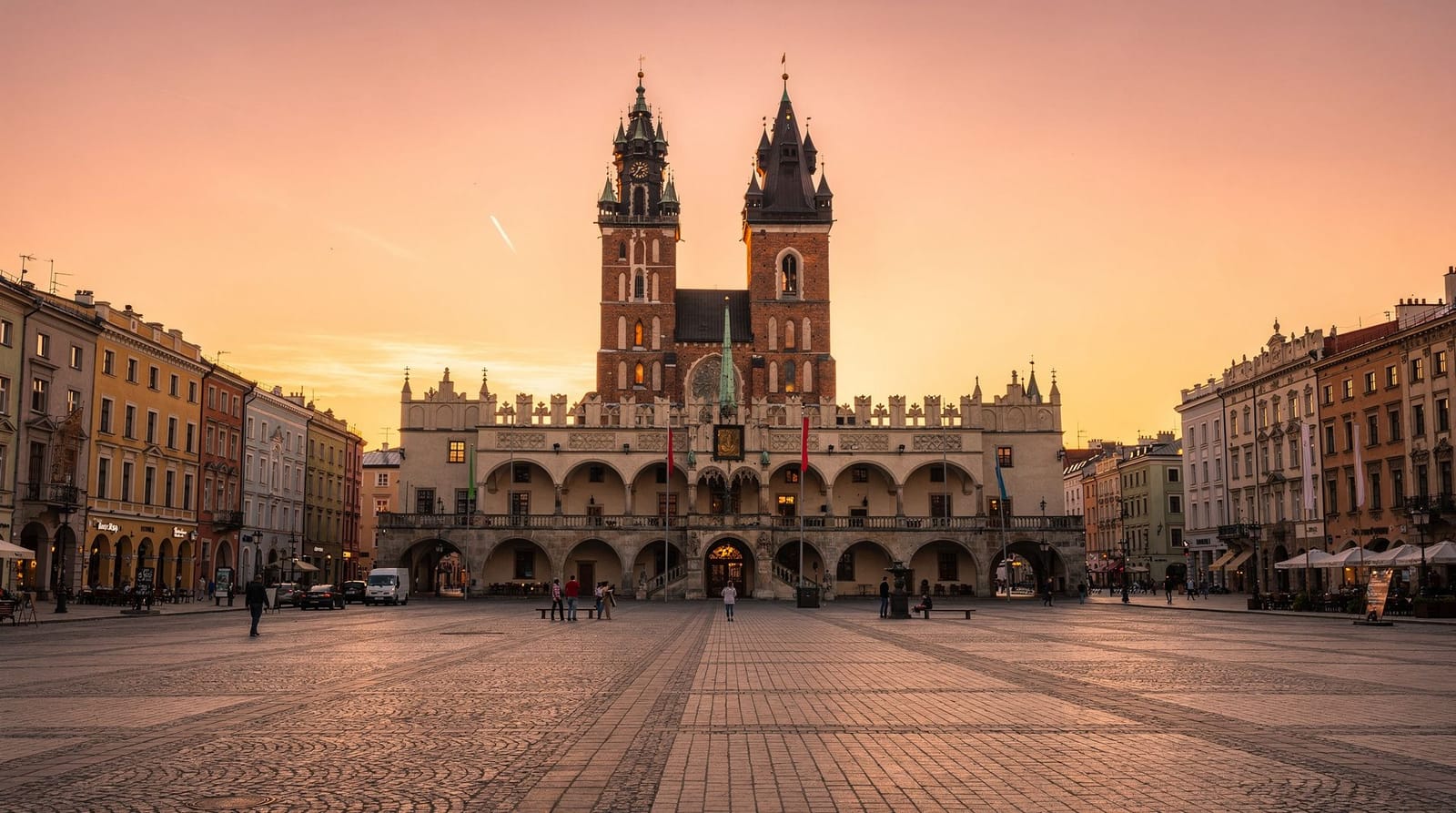
The photographs of Kraków that have become visual shorthand — the Rynek Główny with the Sukiennice at dusk, the twin towers of St. Mary’s Basilica against a summer sky, Wawel Castle reflected in the Vistula — are clichés in the technical sense that they have been repeated so often that their status as images precedes their status as places. They are also clichés because they are genuinely beautiful, and the reason people photograph the same things repeatedly is that those things are worth photographing.
The aim here is not to dismiss the postcard shots but to give them honest context — the best times, the best angles — and then move to the less-photographed material that Kraków contains in considerable abundance.
Rynek Główny: the square at the right moment
The main market square in daylight is at its most photogenic from above. The Town Hall Tower (Wieża Ratuszowa) on the western side of the square offers a viewing platform at the top; the ticket is 22 PLN (5.25 €) and the view gives the square’s proportions in full — one of the largest medieval market squares in Europe, 200 metres per side, with the elongated Sukiennice cutting through its centre.
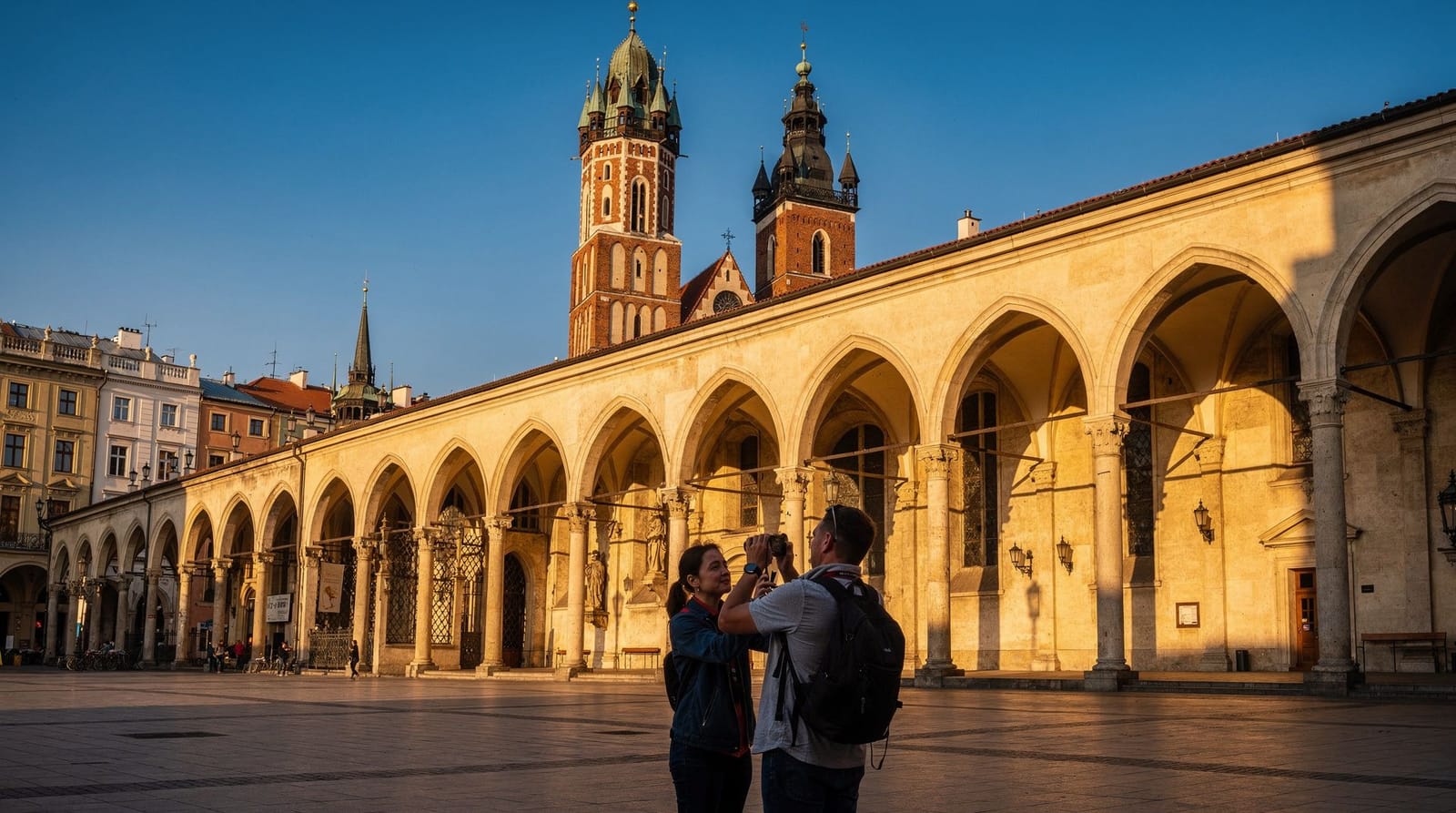
At ground level, the shot that works consistently is from the northeast corner of the square looking southwest — you get the length of the Sukiennice in one frame with St. Mary’s Basilica behind it and (if you time it) the trumpeter’s window visible in the taller tower. Early morning is the only time this is achievable without foreground pedestrian chaos; arrive by 7:30.
If you want the vertical view without queuing at the wrong moment, the Town Hall Tower guide explains what to expect at the top, and the Cloth Hall guide is useful for understanding the building you will be framing along its full length.
The square at blue hour (15-30 minutes after sunset) is the underrated alternative. The surrounding buildings are artificially lit, the sky retains some colour, and the crowd thins significantly compared to the golden-hour rush that fills the square with photographers from 19:00 onwards. A tripod is useful but not strictly necessary; lean against a column of the Sukiennice for stability.
St. Mary’s Basilica: closer is counterintuitive
The standard photograph of St. Mary’s is taken from the square and shows both towers, the Gothic brick facade, and as much sky as the focal length allows. This photograph is widely available and correct.
The less-obvious approach: the interior. The polychrome decoration, the Veit Stoss altarpiece (the largest Gothic altarpiece in the world, completed 1489), and the light through the stained glass windows produce images that are difficult to predict and excellent when they work. Photography is permitted inside for a small fee; a 35mm or 50mm equivalent lens in relatively low light is more useful than a wide angle.
The view from outside, looking toward the basilica along ul. Sienna (the alley running along the south side), is a compression shot that produces something less expected than the frontal view — the towers emerge from a narrow gap between buildings.
Wawel: the approach and the overlooked angle
Wawel Hill from the south bank of the Vistula — the Podgórze side — is the view that most visitors from the north bank never make. Cross the Bernatek footbridge into Podgórze and walk five minutes east along the south bank; the castle rises on the opposite bank in a composition unavailable from the standard viewpoints. This is the angle used in many historical paintings of Kraków precisely because it shows the hill’s relationship to the river and the city’s defensive logic.
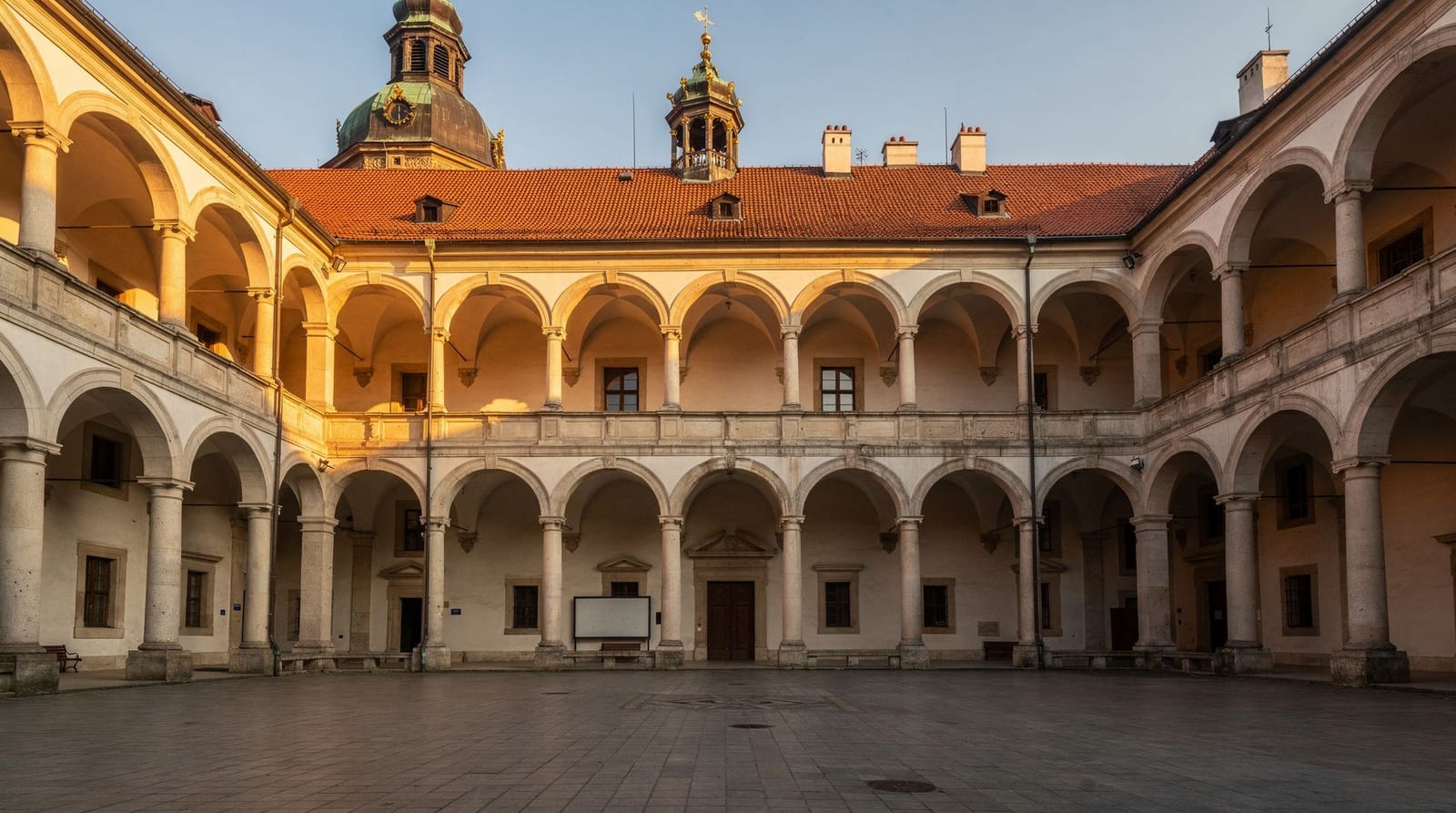
On the hill itself, the inner courtyard of the castle (accessible without tickets for the state rooms) is an early Renaissance arcaded space that photographs well in oblique morning light. The loggia on the upper floors, where the light falls through the arcades onto the courtyard paving, is technically architectural photography but not inaccessible.
The Dragon’s Den exit on the riverbank side gives an unusual view back up to the castle’s rock base — the limestone is worn and dramatic and produces compelling foreground for the structure above.
If you also want to see the interiors rather than only photograph the hill from outside, a guided visit of the castle and cathedral saves you working out the entry logistics yourself, leaving your attention free for the light and the architecture.
Kazimierz: layered and un-obvious
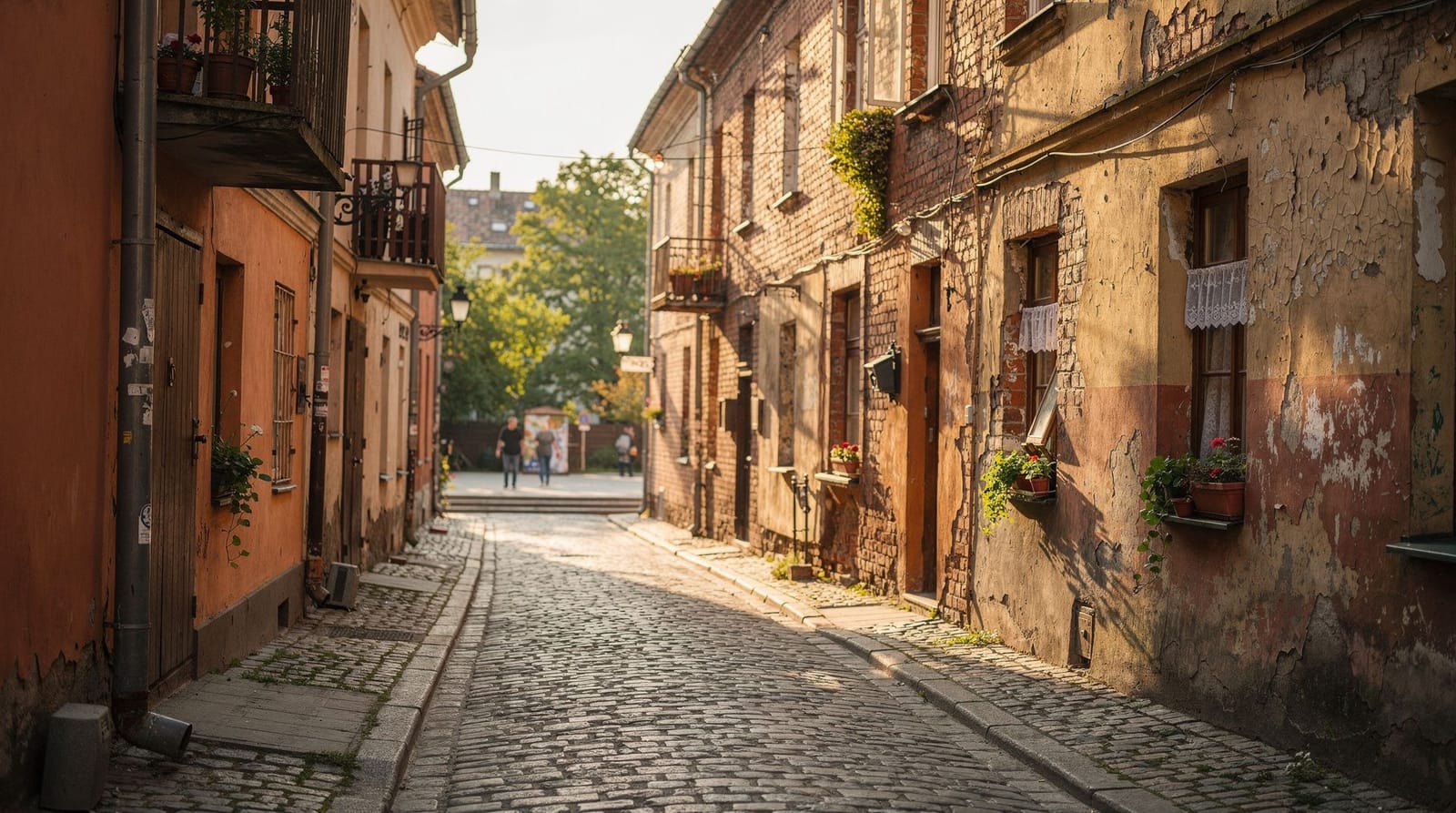
Kazimierz is the neighbourhood that rewards slower attention. The streets around ul. Szeroka — the wide “street” (actually a long, thin square) that was the centre of Jewish commercial life — are most compelling in early morning before the cafés open, when the pre-war buildings have the quality of a city not yet entirely awake.
The Old Synagogue on ul. Szeroka is photographically interesting from the south side, where the building’s Gothic masonry emerges from a small garden at an angle that avoids the main entrance crowd. The Remuh Synagogue nearby has a cemetery (Cmentarz Remuh) with Renaissance tombstones, some of which are remarkable objects. Photography inside religious buildings in active use requires discretion; the cemetery is generally open to visitors.
Plac Nowy at dawn on a Sunday morning, when the flea market stalls are setting up around the round rotunda, is a documentary photography opportunity that almost no one takes because almost no one is awake for it. The rotunda itself, the traders’ vehicles, the early light on the surrounding tenements — it is a genuinely urban scene without tourist content.
The passage at ul. Józefa 3, which connects the street to a courtyard, is a frequently photographed compressed-space shot: washing lines, back facades, irregular windows. Do not be embarrassed about making the same photograph as five hundred other people; it is a good photograph.
Podgórze: the bridge and the factory
The Bernatek Bridge (Kładka Ojca Bernatka) between Kazimierz and Podgórze is the footbridge covered with padlocks — couples’ names and dates inscribed on metal locks attached to every available cable. The photographs of the locks with the river and the opposite bank in focus are easy to make and produce results that look nothing like typical travel photography. In late afternoon with the sun low over the water, the locks catch light in a way that is genuinely beautiful.
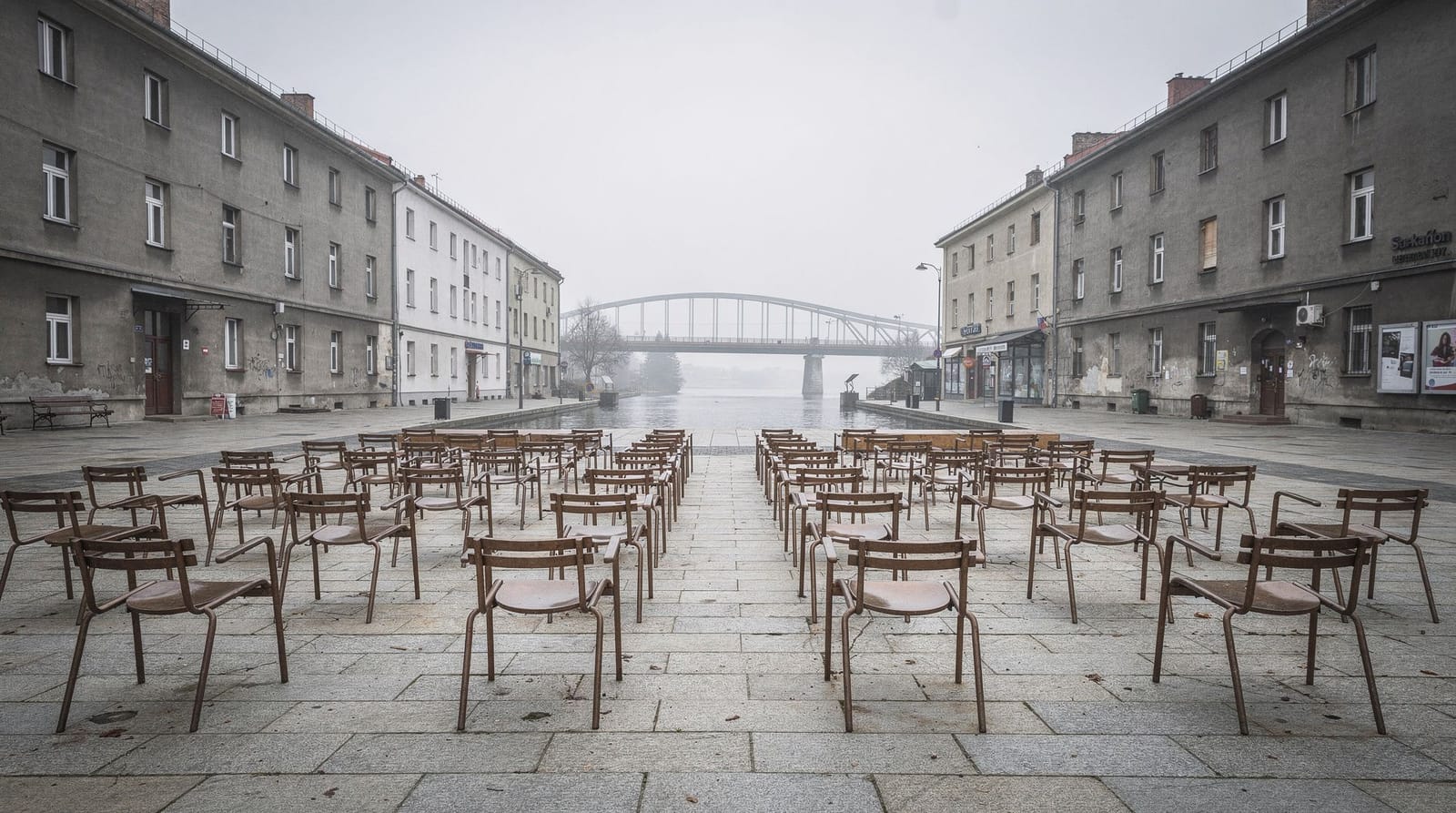
Ghetto Heroes’ Square in Podgórze, with its 33 iron chairs, is a photography location that requires thought. The chairs as objects are architecturally clean and photograph straightforwardly. The context — 33,000 people murdered — makes framing a considered act rather than an automatic one. Empty chairs in low light, without people in the frame, tend to make the memorial subject rather than the tourist-at-memorial subject, which seems more appropriate.
The MOCAK Museum of Contemporary Art, a short walk from Ghetto Heroes’ Square, has a good contemporary architectural exterior and is worth including if you are in the area. The MOCAK guide and the Ghetto Heroes’ Square guide give the background that helps you decide how to frame each place.
Nowa Huta: the shots nobody has
Nowa Huta is approximately six kilometres from the centre and reached most usefully by tram (lines 4 or 15 from near the main station). It is the socialist-realist district built from 1949 onwards for steelworkers, designed to be a model communist city and built at a scale intended to impress from above.
The central square, Plac Centralny (now renamed Plac Ronalda Reagana, the name change being its own kind of historical statement), has monumental Stalinist-classicist architecture on all four sides — five-storey blocks with decorative facades, covered walkways at street level, the proportions designed for a political purpose. The photography challenge here is the emptiness — the square is large and on most days has very few people in it, which either helps or hurts depending on whether you want a human presence.
The vista south along al. Róż toward the main avenue is the classic Nowa Huta shot: a symmetrical recession through identical blocks to a point on the horizon. A slightly wide lens and a tripod produce something geometric and unusual. This is Soviet-era urban planning at its clearest expression, and photographing it as urban landscape rather than as political symbol produces genuinely interesting images.
A guide helps here more than in most districts, because the stories behind the facades explain what you are framing. If you would rather walk it with context, a guided walk through the former communist district in English pairs well with a camera, and the Nowa Huta guide gives the background beforehand.
Professional photoshoot options
For portraits or professional images in Kraków’s most compelling locations, guided photoshoot experiences connect you with local photographers who know the light schedules and the technically difficult spots.
Book a professional photoshoot in Kraków’s city centreThe practical value here is not just the photographer’s skill but the local knowledge: the shot that requires being at a specific archway at 8:15 on a clear morning, or the courtyard in Kazimierz that is inaccessible without knowing which door to try, or the precise angle on Wawel from the south bank at sunset. These are the photographs that distinguish a well-researched trip from a general one.
Light and seasons
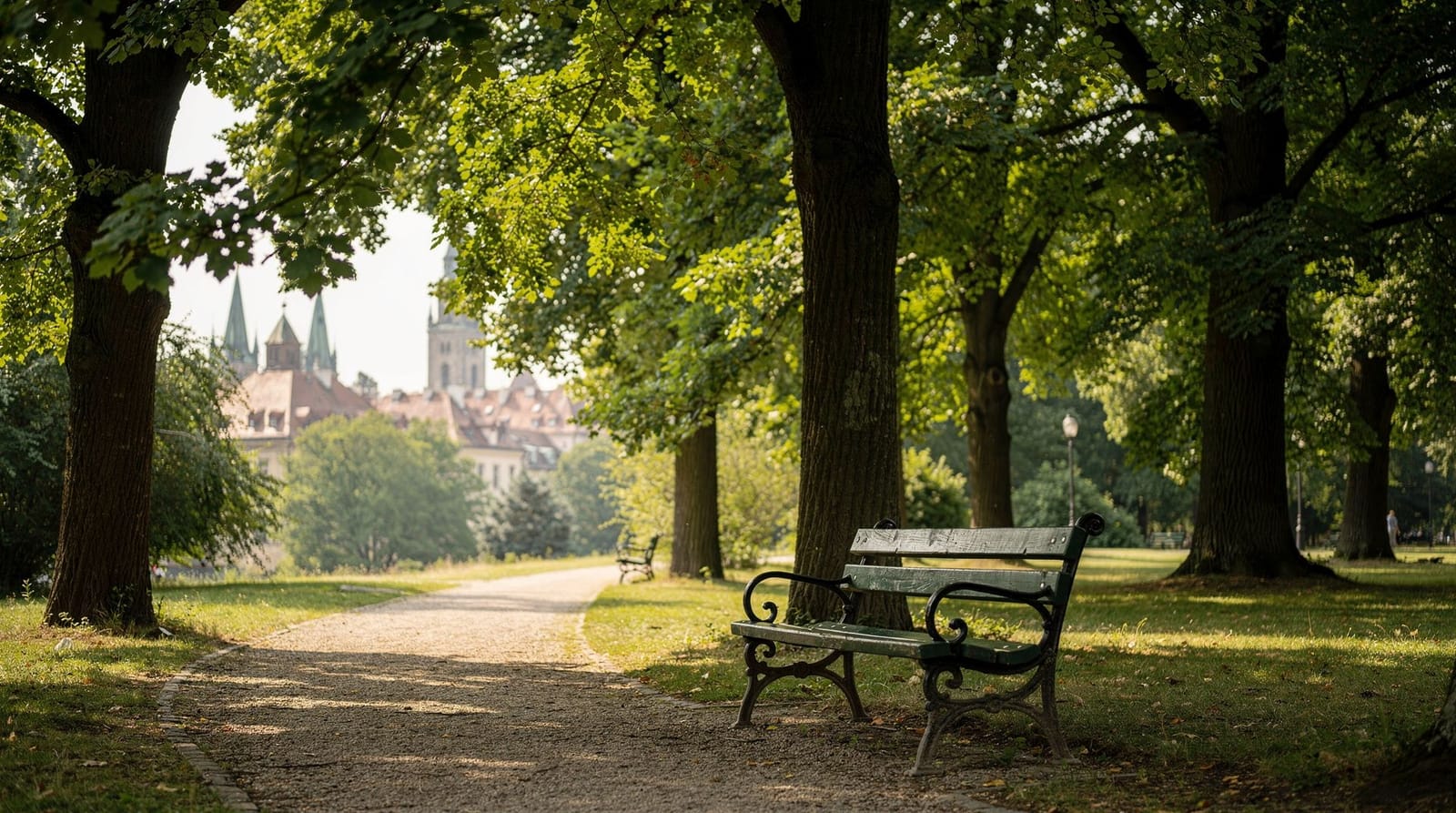
Spring (April-May) offers blossom on the Planty trees with medieval stone in the background — a combination available for approximately a two-week window. Summer has longest days but most crowded foregrounds; early morning starts are mandatory for crowd-free shots. Autumn (October) gives warm light, coloured leaves in the Planty, and a mist over the Vistula on cold mornings that is atmospheric in specific and unrepeatable ways. Winter (December especially) with the Christmas market lights on the Rynek Główny produces glowing, warm-toned images that account for a significant fraction of all photographs made in Kraków.
Seasonal planning matters as much as location, so the best time to visit Kraków is worth a read before you fix your dates, and the Planty Park guide points to the green ring around the Old Town where the blossom and autumn colour are at their best. If you only have a short stay, the Kraków 2-day itinerary shows how to fit several of these districts into a realistic plan.
The honest advice: pick the light and let the location follow. In Kraków, the best location is usually whichever one you can reach at the best time of day. The quality of a golden-hour shot of the Planty path is not lesser than a golden-hour shot of Wawel; it is differently beautiful and considerably less competed-for.
The Kraków photoshoot guide covers the professional side of this in more depth. For context on the city’s geography and the connections between these locations, the Kraków getting around guide is the most practically useful next read.
Best time by season
| Season | What’s good | Trade-off |
|---|---|---|
| Spring (Apr-May) | Blossom in the Planty against medieval stone | Short window, ~2 weeks |
| Summer (Jun-Aug) | Longest days, most golden-hour options | Most crowded foregrounds |
| Autumn (Oct) | Warm light, coloured leaves, Vistula mist | Shorter days |
| Winter (Dec) | Christmas market lights on the Rynek | Cold, early sunsets around 16:00 |
Frequently asked questions about best photography spots in Kraków
What’s the best time of day to photograph the Rynek Główny? Early morning before 7:30am for an empty square, or blue hour (15-30 minutes after sunset) for lit buildings against a still-coloured sky. Both avoid the golden-hour crowd that fills the square from around 19:00.
Is Nowa Huta worth a trip for photography? Yes, if Soviet-era urban planning interests you. It’s a completely different visual register from the medieval centre — symmetrical Stalinist-classicist architecture and largely empty public squares — reached by a 20-minute tram ride (lines 4 or 15).