Kraków by bike: impressions from a guided tour through four districts
Kraków is flat, compact and spread across four districts that don’t sit next to each other — which makes it one of the better European cities to see partly by bike. Here’s what a four-hour guided tour through the Old Town, Kazimierz and Podgórze actually showed me that two days of walking hadn’t.
| Where | Old Town, Royal Route, Kazimierz, Podgórze, Vistula riverbank |
| Cost | around 120–160 PLN (€28–38) per person for a 4-hour guided tour |
| Time needed | 2–4 hours depending on route |
| Getting there | Rental points near the main square; tours depart on foot with the group |
| Best time | Morning (8:00–9:00), before Old Town foot traffic builds |
Why cycling made sense for Kraków
The instinct when visiting a historical city is to walk. This is correct for certain things — the Rynek Główny and Wawel Hill reward a slow pace and stopped attention, and cycling past them would be a category error. But Kraków is also a city with three or four distinct districts worth visiting, each separated by fifteen to twenty minutes of walking, each requiring their own time. Over a three-day visit, the accumulation of inter-neighbourhood walking becomes significant.
A bike tour solves this. It covers the connective tissue between the notable places — the streets and riverbanks and small squares that a walking itinerary tends to cut for time — while letting you stop at anything interesting along the way.
If you are still deciding how many days the city deserves, the how many days in Kraków guide and the 3-day itinerary show where a morning on two wheels fits best. For getting between districts without a bike, getting around Kraków lays out the alternatives, and the public transport guide covers trams and buses.
The tour I joined
I booked a four-hour tour covering the Old Town, the Royal Route, Kazimierz, Podgórze, and the Vistula riverbank.
Book a Kraków bike tour through the Old Town, Jewish Quarter and GhettoThe bikes were Dutch-style city bikes with comfortable upright geometry — appropriate for the flat terrain, slightly ungainly at low speeds compared to anything more sporty but perfectly functional for the pace of a guided tour. Helmets were provided and optionally worn; in July, the group of eight that I joined was split roughly evenly on this. The guide wore one.
We departed from a rental point near the main square at 9:00, early enough to avoid the worst of the tourist foot traffic in the Old Town streets.
The Old Town and Royal Route by bike
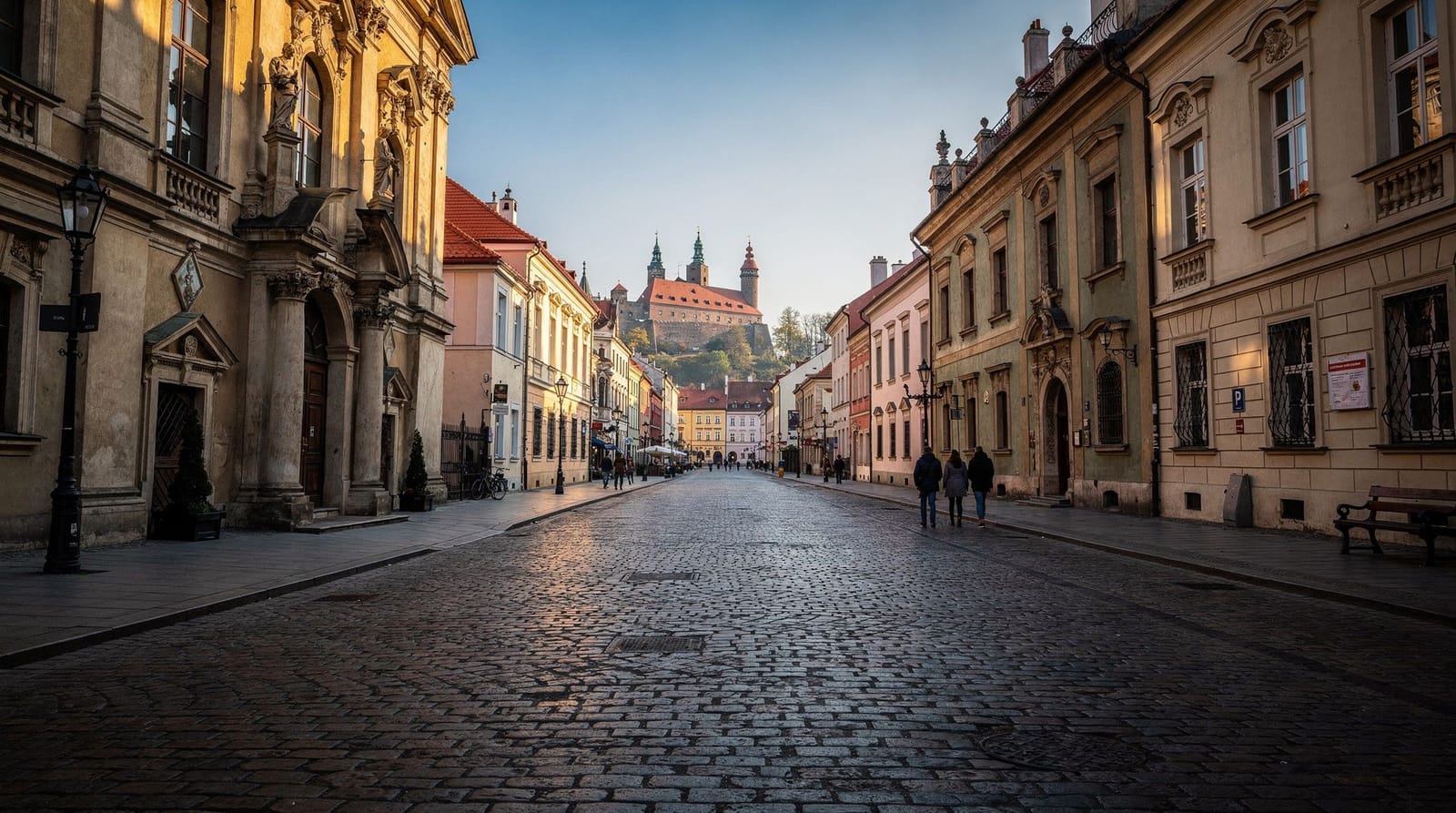
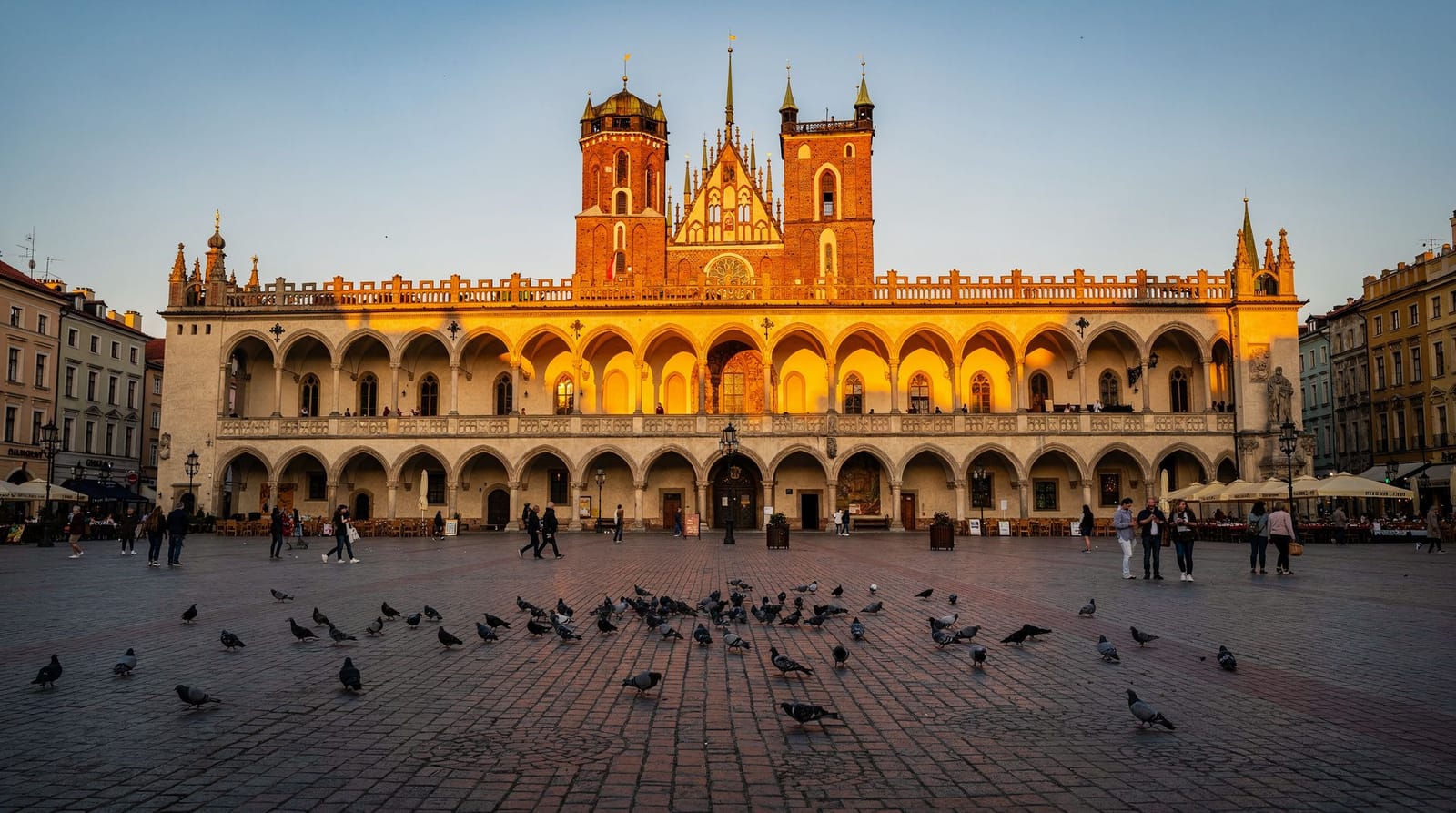
The Old Town is formally a pedestrian zone — motorised vehicles are prohibited — but cyclists are permitted on most streets outside the immediate Rynek area. In practice this means weaving through groups of tourists in the streets around St. Mary’s Basilica in a way that requires attention and sometimes patience. At 9:00 in July this was manageable; I would not want to attempt it at 11:00.
The guide took us along ul. Grodzka — the main artery of the Royal Route running south from the market square toward Wawel — at a pace that allowed stopping for brief explanations at relevant points: the Church of St. Andrew (one of the few buildings in Kraków to survive the Mongol raids of the 13th century, visible in its Romanesque architecture), the Dominican Church, the small square of Wszystkich Świętych.
What a bike allows on this route that walking does not is the shift in perspective that comes with mild speed — the ability to register a facade, a street corner, a detail, and keep it in motion rather than stopping and committing the attention of a walking pace. This sounds like a disadvantage but is actually a way of building a spatial understanding of the city that walking produces more slowly. After an hour on the bike, I had a more coherent mental map of the Old Town’s structure than I did after two days of walking through it.
Kazimierz: slower streets and better stops
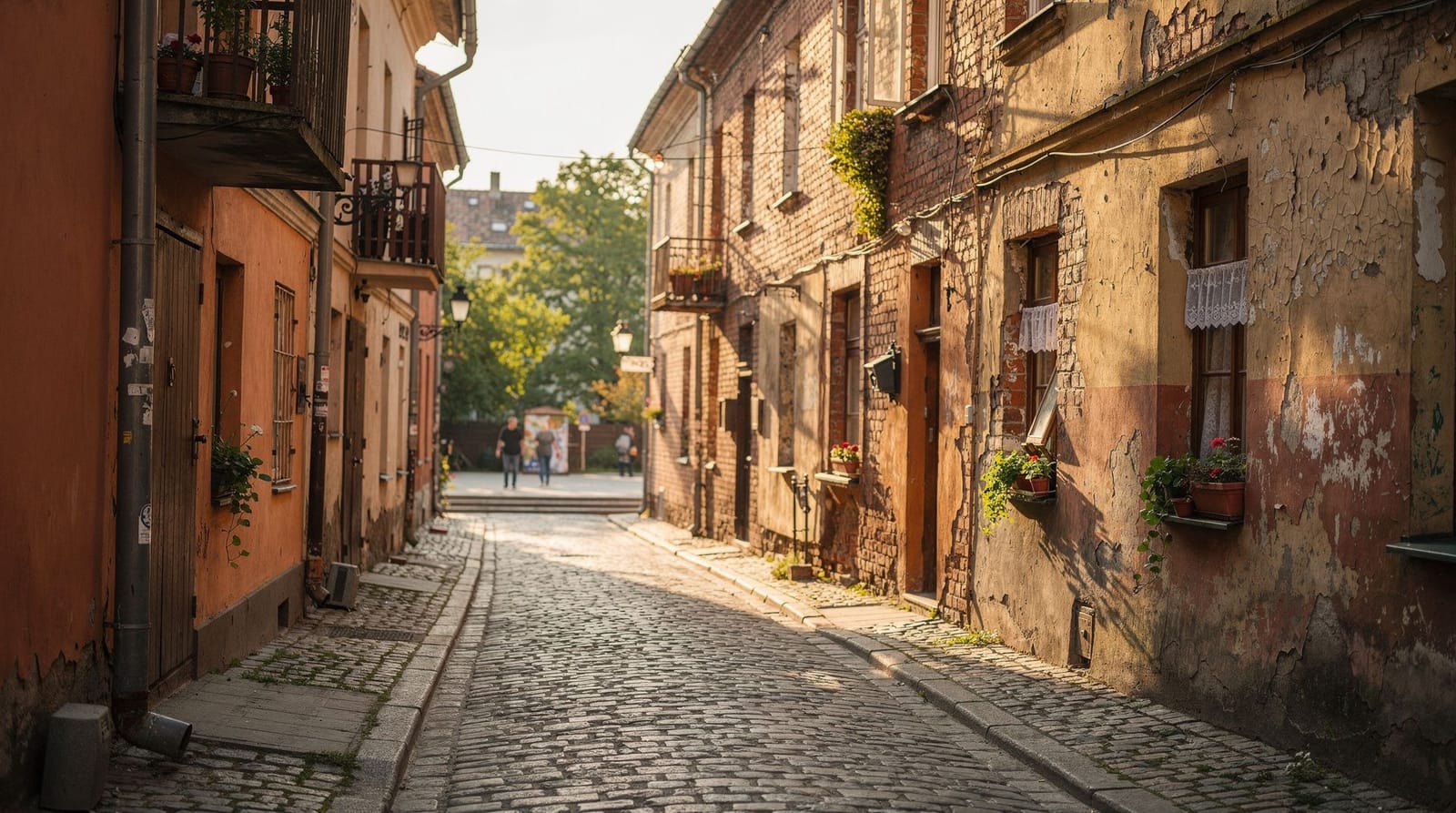
Kazimierz is the best part of this tour. The district’s street scale — narrower, more irregular than the grid of Nowa Huta or the formal streets around the Rynek — is made for cycling at a gentle pace. We went through streets I had missed entirely in two previous walking visits, including the quiet section around ul. Miodowa, where a sequence of synagogues sits in various states of preservation and use.
The guide stopped at the Old Synagogue (Stara Synagoga), the oldest Jewish religious building in Poland, now a branch of the City Historical Museum. The building was used as a stable by the Nazis during the occupation and was restored after the war. The guide’s explanation of Kazimierz’s pre-war Jewish population — around 65,000 people in the neighbourhood before 1939, the majority of whom did not survive — was delivered without melodrama, which made it more rather than less affecting.
Plac Nowy, the central square of Kazimierz with its round rotunda, was the coffee stop. Kazimierz’s café culture has expanded significantly over the past decade; the neighbourhood now has more coffee shops per square metre than anywhere else in the city, and the quality is generally good. We parked bikes against a wall and sat with coffee for fifteen minutes while the guide answered questions.
If the Kazimierz stops caught your attention, the Kazimierz Jewish Quarter guide and the page on the Old Synagogue go much deeper than a moving tour can. If you prefer to go on foot, a guided walk through the Jewish Quarter lets you step inside the places a bike only passes. The Kazimierz food scene is also worth a separate, unhurried visit, and Plac Nowy and its zapiekanki make an easy snack stop on foot.
Crossing into Podgórze: the other side of the river
The Vistula crossing takes you from Kazimierz into Podgórze, the district on the south bank that was the site of the wartime Jewish Ghetto. The bridge is a modern footbridge (the Bernatek Bridge, also known as the bridge of locks for the padlocks attached to its cables) that cyclists share with pedestrians.
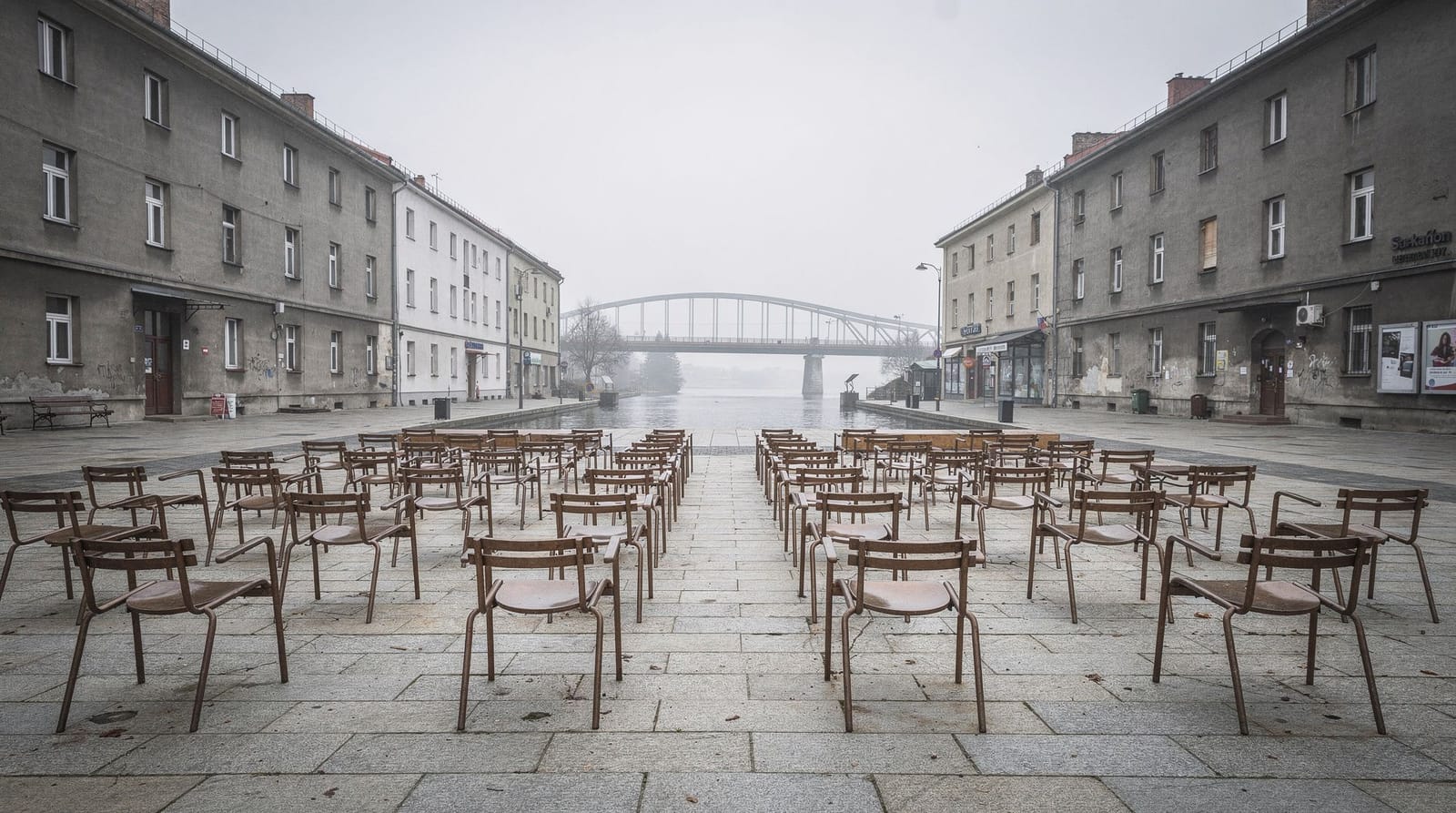
Podgórze is physically different from Kazimierz — lower-density, more residential, with a different architectural character shaped by its industrial history and post-war development. The tour moved through Ghetto Heroes’ Square (Plac Bohaterów Getta), where 33 cast-iron chairs — one for each thousand of the ghetto’s inhabitants — are arranged across the paving as a memorial. This is among the most quietly devastating public memorials I have seen anywhere in Europe.
The Schindler Factory Museum is visible from the square. We did not stop inside — the guided museum tour is a separate, longer experience — but the exterior gives context: the factory itself is an ordinary industrial building. The ordinariness is important.
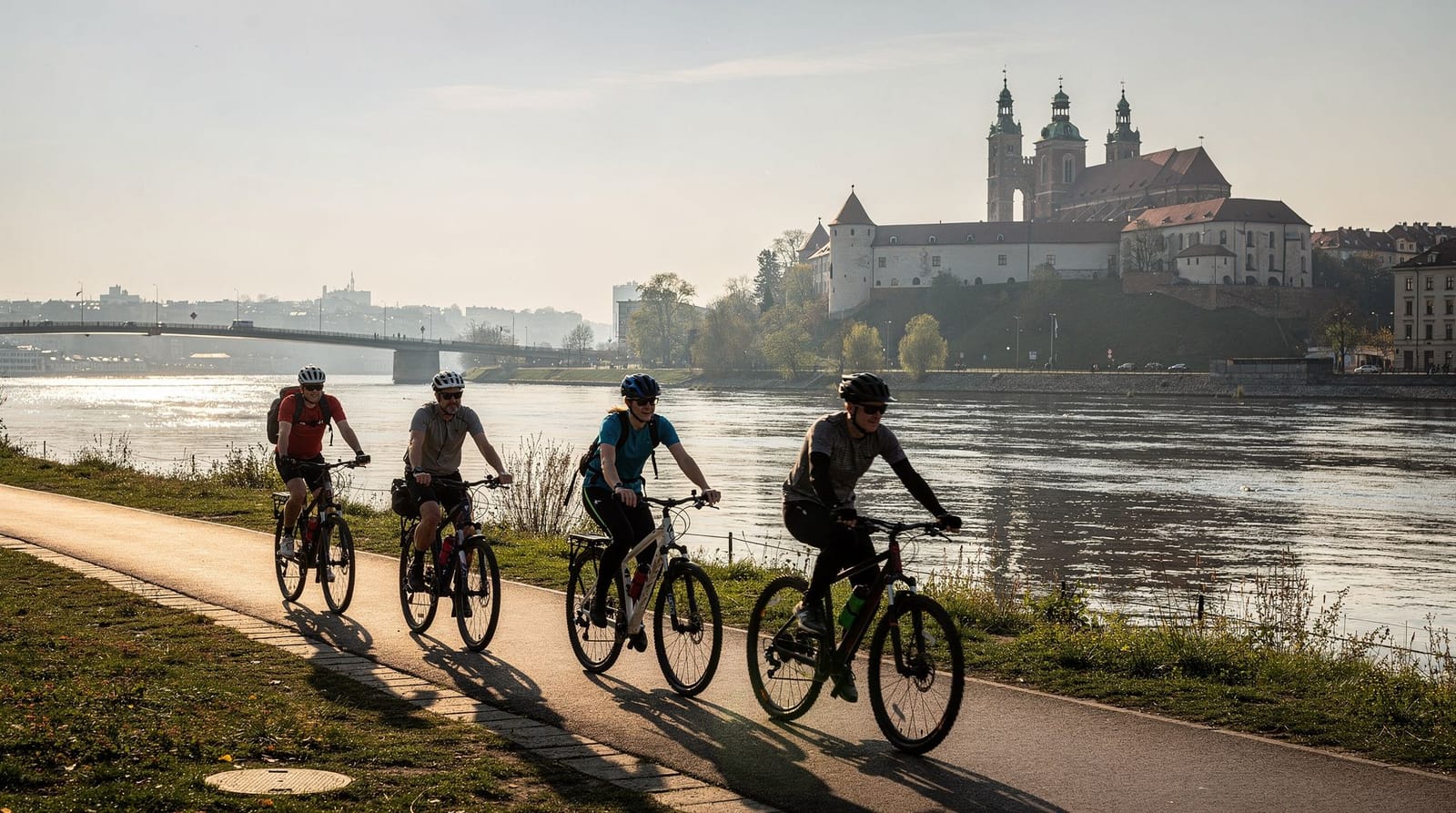
From Podgórze, the tour returned along the south bank of the Vistula, which is less developed than the Old Town bank and has a riverfront path used primarily by cyclists and joggers. The view back across the water to Wawel Hill from this perspective — the castle and cathedral rising from the limestone bluff, the Vistula in the foreground — is a composition you do not get from the pedestrian areas on the north side.
The tour only brushes the surface here. The Podgórze and ghetto guide, the page on Ghetto Heroes’ Square and the Pharmacy and the Schindler’s Factory museum guide are the places to continue if you want to give this district the time it deserves. For wider context, Kraków under Nazi occupation sets the scene.
The riverbank: the section that surprised me most
The Vistula embankment on the Old Town side has been significantly developed as public space over the past decade — a promenade, café barges (tratwy) moored along the bank, benches, grass slopes where people sit in summer evenings. By bicycle it is fast and pleasant. On foot, it is an addition to the walking itinerary that most tourists skip because it requires a deliberate decision to walk away from the landmarks.
The guide took us along the bank from below Wawel back toward the Old Town, then up through Dębniki — a residential district across the bridge that most tourists never reach — to complete the circuit. Dębniki was the neighbourhood where the young Karol Wojtyła (later Pope John Paul II) attended school and lived before his ordination; a small plaque on the relevant building is not on most tourist maps.
The Dębniki detour is a small reminder of how much of the city lies outside the usual circuit. The Pope John Paul II in Kraków guide follows his footsteps in more detail, and the Vistula river cruise guide offers another way to see the same riverbank, this time from the water.
What a bike tour adds and doesn’t add
The honest assessment: a bike tour is not the right way to visit Wawel Castle or to understand the Rynek Underground Museum or to spend the appropriate time at Ghetto Heroes’ Square. It is the right way to establish spatial and historical context — to understand how the districts relate to each other, what the transitions look and feel like, where the residential city exists outside the tourist overlay.
For first-time visitors with limited time, doing the bike tour on Day One and then spending subsequent days on foot in the neighbourhoods that interested you most is an efficient strategy. The Kraków bike tours guide covers the options in more detail, including shorter thematic tours and the e-bike variants that cover more ground.
The city is genuinely flat — or flat enough that no one in our group of eight found the cycling physically demanding at any point. Kraków’s active travel guide is relevant if you want to extend this into a more significant cycling day.
Practical notes
Timing: July mornings work; July afternoons are hot and the tourist density in the Old Town is at its maximum. Start at 8:00-9:00 or wait for 17:00 when the day-trip groups have largely cleared.
Duration: Four hours is the right length for a comprehensive tour. Two-hour options exist but necessarily omit Podgórze or the riverbank.
Weather: Kraków gets afternoon thunderstorms in summer with some regularity. Most tour operators will complete a tour in light rain; genuine downpours result in rescheduling. Check the morning forecast.
What to bring: Water, a layer for wind on the riverbank, and a camera — the mobile-phone-on-bike photography requires pauses, which the guides will accommodate if you ask.
I returned the bike at 13:00, having covered roughly 18 km over four hours, and walked immediately to a milk bar for lunch. The spatial confidence of having seen the city from a bike made the afternoon’s independent walking noticeably more purposeful.
Before you go, a few planning pages help: when to visit Kraków for the weather side of things, the packing guide for what to carry on a summer morning, and Kraków for first-timers for the bigger picture. If the bike tour whets your appetite for other ways of moving through the city, compare it with e-scooter tours and golf cart tours. Travellers who enjoyed this piece may also like the first-time tips and hidden gems write-ups.
Bike tour vs walking tour vs e-bike
| Option | Best for | Typical length | Rough cost |
|---|---|---|---|
| Guided bike tour | Covering four districts + riverbank in one session | 2–4 hours | 120–160 PLN |
| Walking tour | Wawel, the Rynek, the Old Town in depth | 2–3 hours | 80–130 PLN |
| E-bike tour | Same ground as a bike tour with less physical effort | 2–3 hours | 150–200 PLN |
If you would rather take the slower option, a guided walking tour of the Old Town gives you the stories behind the facades at a pace where you can stop and look.
The honest read: a bike tour and a walking tour aren’t substitutes, they’re sequential. Do the bike tour first for orientation, then walk the specific streets that interested you. An e-bike is worth the premium mainly if hills or heat are a concern — Kraków itself barely has hills, so the advantage is smaller here than in, say, Zakopane.
Who this isn’t for
Small children, anyone uncomfortable cycling in traffic (the Old Town’s pedestrian streets require some negotiation with foot traffic), and anyone whose priority is Wawel’s interiors or the Rynek Underground Museum — both need dedicated, unhurried time that a moving tour can’t give them. The Kraków for active travelers guide covers other ways to see the city at a faster pace, including e-scooters and segways.
Frequently asked questions about Kraków by bike
Do I need to be an experienced cyclist for a Kraków bike tour? No. The bikes are upright city bikes, the terrain is flat, and guided tours keep a moderate pace with regular stops. Basic comfort riding in a group on shared streets is all that’s needed.
Is a bike tour better than walking for a first visit to Kraków? Neither replaces the other. A bike tour is the faster way to understand how the Old Town, Kazimierz, Podgórze and the riverbank relate to each other; walking is still necessary for Wawel’s interiors, the Rynek Underground Museum, and anywhere you want to linger.