Nowa Huta: Kraków's socialist city and what it tells you about communism
Krakow: Nowa Huta former communist neighborhood walking tour
What is Nowa Huta and why is it worth visiting?
Nowa Huta is a purpose-built socialist-realist district constructed from 1949 onwards on the eastern outskirts of Kraków as a showcase communist city. It is the best-preserved example of socialist urban planning in the world, now a living neighbourhood of 200,000 people, and a uniquely legible window into how communist ideology was translated into architecture, city planning, and everyday life.
Why Nowa Huta exists
Most visitors to Kraków concentrate on the medieval core. Those who venture 8 km east to Nowa Huta discover something entirely unexpected: a perfectly symmetrical socialist city built from bare fields between 1949 and the mid-1960s, now largely intact and still inhabited by the people and descendants of the people who were moved there.
Nowa Huta (“New Steelworks” in Polish) was not simply a housing development. It was an ideological project: proof that communist Poland could build a modern, rational, equitable city from scratch; a deliberate counterweight to Kraków’s bourgeois intellectual and Catholic identity; and a practical instrument for creating a new class of industrial workers who would be loyal to the communist state.
Understanding why it was built, how it was built, and what it became is one of the most instructive things you can do in this part of Europe.
| Where | 8km east of Old Town — tram 4, 10, 22 or 62 to Plac Centralny |
| Time needed | Half day (3–4hrs) for the main axis and museum; full day with lunch and the allotment gardens |
| Cost | Tram 60-minute ticket 8 PLN; museum: check muzeumkrakowa.pl (branch listed as temporarily closed); guided tours from GYG |
| Best time | Weekday afternoon for the most authentic, least touristy feel |
| Don’t miss | Arka Pana church, Plac Centralny, Nowa Huta Museum |
For context on the wider Nazi-occupation history that preceded the communist period, see the Kraków under Nazi occupation guide and the broader WWII Kraków guide — Nowa Huta’s story picks up almost exactly where that history leaves off.
The political logic: why build it next to Kraków?
The choice of location was not accidental. Kraków in 1949 was everything communist Poland’s new rulers distrusted: a city of universities, churches, the intelligentsia, aristocratic memory, and pre-war bourgeois culture. The authorities needed to dilute it.
By constructing a massive steelworks — the Lenin Steelworks (Huta im. Lenina), renamed the Sendzimir Steelworks after 1989 — alongside a planned workers’ city, they created a new electoral and social bloc. Workers imported from rural areas across Poland would outnumber Kraków’s existing educated population, attend newly built cinemas and cultural centres instead of churches, and vote accordingly.
The plan succeeded in changing Kraków’s demography but failed politically: Nowa Huta’s workers became some of the most active participants in the Solidarity movement of the 1980s, and the neighbourhood’s fight to build a church — denied by authorities for decades — became one of the key symbolic battles of the era.
The architecture: socialist realism in practice
Nowa Huta was designed by a team led by architects Tadeusz Ptaszycki and Tadeusz Rembiesa. The master plan drew on both Soviet precedents (Stalin’s Moscow rebuilding program) and Renaissance urban ideals — which created a curious aesthetic hybrid.
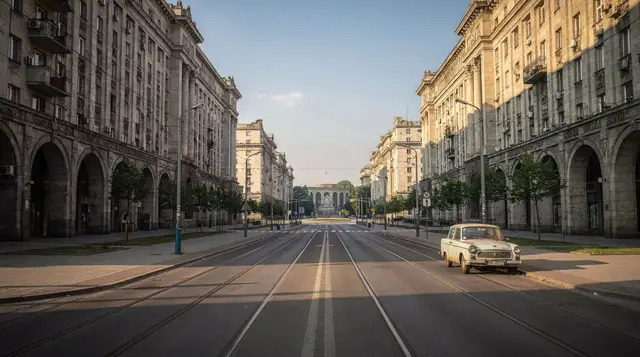
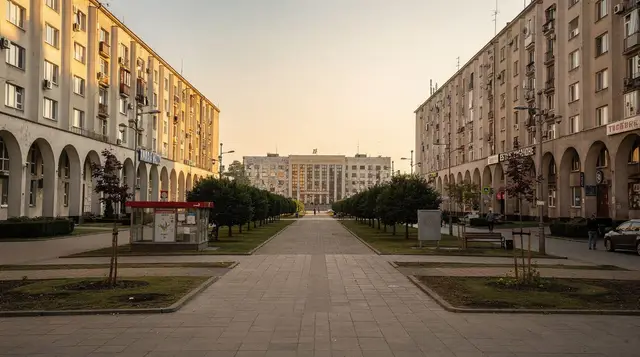
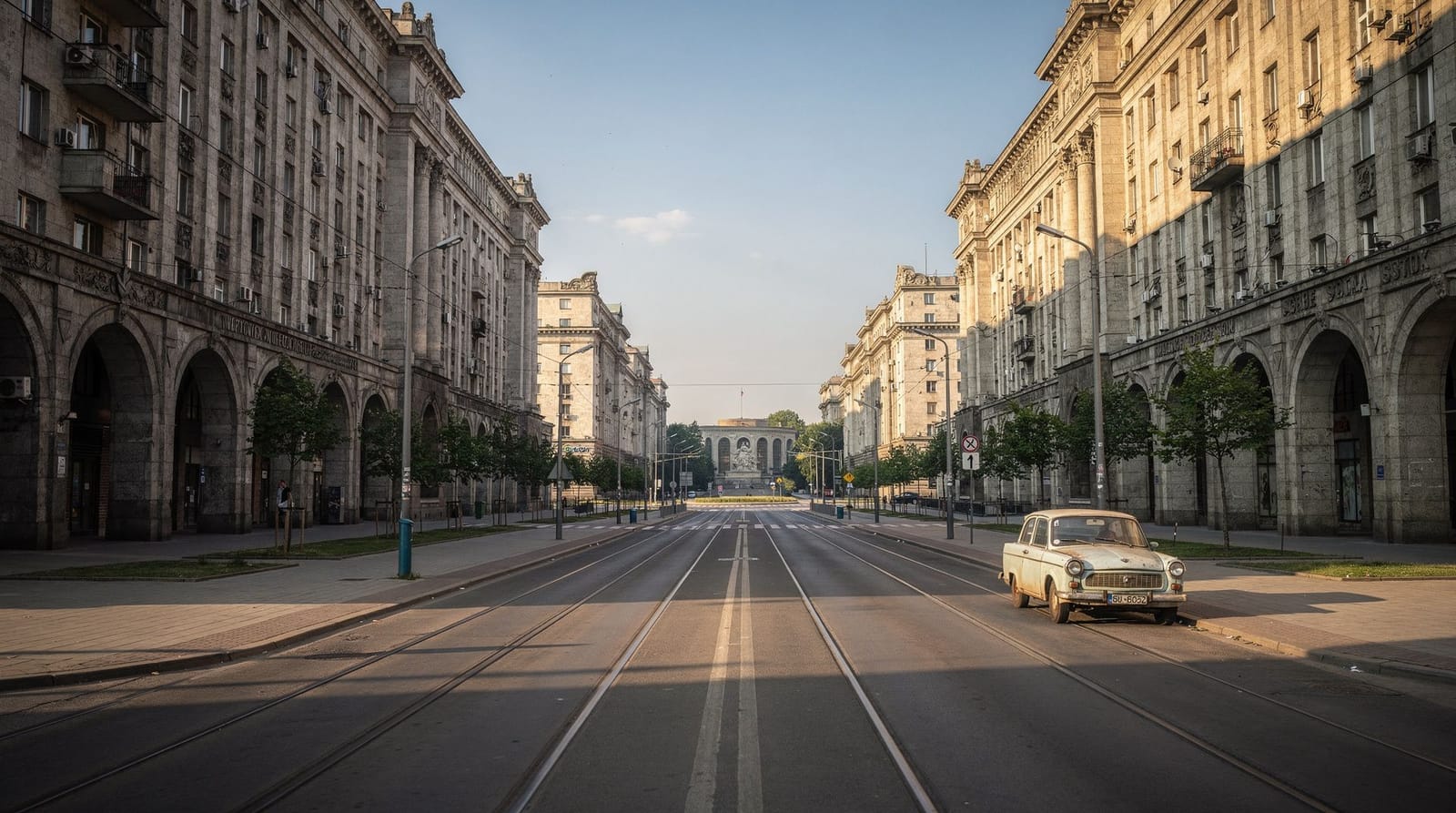
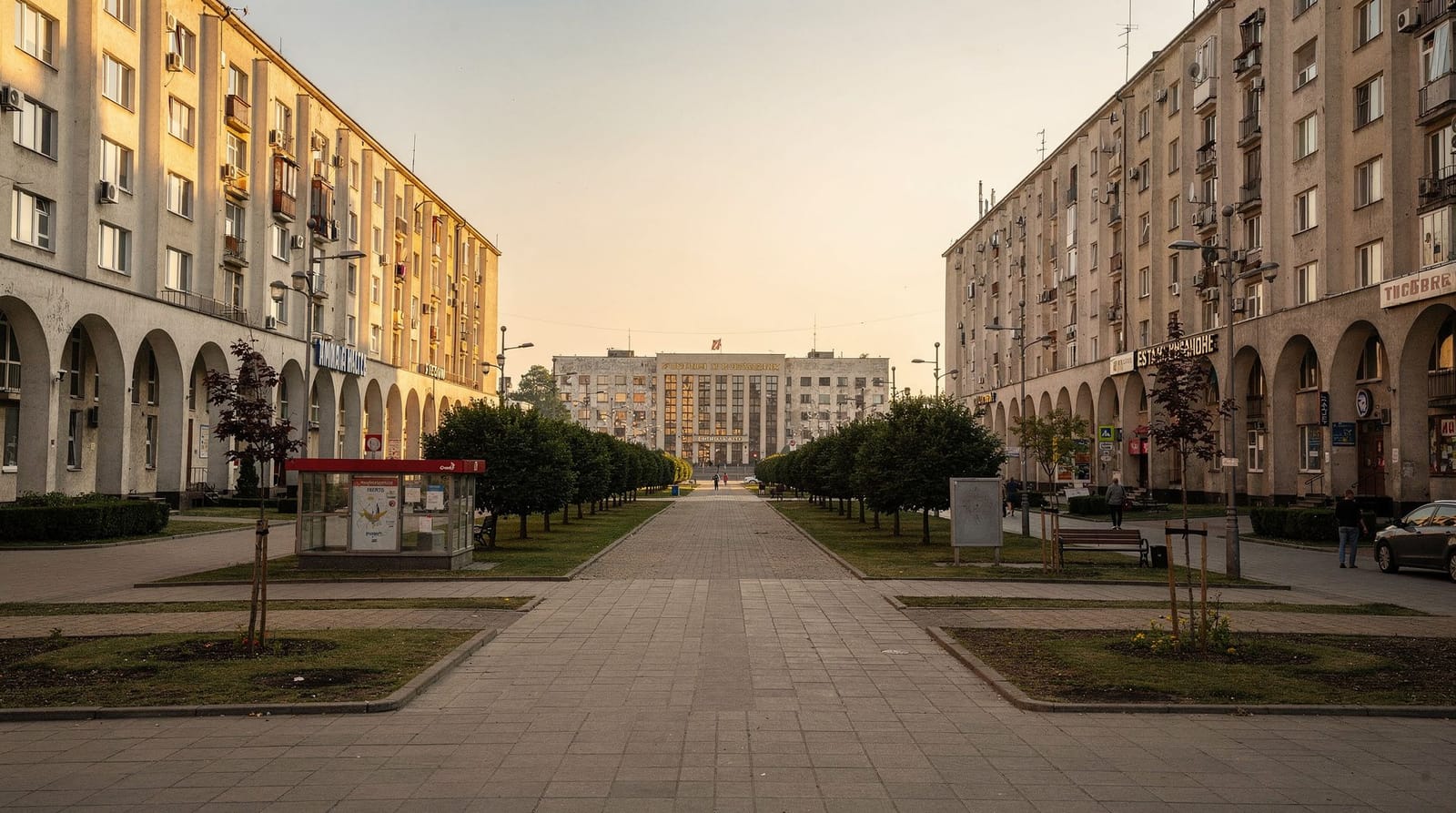
The central axis, Aleja Róż (Avenue of Roses), runs east from the main square toward the former steelworks. It is broad, lined with mature trees, and flanked by monumental limestone-clad apartment buildings with arcaded ground floors, ornamental cornices, and classical proportions. The effect is grand and somewhat disorienting — this is not the brutalist concrete of later communist housing estates (the “blokowiska”), but something more considered.
Plac Centralny (Central Square, renamed Plac Ronalda Reagana in 2004) is the heart of the district. It is a large formal square with fountains, surrounded by five-storey residential blocks with internal courtyards. The proportions are those of a European city square rather than the vast windswept plazas of Soviet planning. In summer, people sit at café tables and children play — the square functions, which is not something you can say of all socialist urban planning.
The street grid is based on a radial system: wide boulevards radiate from the central square, with secondary streets creating a regular pattern. Everything is at a human scale compared to the gigantism of Soviet cities; Kraków’s architects had enough autonomy to moderate the worst excesses of the style.
The steelworks itself is visible on the eastern horizon — enormous, rusting, now largely decommissioned. At its peak in the 1970s, the Lenin Steelworks employed 40,000 workers and produced 6 million tonnes of steel per year. The pollution it generated contributed to the corrosion of Kraków’s medieval buildings and the respiratory problems of its residents — a bitter irony that the workers’ paradise was destroying the city it was meant to improve.
The church that broke the system
No single story better illustrates the contradictions of communist Nowa Huta than the battle over Arka Pana Church.
The original plan for Nowa Huta included no churches — consistent with communist anti-clerical policy. Local residents, most of them Catholic and from rural Poland, immediately began agitating for a place of worship. Authorities refused, installed a committee room on the site earmarked for a church, and for years maintained that a workers’ city had no need for religion.
What followed was a 20-year struggle involving street protests, arrests, sit-ins, and several periods of violence. The authorities eventually relented under international pressure, granting permission in 1967. The church — now known as Arka Pana (Lord’s Ark) for its resemblance to a ship — was designed by Wojciech Pietrzyk and built by local volunteers over a decade, finally consecrated in 1977. The dedication ceremony was conducted by Karol Wojtyła, then Archbishop of Kraków — two years before he became Pope John Paul II.
The church stands at ul. Obrońców Krzyża in Nowa Huta’s western part, and it remains one of the most architecturally striking buildings in the district: a modernist concrete vessel with a sharply angled roof, its interior walls studded with a million stones collected from every region of Poland by the parishioners who built it. The tabernacle contains a piece of moon rock, given by the American astronaut James Irwin as a gesture of solidarity.
It is free to enter, visually extraordinary, and historically essential.
Karol Wojtyła’s connection to Nowa Huta
The consecration of Arka Pana by Karol Wojtyła is not a footnote — it is one of the clearest threads linking Nowa Huta’s story to the man who became Pope John Paul II. As Archbishop of Kraków through the 1960s and 1970s, Wojtyła repeatedly sided with Nowa Huta’s residents in their long fight for a church, celebrating open-air Christmas Mass at the site years before permission was granted and using his position to keep international pressure on the authorities. The Pope John Paul II in Kraków guide traces this relationship in full, and travellers building a JPII-themed day can pair Nowa Huta with the Wadowice day trip to his birthplace, about 50km southwest.
Solidarity and the fall of communism
Nowa Huta’s workers, despite being created as the state’s loyal industrial base, became central to the opposition movement that ultimately ended communist rule in Poland.
The 1980 strikes at Kraków’s steelworks, coordinated with the Gdańsk shipyard strikes that gave birth to Solidarity, were among the largest in Poland. Workers from Nowa Huta — men who had been brought to build the communist dream — were among the most active. The neighbourhood became a stronghold of the underground Solidarity movement through the martial law period (1981–1983).
The Home Army resistance and Solidarity history guide covers this broader narrative.
The Nowa Huta Museum
The district’s main dedicated museum occupies a former cultural centre on Aleja Róż. It covers the history of Nowa Huta from planning through construction, the daily life of the steelworks workers, the church struggle, Solidarity, and the post-1989 transformation. The collection includes period photographs, archive footage, reconstructed interiors, and — memorably — original communist-era objects including propaganda posters, medals, and domestic items.
The museum is small (plan an hour), well-designed, and provides the orientation to make the neighbourhood’s streets make sense. The Museum of Kraków currently lists this branch as temporarily closed, so check muzeumkrakowa.pl before you go. A skip-the-line Nowa Huta Museum communist Poland tour is available via GetYourGuide and includes guided commentary that puts the exhibits in context.
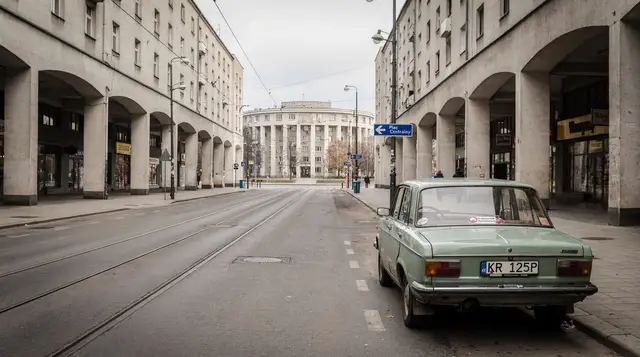
The district was designed to be driven through, not walked: a private Nowa Huta tour in communist-era cars covers the axes and the steelworks at the scale they were planned for, which changes what the place looks like.
Touring Nowa Huta: the options
There are three main ways to explore the district:
Walking tour: The most flexible option. A Nowa Huta former communist neighbourhood walking tour from central Kraków covers the main architectural set-pieces, the Arka Pana church, the steelworks panorama, and gives time for the museum. Allow 3–4 hours including transport.
Trabant tour: One of the great Kraków experiences. The 3.5-hour communism deluxe tour by Trabant puts you in a restored East German Trabant car — the quintessential communist vehicle — for a circuit of Nowa Huta’s key sites with a knowledgeable guide. The aesthetic combination of Trabant and socialist architecture is both surreal and historically coherent. Excellent for couples and small groups.
Bike tour: A communism bike tour allows you to cover more of the district at a pace that permits stops and detours. The flat terrain of Nowa Huta makes cycling easy. This is the best option for those who want to explore the residential streets beyond the main tourist circuit.
Getting there independently
Nowa Huta is 8 km east of the Old Town and well-served by public transport. Tram lines 4, 10, 22, and 62 run from the city centre (stop Wawel or Teatr Bagatela) directly to Plac Centralny. Journey time approximately 35–40 minutes. A 60-minute ticket costs 8 PLN (≈ €1.90), which covers the journey.
By taxi or Bolt/Uber, the journey takes 20–25 minutes in normal traffic and costs approximately 25–35 PLN (≈ €6–8). Avoid the journey during peak hours (8:00–9:00 and 16:00–18:00).
The best approach for independent visitors is to take the tram to Plac Centralny, walk the main axis to Arka Pana, visit the museum on the return, and take a tram back. Add a Trabant or bike tour if you want guided context.
What to eat in Nowa Huta
The district has several good options for a mid-visit lunch or dinner. Restauracja Stylowa at Aleja Róż 1, on the main square, is the most historically resonant: it was the district’s main restaurant during the communist era and retains period décor, serving traditional Polish food at reasonable prices. Main courses 35–55 PLN (≈ €8–13).
Bar Mleczny Centralny, the local milk bar (bar mleczny — communal canteen), serves cheap Polish staples including pierogi, bigos, and żurek soup. Expect to pay 15–25 PLN (≈ €4–6) for a full meal. Cash only; arrive during peak lunch hours (12:00–14:00) to see the space in full use.
Nowa Huta beyond the tourist circuit
Most guided tours cover the main axis (Plac Centralny to Arka Pana) and leave it there. The district rewards further exploration.
The inner courtyards: The apartment blocks on Aleja Róż and its parallel streets were designed with large internal courtyards — green spaces intended to provide residents with outdoor areas without requiring them to use public streets. Many of these courtyards still contain original tilework, mosaic decorations, and small playgrounds. They are accessible through the archways in the ground floors of the buildings and give a more intimate sense of how the district was actually designed to be lived in.
Allotment gardens (działki): The large belt of allotment gardens stretching east of the central area toward the steelworks is one of the district’s most distinctive features. Allotment gardens were an officially encouraged form of private cultivation in communist Poland — a pragmatic acknowledgment that collective agriculture could not meet food demand. The Nowa Huta działki are particularly large, many with small summer houses. In spring and summer, they function as a kind of informal urban village within the urban grid.
Kopiec Wandy (Wanda’s Mound): The artificial earthen mound in the eastern part of Nowa Huta, traditionally associated with the legendary Princess Wanda (daughter of Kraków’s founding hero Krak), is a pre-medieval monument surrounded by what is now residential Nowa Huta. Climbing it takes about five minutes and provides the best panoramic view of the steelworks complex to the west and the city beyond. Archaeologically documented as a genuine early medieval burial mound, though the specific identification with Wanda is legendary rather than historical.
The Nowa Huta parish churches: In addition to the famous Arka Pana, the district contains several other churches built or substantially expanded during the communist period, each with a story of community resistance to the state’s anti-clerical policies. The Church of the Mother of God of Częstochowa in Mistrzejowice, consecrated in 1983, was built with the personal support of Cardinal Wojtyła and became a centre of Solidarity activity during the martial law period.
Daily life in Nowa Huta: what residents experienced
When the first residents moved into Nowa Huta’s apartment blocks in the early 1950s, many were coming from rural Poland — small villages in the Małopolska region, the Carpathians, or even more distant provinces. The transition to urban, industrial life was abrupt and often disorienting.
The apartment blocks provided housing that was genuinely better than what many residents had left: indoor plumbing, central heating, electricity. The communal facilities — the cultural centre, the cinema (Kino Świt, still operating), the library — were new and functional. By the standards of rural Poland in the early 1950s, Nowa Huta offered material improvements that were real, not merely propagandistic.
What the early residents also found was that the planned city had not planned for everything. The original design had no churches, very limited retail infrastructure, and insufficient childcare. The cultural centres and cinemas were propaganda outlets as much as entertainment venues. The workplace — the steelworks — was dangerous, physically demanding, and subject to production quotas that could not be met without cutting safety corners.
Over the decades, Nowa Huta developed the complex social texture of a real community: networks of solidarity, mutual support, the informal economy that supplemented the official one, and the religious life that the state could not suppress. These are the elements that the best guided tours try to convey.
After communism: Nowa Huta today
The post-1989 transformation hit Nowa Huta hard. The steelworks contracted from 40,000 workers to a fraction of that number; unemployment rose sharply; younger residents with mobility left for central Kraków or abroad. The housing estates that had been considered desirable in the 1950s were now seen as symbols of the communist past.
The subsequent three decades have been uneven. Some areas have been well maintained; others show the marks of under-investment. A new generation of artists, attracted by cheap rents and large studio spaces, has moved in and begun a gentrification process similar to that seen in comparable post-industrial districts across Europe.
Nowa Huta today is a complex, lived city within a city — not a preserved museum and not a ruin, but a working-class district in transition. The best way to appreciate this is simply to spend time there beyond the standard tourist circuit: eat at a bar mleczny, walk the residential streets, sit in Plac Centralny on a weekday afternoon. The district reveals itself in its ordinariness as much as in its exceptional history.
Nowa Huta vs the Old Town: which to prioritise
If your time in Kraków is limited, it helps to know how the two experiences compare before deciding whether Nowa Huta earns a half-day of your itinerary.
| Old Town | Nowa Huta | |
|---|---|---|
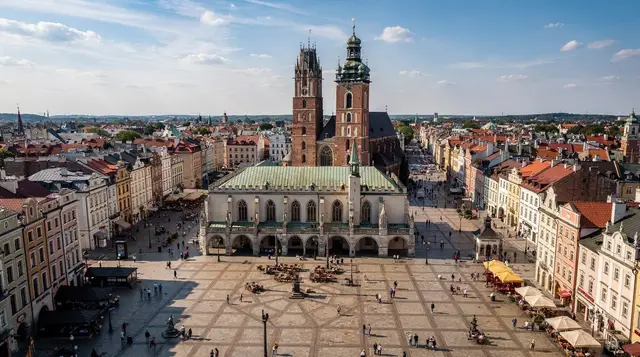
| Character | Medieval, Renaissance, Baroque — Kraków’s postcard image | 20th-century socialist-realist planned city |
| Time needed | 1–2 days minimum | Half day (3–4hrs) is enough |
| Crowds | Busy year-round, especially Rynek Główny | Quiet outside guided-tour groups |
| Best for | First-time visitors, architecture, nightlife | History buffs, photographers, communism-curious travellers |
| Getting there | Walkable from most hotels | Tram 4/10/22/62, ~35–40 minutes from centre |
Read the full destination guide to Nowa Huta for more on the neighbourhood, and see getting around Kraków for tram and ticket details beyond the basics above. For a wider primer on how Poland’s 20th century shaped the city, Polish history for visitors is the essential companion piece, and our WWII history itinerary shows how Nowa Huta fits into a broader day-by-day plan alongside occupation-era sites. If you’d rather have a guide narrate the ideology behind the architecture as you walk, the communist Kraków tour guide rounds up the best options.
Frequently asked questions about Nowa Huta and communism
Is Nowa Huta still a working-class neighbourhood?
Yes, in many respects. The post-communist transformation brought unemployment as the steelworks contracted dramatically (from 40,000 workers to around 3,000 today), and parts of the district show the consequences: shops that never reopened, blocks that are under-maintained, a demographic skewing older as younger residents moved elsewhere. But Nowa Huta also has a growing arts scene, cheap rents attracting young creative workers, and new businesses that coexist with the original structures.
Can you tour the steelworks?
Organised tours of the Arcelor Mittal Kraków steelworks (formerly Lenin, then Sendzimir) are occasionally available and can be booked through the Nowa Huta tourism office. The site is operational, so public access is restricted. The best views of the complex are from the Kopiec Wandy hill just east of the district.
Was Nowa Huta always part of Kraków?
No. Nowa Huta was established as a separate administrative city in 1951 but incorporated into Kraków in 1951 (the boundary change was partly administrative, partly designed to dilute Kraków’s electorate). It remains technically a district (dzielnica) of Kraków rather than an independent municipality.
What is “socialist realism” in architecture?
Socialist realism was the mandatory aesthetic style in Soviet bloc countries from the late 1940s to the mid-1950s. In architecture, it combined Stalinist gigantism — broad boulevards, monumental public buildings — with superficial classical detailing and references to historical national architecture. The goal was to create architecture that was accessible to the masses, optimistic in appearance, and legible as progress. In Poland it lasted roughly from 1949 to 1956, when Khrushchev’s denunciation of Stalin opened the way for modernist architecture.
How much time should I set aside for Nowa Huta?
A focused half day (3–4 hours including transport) covers the main axis, Arka Pana, and the museum comfortably. Add another hour or two if you want to explore the inner courtyards and allotment gardens, or eat a proper meal at Bar Mleczny Centralny or Restauracja Stylowa rather than rushing back to the centre.
Is Nowa Huta worth it if I only have 2–3 days in Kraków?
It depends on your interests. If you’re a first-time visitor prioritising the Old Town, Wawel, and Kazimierz, Nowa Huta is a reasonable trade-off to skip on a short trip. If 20th-century history and architecture particularly interest you, it’s worth carving out a half day even on a 3-day trip — nothing else in Kraków offers a comparable experience.
Top experiences
Bookable activities with verified prices and instant confirmation on GetYourGuide.