A secular visitor's story: going to Częstochowa for the Black Madonna
Going for the wrong reasons
I should be honest about why I went. I was visiting Kraków for six days, had done the expected things — Wawel, Wieliczka, Kazimierz, a long evening at the Schindler Factory Museum — and was looking for a day trip that was different in character from the previous ones. Częstochowa was described in several places I read as “the spiritual heart of Poland,” which is a phrase that tends to produce either immediate interest or immediate disinterest, and mine was the former.
I am not religious. I was curious. These turned out to be entirely sufficient reasons to go.
| Where | Częstochowa, 120km northwest of Kraków |
| Time needed | Full day; guided tours run around 8:00-19:30 |
| Cost | Train fares vary with booking time; the treasury is visited on a guided tour |
| Getting there | Direct train from Kraków Główny, or a guided day tour |
| Busiest day | August 15 (the Assumption) — plan around it if possible |
Getting to Częstochowa from Kraków
Częstochowa is 120 km northwest of Kraków, roughly 1.5-2 hours by bus or 1.5 hours by direct train. The train from Kraków Główny is the more comfortable option; the journey on IC or TLK services has fares that vary with booking timing; check current prices with PKP Intercity.
I booked a tour instead, partly for the guide and partly because I had been warned that Częstochowa as a city — beyond the monastery — offers limited standalone interest, and having a structured day was sensible.
Book a Częstochowa Black Madonna day tour from KrakówThe bus departed at 8:00 from near the Old Town, reached Jasna Góra by 10:30, and returned to Kraków by 19:30. The day was full without being rushed.
Arriving at Jasna Góra
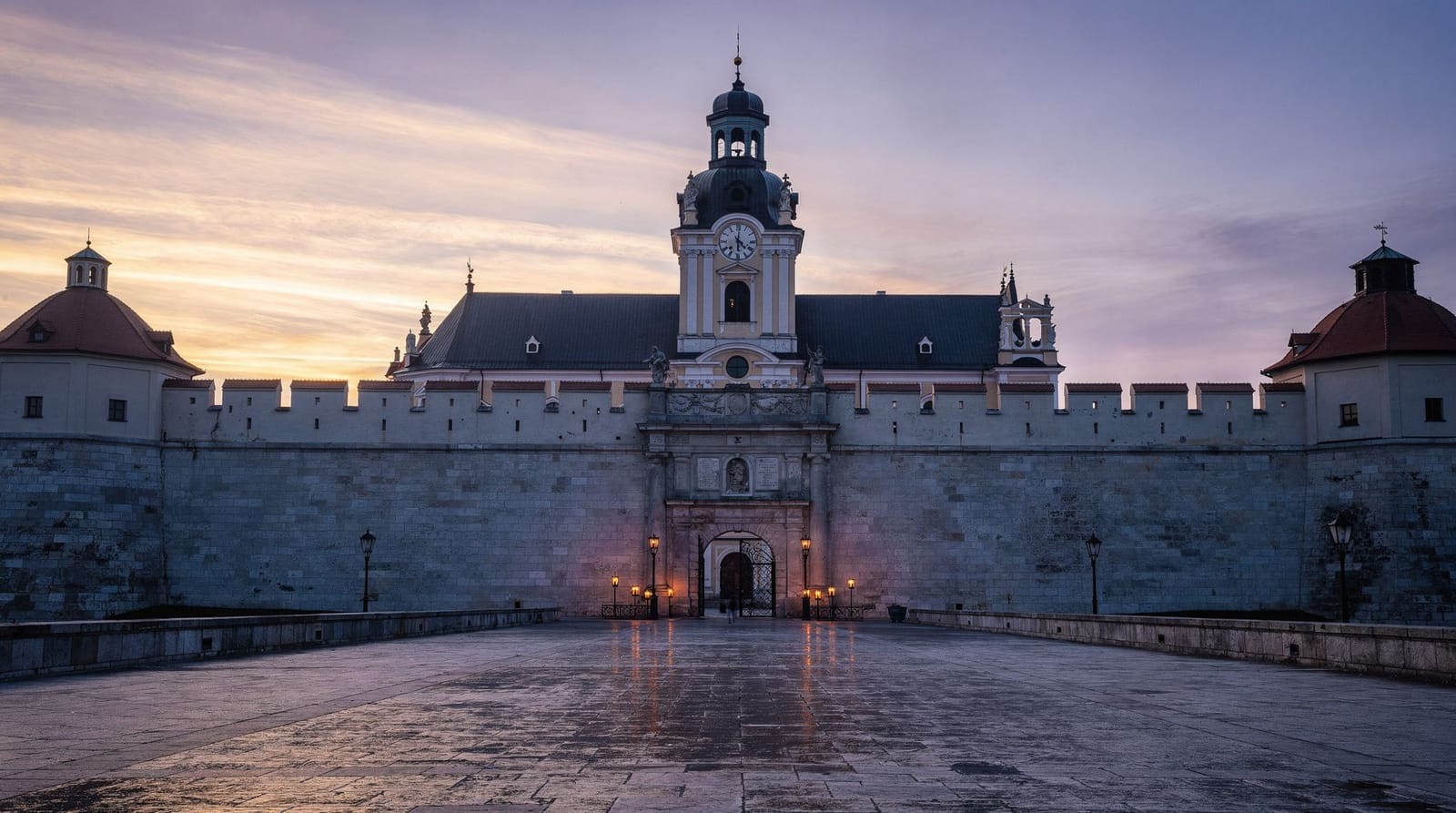
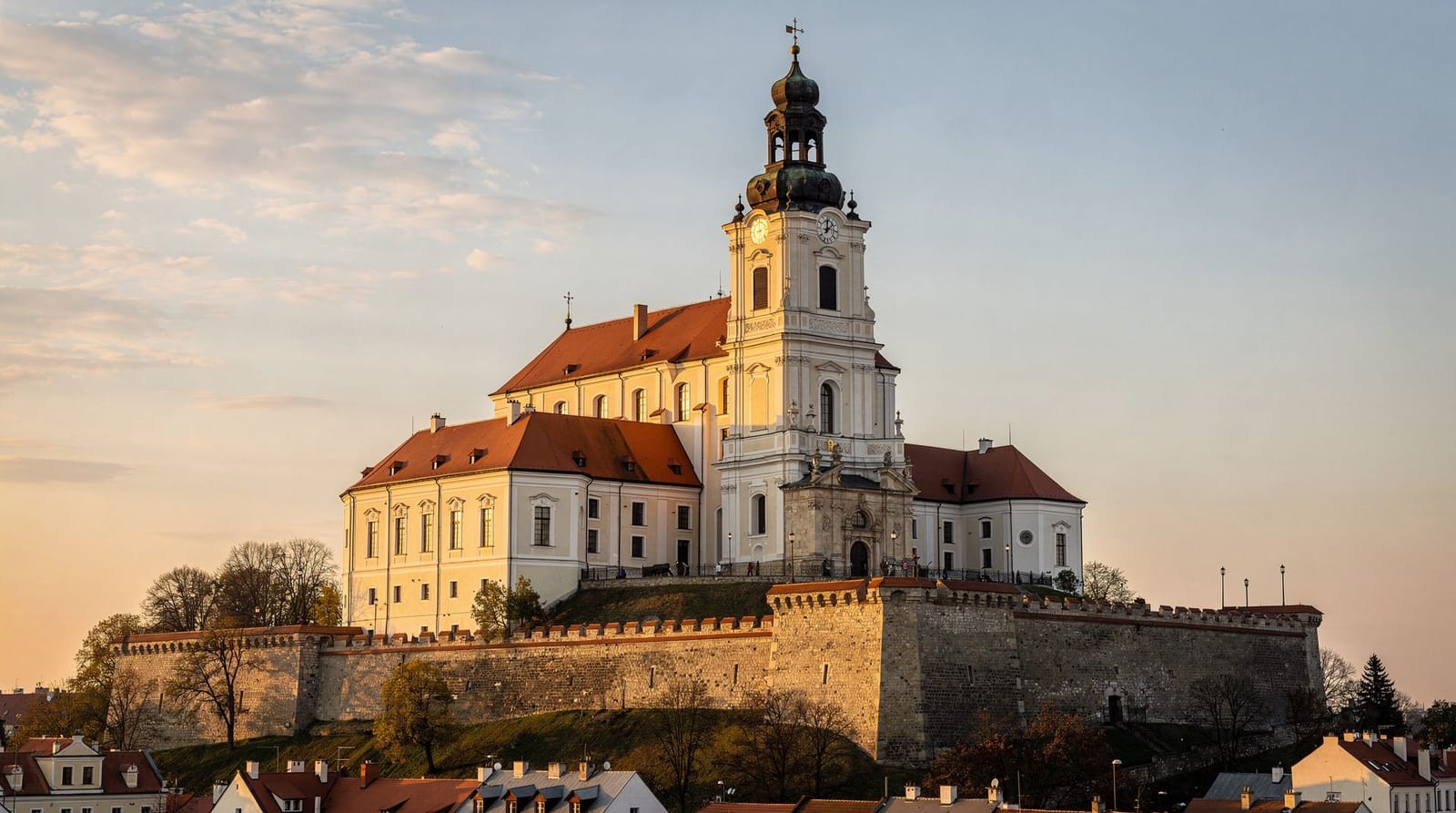
The monastery sits on a small hill (the name “Jasna Góra” means “Bright Hill”) at the edge of Częstochowa’s city centre. From the bus, the approach is visible some time before arrival — the tall tower and the monastery walls rising above a commercial district of religious-tourism infrastructure: souvenir shops, accommodation, restaurants, ambulance vendors, a pilgrim information centre.
August is peak pilgrimage season. Groups of pilgrims arrive on foot from across Poland — some walking for days or weeks — and the roads around the monastery are marked with the routes they have taken. Inside the gates, the atmosphere is unlike anything I had encountered on the rest of my Polish trip.
The monastery complex is large: church, chapel of the Madonna, fortifications, treasury, museum, a large courtyard where pilgrims stand or sit or pray in groups. On the morning I was there, a group of perhaps two hundred had just completed a multi-day walking pilgrimage from Warsaw; they were kneeling in the courtyard in the sun, many of them visibly exhausted, some crying. A priest was leading a prayer through a sound system.
I stood at the edge of this and tried to understand what I was seeing.
The Black Madonna itself
The icon known as the Black Madonna — Czarna Madonna, or Our Lady of Częstochowa — is a Byzantine-style image of the Virgin Mary holding the Christ child. It is approximately 122 cm by 82 cm, painted on lime wood, and partially covered by a silver relief panel that obscures the clothing and background of the original image, leaving only the faces and hands visible.
The painting is darkened by age and the centuries of candle smoke that have accumulated in the chapel. The faces are narrow and austere in the Byzantine manner — not the soft, approachable Madonna of Western European painting but something older and more formal, with gold-leaf traces visible around the faces.
Access to view the icon is controlled by schedule. The silver covering is ceremonially raised several times daily; during these periods, the chapel fills with pilgrims pressing forward for a better view, and the atmosphere shifts to something that is, for lack of a better secular description, extremely intense. I found a position near the back of the chapel during one opening and watched what happened.
What I can report accurately: the people in front of me were affected in ways that I could see clearly and that my own framework for understanding had limited purchase on. An elderly woman immediately ahead was weeping steadily, not in distress but in something that appeared to be relief or gratitude. A young man beside her was completely motionless for the duration. The crowd density was significant and no one in it seemed to register it.
The treasury and fortifications
Beyond the icon, the monastery has substantial historical interest. The treasury contains centuries of votive offerings — weapons, royal regalia, jewellery — left by Polish kings and nobles either in thanks for victory or supplication before conflict. A royal sword from the 15th century. A set of jewelled coronation vestments. The accumulated material expression of Polish rulers’ relationship with this specific place.
The walls of the monastery are a military fortification — Jasna Góra resisted a Swedish siege in 1655, during a period of catastrophic Swedish invasion of Poland known as the Deluge. The Polish resistance at Częstochowa became a rallying point; the subsequent recovery of Polish territory was attributed by contemporaries to miraculous intervention. The event is commemorated in a mural cycle in one of the monastery’s rooms that is vivid and completely partisan and historically significant regardless of your religious position.
What Częstochowa taught me about Poland
I left the monastery understanding something about Polish Catholicism that I had not previously grasped, which is that it is not primarily a private religious practice — it is an identity structure that has survived partition, occupation, communism, and forty-five years of state atheism. The attachment to Jasna Góra is not merely devotional. It is the attachment of a people who maintained a continuous cultural identity through periods when the state worked actively against that identity, and who did it partly through this specific place.
The communist government tried various approaches to containing the institution — restricting pilgrimages, limiting crowds, propagandising against organised religion — and failed at all of them. The pilgrimages continued anyway, often through determined community organisation. The fact that the current Polish state’s relationship with Catholic identity is itself complicated and contested adds another layer to any contemporary visit.
I am not qualified to explain any of this fully. What I can say is that visiting Częstochowa as someone with no stake in Polish religious identity produced more genuine understanding of that identity than reading about it had.
Combining it with the rest of Małopolska
Częstochowa sits outside the usual cluster of Kraków day trips — it’s the only one of the region’s major excursions that heads northwest rather than south or west — which is partly why it gets overlooked by visitors working through a standard list. If you’re building a longer trip and want to weigh it against Wieliczka, Auschwitz or the Tatras, the best day trips from Kraków guide ranks the options by time, cost and what each delivers. For readers who want the deeper historical context behind what I was seeing at Jasna Góra — partition, occupation, the survival of Polish identity under pressure — the Polish history for visitors guide is a better starting point than anything I could compress into this account.
Pairing the day with the rest of a Kraków stay
Jasna Góra works best as a contrast to the other days of a trip. After the royal and secular history of the Wawel Castle guide, the Wawel Cathedral and the Old Town, Częstochowa shows a different side of Polish history, one carried by ordinary pilgrims rather than kings. If the religious thread interests you, the Pope John Paul II in Kraków guide and the Wadowice day trip follow it in a different direction, while Kalwaria Zebrzydowska is another pilgrimage site closer to Kraków.
For the darker chapters of the same national story, the WWII Kraków guide and the guide to visiting Auschwitz with respect sit well alongside a day like this one; for the site itself, a self-guided visit to Auschwitz-Birkenau with extra time on site suits travellers who prefer to move slowly and in silence. If you are still deciding how many days to give the whole trip, the how many days in Kraków guide and the 3-day itinerary help you see where a full day away from the city fits. And if you want more first-person accounts in the same spirit, my reflection on Auschwitz covers a very different but equally weighty visit.
Practical notes for the secular visitor
What to wear: The chapel requires covered shoulders and knees. A scarf or light jacket is sufficient if you are in summer clothing.
The schedule: On weekdays the icon is uncovered at 6:00 and again at 13:30, and covered at 12:00; Sundays and feast days differ, so check current times on the official Jasna Góra website before visiting.
Behaviour: This is an active place of worship, not a museum. Photography is technically permitted in some areas and not others; signage is inconsistent. When in doubt, watch what others do. Silence in the chapel itself is both requested and largely maintained.
The treasury: It is visited as part of a guided tour of the monastery; check current prices and hours on the official Jasna Góra website. It is worth it for the historical content.
The city beyond the monastery: The surrounding streets have little of interest beyond the pilgrimage economy. The restaurant immediately outside the gates is adequate; your tour’s lunch arrangements are likely to be more comfortable.
Return logistics: If travelling independently by train, the direct services are comfortable. The return journey from Częstochowa at 17:00-18:00 may coincide with day-trippers and pilgrims; the trains fill but are not unmanageably crowded outside of peak feast days (August 15, the Assumption, is the busiest single day of the year and should be factored in if your dates coincide).
If you would rather not manage trains and the chapel schedule yourself, a guided day trip focused on the sanctuary and its icon takes care of the logistics and leaves you free to concentrate on the place itself. The Częstochowa day trip guide covers transport options and timing in more detail. For a broader context on the region, the Małopolska itinerary situates this alongside the other significant sites in the area.
Whether to go
The question of whether a secular visitor “should” go to Jasna Góra is not one I would presume to answer universally. What I found was an encounter with something genuine and without parallel in my travels through Poland — a place where an abstract historical claim about religious identity becomes concrete and present. That this required setting aside some instincts about how religious spaces operate as tourist attractions was part of the value.
Go if you are interested in Poland as a country with a specific history, not just Poland as a location for a city break. The icon is extraordinary regardless of faith. The pilgrims make it extraordinary in a different way. The whole thing is real in a manner that the typical tourist-site experience frequently is not.
Frequently asked questions about secular visitor’s story
Is Częstochowa worth visiting if I’m not religious? Yes — the value isn’t devotional, it’s the encounter with something historically and culturally significant that has no real parallel elsewhere in Poland. Go with curiosity about Polish identity and history rather than expecting a conventional sightseeing day, and it delivers.
How much time should I set aside for Częstochowa from Kraków? A full day, realistically. The round trip alone takes 3-4 hours by train, and the monastery complex — the icon, treasury, fortifications and courtyard — rewards a slow visit rather than a rushed one. Guided tours typically run from around 8:00 to 19:30.