Wieliczka Salt Mine with children: what to expect
From Krakow: Wieliczka Salt Mine tour & fast-track ticket
Duration: 4h
Is Wieliczka Salt Mine good for children?
Yes — most children aged 6 and up find it genuinely fascinating: underground chambers, salt sculptures, a cathedral carved from rock salt, and atmospheric lighting. The tour involves about 800 stairs and 3 km of walking, which is manageable for most school-age children. Children under 5 often struggle with the confined spaces, the length (2–3 hours) and the darkness. Entry is free for under-4s; reduced prices for ages 4–16.
Why children love Wieliczka
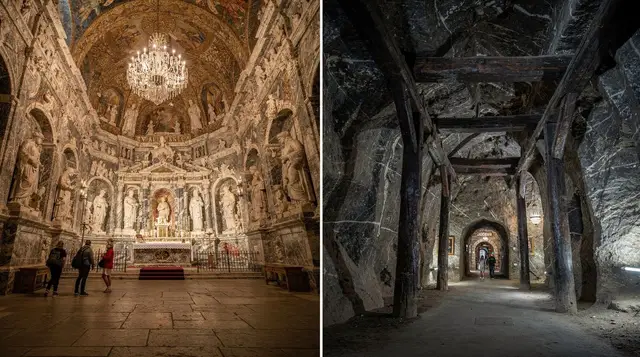
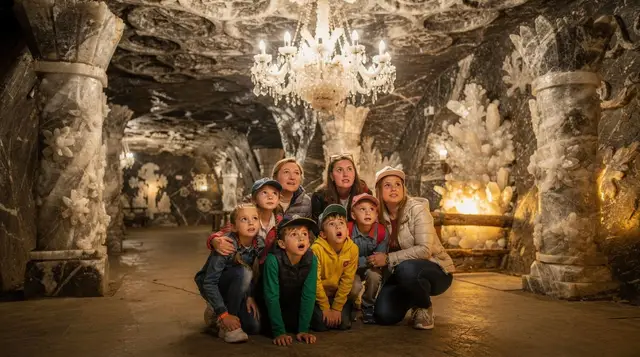
The Wieliczka Salt Mine isn’t on the children’s itinerary because parents need a cultural box-tick. It’s there because children find it genuinely compelling: a world underground, chambers large enough to play basketball in, crystal formations that look like something from a fantasy novel, and salt chandeliers hanging from cathedral ceilings.
The mine has been worked since the 13th century and the tourist route covers the highlights of nine centuries of underground activity — the miners who carved their own chapels in the rock, the salt sculptures depicting Biblical scenes and Polish legends, the underground lake that reflects the pale salt formations above it. For a child with an active imagination, the mine is an extraordinary place.
The honest caveat: it is a 2–3 hour guided tour, 135 metres underground, covering approximately 3 km of passages and 800 stairs (mostly descending, some ascending). Children under 5 frequently struggle with this — not because it’s scary but because it’s long and physically tiring. The temperature underground is a constant 14–16°C (bring a light jacket), and the humidity is high. The entrance staircase alone descends 64 metres via 378 wooden steps; this takes about 10 minutes at a child’s pace.
| Where | Wieliczka town, 14 km southeast of Kraków |
| Cost | ~95 PLN children 4–16, ~130 PLN adults, family tickets available |
| Time needed | 3–4 hrs total including travel |
| Getting there | Fast-track tour transport is easiest with kids and luggage |
| Best age | 6–9 is the sweet spot; under 3 not recommended |
What the tour includes
The standard Wieliczka tourist route (Trasa Turystyczna) visits about 20 chambers from a total of over 300 excavated levels. Key stops include:
Chamber of the Blessed Kinga (Kaplica Świętej Kingi): This is the unmissable highlight — an enormous underground chapel 54 metres long, 18 metres wide and 12 metres high, entirely carved from salt including the floor, walls, chandeliers, altarpieces and sculptures. It has been in continuous use as a chapel since the 17th century. Wedding ceremonies are still held here.
The scale of the chapel is difficult to prepare children for. The effect when the doors open into this space for the first time is reliably impressive.
Jezioro Weimar (Weimar Lake): An underground lake with still, dark water that perfectly reflects the salt formations above. The lighting here is atmospheric — torches rather than electric lighting — and the effect on children is strong.
Copernicus Chamber: A 12-metre-tall statue of Nicolaus Copernicus carved from salt, in the chamber named after a famous visit he made to the mine. The story of how he verified the Earth’s rotation by dropping a plumb line in the shaft is (possibly apocryphally) told by guides.
Miners’ legends: Polish mining folklore has some vivid characters — including the mischievous gnome Skarbnik who guards the salt treasure. Guides good with children lean into these stories; younger children in particular respond well.
Practical details for families
Getting there from Kraków: The mine is 14 km southeast of Kraków. Options: tram no. 304 (from Wielicka square, approximately 35 minutes), minibus from Dworzec Główny Wschód (25 minutes, very frequent), or organised tour with transport.
Wieliczka Salt Mine fast-track ticket from Kraków includes transport and skip-the-line entry — the most convenient option for families who don’t want to navigate trams with children and luggage. In summer, walk-in queues can be 2–3 hours; fast-track entry is a real time-saver.
Wieliczka Salt Mine guided tour with transport from Kraków is the alternative, with a slightly different logistics model; both work well for families.
Tickets: As of May 2026, the standard tourist route costs 130 PLN (€31) for adults and 95 PLN (€23) for children aged 4–16. Children under 4 enter free. Family tickets (2 adults + 2 children) are available at 420 PLN (€100). These prices apply to walk-in tickets; GYG-booked tours include entry in the package price.
Guided tour requirement: The tourist route must be done with a guide — self-exploration is not permitted on the standard route. Tour groups form at regular intervals; English-language groups run every 30–45 minutes in high season. The guide takes you through the route over 2–2.5 hours. The pace is set by the slowest group member; guides are generally patient with children.
Temperature: 14–16°C underground, year-round. On a hot summer day, this is a relief; on a spring or autumn day, dress warmly. The temperature shock from the summer heat above ground to the mine temperature below can trigger headaches or shivering in some children — bring a fleece or light jacket regardless of the outdoor temperature.
Claustrophobia: The passages between chambers are narrow in places (single file, low ceilings) but the chambers themselves are vast. True claustrophobia (enclosed spaces) is a genuine issue; general nervousness about being underground is common in children aged 7–9 but typically resolves once they’re inside and can see how large the spaces are.
Lifts: There are lifts available for the ascent (most tours exit via lift rather than stairs). The descent is always by staircase. For families with strollers: strollers cannot go into the mine. Baby carriers work; ask at the entrance for the current policy on carrying infants.
Age-by-age breakdown
Under 3: Not recommended. The tour is simply too long and the environment too unfamiliar. Children this age will be difficult to manage underground for 2–3 hours.
Ages 3–5: Possible but challenging. The Chapel of Kinga and the underground lake will impress even a 4-year-old, but sustaining engagement for the full tour is difficult. Consider whether your specific child can walk 3 km without being carried.
Ages 6–9: The sweet spot for child engagement. Old enough to understand the historical context in simplified form (miners, salt as money, medieval Poland), young enough for the cave-and-magic framing to work fully. The dragon and gnome legends resonate with this age group.
Ages 10–14: Genuine historical and geological interest becomes possible. The guide’s explanation of how the chambers were excavated, how the salt formations develop over centuries, and what the mine’s economic role was in Polish history is accessible to this age group.
Ages 14+: Full adult engagement. The Chapel of Kinga is genuinely awe-inspiring regardless of age; the historical depth of the site becomes more meaningful.
Age suitability at a glance
| Age | Suitability | Notes |
|---|---|---|
| Under 3 | Not recommended | Tour length and unfamiliar environment are too much |
| 3–5 | Challenging | Possible if your child can walk 3 km without carrying |
| 6–9 | Sweet spot | Legends and scale genuinely captivate this age group |
| 10–14 | Strong | Historical and geological context becomes meaningful |
| 14+ | Full engagement | Same experience as an adult visitor |
What to pack for a family visit
A light jacket or fleece for every family member, regardless of the season — the 14–16°C underground temperature catches people off guard even in August. Comfortable closed shoes rather than sandals, since the stone and wooden steps can be uneven. A small snack and water bottle for the 2–2.5 hour tour, since there’s no stopping for food along the standard route. If your child gets cold easily, an extra layer is worth the space in your bag; the humidity underground makes the cool temperature feel more penetrating than the number suggests.
Timing your visit
Summer: The mine is open year-round and is a popular rainy-day/hot-day refuge (the 14°C temperature is welcome in August). Queue times in July–August can be extreme without advance booking — 2 hours or more for walk-in tickets. Book in advance.
Spring/Autumn: Shorter queues, comfortable temperatures. April–May and September–October are ideal for families — the mine is not crowded, and the outdoor temperature is compatible with the underground temperature difference.
Winter: The mine is open but visitor numbers drop significantly. January and February are the quietest months; if you’re visiting Kraków for the Christmas markets, a Wieliczka visit can fit around it without the crowds.
Time of day: Morning visits (opening at 8 am) are consistently less crowded than afternoon visits. The last entry for the tourist route is typically 5–6 pm depending on season; check the mine’s website for current times.
Combining Wieliczka with other family activities
Most families treat Wieliczka as a half-day (3 hours including travel from Kraków) and combine it with an afternoon in the city. A reliable combination:
Morning: Wieliczka (depart Kraków 8:30 am, return by 1 pm) Afternoon: Old Town and Wawel Dragon, or Kazimierz + Plac Nowy zapiekanki
The family day trips guide has more combinations, including how Wieliczka compares with Energylandia for families with different interests. For a rainy day when the mine’s constant underground temperature is especially appealing, see the rainy-day activities for kids guide. And for planning the rest of a family trip around Kraków, the Kraków with kids guide covers the fuller picture beyond day trips.
Frequently asked questions about Wieliczka with children
Is Wieliczka underground scary for children?
The mine is well-lit throughout the tourist route; there are no truly dark sections. The passages are narrow in places but not claustrophobic for most children. Children who are afraid of the dark or confined spaces may be nervous initially — the best approach is to acknowledge that it’s unusual and to walk into the first few chambers before judging. Most children who are initially nervous settle within 15–20 minutes.
Can you take a buggy or stroller into the mine?
No — the staircase descent and narrow passages make strollers impractical. Baby carriers (slings, frontpacks) work for infants. Older children must walk. There is no alternative access for the standard tourist route.
How long does a Wieliczka visit take including travel?
Allow 3–4 hours total from Kraków: 30–40 minutes travel each way plus 2–2.5 hours underground. With a fast-track booking, you avoid the queue; with a standard ticket in summer, add 60–120 minutes for the queue.
Is Wieliczka educational for school-age children?
Very much so — the mine’s history overlaps with Polish history, medieval trade economics, geological processes and engineering. The guides on English-language tours are generally good at calibrating explanations for mixed groups including children. A 10-year-old with prior interest in geology or history will get particular value.
What if my child needs to use the bathroom during the tour?
There are restroom facilities at points along the route, including near the Chapel of St Kinga and at the exit level before the lift. Guides are generally accommodating about brief stops if a child needs one, but it helps to use the facilities at the entrance before starting, since the tour doesn’t pause on a fixed schedule.
Is Wieliczka better for families than Bochnia Salt Mine?
For most families, yes — Wieliczka’s infrastructure (wider walkways, a lift for the ascent, more visual variety) is more forgiving for children than Bochnia’s mine train and boat ride, which suit slightly older kids better. The Wieliczka vs Bochnia comparison guide covers the full trade-offs if you’re considering either.
Top experiences
Bookable activities with verified prices and instant confirmation on GetYourGuide.