Wieliczka guided tour vs going independently: the honest comparison
From Krakow: Wieliczka Salt Mine tour & fast-track ticket
Duration: 4h
Is it better to book a Wieliczka tour from Kraków or go independently?
For most visitors, a guided tour from Kraków (transport + fast-track entry, ~120–180 PLN) saves significant time and stress versus going independently (~50 PLN transport + 109 PLN entry = ~159 PLN, plus queuing risk). Going independently gives you more flexible timing and suits confident travellers who prefer to manage their own logistics.
The question almost every Kraków visitor asks
Wieliczka Salt Mine is one of the most visited attractions in Poland — around one million visitors per year pass through its tunnels. The practical question is not whether to go, but how: book a guided tour package from Kraków, or make your own way and buy tickets at the mine?
The honest answer depends on your travel style, budget, and how much you value convenience over cost saving. This guide gives you the real numbers and the real trade-offs.
| Where | Wieliczka town, 14 km southeast of Kraków |
| Cost | ~121–130 PLN independent; ~120–200 PLN guided tour |
| Time needed | Half a day either way (3.5–4.5 hrs total) |
| Getting there | Bus 304/305, train, or included tour transport |
| Best time | Book ahead for May–September regardless of route chosen |
Side-by-side cost breakdown
Going independently
| Cost element | Amount |
|---|---|
| Transport: bus 304 or minibus from Kraków Główny | ~4–8 PLN (€1–2) each way |
| Or taxi/Bolt from Kraków city centre | ~50–80 PLN (€12–19) each way |
| Wieliczka Salt Mine guided tour (adult, self-purchased) | ~109 PLN (€26) |
| Total by public bus (return) | ~121–125 PLN (€29–30) |
| Total by taxi/Bolt (return) | ~209–269 PLN (€50–64) |
Note: entry to Wieliczka always includes a guided tour — you cannot explore independently. You buy a ticket for the tourist route, which includes a guide. The question is whether you add transport to that.
Booking a tour from Kraków
| Tour type | Typical cost |
|---|---|
| Fast-track entry + guided tour from Kraków | ~120–160 PLN (€29–38) |
| Guided tour with transport (minibus) | ~130–180 PLN (€31–43) |
| Hotel pickup option | ~140–200 PLN (€33–48) |
Booked through GYG, the fast-track option often works out similar to or slightly more expensive than public bus + ticket — but includes the queue skip which has real value in peak season.
What “independent” actually means at Wieliczka
A crucial clarification: there is no self-guided visit to Wieliczka Salt Mine. Entry to the Tourist Route (the main visitor route) always requires joining a guided group led by a mine guide. You cannot wander the galleries alone. This is a safety regulation in an active heritage mine.
So when people say “going independently,” they mean: arranging your own transport to the mine and buying your ticket on arrival (or online in advance), then joining the next available English-language guided group. You still have a guide — just not a Kraków-based one who also handled transport.
This distinction matters because some visitors assume “independent” means a more flexible, personal experience inside the mine. It does not. Once inside, everyone has a guide.
The queue reality in peak season
From May to September, Wieliczka Salt Mine receives enormous visitor numbers. English-language guided groups depart roughly every 15–30 minutes, but in peak hours (10 am–2 pm) the wait for the next available English-language slot can be 1–2 hours even with a ticket.
Booking an advance ticket online at wieliczka.eu (with a specific time slot) avoids this — but requires planning ahead. The mine’s own online booking sells out weeks in advance in summer.
Tours booked through operators like GYG include reserved slots that bypass the standard walk-in queue. The Wieliczka Salt Mine fast-track ticket specifically allocates you a priority time slot. The guided Wieliczka tour with transport handles both transport and a reserved group time.
If you go independently and turn up without a pre-booked timed ticket in July or August, you genuinely risk being turned away or facing a 2-hour wait.
Transport options from Kraków in detail
Public bus (cheapest, least convenient)
Buses 304 and 305 (and some variants) run from Kraków Główny bus station and several stops around the city. The route takes 30–45 minutes depending on traffic. The bus stops near the mine entrance in Wieliczka town.
- Cost: approximately 4–8 PLN (€1–2) per journey with a Kraków public transport ticket
- Frequency: roughly every 30 minutes during the day
- Catch: buses can be overcrowded in peak season; standing for 40 minutes with luggage is uncomfortable
- Return: buses back to Kraków run until late evening
Minibus / shared transfers
Unofficial minibuses (busy vans) congregate around Kraków Główny and operate shuttle-style to Wieliczka. Prices are typically 10–20 PLN per person each way. Faster than bus and more direct. Legitimate but informal.
Tram + local bus combination
Tram line 6 from Rynek Główny runs towards the Wieliczka direction, with a transfer to a local bus. This works but takes longer and requires navigating a transfer point.
Uber/Bolt
Point-to-point convenience, roughly 50–70 PLN (€12–17) each way. Return journey means either waiting for Bolt or booking a return vehicle — neither is guaranteed in Wieliczka town. Taking Bolt there and organised tour transport back is a popular combination.
Guided tour with transport (most convenient)
The Wieliczka Salt Mine tour with hotel pickup collects from your accommodation, handles the drive, reserved entry, a mine guide, and the return journey. Total package, no logistics required.
What you gain by booking a tour
Reserved entry slot: The most valuable benefit. In peak season, this alone saves hours.
No transport hassle: Particularly relevant for visitors with heavy luggage, families with children, or those who find navigation in a foreign city stressful.
Kraków-context guide: Some Kraków-based guided tours include a city guide who provides context about Kraków, Wieliczka, and the region during the drive — a small but genuine extra.
Return logistics handled: No standing at a minibus stop after 3 hours underground.
Single payment: No juggling transport tickets, mine tickets, and change.
What you gain by going independently
Lower cost: If you travel by public bus each way and book your mine ticket online at the standard price, you pay roughly 121–130 PLN total — competitive with or cheaper than many tour packages.
Flexible timing: You choose when to arrive and when to leave. If you want to arrive at 9 am when the mine opens (before tour groups congregate), you can. If you want to spend time in Wieliczka town afterwards, no minibus driver is waiting for you.
No group dependency: If your plans change (weather, illness, change of heart about timing), you can adjust without affecting others.
Exploring Wieliczka town: The town of Wieliczka itself has a pleasant market square and some local cafes worth visiting — a guided tour group typically does not allow time for this.
Learning to navigate Polish regional transport: For travellers who plan to take other independent day trips later in their visit — to Bochnia or beyond — doing Wieliczka independently first is a low-stakes way to get comfortable with Kraków’s regional bus and train system before attempting something further afield.
Our recommendation
First-time visitor in peak season (May–September): Book a tour. The reserved entry slot is not a luxury — it is a necessity. The cost difference over independent travel by bus is small (often 20–40 PLN/€5–10), and the time saved is real. The fast-track option is the best value; hotel pickup is worth it if your accommodation is not near the city centre.
Off-peak visitor (October–April): Independent travel is perfectly viable. Book your mine ticket online in advance (wieliczka.eu), take the bus, and enjoy Wieliczka without the crowds. November–March is significantly quieter.
Budget-conscious traveller any time: Go independently by bus, but book your online ticket with a specific time slot. Do not walk in hoping for the best.
Visitor combining Wieliczka with another day trip: Many visitors combine Wieliczka with another attraction; see our day trips from Kraków hub for options. A tour package makes combination trips logistically easier.
Tour vs. independent: the quick decision table
| Factor | Guided tour from Kraków | Independent |
|---|---|---|
| Peak-season reliability | High — reserved slot | Risky without advance booking |
| Cost | Slightly higher (~120–200 PLN) | Slightly lower (~121–130 PLN) |
| Effort | Minimal — pickup, guide, return handled | Requires planning transport and timing |
| Flexibility | Fixed schedule, group pace | Choose your own arrival and departure |
| Best for | First-timers, families, peak season | Confident travellers, off-season, budget focus |
Inside the mine: what the tour actually covers
Whichever way you arrive, the Tourist Route covers approximately 22 chambers across 3.5 km of galleries at depths between 64 and 135 metres. The tour lasts approximately 2–2.5 hours. Highlights include:
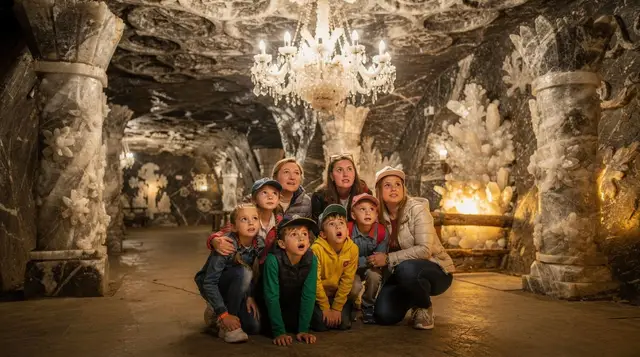
- Chapel of St Kinga — the centrepiece: a full underground chapel with salt chandeliers and carved salt sculptures of biblical scenes
- Weimar Chamber — an underground lake with haunting green lighting
- Salt crystal formations — naturally occurring stalactites in salt
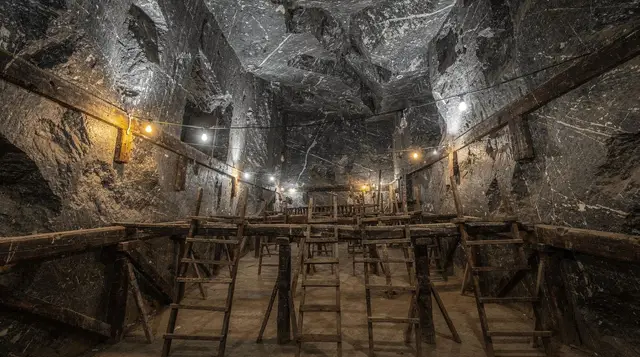
- Historic mining equipment — horses worked underground, pulleys, extraction technology across centuries
- Dwarfs and mythological sculptures — a tradition of mine workers carving figures
The exit is by lift (elevator), not stairs — you do not have to climb back up.
Understanding the tourist route in depth
Whether you arrive by tour or independently, every visitor to Wieliczka Salt Mine joins the Tourist Route — the standard visitor circuit. Here is a more detailed look at what this route covers and how to make the most of it.
The descent
The route begins with a descent of 380 wooden steps (out of the total 800 on the downward journey) to the first underground level at 64 m below the surface. This is one of the aspects visitors most underestimate — it is not particularly strenuous, but those with knee problems or reduced mobility should consider it carefully. The stairs are wide and well-lit, with handrails throughout.
The Daniłowicz Shaft
Near the beginning of the route, you pass through chambers carved around the historic Daniłowicz shaft — one of the mine’s principal extraction shafts from the 17th century onward. The engineering of the wooden windlass mechanism (used to lift salt and miners) is preserved here. The scale of pre-industrial mining that produced these quantities of salt is genuinely impressive.
The salt crystal chambers
Several chambers along the Tourist Route feature naturally occurring salt crystal formations — stalactites, columns, and encrusting crystalline structures formed from slowly evaporating brine. These chambers are quieter and less dramatic than the grand carved spaces, but geologically fascinating.
The Chapel of St Kinga: what to expect
St Kinga’s Chapel is reached after about 90 minutes of walking the route, at a depth of 101 m. The dramatic reveal — entering through a set of doors into a vast underground church with a vaulted salt ceiling — is one of the most effective “big moment” reveals in any European attraction.
The chapel took 67 years to create (from 1895 to 1963), carved almost entirely by four generations of miners in their off-duty hours. Key elements:
- The chandeliers: made entirely of salt crystals, they diffuse the light into a warm amber glow
- The floor: grey-green salt tile
- The bas-relief behind the altar reproducing the Last Supper (after Leonardo da Vinci)
- Six bas-relief scenes from the Bible around the walls, carved in high detail
- The portrait of Pope John Paul II (a native of Wadowice, 30 km from Kraków), added in 1999
Mass is still celebrated in the chapel on special occasions. In peak summer, the chapel is visited by hundreds of groups per day; the combination of tour groups is managed by staggering departures, but the chapel still feels busy in July and August.
The underground lake and final chambers
The Weimar Chamber — named for the Viennese management office location in the 19th century — contains the mine’s most photographed underground lake. The water appears dark and bottomless; the green and amber lighting creates an otherworldly atmosphere. Wooden jetties allow visitors to stand over the water.
The route continues through several more chambers before reaching the lift for the ascent.
Practical details visitors often miss
The bookshop and museum near the exit
The Wieliczka Salt Mine exit route passes through a museum section and a bookshop selling publications about the mine’s history, salt geology, and the broader history of Polish salt trade. If you buy independently and have time before your tour, browsing these exhibitions adds context.
The restaurant underground
Yes, there is a restaurant underground. The Miner’s Tavern (Gospoda Mineir) at 135 m depth serves Polish food and drinks for visitors who have pre-booked it as part of a dining experience or conference package. Standard tour visitors cannot simply drop in for lunch — it is a separate booking. But the experience of eating 135 m underground is unusual, and packages are available at wieliczka.eu.
The spa and health sections
The mine operates a speleotherapy facility for people with respiratory conditions. The underground air (constant humidity, aerosol salt particles, 14°C) has documented therapeutic effects for asthma and allergies. Day spa and overnight therapeutic stays are available separately from the tourist route — a niche but interesting option if you have respiratory health interests.
Photography: what works and what doesn’t
Photography is permitted throughout the Tourist Route. The lighting is artificial and quite amber-warm in most sections — this gives phone cameras more colour to work with than you might expect in a cave. The Chapel of St Kinga is dramatically lit and photographs well. The underground lakes respond well to slow shutter speeds if you can stabilise your camera; phones in “night mode” can capture them effectively.
Flash is not restricted but is also not necessary — the mine is well lit. The challenge is conveying scale, which requires wide-angle lenses.
Common mistakes and how to avoid them
Arriving too late: If you go independently and arrive at 11 am in August hoping to walk in, you are likely to face a 1–2 hour wait for the next available English-language slot. Arrive at opening (9 am) or book in advance online.
Underestimating the physicality: 800 stairs down, 3.5 km of walking on uneven underground floors, and some narrow passages. It is not extreme, but visitors with mobility issues or those who dislike enclosed spaces should research the mine’s specific accessibility options before booking.
Skipping the context: The mine is far more interesting if you know something about salt’s economic history in Poland before you go. A quick 20-minute read about the Wieliczka mine’s history transforms what might be a series of impressive rooms into a comprehensible journey through 700 years of industrial and artistic heritage.
Combining with Auschwitz the same day: Some visitors attempt both in one day. It is physically and emotionally exhausting. If you must combine them, do Wieliczka first (morning) and Auschwitz second, not the reverse. Better: give each a separate day. See our day trips from Kraków hub for scheduling advice.
Forgetting to book the return: If you go independently, plan your return. The bus back to Kraków is easy and frequent, but the last buses from the Wieliczka stop run in the early evening. Do not get stranded by assuming a bus will always be available.
How this compares to other Kraków day-trip decisions
The tour-vs-independent question isn’t unique to Wieliczka. Auschwitz raises the same trade-off, covered in the Auschwitz guided vs self-guided guide, and Zakopane has its own version in the Zakopane tour vs DIY guide. The pattern across all three is consistent: sites with strict timed-entry systems and high summer demand favour booking ahead, while sites with more flexible access reward independent travel more. Wieliczka sits firmly in the first category because a guide is mandatory regardless of how you arrive — the only real variable is transport and queue priority.
Frequently asked questions about Wieliczka tours vs independent visits
Can I just turn up at Wieliczka without a ticket?
In off-peak season (November–March), walk-in tickets are often available. In peak season (May–September), walk-ins frequently face 2-hour waits or being turned away. Book in advance.
How long does the public bus journey take from Kraków?
The 304/305 bus takes approximately 35–45 minutes from central Kraków stops depending on traffic. It is typically slower than a minibus or car but costs almost nothing.
Is the Wieliczka tour included in the Kraków City Card?
The Kraków City Card does not include Wieliczka Salt Mine entry — the mine is a separate enterprise not covered by municipal cards. See our Kraków City Card comparison for what the cards do cover.
Can I visit Wieliczka Salt Mine without a guide?
No. Guided tours are mandatory for visitor safety in the active heritage mine. All visitors join a guided group. The tourist route does not permit independent exploration.
Is Wieliczka suitable for people with limited mobility?
The Tourist Route involves 800 steps descending and some narrow passages. It is not wheelchair accessible. The mine does offer an alternative miner’s lift descent for those who cannot manage stairs — contact wieliczka.eu in advance to arrange this. The exit lift is accessible.
Does booking a tour guarantee a better guide than going independently?
Not necessarily — the guide quality is set by the mine, not by whether you booked through a Kraków tour operator. What a Kraków-based tour adds is a reserved entry slot, handled transport, and sometimes extra city context during the drive. If in-mine guide quality is your only concern, a self-purchased ticket gets you the same mine guides as any tour.
Is it worth paying extra for hotel pickup specifically?
For most visitors, no — hotel pickup mainly saves the 10–15 minute walk to a central meeting point, which rarely justifies the price difference. It’s worth it if your accommodation is outside the centre, you’re travelling with young children or heavy luggage, or you simply prefer door-to-door convenience without weighing the cost.
Top experiences
Bookable activities with verified prices and instant confirmation on GetYourGuide.