Dunajec gorge rafting guide: wooden raft through the Pieniny from Kraków
From Krakow: Dunajec River rafting
How long is Dunajec River rafting and what does it cost from Kraków?
The raft journey covers 18 km from Sromowce Niżne (Kąty) to Szczawnica, taking 2–2.5 hours on the water. Door-to-door from Kraków is a full day (9–10 hours). Guided tours cost approximately 130–180 PLN per person including transport. Independent access is possible but involves complex connections; the tour option is strongly preferred.
| Where | Sromowce Niżne (Kąty) to Szczawnica, Pieniny Mountains |
| Cost | Around 130–180 PLN guided from Kraków; ~70–90 PLN raft only |
| Time needed | 2–2.5 hrs on the water; 9–10 hrs door-to-door from Kraków |
| Getting there | Guided coach recommended; independent access is a long multi-leg trip |
| Best time | April–October only; September–October for quiet, colourful water |
The Dunajec Gorge: a natural border canyon
The Pieniny Mountains are modest in altitude — the highest point, Trzy Korony (Three Crowns), reaches only 982 m — but they punch far above their weight in scenic drama. Limestone karst, eroded into towers, ridges, and cliffs over millions of years, creates a canyon of extraordinary beauty. Through the heart of this canyon runs the Dunajec River, forming the border between Poland and Slovakia for approximately 27 km.
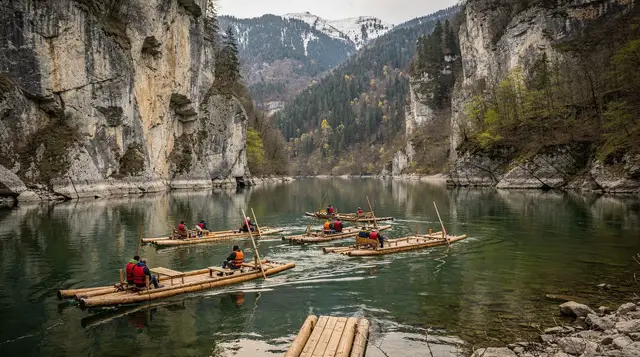
The traditional wooden raft journey through the Dunajec Gorge — from Sromowce Niżne to Szczawnica — has been running for tourist visitors since the 1830s. Two raftsmen (flisacy) in traditional Podhale dress pole and steer a linked set of five to six dugout logs through the gorge, with passengers seated on benches under a wooden canopy. The tradition predates tourism; Dunajec rafters have been guiding boats through this section since at least the 17th century.
From Kraków, this is one of the most distinctive day trips available — not a theme park recreation of a historical activity but an actual living tradition, operated by the same flisacy guilds that have worked this river for generations.
The 18-kilometre journey: what you’ll see
Kąty landing to Czerwony Klasztor junction (0–5 km)
The raft sets off from the landing at Sromowce Niżne (Kąty) — a small gathering of boat launch points and riverside stalls. The river immediately enters the gorge. The first kilometres feature the most dramatic cliffs: Sokolica peak (747 m) visible to the left (Polish side), and the ruins of Červený Kláštor monastery visible on the Slovak bank to the right.
Limestone walls rise 200–300 m above the water. The river at this point is narrow — 30–50 m across — and the contrast between the confined gorge and open sky above creates a remarkable sense of enclosure. The raft follows the main current; the flisacy steer with long wooden poles.
The Slovak bank: Červený Kláštor
Approximately 5 km in, the ruined Červený Kláštor (Red Monastery) is visible on the Slovak side — a 14th-century Carthusian foundation with a distinctive red-roofed church. The monastery is accessible from the Slovak side (you cannot disembark on the Polish raft at this point). It is the most visible historical landmark on the journey.
Central gorge (5–12 km)
The gorge section continues. The river passes Trzy Korony (Three Crowns) ridge rising on the Polish side — the classic postcard view of the Pieniny. The hiking trail to Trzy Korony summit is visible high above. This is the most photographed stretch.
The river current varies — some sections are fast, others slow with beautiful still-water reflections of the cliffs. The raftsmen often pause at particularly scenic viewpoints. There is no whitewater in the conventional rafting sense — the Dunajec raft is a slow, scenic journey, not an adrenaline experience.
Approach to Szczawnica (12–18 km)
The gorge opens progressively as the river approaches Szczawnica. The last kilometres pass through a gentler landscape. The raft journey ends at the Szczawnica landing — a small spa town known for its mineral springs and hiking trails.
The rafting season and conditions
April to October
The season runs April through October, weather and water levels permitting. April is earliest — the river runs fast with snowmelt, which some rafters find more dramatic; others find the banks still brown and the air cold. May–June: river levels normalise, banks green up. July–August: peak season, multiple rafts in convoy at busy times. September–October: quietest, best autumn colours.
The raft journey is cancelled in heavy rain (visibility, current safety) and if river level is too high. Operators refund in these circumstances; check morning conditions if you’re organising independently.
Can I raft in winter?
No. The rafting season closes in late October or early November and does not reopen until April. In winter, the river may freeze in cold snaps. The Pieniny and Dunajec gorge remain accessible for hiking, but raft tours are suspended.
Tour options from Kraków
Standard Dunajec rafting day trip
The Dunajec River rafting day trip from Kraków is the simplest option: return coach from Kraków, the full 18 km raft journey, and return from Szczawnica. Total time from Kraków: 9–10 hours. No specific guide commentary on the raft itself — the flisacy are your guides, and they will point out key sights in Polish and sometimes basic English.
Typical price: 130–160 PLN (€31–38) per person.
Dunajec rafting with guided commentary
The Dunajec River Gorge rafting tour from Kraków adds an English-speaking guide who explains the gorge geology, Pieniny National Park ecology, the history of the flisacy tradition, and the Polish-Slovak border context. Recommended for visitors who want deeper context.
Typical price: 140–175 PLN (€33–42) per person.
Rafting and thermal baths combination
The Dunajec River rafting with thermal baths option adds a post-raft session at the Chochołów or Zakopane thermal baths — a genuinely excellent combination that pairs outdoor activity with relaxation on the return journey.
Typical price: 200–260 PLN (€48–62) per person.
Dunajec and Zakopane combination
The Dunajec River Gorge and Zakopane full-day trip from Kraków combines the raft journey with a Zakopane town visit — covering both the Pieniny gorge and the Tatra gateway in a single (long) day. Best if you haven’t visited Zakopane before.
Independent access
Getting to the Dunajec rafting start independently from Kraków requires effort:
By car: Drive Kraków → Nowy Targ (approximately 70 km, 1h10) → Krościenko nad Dunajcem → Sromowce Niżne (Kąty landing). Total: approximately 120–130 km, 2 hours. Park at the Kąty landing (free or small fee). After the raft arrives at Szczawnica, arrange return to Kąty by taxi (approximately 30–40 PLN) or by mini-bus shuttle offered by some operators.
By public transport: Kraków to Nowy Targ by train (1h45), then local bus from Nowy Targ to Krościenko (40 minutes), then taxi or local transport to Kąty. Technically feasible but involves 3+ transport changes and is only worth it if you genuinely enjoy independent logistics.
Raft tickets independent: Purchase tickets at the Kąty landing from the flisacy cooperative (Stowarzyszenie Flisaków Pienińskich) — approximately 70–90 PLN per person for the raft journey itself. No advance booking required for individual tickets; groups should book ahead in July–August.
After the raft: Szczawnica
Szczawnica is a pleasant small spa town at the end of the raft journey. Key points:
Szczawnica mineral springs: The town has several mineral spring pavilions where you can taste the naturally occurring bicarbonate-sulphate water — free or minimal cost. The spa culture here dates to the 19th century.
Hiking trails: Szczawnica is a trailhead for several Pieniny paths, including the ascent to Trzy Korony (approximately 2 hours from town, 480 m elevation gain). The view from the top overlooks the entire gorge you’ve just floated through — highly recommended if you have energy after the raft.
Restaurants in Szczawnica: Restauracja Pieniny (Szlachtowska 1) and several café-restaurants along the main street serve Polish mountain food (25–45 PLN mains). More interesting than eating in the tourist strips near the landing.
Practical details
What to wear
- Waterproof or weather-resistant jacket (spray from the river; unexpected rain)
- Comfortable walking shoes — the landing points are uneven
- Layers: the gorge is sheltered but the river creates its own microclimate; evenings cool quickly
- Sunscreen and sunglasses for fine summer days on the open sections
What’s provided
The raft boats are open-sided but have a wooden canopy roof. Benches with some back support. There is no storage for large backpacks — bring a day pack only. No life jackets are required or typically provided (the current is calm throughout); some operators have them available on request.
Photography
The gorge is spectacular and wide-angle shots from the raft work well. A waterproof phone case is a sensible precaution. The best photographs are typically in the first 5 km of the gorge, when the cliffs are highest. The Trzy Korony reflection in calm water (morning departures) is the classic shot.
Rafting season at a glance
| Period | Water/scenery | Crowds |
|---|---|---|
| April | Fast, cold snowmelt; banks still brown | Low |
| May–June | Normal levels, banks green up | Medium |
| July–August | Warmest, most reliable weather | High — convoys of rafts |
| September–October | Calmer water, best autumn colour | Low |
| November–March | Closed | — |
Combining Dunajec with the rest of your Tatra trip
Most visitors reach the Dunajec Gorge as part of a wider Tatra Mountains or Zakopane trip rather than a standalone outing, since the travel time from Kraków is substantial either way. If hiking is also on your list, the Tatra Mountains hiking guide covers routes that pair well with a rafting day earlier or later in your trip — though not on the same day, given the distances involved. Travellers prioritising Morskie Oko should treat it as a separate day entirely; the drive between the Pieniny and that side of the Tatras adds hours neither itinerary can absorb comfortably. For a lower-effort nature day trip closer to Kraków, the Ojców National Park hiking guide is worth considering instead, and the nature near Kraków overview puts all of the region’s outdoor day trips side by side so you can weigh which ones fit your itinerary.
If you want the post-raft relaxation, pairing with Zakopane’s thermal baths is one of the most popular combinations for good reason — a warm soak after several hours on cool river water and open-sided rafts is a genuinely pleasant way to end the day.
Honest assessment: is it worth it?
Yes, with appropriate expectations. The Dunajec raft is not an adventure sport — it is a scenic float through one of Central Europe’s most beautiful river gorges. The 2–2.5 hours on the water passes quickly. The traditional flisacy costume and wooden craft add genuine cultural texture. The Pieniny scenery is genuinely outstanding.
The main caveats: it is a long day from Kraków for 2.5 hours on the water. It is not suitable in bad weather. And it does not combine naturally with Morskie Oko (the drive between Pieniny and the Tatras adds hours). Combine with Zakopane or the thermal baths for the most satisfying day.
Frequently asked questions about Dunajec gorge rafting
Is Dunajec rafting safe for children and non-swimmers?
Yes. The Dunajec raft on the standard tourist section carries no whitewater rapids. The river is slow and calm. Children of any age are welcome (lap seating for infants). Non-swimmers are perfectly safe on the raft. The main minor hazard is splashing from the poles near the faster sections — cover electronics.
How do I get from Szczawnica back to Kraków?
Guided tours include return transport from Szczawnica to Kraków by coach. Independent visitors: taxi from Szczawnica to Nowy Targ (approximately 30 km, 60–80 PLN), then train or bus to Kraków. Some operators offer a mini-bus shuttle from Szczawnica back to the Kąty car park.
Can I book the raft independently in Szczawnica or Kąty?
Yes — the flisacy cooperative at Kąty landing sells tickets for individuals on the day (approximately 70–90 PLN per person). In peak summer (July–August), group slots may be fully booked. Individuals usually get on quickly. No advance booking required for individuals; groups of 6+ should book in advance via the cooperative’s website.
What is the difference between the wooden raft and modern inflatable?
Traditional wooden rafts (tratwy drewniane) are the iconic experience, operated by the Stowarzyszenie Flisaków Pienińskich. Some tour operators use inflatable craft for sections outside the national park. For the authentic cultural experience, ensure your tour uses the traditional wooden raft on the Pieniny section.
What’s the best month to go if I want fewer crowds?
September and October offer the best balance — the water is calmer than spring snowmelt, the summer convoys have thinned out, and the Pieniny hillsides turn genuinely striking autumn colours. May and early June are the next best option if autumn doesn’t suit your travel dates. July and August guarantee the warmest weather but also the busiest rafts and landing points.
Top experiences
Bookable activities with verified prices and instant confirmation on GetYourGuide.