Cloth Hall (Sukiennice) guide: market, gallery & medieval history
Krakow: Collegium Maius, St. Mary Basilica & Cloth Hall
Duration: 2.5h
What is inside the Cloth Hall (Sukiennice) in Kraków?
The ground floor hosts stalls selling amber, leather goods, and Polish crafts — free to browse. The first floor houses the Gallery of 19th Century Polish Art, a branch of the National Museum with major works including Jan Matejko's battle paintings. Entry to the gallery costs around 32 PLN (7.60 €).
| Where | Centre of Rynek Główny, Old Town |
| Cost | Free (ground floor market); around 32 PLN gallery entry |
| Time needed | 15–20 min market browse; 45–60 min with gallery |
| Getting there | In the middle of the main square, unmissable on foot |
| Best time | Before 10:00 or after 16:00 for a calmer market browse |
The trading hall at the heart of medieval Kraków
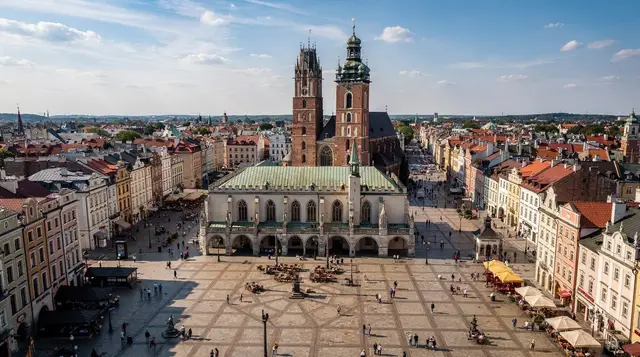
The Sukiennice — the Cloth Hall — occupies the entire centre of Rynek Główny, Kraków’s main market square. It is not on the edge of the square but in the middle of it, a long Renaissance building (108 metres by 18 metres) that divides the space into two halves and has done so since the 14th century. At the time of its construction, Kraków was the capital of a major European kingdom and one of the continent’s principal trading cities; the Cloth Hall was the hub of that commerce.
Cloth — particularly imported Flemish and English wools and domestically produced textiles — was the commodity that made medieval Kraków wealthy. The hall served as the covered market and inspection point for all cloth entering the city. By the Renaissance, the building had been expanded and given its arcaded loggias (the row of arched openings you see on both long sides), the decorative attic parapet with carved mascarons (grotesque faces) above the roofline, and the general appearance it still holds today.
The architecture
The current form of the Sukiennice dates primarily from a Renaissance rebuilding in the 1550s, after a fire in 1555. Italian architects working in Poland under the patronage of the Jagiellonian kings designed the loggias and the carved attic. The mascarons — grotesque human and animal faces running along the parapet — are among the most distinctive decorative elements; each is slightly different, made by Renaissance craftsmen apparently competing for expressiveness.
At each end of the building, small turrets rise above the roofline. The overall proportions are horizontal and relatively restrained — Kraków’s Renaissance is the Italian manner adapted to the Polish climate and building tradition, with heavier walls and fewer open loggias than you would find in Florence or Rome.
The ground floor: the craft market
The ground floor is a covered market hall running the full length of the building. Stalls sell amber jewellery, leather goods, folk art, chess sets, decorative boxes, linen, and assorted Polish souvenirs. Entry is free during market hours (approximately 09:00–18:00 daily, sometimes extended in summer).
A word on amber: this is a major category but buyer caution applies. The ground floor market contains both genuine Baltic amber (fossil tree resin, 40–60 million years old) and imitation resin made to look like amber. Legitimate amber will be warm to the touch, slightly tacky if you press your thumbnail into it hard, and will produce a pine resin smell if you rub it vigorously. A very low price (under 20 PLN / ≈ 4.80 € for a significant piece) is a strong indicator of imitation. Ask for a receipt and check the vendor’s certification if buying a significant piece. The honest Kraków guide covers amber and other souvenir pitfalls in more detail.
Leather goods: the Sukiennice is one of the better places in the Old Town for genuine leather goods — wallets, bags, belts — at fair prices. The quality range is wide; examine stitching and hardware before buying.
Folk art: painted wooden boxes, hand-embroidered tablecloths, and Polish pottery (especially the distinctive blue-and-white Bolesławiec pottery) are the more distinctive crafts. Prices are generally fair.
The gallery upstairs: 19th-century Polish painting
The first floor of the Sukiennice houses the Gallery of 19th Century Polish Art, a branch of the National Museum in Kraków. This is one of the most significant collections of Polish Romantic and Historicist painting in existence, and is largely overlooked by tourists who treat the Sukiennice only as a souvenir market.
The collection centres on works by Jan Matejko (1838–1893), who was born in Kraków and is the dominant figure in Polish historical painting. His large-format canvases depicting battles, coronations, and moments from Polish history — The Battle of Grunwald (in Warsaw, but there are studies here), The Union of Lublin, and numerous royal and patriotic scenes — defined how 19th-century Poles visualised their medieval greatness at a time when the Polish state had been erased from the map. The scale of these paintings is overwhelming in person; photographs do not convey the ambition or the detail.
Beyond Matejko, the collection includes:
- Józef Chełmoński: naturalistic paintings of the Polish countryside, peasants, and horses — considered among the finest Polish Realist works.
- Henryk Siemiradzki: monumental classical-subject paintings in the academic tradition, including his famous depiction of early Christian martyrs.
- Jacek Malczewski: Symbolist works infused with Polish Romantic mythology — distinctive and unusual.
- Aleksander Gierymski: urban scenes of Jewish Kraków and Warsaw in the 1880s–1890s, painted with unusual social observational quality.
Tickets: approximately 32 PLN (≈ 7.60 €) for adults, reduced prices for students and seniors. Free entry on selected days — typically one day per week; check mnk.pl for the current schedule. The gallery is sometimes closed for renovation periods.
Opening hours: Tuesday–Sunday 10:00–18:00 (last entry 17:30). Closed Monday. Evening openings on selected dates in summer.
A combined visit to Collegium Maius, St. Mary’s Basilica, and the Cloth Hall via a guided tour is the efficient way to cover all three indoor highlights in one morning. A private Old Town and Cloth Hall tour covers the building’s history and the craft market with a licensed guide.
Kawiarnia Noworolski
Inside the Sukiennice, at the northern end, is Kawiarnia Noworolski — a cafe that has occupied this space since 1910. It is a genuine Kraków institution: the stucco ceilings, the old-fashioned service, the cakes and coffee at prices that are not inflated for tourists. Polish public intellectuals have been meeting here for over a century. If you want coffee and cake in the Rynek area without paying the terrace premium, this is where to go. A coffee and cake costs around 18–22 PLN (≈ 4.30–5.20 €).
The Sukiennice in context
The building occupies an interesting position in Polish civic identity. It is on the UNESCO World Heritage list (as part of the historic centre of Kraków), it was the site of the reading of the Kościuszko Uprising act in 1794, and it survived both World Wars largely intact. During communist rule it continued to function as a market and was eventually restored in the 1950s. The combination of Renaissance architecture, active craft market, and serious art gallery in a single building on a medieval square is genuinely unusual by European standards.
The Cloth Hall in a wider Old Town visit
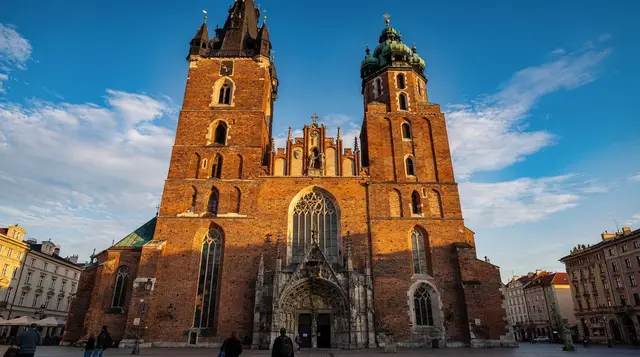
The Sukiennice sits at the centre of a cluster of major sights, and most visitors see it as one stop on a longer square-and-surroundings walk. The Rynek Główny main square guide covers the square as a whole, including the underground museum beneath it. St Mary’s Basilica, with its famous wooden altarpiece and hourly trumpet call, is a two-minute walk across the square. The Town Hall Tower, the last remaining fragment of Kraków’s medieval town hall, stands just behind the Sukiennice’s southern end and is worth the climb for the view back down onto the market roof. For a slightly longer detour, Collegium Maius, the oldest building of the Jagiellonian University, is a 5-minute walk northwest. If you’d rather have a guide connect all of this history rather than piecing it together yourself, the Old Town walking tour guide compares the main guided options.
Amber shopping: a closer look
Because the Sukiennice market is the most convenient amber shopping in the city, it’s worth a slightly longer note on buying well. Genuine Baltic amber varies enormously in price depending on clarity, inclusions (insects or plant matter trapped in the resin command a premium) and colour — pale “butterscotch” amber and rare blue or green amber cost more than the common honey-brown tone. A reputable stall will happily explain the piece’s origin and let you examine it closely; hesitation or a refusal to discuss authenticity is itself a warning sign. If you want a serious piece as a souvenir rather than a small trinket, it’s worth comparing prices at a few stalls before committing, since the same style of pendant can vary 30–40% between neighbours selling almost identical stock.
Practical tips
- Photography: free in the ground floor market. The gallery upstairs: check the current policy, as some institutions restrict photography of individual works.
- Crowds: the ground floor is busiest between 10:00 and 14:00. If you want to browse the market calmly, come before 10:00 or after 16:00.
- Prices: compare across stalls before buying. The same amber pendant can vary by 30–40 % between adjacent stalls.
- Toilets: public toilets are available near the market hall; a small fee (around 2–3 PLN) is charged.
Frequently asked questions about the Cloth Hall
Is the Cloth Hall (Sukiennice) free to enter?
The ground floor market is free to enter and browse during market hours. The Gallery of 19th Century Polish Art on the first floor charges around 32 PLN (≈ 7.60 €) for adults. There are free admission days — usually one per week; check mnk.pl.
What is sold in the Cloth Hall market?
Primarily amber jewellery, leather goods, folk crafts, Polish pottery, linen, and wooden items. It is the most centrally located souvenir market in Kraków but prices are not necessarily the lowest. The quality of amber varies significantly — buy from sellers who can demonstrate authenticity.
Is the art gallery in the Cloth Hall worth visiting?
Yes — the Gallery of 19th Century Polish Art is genuinely significant and has major works by Jan Matejko and other leading Polish painters. It is largely overlooked by tourists focused on the ground floor market, which means it is rarely crowded. If you have any interest in Polish history or 19th-century European art, it deserves 45–60 minutes.
What is the history of the Cloth Hall?
The Sukiennice was built in the 14th century as the city’s covered cloth market, rebuilt in Renaissance style after a fire in 1555, and restored to its current appearance in the 19th and 20th centuries. It is one of the best-preserved medieval market halls in Central Europe and has been a UNESCO World Heritage Site since 1978.
How much time should I budget for the Cloth Hall?
Fifteen to twenty minutes covers a browse of the ground-floor market. Add 45–60 minutes if you also want the Gallery of 19th Century Polish Art upstairs — it’s a small enough collection to do justice without an entire afternoon, but the Matejko canvases reward slowing down rather than rushing through. Combined with the rest of the Old Town, most visitors fold the Sukiennice into a half-day loop around the Rynek.
Top experiences
Bookable activities with verified prices and instant confirmation on GetYourGuide.